Retirement Planning Template
Retirement Planning Template for FIRE Seekers
One retirement planning template you set up around an early stop date: a retirement age you choose, a horizon that can run fifty years or more, and the withdrawal rate reported for every year of it.
In Depth
The FIRE Math - Savings Rate, Withdrawal Rate, and Time
The core insight behind FIRE is that the savings rate, not the income level, is the primary driver of how quickly financial independence can be reached. Someone saving 50% of their income reaches independence in roughly 17 years regardless of whether they earn $60,000 or $160,000, assuming investment returns follow historical patterns. This mathematical relationship between savings rate and working years is what makes early retirement possible for people across a wide income range, not just high earners.
The withdrawal phase in FIRE is fundamentally different from traditional retirement because the timeline is so much longer. A 35-year-old reaching financial independence needs savings to last 50 or 60 years - far longer than the 25-30 year horizon most retirement research assumes. The 4% rule was designed for 30-year retirements, and many FIRE practitioners adopt a more conservative withdrawal rate of 3-3.5% to account for the extended timeline. Sequence-of-returns risk, the danger of poor market performance in the early years, becomes a larger concern over longer periods.
Healthcare is often the most significant variable cost in early FIRE planning. Before Medicare eligibility at 65, health insurance through the ACA marketplace can cost hundreds to over a thousand dollars per month depending on coverage level and location. Importantly, ACA subsidies are based on Modified Adjusted Gross Income, which means the withdrawal strategy directly affects insurance costs. Some FIRE practitioners structure their withdrawals to stay below subsidy thresholds, adding another constraint to the planning equation.
The Challenge
Why FIRE Retirement Planning Is Different
Traditional retirement planning assumes you retire at 60-65 and need money for 20-30 years. FIRE retirement might start at 35-50 and needs to last 40-60 years. The planning requirements are fundamentally different.
Decades without traditional retirement account access
Retiring at 40 means 19+ years before penalty-free access to most retirement accounts. Bridge strategies using taxable accounts, Roth contributions, and conversion ladders need precise modeling.
Longer time horizon amplifies uncertainty
A 50-year retirement faces more market cycles, more inflation compounding, and more life changes than a 25-year retirement. Planning needs to account for this extended uncertainty.
Healthcare before Medicare is expensive
ACA marketplace plans, direct-pay insurance, or health sharing - the cost of healthcare from early retirement to age 65 is one of the biggest FIRE planning challenges.
Sequence of returns risk is magnified
A bad market in years 1-5 of a 50-year retirement has far more impact than in a 25-year retirement. The plan needs to survive early downturns.
Ready to take control of your fire seeker finances?
What You Get
Early Retirement Planning Features for FIRE
Retirement age and spending you set
Target retirement age and total annual expenses are plain input fields, so a lean plan and a fat one are the same template run with different numbers. Life expectancy sets how long the projection has to hold.
Withdrawal rate for every year
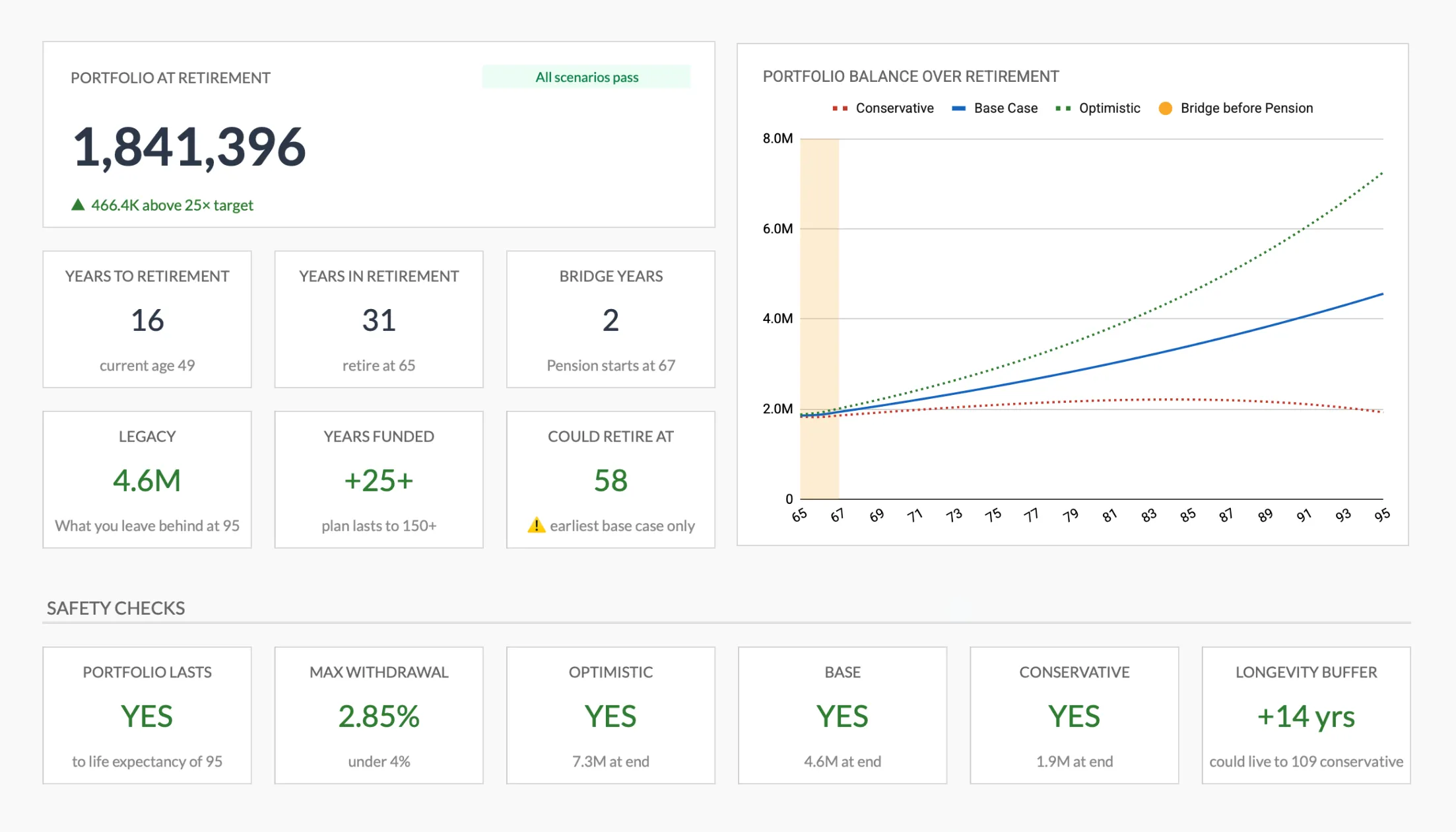
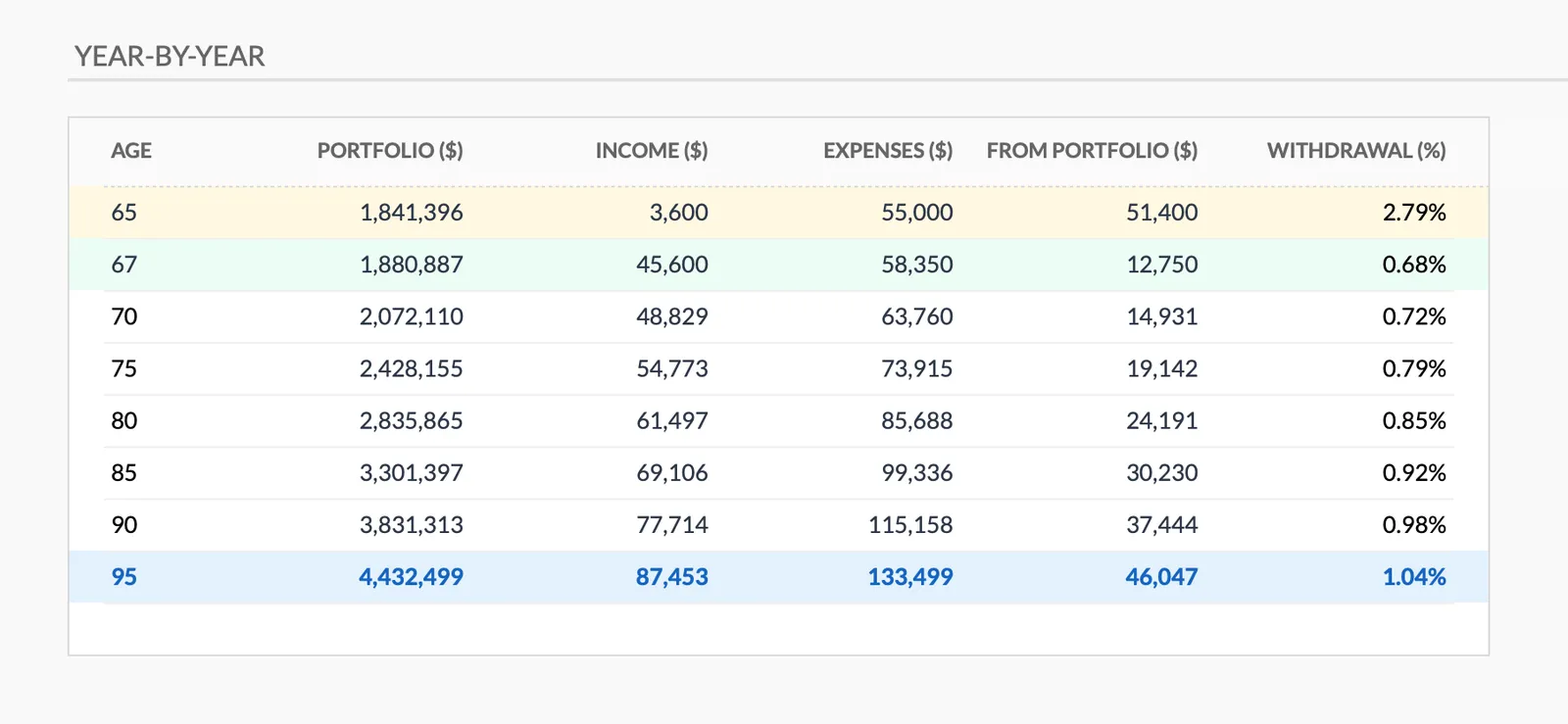
The year by year table reports the amount drawn from the portfolio and the withdrawal rate at each age, and the summary checks the maximum against 4%. There is one combined portfolio, so drawdown order is not modeled.
Bridge years before pension income
The gap between your retirement age and the pension start age is counted separately, shaded on the charts, and its average withdrawal rate checked against 4%. For an early retiree that gap can run twenty years or more.
Expenses that grow with inflation
Total annual expenses goes in as one figure for the first year of retirement, healthcare included, and the inflation rate you set grows it every year after that.
Long-term sustainability analysis
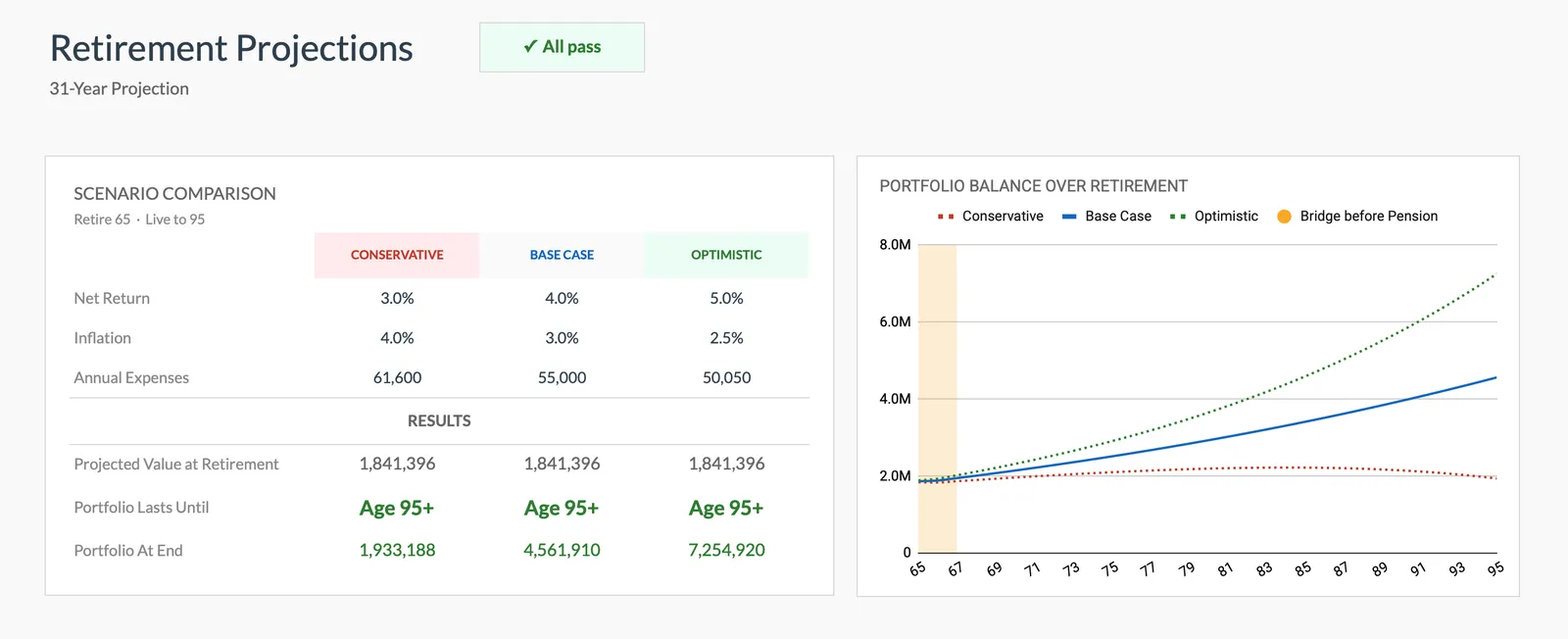
The projection runs from your retirement age to your life expectancy, fifty years or more if that is what you enter, and reports whether the portfolio lasts under conservative, base and optimistic returns.
Pension income with a start age
One monthly figure and one start age cover any income that begins later, Social Security among them. Comparing claiming ages means changing the start age and running the projection again.
See It In Action
What the template looks like
Browse through the template to see how it handles retirement projections, milestone tracking, and income planning.
- Retirement overview dashboard
- Savings growth projections
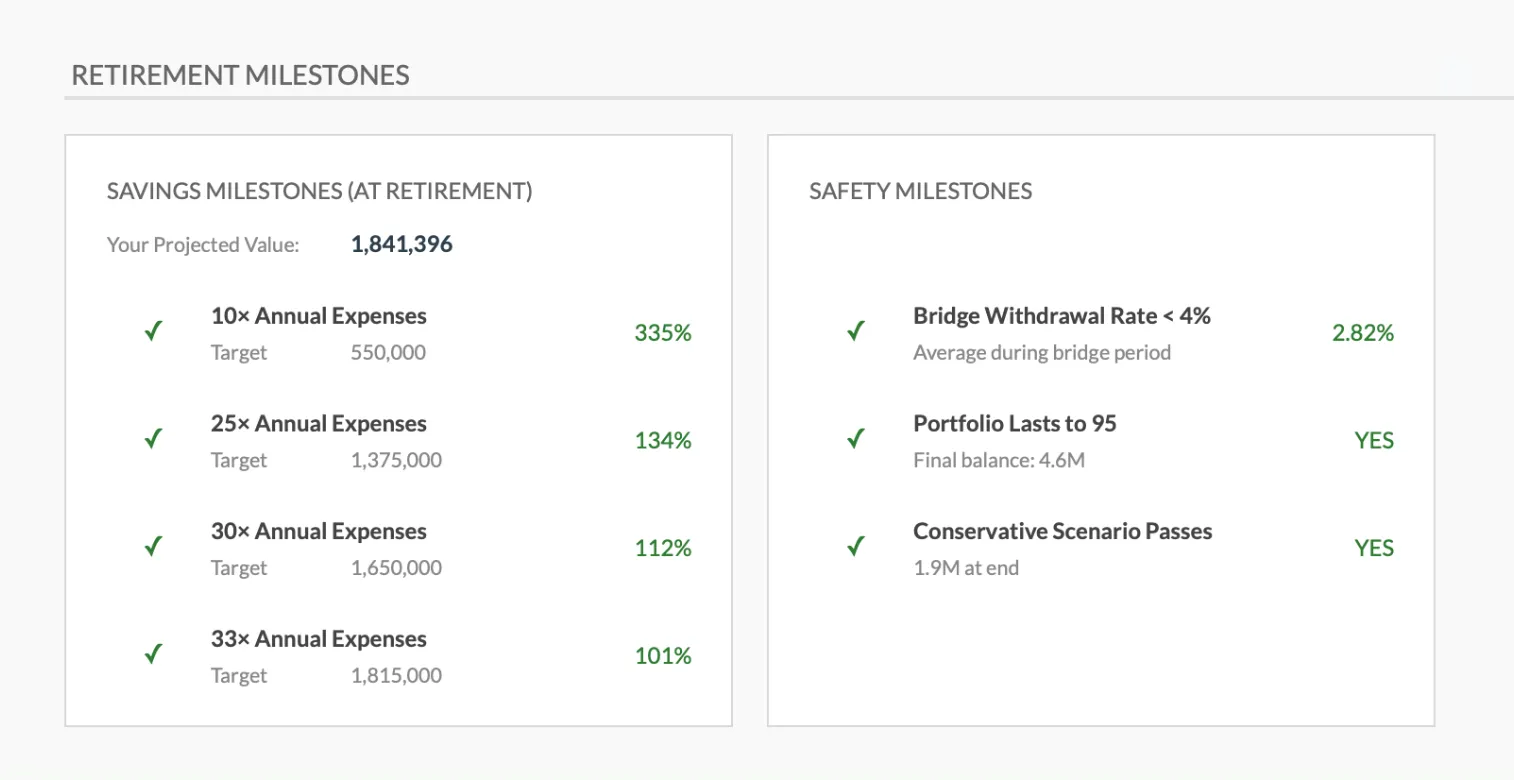
- Retirement milestone tracking
- Income vs expenses analysis
- Year-by-year projection
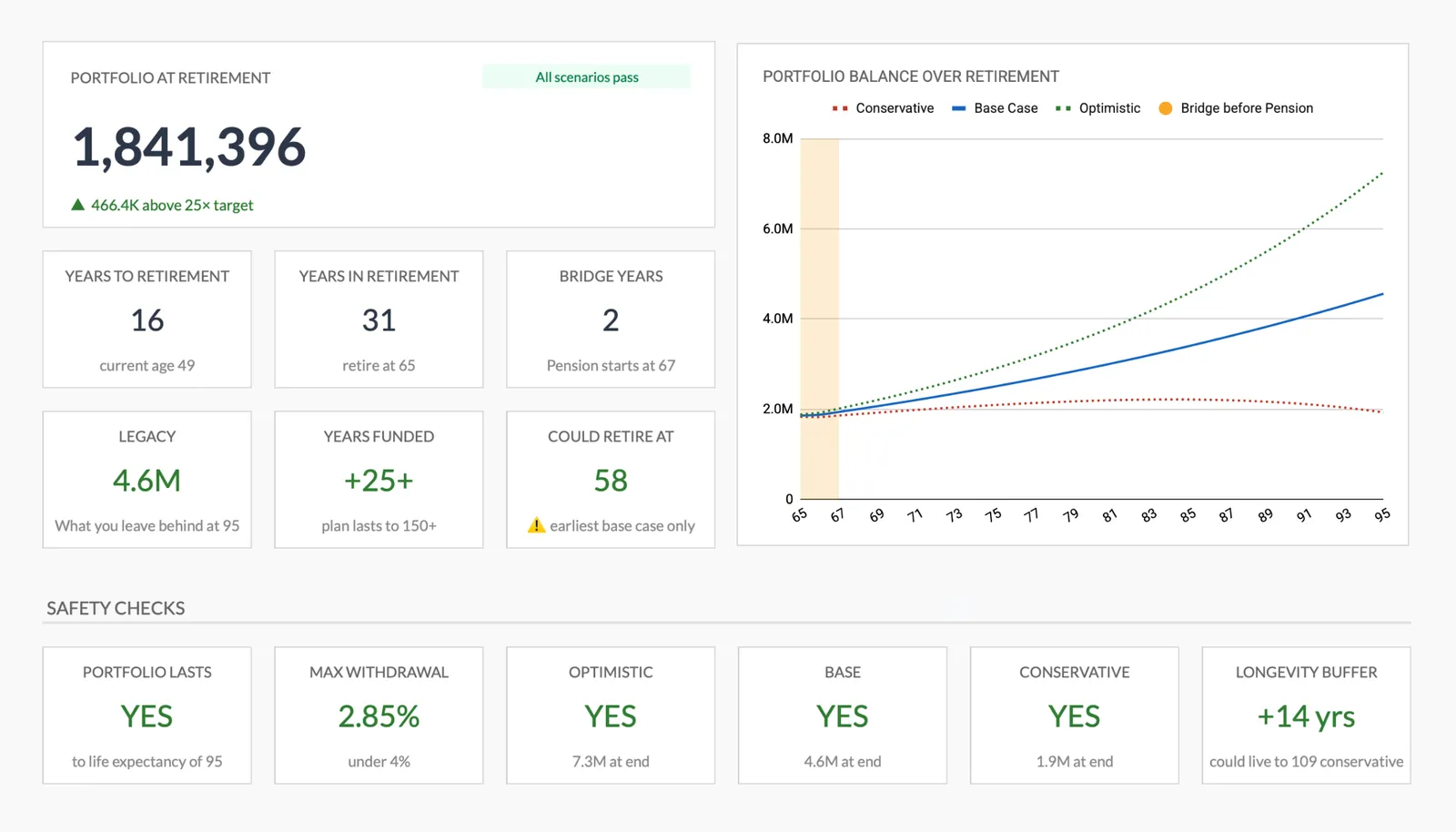
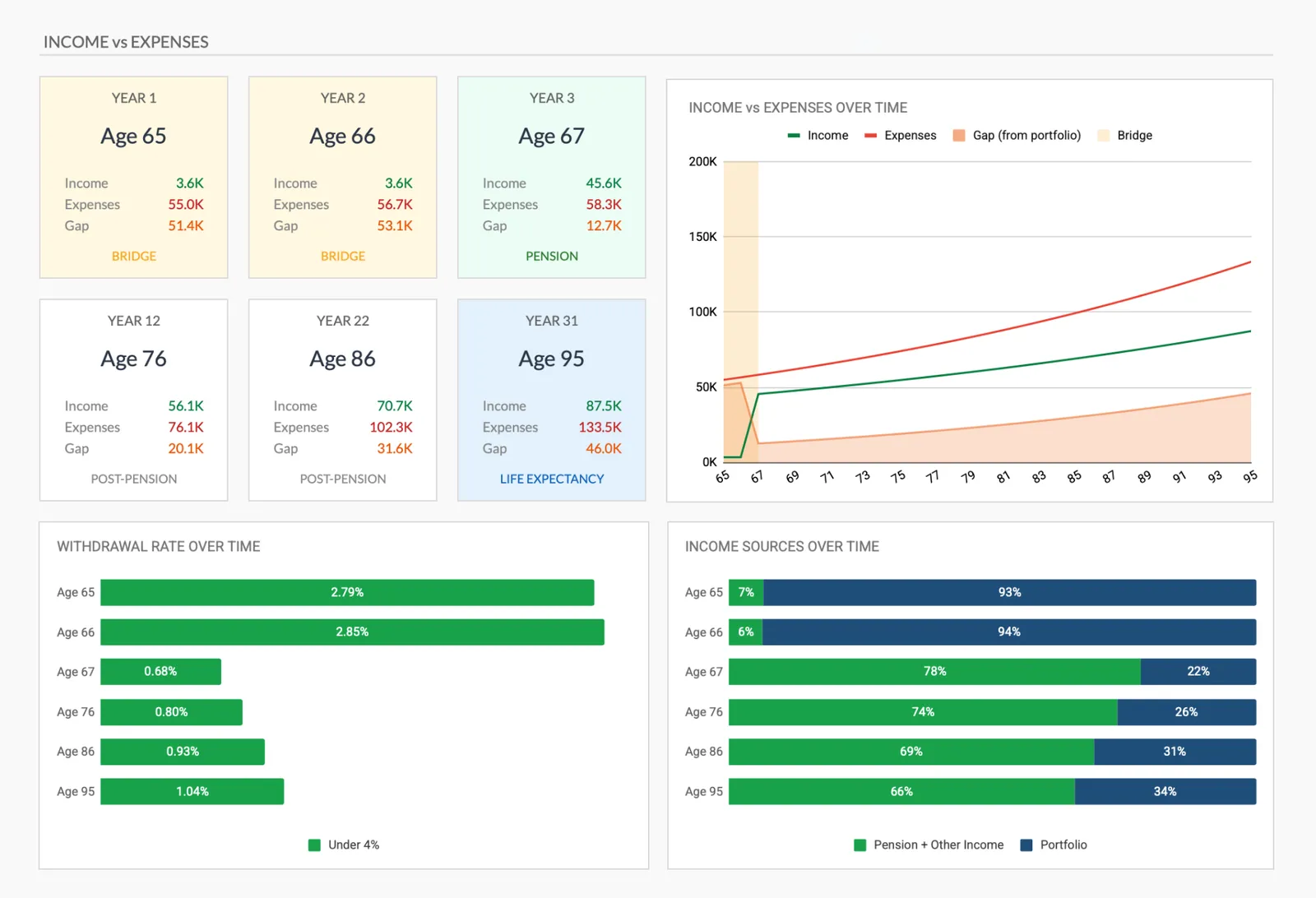
Complete retirement overview with projections
Project your retirement savings growth
Track progress toward retirement goals
Plan your retirement income against expenses
Detailed year-by-year retirement projection
Getting Started
Begin Mapping Your Early Retirement Path
Enter your target FIRE age and spending
Define when you want to reach FI and how much you plan to spend annually. These are the foundation of every projection.
Enter savings as one balance
Total current savings is a single figure covering taxable, traditional, Roth and HSA balances together. Annual savings is the new money you add each year until you stop.
Set the pension start age
The years between your retirement age and that start age are counted as the bridge period, funded from the portfolio plus any other income. The template shows what they cost without modeling account access rules.
Fold healthcare into the expense figure
There is no separate healthcare category and no subsidy calculation. Whatever you expect cover to cost before Medicare belongs inside the total annual expenses figure.
Read the unfavorable scenarios
The conservative column already runs a lower return with higher inflation. The what-if cards add a 20% market drop, expenses 10% higher, and the minimum return the plan needs to hold.
Common Questions
Retirement Planning for FIRE Seekers- FAQ
What withdrawal rate is safe for a 50-year retirement?
Historical analysis suggests lower rates for longer retirements, with 3% to 3.5% commonly discussed for very long horizons. The template does not take a withdrawal rate as an input: it calculates the rate each year from your expenses against the portfolio, so testing a lower one means entering lower expenses or a larger starting balance.
How does the Roth conversion ladder work?
Convert traditional IRA funds to Roth each year, and after a five-year seasoning period the converted amount can be withdrawn penalty-free. The template does not model conversions, account types or the seasoning period, because its projection runs on one combined portfolio.
What about healthcare costs?
There is no separate healthcare category, so it goes into the single annual expenses figure. ACA marketplace subsidies depend on your MAGI, which the template does not calculate, so that part of the picture sits outside the sheet.
Can I include side income after FIRE?
Yes. The monthly other income field covers part-time work, consulting or anything else that pays from day one, and it counts during the bridge years as well as after the pension starts.
How do I handle Social Security decades away?
Enter it as pension income with the start age set to your claiming age. A stacked chart then shows what share of each checkpoint year comes from it and what share still comes from the portfolio.
What if I reach FIRE but markets crash right after?
One of the what-if cards is a 20% market drop, and it reports the age the portfolio would run out under that shock. The conservative column runs a lower return across the whole horizon alongside it.
Can't find the answer you're looking for? Contact our team
Start retirement planning as a fire seeker
One-time purchase. No subscription. Your financial data stays in your Google Drive.