New Jersey
Tax Planner Template for New Jersey
Organize your federal and New Jersey state tax planning in Google Sheets. With high property taxes and multiple income tax brackets, organized planning is especially valuable.
In Depth
New Jersey's Income and Property Tax Picture
New Jersey presents a dual challenge for tax planning: one of the highest top income tax rates in the country and the highest effective property tax rates in the nation. The income tax runs from 1.4% through middle rates of 5.525% and 6.37% up to 8.97% above $500,000 and 10.75% above $1 million, with bracket thresholds that differ by filing status and are not indexed to inflation. For most moderate-income residents, the lower brackets keep the effective state income tax rate reasonable, but the property tax burden is inescapable regardless of income level.
Property taxes in New Jersey routinely exceed what homeowners pay in most other states: the effective rate is roughly double the national average, and the average residential bill passed $10,500 in 2025. For years the $10,000 federal SALT cap meant much of that was not deductible. That changed for 2025 through 2029, while the cap sits at $40,000, indexed about 1% a year and phasing back toward $10,000 for incomes above roughly $500,000, before reverting to $10,000 in 2030. On the state return, property taxes on a principal residence are deductible up to $15,000, a cap that sits above the average bill.
New Jersey does not allow any local income taxes, which is a silver lining compared to states like Maryland or Ohio where local layers add further complexity. For retirees, Social Security is fully exempt, and residents 62 and older with total income up to $100,000 can exclude a substantial amount of pension and retirement income, with partial exclusions up to $150,000 rather than a hard cutoff at the first threshold. Property tax relief programs such as ANCHOR and the Stay NJ benefit for homeowners 65 and older can offset part of the property tax bill for eligible residents.
New Jersey
Tax Planning in New Jersey
New Jersey has a graduated income tax with one of the highest top rates in the country and some of the highest property taxes in the nation. The combination makes comprehensive tax planning particularly important.
Graduated Income Tax
New Jersey has a graduated income tax with rates from 1.4% to a top marginal rate of 10.75% on income over $1 million [1]. The bracket thresholds differ by filing status and are not indexed to inflation.
Highest Property Taxes
New Jersey has the highest effective property tax rates in the country [2]. This significantly impacts the federal SALT deduction and overall tax planning.
Retirement Income
New Jersey exempts Social Security benefits from state tax. Residents 62 and older with total income of $150,000 or less can exclude some or all of their pension, annuity, and IRA income, with the largest exclusions at incomes up to $100,000.
No Local Income Tax
New Jersey does not allow local income taxes. The state rate is the only income tax to plan for, though property taxes at the local level are a major factor.
Get the Annual Tax Planner
Getting Started
How to Use the Template for New Jersey Taxes
Enter income with attention to the millionaire's tax threshold
Add all income sources - wages, business income, investments, and other earnings. New Jersey's top bracket rate of 10.75% applies to income above $1 million. If your income approaches that threshold, the template helps you see how crossing it affects your state liability. Income that fluctuates - such as bonuses, stock sales, or business distributions - can push you above the line in some years.
Track property taxes alongside the SALT cap
New Jersey has the highest effective property tax rates in the country, and the average residential bill passed $10,500 in 2025. Enter your annual property tax amount in the deductions section. The federal SALT cap was raised from $10,000 to $40,000 for 2025, rising about 1% a year through 2029 before reverting to $10,000 in 2030, and it phases back down toward $10,000 once income passes roughly $500,000. Under the higher cap, many New Jersey households can deduct both their property tax and their state income tax again, which makes tracking both worthwhile.
Review the retirement income exclusion if applicable
Residents 62 and older (or disabled under Social Security rules) with total income of $100,000 or less can exclude up to $100,000 (joint), $75,000 (single), or $50,000 (married filing separately) of pension, annuity, and IRA income. Between $100,001 and $150,000 the exclusion phases down in two steps rather than disappearing at once; above $150,000 it no longer applies. Enter retirement income separately so you can see which band your total income falls into.
Note the exit tax for home sale planning
New Jersey requires sellers of real property to pay an estimated tax at closing - sometimes called the "exit tax" - calculated as a percentage of the sale price or estimated gain. If you plan to sell property, use the notes section to flag this obligation. The payment is credited against your final New Jersey tax return, but it requires cash at closing.
Monitor quarterly estimated payments at both levels
New Jersey requires estimated payments on income not subject to withholding. With the state's high rates, underpayment penalties can be meaningful. Use the quarterly tracker for both federal and New Jersey obligations. The state's safe harbor rules differ from the IRS - generally requiring payment of a percentage of the current or prior year's liability to avoid penalties.
See It In Action
What the tax planner looks like
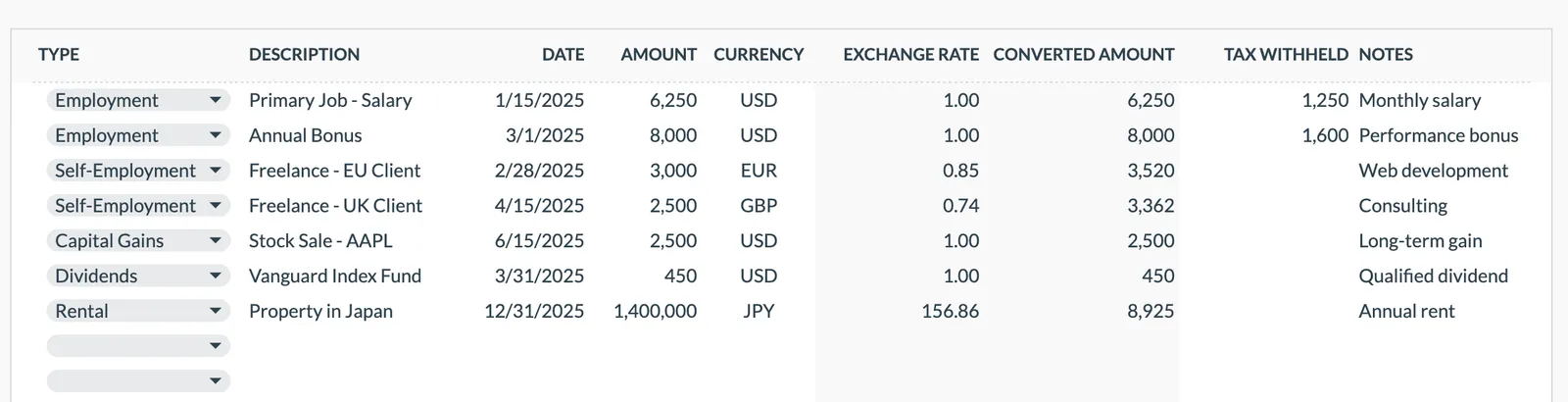
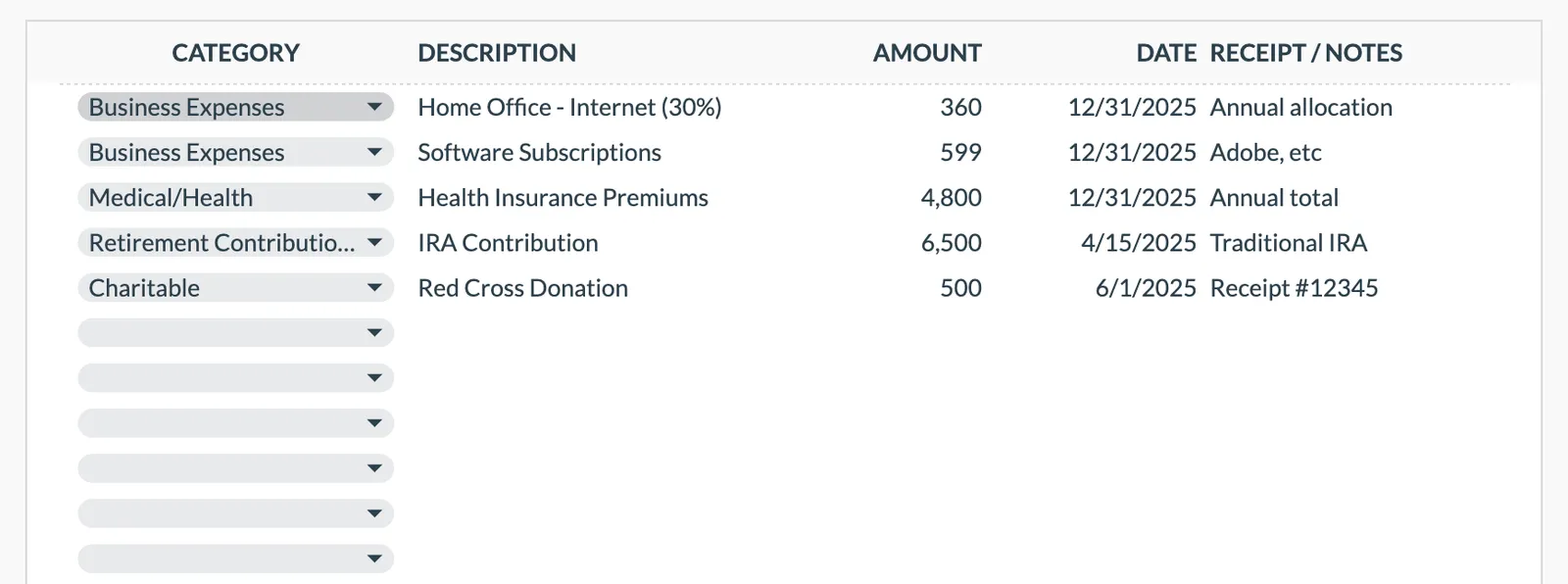
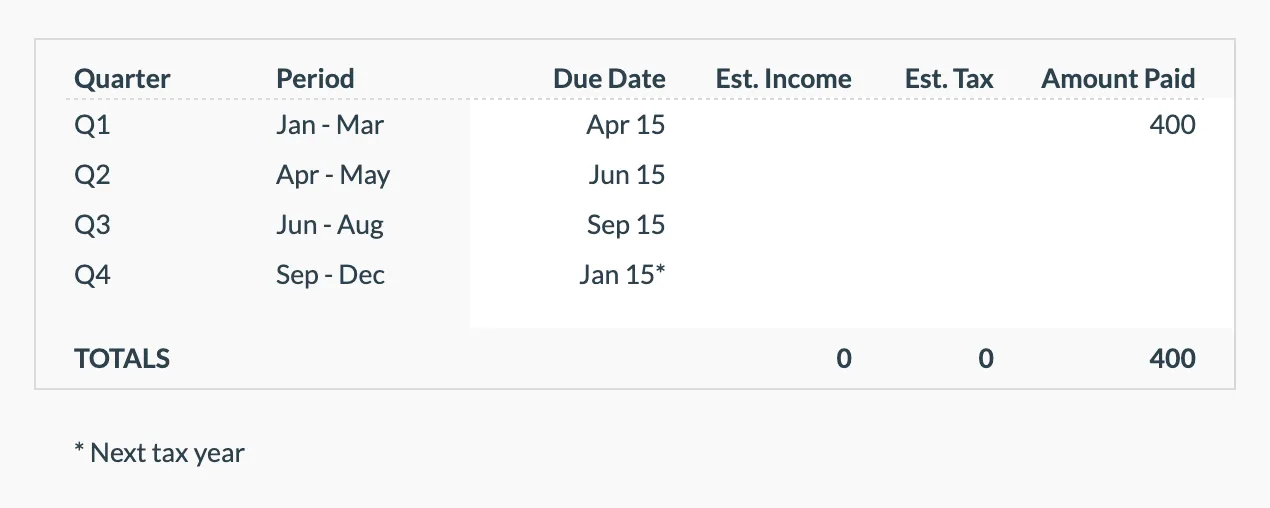
Browse through the template to see how it tracks income, deductions, credits, and estimated quarterly payments.
- Annual tax overview dashboard
- Income tracking by source
- Deductions and credits organizer
- Quarterly payment tracker
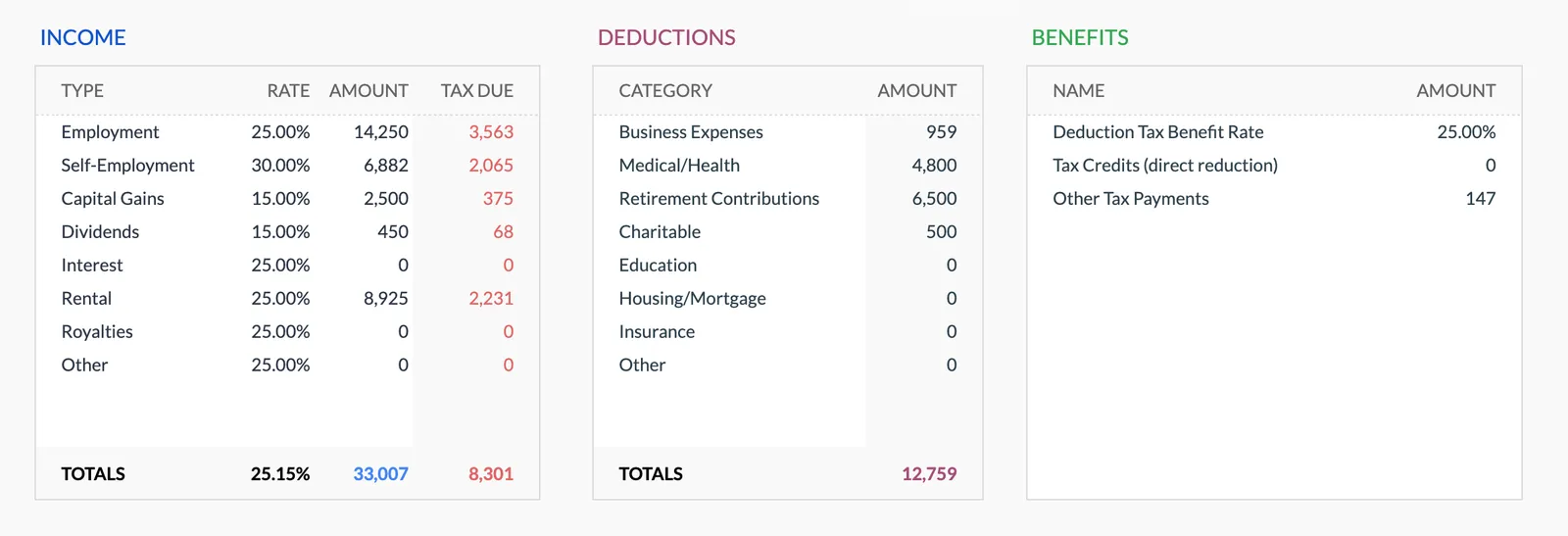
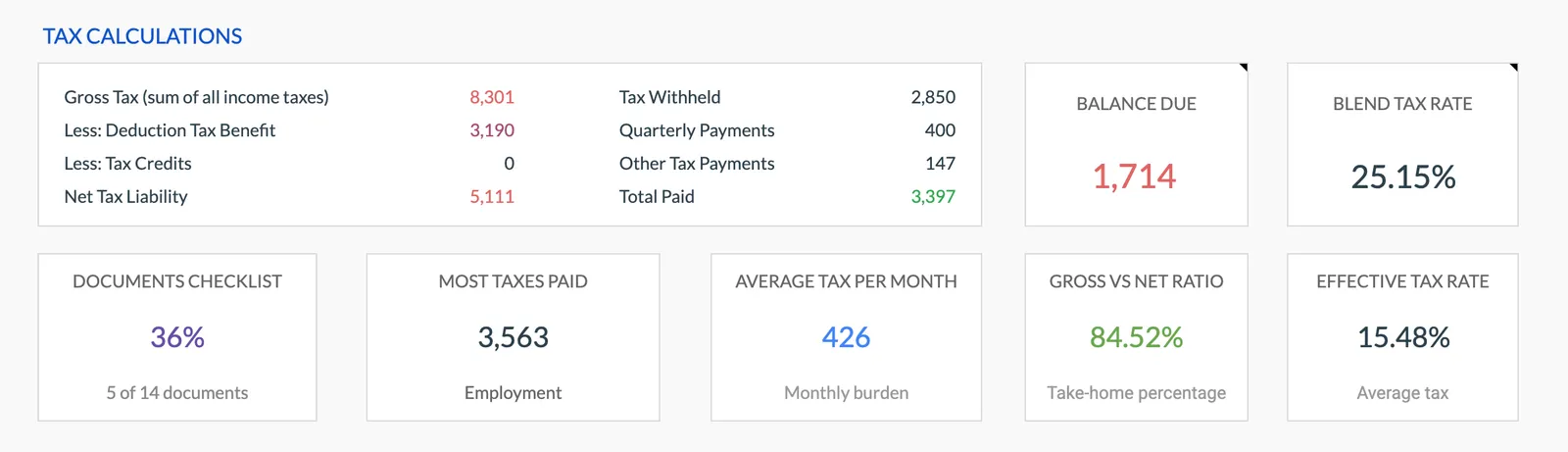
Annual tax overview with key figures
Detailed tax breakdown and projections
Track all income sources for tax purposes
Organize and track tax deductions
Plan and track quarterly estimated tax payments
Common Questions
Tax Planning in New Jersey - FAQ
What is New Jersey's millionaire's tax?
New Jersey applies a top marginal rate of 10.75% on taxable income exceeding $1 million [1]. This rate represents a significant jump from the 8.97% that applies between $500,000 and $1 million. The $1 million threshold applies per return, not per person on a joint filing. For high earners whose income fluctuates near this level, the bracket jump can meaningfully change the state tax bill from one year to the next.
How do New Jersey's property taxes affect federal tax planning?
New Jersey has the highest effective property tax rates in the nation, at roughly 2.2%, and it is the only state where the average residential bill exceeds $10,000 (about $10,570 in 2025). The federal SALT deduction cap was raised from $10,000 to $40,000 for 2025, rising about 1% per year through 2029 and reverting to $10,000 in 2030; the higher cap phases back down toward $10,000 once modified adjusted gross income passes roughly $500,000. For many New Jersey households this means property tax and state income tax are both deductible again, at least through 2029, which changes a calculation the old cap dominated for years.
What is the New Jersey exit tax on property sales?
When selling real property in New Jersey, non-resident sellers are required to prepay estimated tax at closing. This is sometimes called the exit tax. The payment is the higher of the top tax rate (10.75%) applied to the estimated gain or 2% of the total sale price. It is a prepayment, not an additional tax: the amount is credited against the seller's New Jersey return, and any overpayment is refundable. Residents who remain in New Jersey are generally exempt from the closing-time prepayment by filing the residency certification form.
Does New Jersey offer a property tax deduction on the state return?
Yes. New Jersey allows a deduction for property taxes paid on a principal residence, up to $15,000, on the state income tax return (or a $50 refundable credit where that is more favorable). The $15,000 cap sits above the state's average residential property tax bill, so most homeowners can deduct their full bill; renters can count 18% of rent as property taxes. Separate state relief programs such as ANCHOR provide additional property tax benefits for eligible homeowners and tenants.
How does New Jersey treat retirement income?
Social Security benefits are fully exempt from New Jersey state tax. Residents 62 and older (or disabled under Social Security rules) with total income of $100,000 or less can exclude up to $100,000 of pension, annuity, and IRA income on a joint return, $75,000 for single filers, or $50,000 married filing separately. The exclusion does not vanish at $100,000: between $100,001 and $125,000 a percentage of eligible income (50% joint, 37.5% single, 25% separate) can still be excluded, and between $125,001 and $150,000 a smaller percentage (25%, 18.75%, and 12.5%). Above $150,000 of total income, no exclusion applies.
Can't find the answer you're looking for? Contact our team
Official Tax Resources
For current rates, forms, and filing deadlines specific to New Jersey:
Organize your tax planning for New Jersey
One-time purchase. No subscription. Your financial data stays in your Google Drive.
Tax rules, rates, and contribution limits change, and official publications can themselves lag behind the law in force. We review these figures on a best-effort basis against sources we consider authoritative, but we cannot guarantee they are current, complete, or that better sources do not exist, and nothing here is tax, legal, or financial advice. For decisions, the relevant government authority is the reference. Last reviewed: August 2026.