
Value real estate in net worth as home equity - current market value minus your outstanding mortgage balance. Pull the market value from an online estimate (Zillow or Redfin), a comparable-sales check, or an appraisal, then refresh it quarterly. Update the mortgage balance monthly so the equity figure stays honest.
For many people, real estate represents their largest asset. Sometimes by far. Getting the value right matters - overestimate and you’re building on false confidence, underestimate and you’re undercounting real wealth.
The mechanics are simple: take your home’s current market value, subtract what you owe on the mortgage, and that’s your equity. What gets tricky is figuring out that market value number.
In the template: The Net Worth Tracker keeps the home value on the Assets tab under Real Estate and the mortgage on the Liabilities tab under Mortgage, and the Summary nets total assets against total liabilities.
Here’s how to handle real estate in your net worth calculation.
The Basic Calculation
Home Equity Formula
Home Equity = Current Market Value - Outstanding Mortgage BalanceExample:
- Home market value: $400,000
- Mortgage balance: $280,000
- Home equity: $120,000
This equity amount goes in your net worth as an asset.
Valuation Methods
Method 1: Online Estimates
Sources:
- Zillow (Zestimate)
- Redfin Estimate
- Realtor.com
Look up your address, use the estimated value. Simple.
These estimates are close but not exact. Redfin reports a median error rate of 1.86% for listed homes and 7.26% for off-market homes, and Zillow publishes comparable figures for the Zestimate. A median error means half of homes sell within that band and half fall outside it, so treat the number as a well-informed guess. Accuracy is highest in areas with lots of recent comparable sales and lower in unique neighborhoods or rural areas.
Works well for regular tracking and quick updates.
Method 2: Recent Comparable Sales
Find 3-5 recently sold homes similar to yours. Same neighborhood, similar size, comparable condition. Average their sale prices and adjust for differences.
This takes more time than checking Zillow, but it’s more accurate if done carefully. Worth the effort when you’re preparing for major decisions.
Method 3: Tax Assessment
Check your property tax assessment for assessed value.
Often outdated and not market-based. Typically conservative. Useful as a baseline or minimum value, but rarely reflects what you’d actually get if you sold today.
Method 4: Professional Appraisal
Hire a licensed appraiser. Cost is typically a few hundred dollars for a standard residential property, varying by market and property type.
Most accurate option - this is what a lender would use. Worth considering for refinancing, buying/selling, or estate planning. Not needed for regular net worth tracking.
Which Method to Use
For Regular Net Worth Tracking
Online estimates work well here. Zillow, Redfin, or Realtor.com. Update quarterly or when you notice estimates have changed significantly.
For Major Decisions
Comparable sales analysis or professional appraisal make sense when you’re:
- Considering selling
- Refinancing
- Working through a divorce settlement
- Doing estate planning
Conservative Approach
Some people prefer conservative estimates. One approach is using the lower of:
- Online estimate
- Tax assessment
- Your purchase price (if recent)
Tracking Home Equity Over Time
What Changes Equity
Increases equity:
- Principal payments on mortgage
- Home value appreciation
- Home improvements that add value
Decreases equity:
- Market value drops
- Taking out home equity loan/HELOC
- Refinancing with cash-out
Monthly Update Approach
| Month | Home Value | Mortgage | Equity |
|---|---|---|---|
| Jan | $400,000 | $280,000 | $120,000 |
| Feb | $400,000 | $279,200 | $120,800 |
| Mar | $400,000 | $278,400 | $121,600 |
Home value updates quarterly; mortgage balance updates monthly.
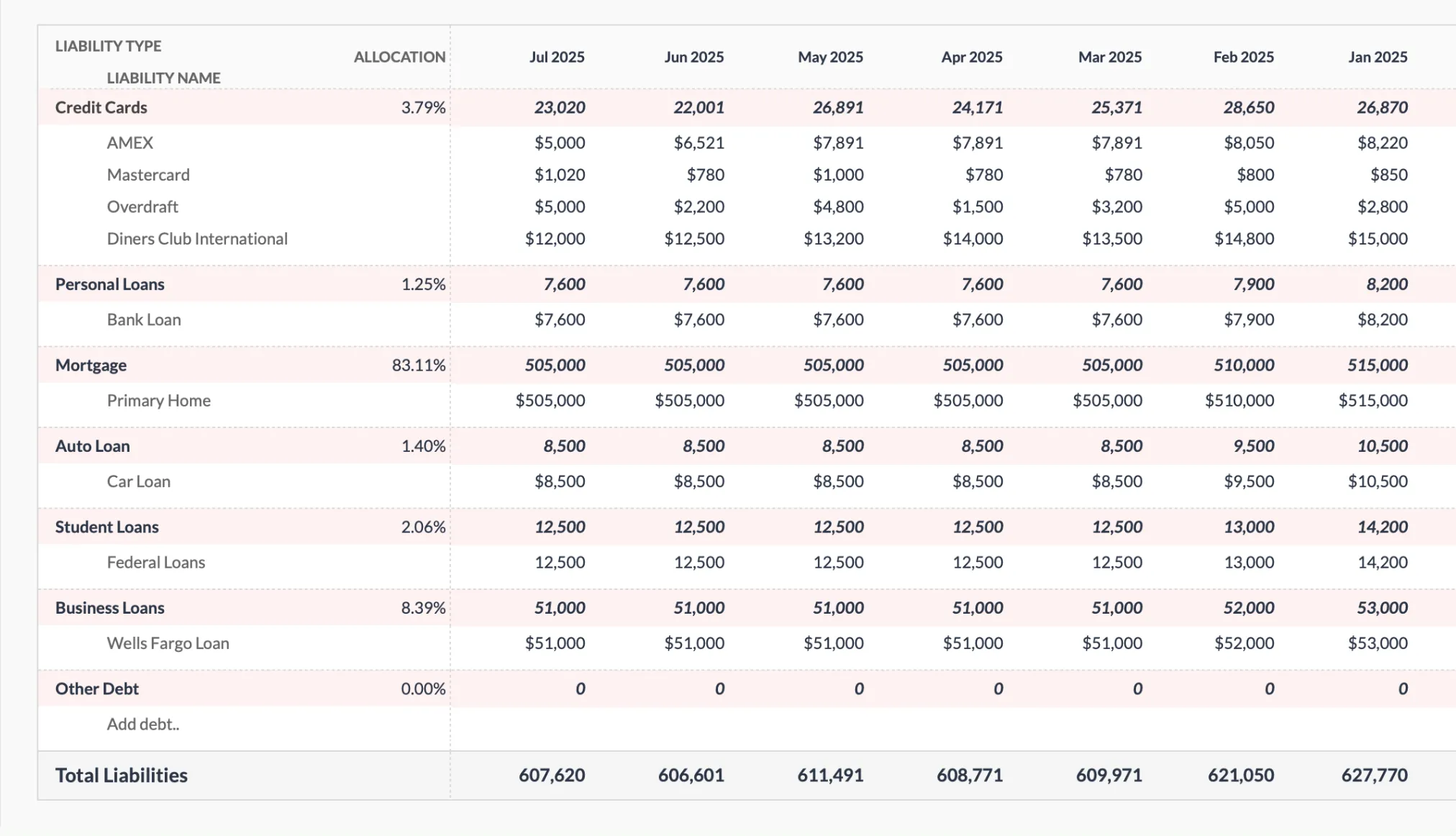
In the Net Worth Tracker, the mortgage sits on the Liabilities tab under a Mortgage type with its own named row, and every month gets its own column. The home value goes on the Assets tab under Real Estate, on rows such as Main Residence and Rental House. There is no per-property equity cell, so the equity picture comes from reading the two tabs together while the Summary works at the level of total assets minus total liabilities.
Multiple Properties
Primary Residence
Value as described above. Straightforward.
Rental Properties
Same calculation - market value minus mortgage balance.
Rental income affects your cash flow and overall financial picture, but the property value calculation stays the same. If a property is held through an LLC or partnership, including business assets in personal net worth has its own wrinkles worth reading.
Vacation Properties
Same calculation here too. One thing worth considering: if you’d never sell it, you might track it separately as “illiquid” assets. This is the same distinction covered in net worth vs liquid net worth, where a home you don’t plan to sell sits outside the money you could reach quickly.
Land
Harder to value than buildings. Tax assessment, recent land sales in the area, or professional appraisal are your options.
Home Improvements and Value
Do Improvements Add to Net Worth?
Not dollar-for-dollar. A $30,000 kitchen renovation might add $20,000 in home value. Sometimes more, sometimes less.
Rough recovery rates:
- Kitchens/bathrooms: 50-80% of cost
- Curb appeal improvements: Often decent return
- Personal preferences (pool, specialty rooms): May not add much
How to Handle in Tracking
Don’t increase home value by renovation cost. Wait for your next valuation update (online estimate or appraisal) to capture any value actually added. The market decides, not your receipts.
Common Mistakes
These property-specific slip-ups are part of a broader set of net worth tracking mistakes that quietly distort the final number.
Overvaluing
Problem: Using optimistic estimates, peak market values, or emotional attachment.
Impact: Inflated net worth creates false confidence.
What helps: Conservative estimates. Better to be pleasantly surprised than disappointed.
Forgetting the Mortgage
Problem: Counting home value as net worth without subtracting mortgage.
Impact: Massively overstated net worth.
What helps: Always use equity (value minus debt), never gross value.
Not Updating
Problem: Using purchase price years later when market has changed.
Impact: Inaccurate net worth - could be over or under depending on market.
What helps: Update home value at least annually, quarterly if actively tracking.
Counting Improvement Costs
Problem: Adding renovation expenses directly to home value.
Impact: Overstated equity.
What helps: Let the market determine value - update estimate after improvements.
Real Estate Market Considerations
Rising Markets
Home values increasing feels good. Worth remembering:
- Gains are unrealized until you sell
- Selling means buying in the same market
- That paper wealth isn’t spendable
Falling Markets
Home values decreasing is uncomfortable. Things to consider:
- Loss is unrealized unless you sell
- If staying long-term, short-term drops matter less
- Estimates fluctuate - panic selling rarely helps
Underwater Mortgages
When your mortgage exceeds home value, equity goes negative. Include that negative number in your net worth, since it’s reality. A negative figure here is not a permanent verdict: principal payments and any market recovery both close the gap, and the negative net worth recovery plan walks through how the numbers turn around over time.
Real Estate in Your Net Worth Tracker
Simple Approach
One line item:
| Asset | Value |
|---|---|
| Home equity | $120,000 |
Detailed Approach
Separate lines:
| Asset | Value |
|---|---|
| Home market value | $400,000 |
| Liability | Value |
|---|---|
| Mortgage balance | $280,000 |
Net worth calculation handles the math. This approach gives you visibility into both the asset and liability components.
Multiple Property Approach
| Property | Value | Mortgage | Equity |
|---|---|---|---|
| Primary home | $400,000 | $280,000 | $120,000 |
| Rental | $250,000 | $190,000 | $60,000 |
| Total RE Equity | $180,000 |
To see how home equity lands inside a full net worth figure, enter your home value and mortgage balance below alongside your other assets and debts:
Update Frequency
Home Value
Check online estimates quarterly. Do a more careful review with comparables annually. Update after major market shifts, renovations, or if you get a professional appraisal. This quarterly cadence lines up with the wider question of how often to calculate net worth.
Mortgage Balance
Monthly updates from your mortgage statement or online account work well. Verify with your year-end statement to catch any errors.
Using the Net Worth Tracker
The Net Worth Tracker takes the home value as an asset under Real Estate, the mortgage as a liability under Mortgage, and one hand-inserted column per month so the history builds up as you go. The Summary totals both sides, shows the change against last month and year to date, and charts assets and liabilities over time.
Real estate is likely your biggest asset, so getting its value right matters for accurate net worth tracking. The mechanics come down to three habits: pull the market value from an online estimate, subtract your mortgage balance to get true equity, and refresh the numbers at least quarterly. Conservative estimates keep the figure honest, and consistent tracking is what turns a single snapshot into real progress over time.
A natural next read is net worth vs liquid net worth, which explains why a home you don’t plan to sell often gets tracked separately from the cash you could reach this week.
Related
- Net Worth Tracker - Home value under Real Estate, mortgage under Mortgage, month by month
- Net Worth Tracking for Beginners
- How Often to Calculate Net Worth
- Net Worth vs Liquid Net Worth
- How to Include Business Assets in Personal Net Worth
Frequently asked questions
Is it worth including my home in net worth?
Yes - it's an asset. Some people also calculate liquid net worth excluding home separately, which can be useful for different planning purposes.
How accurate do I need to be?
Within 10% is fine for tracking purposes. You're looking for trends, not exact numbers.
What about selling costs if I sell?
Some people subtract 6-10% for agent fees and closing costs to show net realizable value. Either approach works - just stay consistent.
Do home improvements add to my net worth?
Not directly. Worth tracking improvement costs separately and letting market valuations capture any value actually added over time.
Zillow and Redfin show different values for my home - which do I use?
Both are estimates built from public records and comparable sales, so a gap is normal. Redfin currently reports a median error rate of 1.86% for listed homes and 7.26% for off-market homes, and Zillow publishes similar accuracy figures. Some people average the two, some use the lower number to stay conservative. What matters is picking one source and staying with it, so month-to-month changes reflect the market rather than a switch in tools.
What if there is no online estimate for my home?
Rural, unique, or newly built homes sometimes lack a reliable online estimate. The usual fallbacks are recent comparable sales in the area, your county tax assessment as a floor, or a professional appraisal.
Sources
About this article
Home-valuation accuracy figures rechecked on 2026-09-10 against Redfin's published Redfin Estimate median error rates and Zillow's published Zestimate accuracy figures. Net Worth Tracker claims checked on 2026-09-10 against the shipped Net Worth Tracking Google Sheet (Summary, Assets, Liabilities and Setup tabs) and the shipped Liabilities screenshot. Last reviewed September 2026.