
Business equity belongs in your personal net worth, though the number is an estimate rather than a market price. Three common approaches are asset-based, income multiple, and comparable sales, and some owners then track 50 to 70 percent of the result to leave room for illiquidity and key-person risk. It can go in as a single line item or a fuller asset-and-liability breakdown, revisited quarterly.
If you own a business, calculating personal net worth gets complicated. Is your business equity part of your net worth? What about business equipment? How do you value something that doesn’t trade on a stock exchange?
Tracking tool: The Net Worth Tracker ships with Business Equity as one of its built-in asset types, so the figure sits alongside cash, brokerage and real estate.
Here’s how to think about business assets in personal financial tracking.
Does Business Value Belong in Your Net Worth?
Including Business Value
Yes, business value belongs in your net worth - but with appropriate caution. A business you own is an asset. Ignoring it understates your true financial position. But overvaluing it creates false confidence.
The challenge is finding the right balance: accounting for real value without inflating numbers based on optimism or emotional attachment.
Different Types of Business Ownership
Sole proprietorship: You and the business are legally one. Business assets are personal assets.
LLC/S-Corp: Separate legal entity, but you own the equity.
Partnership: Your ownership stake is an asset.
C-Corp: Your shares represent value (even if company is private).
What Business Assets to Include
Direct Business Equity
The value of your ownership stake in the business itself. This is the primary asset for most business owners - what your share of the company is worth if you were to sell or if a buyer were to acquire it.
Business-Owned Assets (Personal Use)
Items owned by business but providing personal value:
- Vehicle titled to business but used personally
- Real estate owned by business
Business Bank Accounts
Cash in business accounts that could theoretically be distributed.
Accounts Receivable
Money owed to the business counts as an asset, though it’s worth discounting for collection risk. Not all receivables get paid, so using full face value overstates things.
What to Exclude or Handle Separately
Personal Guarantees on Business Debt
If you’ve personally guaranteed business loans, that’s worth considering as a potential personal liability. The debt may be on the business books, but you’re on the hook if the business can’t pay.
Equipment with Limited Resale Value
Business equipment often has minimal value outside the business context.
Intellectual Property
Hard to value, highly dependent on business success.
Goodwill
Goodwill is intangible value that disappears if the business closes. It exists because of customer relationships, brand recognition, and ongoing operations - not as something you could sell separately.
Valuation Methods
Several methods exist for valuing a business. Each has strengths and weaknesses, and different methods suit different types of businesses.
Method 1: Asset-Based
The asset-based method calculates value as the sum of business assets minus business liabilities.
Formula:
Business Equity = Business Assets - Business LiabilitiesBest for:
- Asset-heavy businesses
- Businesses you’d sell for their assets (real estate, inventory)
- Conservative estimates
Example:
| Item | Value |
|---|---|
| Business bank accounts | $25,000 |
| Equipment | $40,000 |
| Inventory | $15,000 |
| Accounts receivable | $20,000 |
| Business loan | -$30,000 |
| Net Business Equity | $70,000 |
Method 2: Income-Based
The income-based method values a business as a multiple of annual profit or revenue.
Formula:
Business Value = Annual Net Profit × Industry MultipleOn multiples: There is no fixed table. Brokers quote different ranges depending on industry, size, and how much of the revenue recurs without the owner present, and the same business can be pitched at very different numbers by different people. Rather than borrowing a generic figure, the sold-price data described in Method 3 is where a range for a specific industry comes from.
Best for:
- Profitable businesses
- Businesses with steady income
- Getting sense of “going concern” value
Example:
- Annual net profit: $75,000
- Industry multiple: 2.5x
- Estimated value: $187,500
Method 3: Comparable Sales
The comparable sales method values your business based on what similar businesses actually sell for.
How to research:
- BizBuySell.com listings
- Industry associations
- Business brokers
Best for:
- Common business types with sale data
- Planning to sell eventually
Conservative vs. Optimistic
For Net Worth Tracking
For personal net worth tracking, conservative estimates serve you better. Your business feels valuable to you, but buyers discount for key person risk (what if you leave?), transition difficulty, unknown liabilities, and market conditions. What feels like a $200,000 business might sell for $120,000 when reality meets the market.
A Common Discount
Some owners track 50 to 70 percent of what they believe the business is worth rather than the full figure. There is no standard discount, and the size of the haircut tends to follow how much of the value walks out the door with the owner.
Example:
- Estimated business value: $200,000
- Tracked at 50 to 70 percent: $100,000-140,000
How to Structure in Your Tracker
Once you have a conservative business figure, it slots into the same net worth math as every other asset. You can total everything by hand or plug the numbers into a calculator to see the combined picture:
How you structure business assets in your tracker depends on how much detail you want and how complex your business is. Three main approaches work well.
Option 1: Single Line Item
The simplest approach uses one number for business equity:
| Asset | Amount |
|---|---|
| Checking account | $15,000 |
| Investment accounts | $120,000 |
| Business equity | $80,000 |
| Home equity | $95,000 |
Pros: Simple Cons: No detail
Option 2: Business Section
A more detailed approach creates a separate section with breakdown. In the Net Worth Tracker, Business Equity is already one of the built-in asset types, and each business holding gets its own named row underneath it:
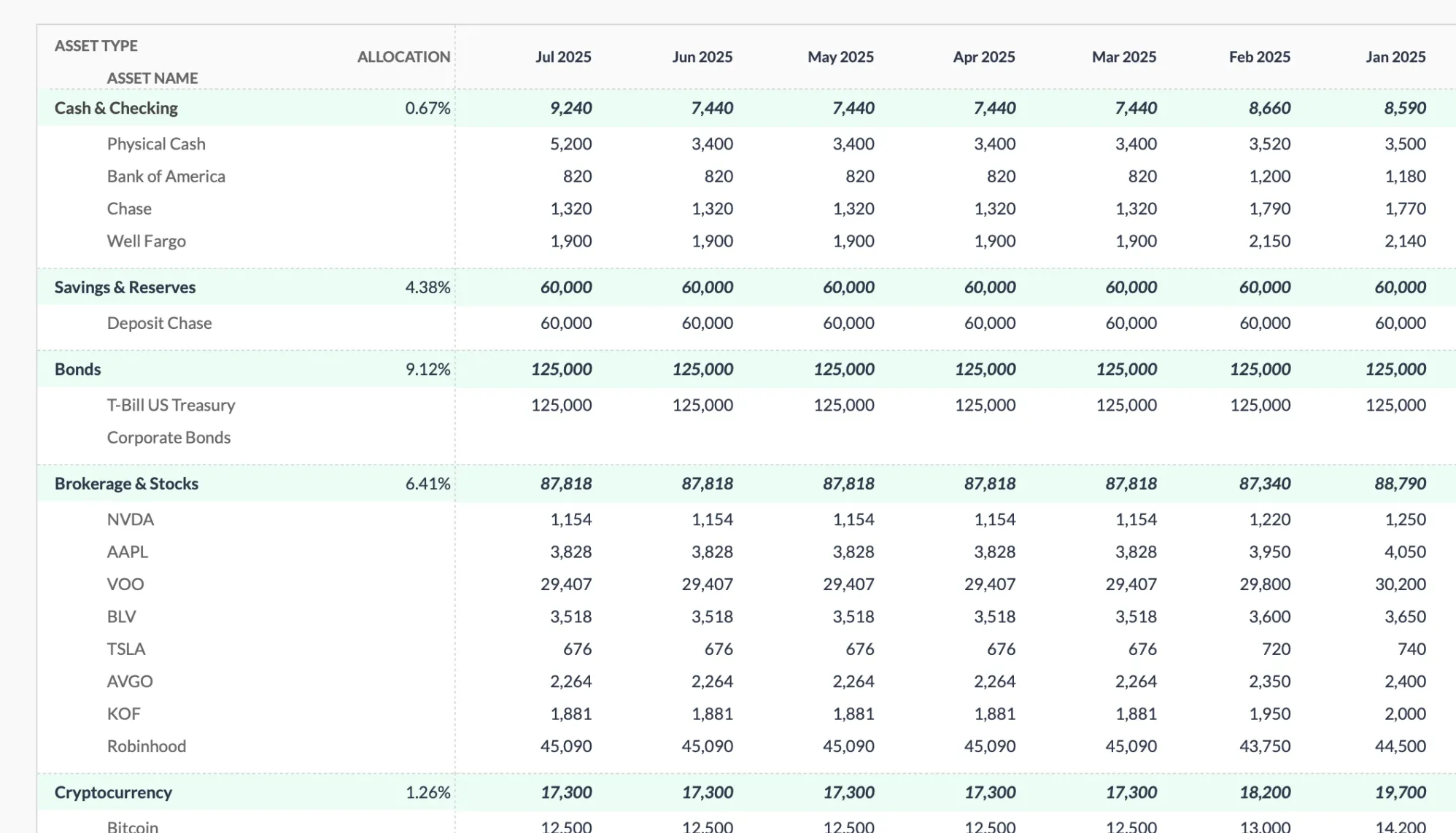 The Net Worth Tracker (Premium) groups assets by type, with one row per account and one column per month. Business Equity is another type further down the same list.
Business Assets:
| Item | Amount |
|---|---|
| Business bank account | $25,000 |
| Equipment (depreciated) | $30,000 |
| Business vehicle | $18,000 |
| Business Assets Total | $73,000 |
Business Liabilities:
| Item | Amount |
|---|---|
| Business loan | -$20,000 |
| Credit line balance | -$5,000 |
| Business Liabilities Total | -$25,000 |
Net Business Equity: $48,000
Option 3: Separate Tracking
Track business and personal net worth separately:
| Metric | Amount |
|---|---|
| Personal net worth (ex-business) | $180,000 |
| Business equity | $80,000 |
| Combined net worth | $260,000 |
Best for: Seeing both pictures clearly.
Updating Business Value
How Often to Revalue
Quarterly updates provide a good balance of accuracy and effort, which lines up with how often most people recalculate net worth overall. Annual updates are the minimum for most businesses. Event-driven updates make sense when significant changes occur: major asset purchase or sale, large profit or loss, debt payoff, or business expansion or contraction.
More frequent updates than quarterly rarely add value unless your business is highly volatile.
What Triggers Revaluation
- End of fiscal year
- Loan application
- Business valuation (professional)
- Major business changes
- Acquisition offers
Special Situations
Side Business
Small side income doesn’t require separate business value tracking. Include just the cash in business accounts. If the side business has minimal assets beyond the bank balance, there’s not much else to track.
Partnership
Include only your ownership percentage:
Your Share = Total Business Value × Your Ownership %Franchise
Value may be constrained by franchise agreement terms on sale.
Professional Practice
Professional practices (law firms, medical practices, etc.) are often valued primarily on income multiple rather than assets. The value is in the client relationships and ongoing revenue, not physical assets.
Business Liabilities
What to Include
Direct business debt includes business loans, lines of credit, equipment financing, and business credit cards. These reduce your business equity directly.
Personal guarantees deserve special consideration. If you’ve personally guaranteed business debt, you’re liable if the business can’t pay. Many business owners track these as potential personal liabilities to maintain a realistic picture of their exposure.
What to Exclude
Business accounts payable: Normal business operations, not long-term liability (unless problematic).
Future obligations: Lease commitments and contracts are typically excluded from personal net worth unless they represent certain loss.
Tax Implications to Consider
Business Value Isn’t Liquid
Unlike investment accounts, business equity can’t be easily converted to cash. You can’t sell 5% of your business to fund a vacation. This illiquidity is worth considering when thinking about your overall financial flexibility, and it is exactly why some people also track a liquid net worth figure that leaves the business out entirely.
Capital Gains on Sale
When you eventually sell, taxes reduce actual proceeds. A business sale is generally not a single transaction for tax purposes: the IRS treats it as a sale of the individual assets, and gains are taxed as capital gains or ordinary income depending on the asset. Long-term capital gains carry their own rates. The headline valuation is a pre-tax number, so the cash you would actually keep is lower.
Retirement Account Analogy
Business equity is similar to retirement accounts in some ways: technically yours, but access is restricted and taxes apply when you convert to cash. One thing not to confuse with business equity is a self-employed retirement plan such as a SEP-IRA or Solo 401(k). Even when it is funded through the business, the account is a personal retirement asset and belongs in your retirement totals rather than inside the business valuation.
Net Worth Tracking for Business Owners
The Net Worth Tracker
The Net Worth Tracker covers the business side with what it already ships:
- Business Equity is one of the asset types on the Assets tab, holding either a single row or one row per business holding
- Business Loans is one of the debt types on the Liabilities tab, so business borrowing sits apart from the mortgage, card and student-loan rows
- The Setup tab classifies Business Equity as Illiquid by default, with a Liquid / Semi-Liquid / Illiquid dropdown for every type, and the Summary splits liquid from semi-liquid assets on that basis
The sheet has no valuation logic. Whatever figure you settle on is the number you type in, and the monthly columns then carry it forward.
Monthly Tracking
For monthly tracking, update business bank balances each month as a quick check. Save full business revaluation for quarterly or annual updates. This approach captures cash flow changes without overcomplicating monthly net worth updates.
Warning Signs
Overvaluing Business
Watch for these overvaluation signs: using “someday” valuations instead of current reality, counting future revenue as current asset, ignoring business liabilities, and making no adjustment for illiquidity. Optimism about your business is natural, but it shouldn’t inflate your net worth tracking.
Undervaluing Business
- Ignoring business entirely
- Only counting cash, not equity
- Using distressed sale prices for healthy business
Business assets are part of your net worth, but they require thoughtful treatment. Conservative valuations, regular but not obsessive updates, and a business figure tracked separately from your personal number keep the picture honest, so you can see both business success and personal financial health clearly. The goal is accurate awareness, not inflated numbers.
Ready to put a business-equity line into a full picture? The Net Worth Tracker groups assets and liabilities by type and charts the total over time, and the Net Worth Calculator gives you a quick combined figure before you commit anything to a spreadsheet.
Related
- Net Worth Tracking for Beginners - the basics before you layer a business on top
- Net Worth vs. Liquid Net Worth - why an illiquid business gets its own line
- Crypto and Alternative Investments in Net Worth - valuing other hard-to-price holdings
- How Often to Calculate Net Worth - setting a revaluation cadence
- Net Worth Tracker - track business equity alongside everything else
Frequently asked questions
When does a professional appraiser make sense?
For regular net worth tracking, professional appraisal isn't usually necessary. For selling, getting investors, or estate planning, professional appraisal provides defensible numbers worth the cost.
What if my business loses money?
Business equity can be negative. If liabilities exceed assets, that affects your net worth. A struggling business actively reduces net worth.
How do I track business growth?
Compare business equity quarter over quarter. Growing equity means the business is adding value. This trend matters more than any single valuation.
Are business retirement accounts included?
Yes - SEP-IRA, Solo 401(k), etc. owned by you are personal assets even if funded through the business. They go in your personal retirement account totals, not in the business valuation.
What if the business has no profit yet?
The income multiple method breaks down when there is no profit to multiply. Some people fall back on the asset-based method (assets minus liabilities) or simply track the cash in the business account until the business has a track record of earnings to value.
Do I use the sale price or my ownership share?
For a partnership or a co-owned company, only your ownership percentage is an asset. Multiply the total business value by your stake, then apply the same conservative discount. A 40% owner of a $200,000 business is tracking $80,000 before any discount, not $200,000.
Should the number match what my accountant reports?
Not necessarily. Book value on a balance sheet, a lender's valuation, and a personal net worth estimate answer different questions. For personal tracking, a conservative going-concern figure is usually more realistic than book value, which can understate a profitable business or overstate a struggling one.
Sources
- Sale of a Business - Internal Revenue Service
- Topic No. 409, Capital Gains and Losses - Internal Revenue Service
- Retirement Plans for Self-Employed People - Internal Revenue Service
About this article
Capital-gains and self-employed retirement-account treatment checked against IRS guidance on the sale of a business and retirement plans for the self-employed. Valuation figures are illustrative examples, not appraisals; no multiple is presented as a market benchmark. Net Worth Tracker claims (Business Equity asset type, Business Loans debt type, Setup liquidity dropdown, Summary liquid and semi-liquid split) checked on 2026-09-10 against the shipped Net Worth Tracker Google Sheet (Summary, Assets, Liabilities, Setup, Data Types tabs); the screenshot is the Assets tab of that sheet. Last reviewed September 2026.