
Negative net worth simply means your debts outweigh your assets, which is common with student loans, mortgages, and early-career finances. This 12-month plan builds a small emergency fund first, then targets the highest-interest debt while you track net worth month by month. A focused year can move a -$25,000 starting point roughly $14,000 closer to zero.
Negative net worth means you owe more than you own. Common with student loans and mortgages. A starting point, not a permanent state.
Plan your recovery: The Financial Planning Template helps you model your trajectory to positive net worth, while the Net Worth Tracker tracks monthly progress.
Here’s a 12-month plan to move toward positive territory. Not a magic fix, just a systematic approach that compounds over time.
Understanding Your Starting Point
Calculate Current Net Worth
Assets (what you own):
- Bank accounts
- Investment accounts
- Vehicle value
- Home equity (if applicable)
- Other valuable assets
Liabilities (what you owe):
- Credit card balances
- Student loans
- Car loans
- Mortgage
- Personal loans
- Other debts
Net Worth = Assets - Liabilities
If negative, that’s your starting point. Write it down.
Knowing your exact starting point matters more than the number itself. A vague sense of “I’m in debt” doesn’t provide the clarity needed for systematic improvement. The specific number becomes your baseline for measuring progress.
Why Negative Net Worth Happens
Common Causes
Student loans: Often the largest contributor for young professionals
Mortgage: Normal early in homeownership - home builds equity over time
Consumer debt: Credit cards and personal loans without matching assets
Car loans: Vehicles depreciate faster than loans are paid
Not All Negative Is Equal
Negative because of student loans or a mortgage is different from negative because of credit cards. One includes assets that might appreciate. The other doesn’t.
Understanding the cause helps determine the approach. Student loan debt often calls for patience and steady payments. Credit card debt typically deserves aggressive attention due to high interest rates. The strategy depends on the composition of what’s driving the negative number.
The 12-Month Framework
Phase 1: Foundation (Months 1-3)
Focus: Stop the bleeding, build tiny emergency fund, understand complete picture
Phase 2: Momentum (Months 4-6)
Focus: Attack high-interest debt, establish systems
Phase 3: Acceleration (Months 7-9)
Focus: Increase income, accelerate debt payoff
Phase 4: Breakthrough (Months 10-12)
Focus: Continue momentum, celebrate progress, plan next year
Each phase builds on the previous one. The foundation phase establishes systems and stops the bleeding. Momentum creates visible progress that fuels continued effort. Acceleration maximizes impact. The final phase consolidates gains and plans the next year.
Month 1: Complete Assessment
Start by listing every debt: balance, interest rate, minimum payment. Then every asset with current value. Calculate exact net worth (the step-by-step method in Google Sheets covers the setup). Track all spending for the full month. Look for quick wins like expenses you can cut immediately.
This is information gathering. No judgment, just facts.
Month 2: Emergency Fund Start
Target $500-1,000 for an emergency fund. Yes, even with debt. Cut obvious expenses, such as subscriptions you don’t use and impulse purchases. Create a basic budget focused on needs versus wants; a Monthly Budget Template makes the needs-versus-wants split easier to see. Open a high-yield savings account for that emergency fund.
Without even a small buffer, any unexpected expense goes on credit cards. Which just adds to the problem.
Month 3: Debt Strategy Selection
Two common approaches:
Debt Avalanche (mathematically optimal): Pay minimums on all debts, extra to highest interest rate
Debt Snowball (psychologically optimal): Pay minimums on all debts, extra to smallest balance
Order your debts by whichever method you choose. Calculate how much extra you can pay per month. Set up automatic payments for the minimums. Apply any extra to your target debt.
The choice between avalanche and snowball is less important than picking one and sticking with it. Both work. The avalanche method saves more on interest; the snowball method provides more frequent wins. A side-by-side breakdown of the two lives in Debt Snowball vs. Debt Avalanche. Either beats paralysis.
Month 4-6: Build Momentum
Each month, track your net worth at the start. Maintain that emergency fund - don’t raid it for non-emergencies. Apply all extra money to your target debt. Review and cut additional expenses. Celebrate small wins.
This is also when you can start exploring additional income. Overtime opportunities. Side gig options. Selling unused items.
Month 7-9: Accelerate
Add an income stream if possible. Increase debt payments with that additional income. Negotiate bills - phone, insurance, subscriptions. Review your progress and adjust if you’re not on track.
If your credit has improved, this might be when you look at balance transfer cards, debt consolidation, or lower-rate loan options. Worth exploring.
Month 10-12: Push Through
Maintain intensity. Don’t relax too soon. Calculate your 12-month progress. Plan Year 2 based on what you learned. Celebrate progress in a way that fits your budget.
Are you on track? Faster than expected? Slower? Adjust your Year 2 plan accordingly.
Realistic Expectations
Sample 12-Month Progress
Starting point: -$25,000 net worth
| Month | Net Worth | Change |
|---|---|---|
| 1 | -$25,000 | Baseline |
| 3 | -$23,500 | +$1,500 |
| 6 | -$20,500 | +$4,500 |
| 9 | -$16,000 | +$9,000 |
| 12 | -$11,000 | +$14,000 |
Still negative, but $14,000 better. That’s progress.
Your own numbers will differ. One way to sketch a realistic timeline is to enter your total balance, interest rate, and monthly payment and see how quickly the debt falls:
Factors That Affect Speed
- Total debt amount
- Interest rates
- Income level
- Expense flexibility
- Life circumstances
Progress varies dramatically based on individual circumstances. Someone with high income and moderate debt moves faster than someone with modest income and significant debt. The point isn’t speed; it’s consistent forward movement.
Tracking Progress
Monthly Net Worth Update
Update the Net Worth Tracker each month to see:
- Current net worth
- Change from last month and year to date
- The full history in the net worth over time chart
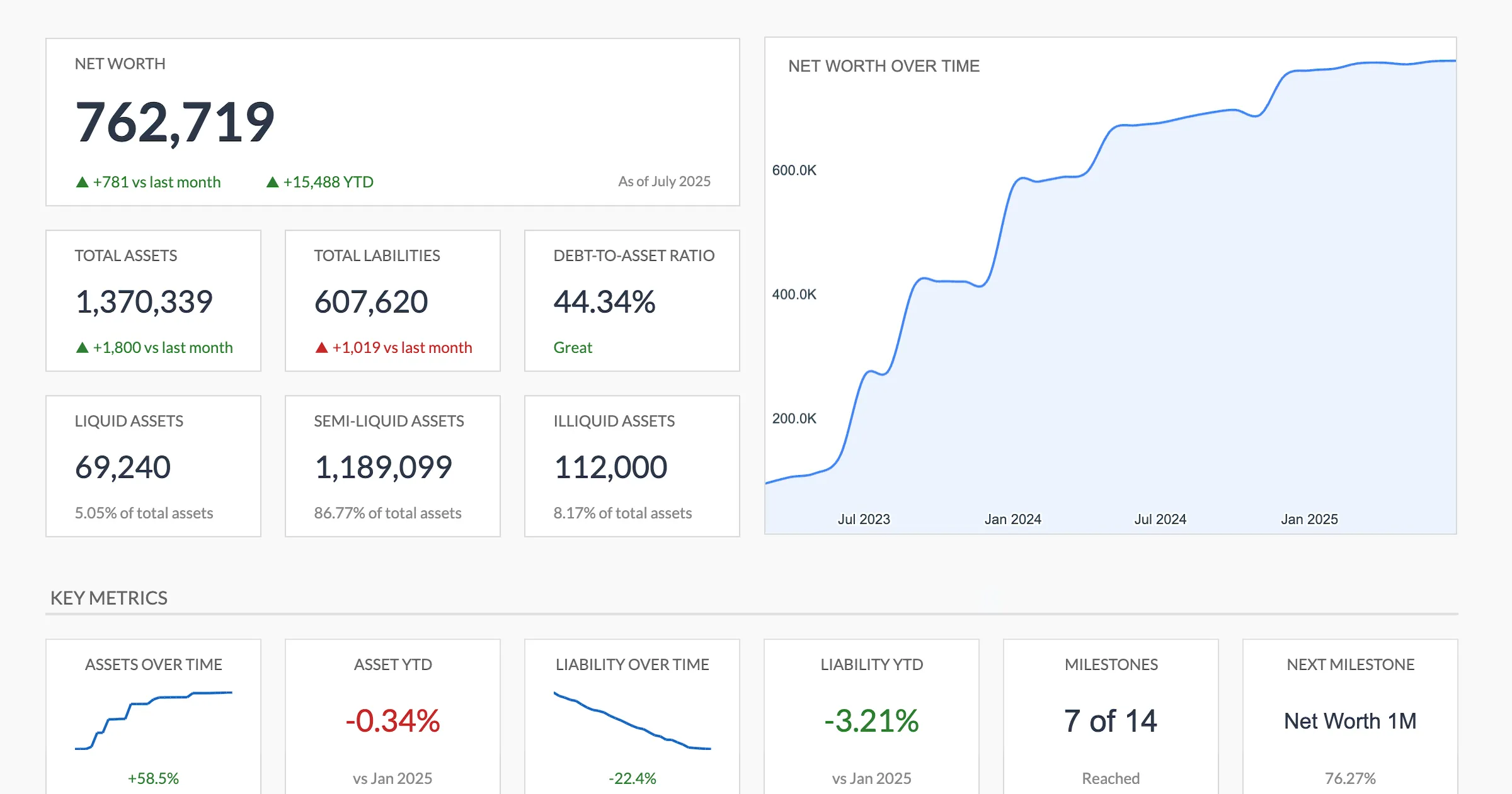
The Net Worth Tracker (Premium) dashboard surfaces the change from last month and the trend line, so a recovery reads as a rising curve even while the number is still negative.
Celebrate Milestones
- First $1,000 debt paid off
- Emergency fund complete
- Net worth improves by $5,000
- Highest-interest debt eliminated
- Credit score improvement
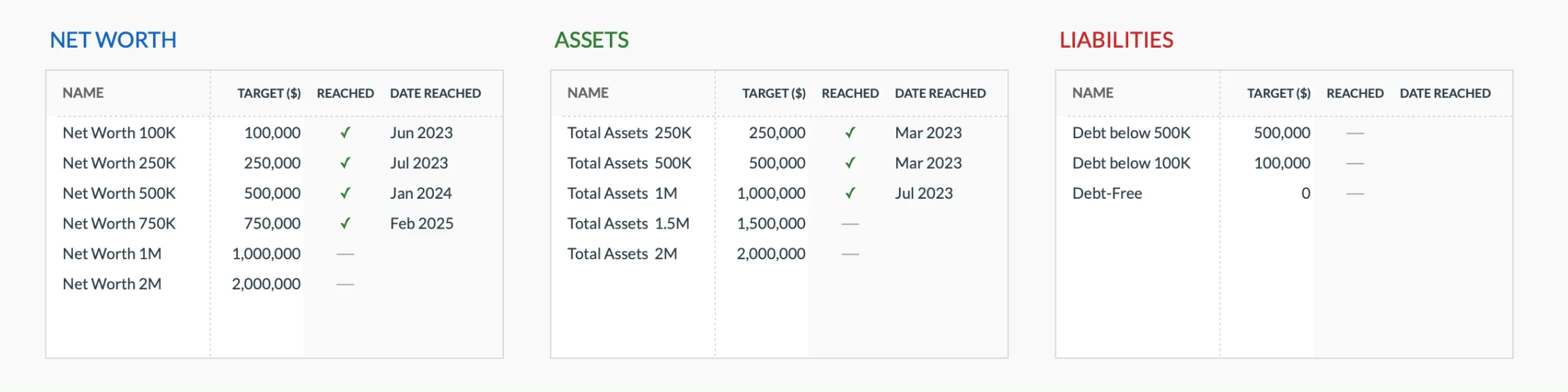
The Net Worth Tracker (Premium) logs milestones like “debt below $500K” or a net worth target and stamps the date each one is reached, which turns a long recovery into a series of visible checkpoints.
Celebrating milestones matters more than it might seem. The journey from negative to positive can take years. Without acknowledging progress along the way, motivation fades. Each milestone is real progress worth recognizing.
Common Obstacles
Unexpected Expenses
This is why emergency fund comes first. Use it if needed, then rebuild.
Income Disruption
If income drops, one approach is to switch to minimum payments temporarily, protect the emergency fund, reduce expenses further, then resume acceleration when income stabilizes.
Motivation Loss
- Review progress charts
- Remember why you started
- Connect with supportive community
- Allow small, budgeted rewards
Obstacles are normal and expected. The plan accounts for them by building the emergency fund first and by creating sustainable habits rather than extreme deprivation. The goal is a system that works even when motivation dips.
After 12 Months
If Still Negative
Continue the process. Negative net worth often takes 2-5+ years to reverse depending on starting point.
If Positive
Shift focus to:
- Building emergency fund to 3-6 months
- Increasing retirement contributions
- Pursuing other financial goals
The 12-month mark is a checkpoint, not a finish line. For many people, the journey continues into year two and beyond. What matters is that you’re moving in the right direction with a system that works for your life. Once you’re making consistent progress, the Financial Planning Template projects assets, debt, and net worth month by month out to an end year you set, using your own assumptions for income, expenses, asset growth, and debt change.
Special Situations
Student Loan Heavy
If student loans are the primary driver, worth exploring income-driven repayment or Public Service Loan Forgiveness if you’re eligible. Some people focus on other debts first while making minimum student loan payments.
Underwater on Home
If your mortgage exceeds home value, time may solve this through home appreciation. Keep making payments. Selling usually isn’t necessary unless circumstances force it.
Credit Card Emergency
If credit cards are the issue, stopping use is a common first step. Balance transfers to lower rates might help. Then attacking those balances as aggressively as your situation allows.
Special situations require adapted approaches rather than abandoning the framework entirely. The core principles apply regardless of the specific debt composition: understand your starting point, build a small buffer, attack debt systematically, and track progress.
Mindset for the Journey
This Is Normal
Many people have negative net worth at some point, especially younger households early in their careers, a pattern visible in the Federal Reserve’s Survey of Consumer Finances. It’s a starting point, not a permanent state.
Small Progress Compounds
$300/month extra toward debt is $3,600 a year, which is meaningful progress.
Trajectory Matters
The direction you’re moving matters more than where you currently are.
Mindset supports the mechanics. The systematic approach provides structure, but believing that change is possible provides the fuel. Each month’s progress, even small progress, builds evidence that the situation is improving.
Related
- Net Worth Tracker - Track recovery progress month by month
- Financial Planning Template - Long-term projections after recovery
- Monthly Budget Template - Manage cash flow during recovery
- Debt Snowball vs. Debt Avalanche - Choose a payoff order
- Emergency Fund Calculator - Size the buffer that comes first
Negative net worth is a position, not a destiny. A systematic 12-month approach builds a foundation, creates momentum, accelerates payoff, and tracks the climb toward positive territory. The next concrete step is a complete assessment: list every debt and asset, calculate the exact number, then load it into the Net Worth Tracker and take it one month at a time.
Frequently asked questions
How long to get to positive?
Depends on your starting point and aggressiveness. Generally 1-5 years for moderate negative net worth.
Should I invest while net worth is negative?
Most people prioritize high-interest debt and emergency fund first. One common exception: employer 401(k) match is free money that many people take.
What about bankruptcy?
Only for severe situations after other options exhausted. Has major long-term credit implications.
Is negative net worth always bad?
Debt for appreciating assets (education, home) can be strategic. Debt for depreciating assets or consumption is problematic.
Is net worth the same as my credit score?
No. Net worth measures assets minus liabilities in dollars. A credit score measures how reliably you have repaid debt. Someone can have a strong credit score and negative net worth, or the reverse. They move somewhat independently.
Can I get a mortgage while my net worth is negative?
Lenders weigh income, debt-to-income ratio, credit score, and down payment far more than a single net worth figure. Many buyers with student loans hold negative net worth and still qualify. The composition of the debt matters more than the raw number.
Sources
- Public Service Loan Forgiveness (PSLF) - Federal Student Aid, U.S. Department of Education
- Income-Driven Repayment (IDR) Plans - Federal Student Aid, U.S. Department of Education
- Survey of Consumer Finances (SCF) - Board of Governors of the Federal Reserve System
About this article
Recovery figures use a worked -$25,000 starting point and the sample month-by-month trajectory shown in the article. Template and calculator claims checked on 2026-09-10 against the shipped Net Worth Tracking Google Sheet (Summary, Assets, Liabilities, Milestones tabs), the Financial Planning Google Sheet (Summary, Goals, Debt, Cashflow, Projection tabs), the Monthly Budgeting Google Sheet (Summary, Budget Plan, Categories tabs), and the Debt Payoff Calculator's own inputs. Student loan program references (income-driven repayment, Public Service Loan Forgiveness) are checked against the U.S. Department of Education's Federal Student Aid site; net worth context against the Federal Reserve Survey of Consumer Finances. Last reviewed September 2026.