
- The Net Worth Tracker follows a single metric, assets minus liabilities, so the trend, not any one month, is the point.
- The Financial Planning Template adds income, expenses, goals, cash flow, and projections when decisions involve trade-offs a single number cannot weigh.
- Both are $29 one-time Google Sheets templates; the Financial Planning PRO Bundle packages the planner with four other templates for $79.
There is a version of personal finance that fits on a single line. Assets minus liabilities. One number. That number, tracked over time, tells you more about your financial direction than almost any other metric.
And then there is the version that wants to know everything - where the money comes from, where it goes, what goals are in play, what the future might look like. One is a compass. The other is a map.
The Net Worth Tracker is the compass. The Financial Planning Template is the map. Here is how to decide which one you need - or whether you need both.
Full toolkit: The Financial Planning PRO Bundle includes the Financial Planning Template along with additional planning tools.
The Case for One Number
Net worth is deceptively simple. Add up what you own. Subtract what you owe. The result is your financial position, one number that captures the whole picture. It is also the measure the Federal Reserve uses to gauge household wealth in its Survey of Consumer Finances, so tracking your own figure puts you on the same yardstick used to describe the whole country.
The Net Worth Tracker is built around this single metric. Update your account balances monthly or quarterly. Watch the number change. That is the entire process.
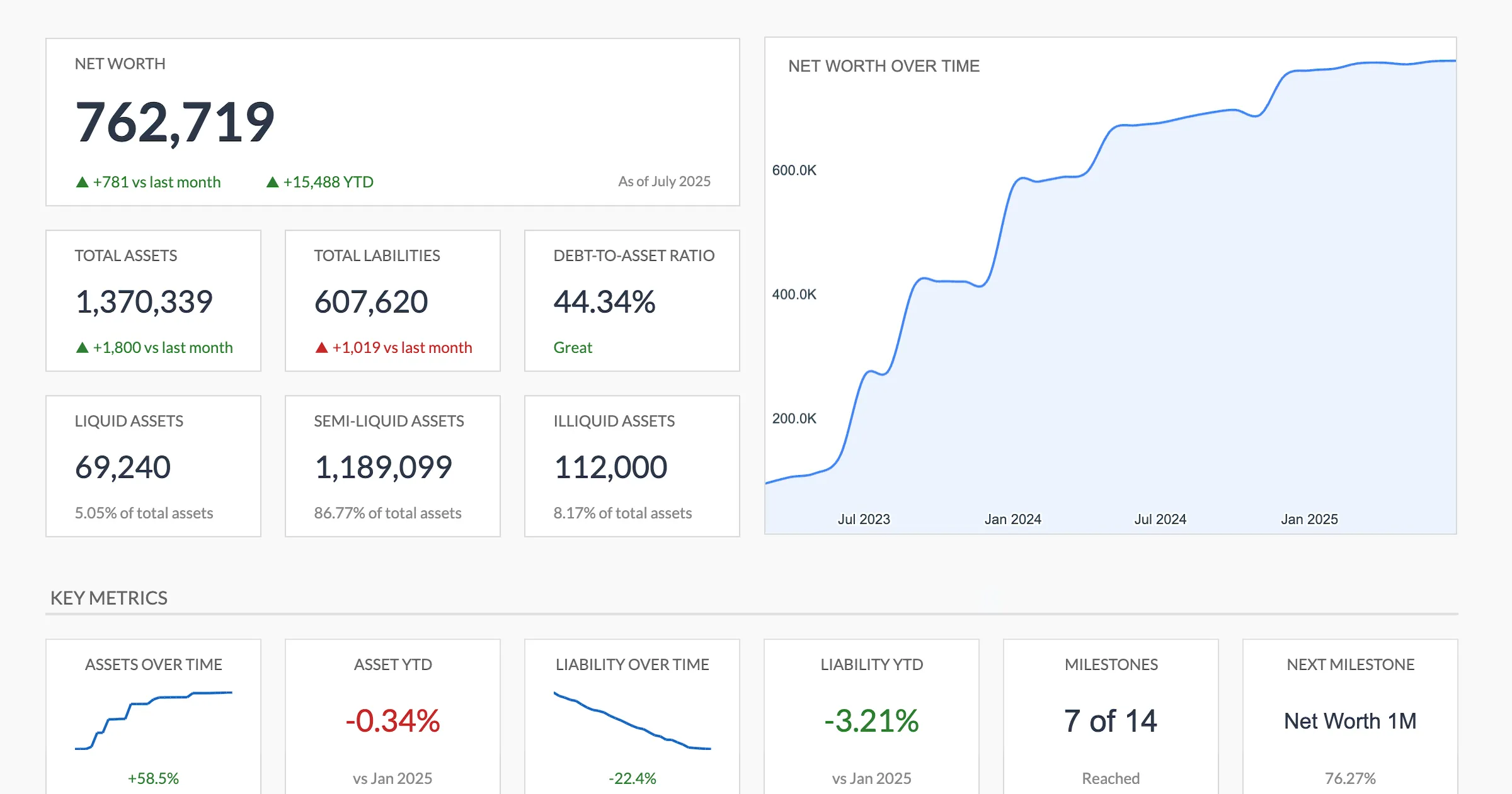
The Net Worth Tracker (Premium, $29) summary tab: one headline number, the assets and liabilities behind it, and milestone progress toward the next target.
Want the number before you decide on a template? The Net Worth Calculator below adds up your assets and liabilities for an instant snapshot, no spreadsheet required.
The power is in the trend. Individual months do not matter much - a market dip drops the number, a bonus pushes it up, normal fluctuations happen. But over six months, a year, several years, the direction becomes unmistakable. Either the gap between assets and liabilities is widening (progress) or it is not (a signal to investigate).
Milestones add motivation. Hitting $10,000 in net worth. Then $50,000. Then $100,000. Each milestone represents a real shift in financial stability, and tracking makes those moments visible rather than abstract. If you want typical targets to aim at, net worth milestones before 40 lays out common benchmarks by age.
The maintenance overhead is minimal. Five to ten minutes per month to update account balances. No transaction logging, no category management, no complex inputs. For people who want financial awareness without a time commitment, the Net Worth Tracker fits perfectly.
What One Number Cannot Tell You
Net worth says nothing about how you got there. A $500 increase in net worth could mean you saved aggressively, your investments grew, or you happened to check on a day the market was up. The tracker does not distinguish between those causes.
It also does not plan ahead. Net worth tracking is a rearview mirror - it shows where you have been and where you are, but not where you are going. The Milestones tab holds target amounts for net worth, total assets and debt, and marks the month each one is reached, but there is no projection of what happens if you change your savings rate and no modeling of different scenarios.
And it does not track cash flow. Someone could have a rising net worth while spending more than they earn (if investment growth masks the overspending). The number alone does not flag this.
The Case for the Full Picture
The Financial Planning Template pulls in more data and asks bigger questions. Assets and debts, yes, but also income, expenses, savings goals, and projections. It connects the pieces: debt payoff affects savings capacity, which affects investment growth, which affects net worth.
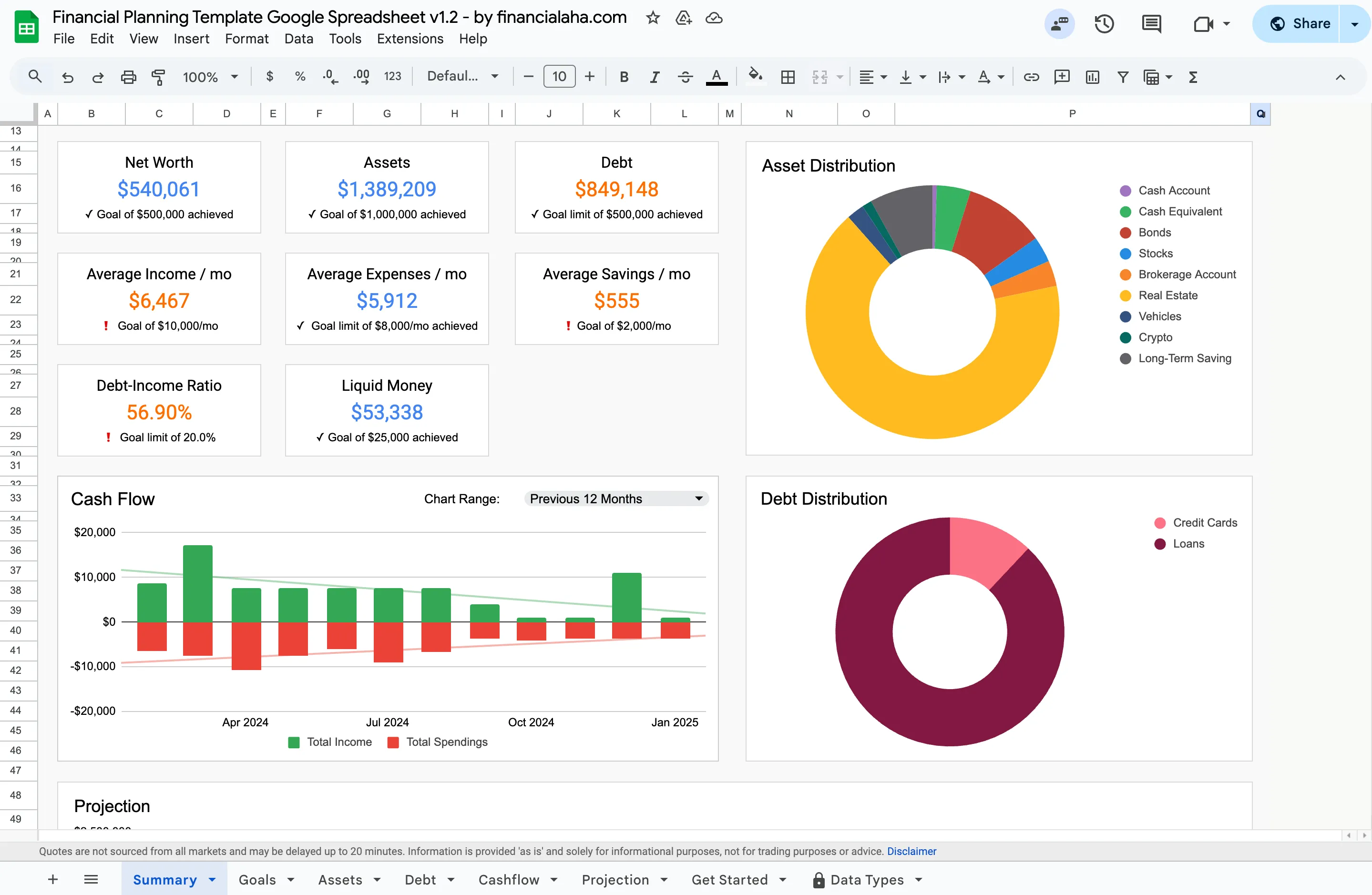
The Financial Planning Template (Premium, $29) summary tab: net worth sits alongside income, expenses, savings, cash flow, and goal tracking, with dedicated tabs for Goals, Assets, Debt, Cashflow, and Projection.
The template is useful when competing goals need sorting out. Pay down the car loan or build the emergency fund? Increase retirement contributions or save for a down payment? These decisions involve trade-offs that a net worth number alone cannot evaluate. The Goals tab holds a target for each of net worth, liquid money, asset value, maximum debt, debt-to-income ratio and average monthly income, expenses and savings, and the Summary marks every one as reached or still short, so the competing targets sit in a single view.
Projections are the other major addition. The Projection tab takes six assumptions you can edit, monthly income and expenses, asset growth, asset yield, debt change and inflation, and runs them out to a projection end year you set. These projections are estimates, not predictions, but they turn vague goals into concrete timelines.
The trade-off is time. The Financial Planning Template takes longer to set up and more effort to maintain. More inputs, more assumptions, more things to update. For someone who just wants to know their net worth, it is more tool than needed.
A Common Path
Many people start with the Net Worth Tracker because it is the lower-friction entry point. The habit of checking account balances and recording them monthly is simple to build and immediately rewarding. If you are new to the number, our guide to net worth tracking for beginners walks through what to include, and how often to calculate net worth covers the update cadence that tends to stick.
Over time, as financial goals get more complex, whether that means multiple savings targets, career decisions with financial implications, or retirement planning that needs real numbers, the Net Worth Tracker starts feeling insufficient. That is when the Financial Planning Template earns its setup time.
The work carries over. The balances you already gather for the Net Worth Tracker are the same ones the Financial Planning Template asks for on its Assets and Debt tabs. They are two separate Google Sheets with no link between them, so the figures move across by copy and paste, but the gathering is done once.
Some people keep both active. The Net Worth Tracker serves as a quick monthly pulse, a short check that says “still moving in the right direction.” The Financial Planning Template gets a deeper quarterly review where the cash flow figures are brought up to date and the goal targets are revisited.
Choosing a Starting Point
If the goal is simply awareness, knowing the number, tracking the direction, and building the habit, the Net Worth Tracker is the right start. Simple, fast, motivating. If you would rather build your own from scratch first, the walkthrough on how to calculate net worth in Google Sheets shows the formulas involved.
If the situation involves competing priorities, specific timelines, or decisions that need modeling - the Financial Planning Template provides the structure for thinking through those questions.
Neither is wrong. They serve different moments in the same financial journey.
The Maintenance Reality
Any financial tool is only useful if it gets updated. A beautiful template that goes untouched for six months is less valuable than a simple tracker updated every month.
The Net Worth Tracker is easier to maintain. Five to ten minutes, monthly or quarterly, to update account balances. That low bar means it is more likely to stay current. The Financial Planning Template asks for more - income updates, expense reviews, goal adjustments, projection checks. Twenty to thirty minutes per month for someone actively using all the features.
Choosing the tool you will actually use consistently matters more than choosing the one with the most features. A simple tracker updated monthly beats a comprehensive planner that gets abandoned in March.
For most people the smallest first step is the easiest to keep: run your number through the Net Worth Calculator above, and if it is a figure you want to watch month over month, the Net Worth Tracker turns that one-off snapshot into a trend. When goals start competing for the same dollars, the Financial Planning Template puts those targets next to the income, expense and projection figures behind them.
Related
- Net Worth Tracker - Track assets, liabilities, and net worth over time
- Financial Planning Template - Comprehensive financial planning and projections
- Financial Planning PRO Bundle - Full planning toolkit for $79
- Net Worth Calculator - Get an instant net worth snapshot in your browser
- Net worth tracking for beginners - What to include and how to start
- How to calculate net worth in Google Sheets - Build the number yourself with formulas
- Net Worth Trackers Compared: Apps vs Spreadsheets - How the templates stack up against apps like Empower and Monarch
- Empower (Personal Capital) as a Mint Replacement - What the free app covers on net worth and where a template fits
Frequently asked questions
Can the Financial Planning Template track net worth too?
Yes. It includes net worth tracking as part of a broader set of features - assets, debts, goals, projections, and more. The standalone Net Worth Tracker goes deeper on that one metric.
Which one is simpler to maintain?
The Net Worth Tracker. It focuses on one thing - updating your assets and liabilities periodically. The Financial Planning Template covers more ground and takes more time to keep current.
How often do these need updating?
Net worth tracking works well on a monthly or quarterly schedule. Financial planning templates benefit from monthly reviews with deeper quarterly check-ins.
Is there a bundle that includes both?
The Financial Planning PRO Bundle ($79) packages the Financial Planning Template with the Net Worth Tracker, the Annual and Monthly budgeting templates, and the Travel Budget Planner. Bought separately those five come to $135, so the bundle is the cheaper route if you want more than one.
Do either of these connect to my bank accounts?
No. Both are Google Sheets templates you update by hand, so nothing links to your bank and your figures stay in your own file. That is why the Net Worth Tracker only needs a few minutes a month - you type in balances rather than reconciling transactions.
Sources
- Survey of Consumer Finances (SCF) - Federal Reserve Board
About this article
Template sheets, inputs and outputs checked on 2026-09-10 against the shipped Net Worth Tracker Google Sheet (Summary, Assets, Liabilities, Milestones, Setup tabs) and the shipped Financial Planning Google Sheet (Summary, Goals, Assets, Debt, Cashflow, Projection tabs); prices and bundle contents checked against the FinancialAha product and bundle data. Net worth as a household wealth measure is drawn from the Federal Reserve's Survey of Consumer Finances. Last reviewed September 2026.