You do not need 20% down - conventional loans start at 3% and FHA at 3.5%, though anything under 20% adds PMI. On a $350,000 home a 20% target is $70,000, plus another 2-5% in closing costs, and saving $1,500 a month reaches it in about 3.7 years. This guide runs the tradeoffs and the timeline.
The down payment is where homeownership goes from browsing Zillow to doing math. It is the number that determines whether you buy this year, next year, or five years from now - and it shapes the mortgage you live with for decades after closing.
The Down Payment Calculator runs the numbers for your situation. No signup required.
The 20% Question
The 20% down payment has taken on an almost mythological status. For a $350,000 home, that is $70,000. For many people, especially first-time buyers, $70,000 feels like an impossible wall.
Here is the thing: 20% is not a requirement. Conventional loans go as low as 3% down, and FHA loans allow 3.5%. On a $350,000 home, 3% down is $10,500, a very different savings target from $70,000.
The 20% number matters for one specific reason: private mortgage insurance (PMI). Put down less than 20% on a conventional loan and the lender may require PMI on top of the monthly payment. What it costs depends on the loan size, the down payment and your credit, and the exact premium shows up on the Loan Estimate. At an illustrative 0.5% to 1% of the loan per year, a $332,500 loan (5% down on a $350,000 home) would run roughly $140 to $275 a month.
PMI is not permanent. Federal rules let you request cancellation once the principal balance is scheduled to reach 80% of the home’s original value, and the servicer has to end it automatically at 78%. Both thresholds run off the original value rather than a later appraisal. It is a real cost during the years it applies, and it is worth including in the math.
The Real Tradeoff: Buy Now or Save More
The decision between a smaller down payment now and waiting to save 20% involves competing costs, and the math is less obvious than it seems.
Buying now with 5% down on a $350,000 home at 6.5%:
Monthly mortgage payment is about $2,102. Add PMI at roughly $175 per month. Total housing cost: $2,277 (plus taxes and insurance). Because the cancellation point is set against the home’s original value, the scheduled balance on that loan does not fall to 80% of $350,000 until about year 10, which puts the total PMI bill near $21,700.
Waiting 3 years to save 20%:
Three more years of rent, say $2,000 a month, totals $72,000. Then the mortgage with no PMI costs about $1,770 per month.
In this scenario, the PMI on the early purchase costs far less than the rent paid while saving. But this calculation ignores home price changes during the waiting period. If prices rise 3% per year, that $350,000 home costs $382,000 three years later - and 20% of $382,000 is $76,400, not $70,000. The target moved.
There is no universal answer here. But for people currently renting, the cost of waiting is real and quantifiable, and the rent vs. buy comparison works through it in full.
What People Forget: Closing Costs
The down payment gets all the attention, but it is not the only cash needed at closing. Closing costs typically run 2-5% of the purchase price, another $7,000 to $17,500 on a $350,000 home.
That turns a 20% down payment target from $70,000 into $77,000 to $87,500 in total cash needed. Many first-time buyers discover this in the final weeks before closing, which is not an ideal time for surprises.
Include closing costs in the savings target from the beginning. It is better to overshoot and have a buffer than to scramble at the finish line.
Building the Savings Plan
The down payment is one of those goals that feels abstract until it is broken into monthly numbers.
Target: $70,000 (20% of $350,000)
Saving $1,000 per month reaches the target in about 5.3 years (with 4.5% interest in a high-yield savings account). At $1,500 per month, it takes roughly 3.7 years. At $2,500 per month, about 2.2 years.
A few things that accelerate the timeline:
Automate transfers. Money that moves to a separate savings account on payday, before it can be spent, stays saved at a dramatically higher rate than money you plan to transfer “later.”
Redirect windfalls. Tax refunds, bonuses, cash gifts - directing these toward the down payment fund can shave months off the timeline. A $5,000 tax refund drops a $70,000 target by two months of $2,500 savings.
Keep it safe. Down payment money is not investment money. A high-yield savings account at 4-5% APY provides meaningful growth with zero risk of loss. The stock market might return more over 5 years, but a 20% drop right before you need the cash pushes the purchase back by years. For timelines under 3 years, preservation matters more than growth.
How Monthly Savings Looks in Practice
For many households, the down payment competes with other financial goals. Retirement contributions, debt payments, emergency fund building, and daily life all want the same dollars.
The Monthly Budget Template can help identify how much room actually exists for down payment savings after covering everything else. Sometimes the answer is smaller than hoped - and that is useful information too. Knowing it takes 6 years instead of 3 is better than assuming 3 and coming up short.
The Financial Planning Template takes the wider view. Its Goals tab holds eight fixed targets, among them liquid money and average savings per month, and the Summary tab marks each one as met or not against the figures in the Assets, Debt and Cashflow tabs. There is no separate down payment line, but a house fund sits inside the liquid money total, so the template shows what that target is competing with. The Projection tab runs the picture forward to an end year you choose, from assumptions for income, expenses, asset growth, asset yield, debt change and inflation.
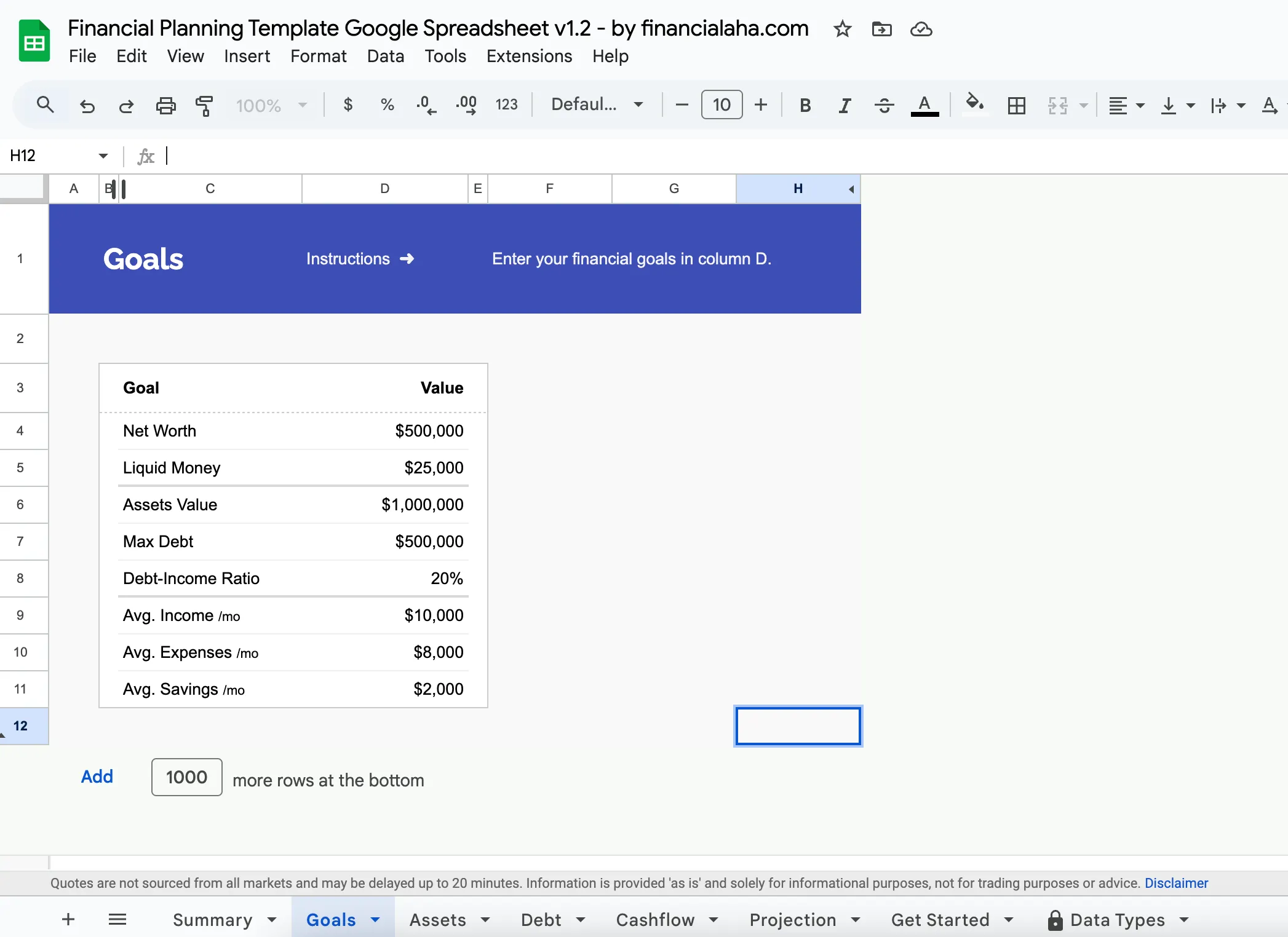
The Goals tab in the Financial Planning Template (Premium tier). The eight targets are fixed: net worth, liquid money, assets value, max debt, debt-to-income ratio, and average monthly income, expenses and savings.
The Emotional Side
Down payment saving is one of the few financial goals where the number feels personal. It is not an abstract retirement target decades away. It is “this is when I can have a home.” That emotional weight makes it both motivating and stressful.
Two things help. First, having a specific target and timeline turns anxiety into a plan. “I need $70,000 and I am saving $1,500 per month, so I am roughly 3.7 years away” is more manageable than “I need to save a lot of money somehow.” Second, tracking progress monthly makes the long timeline feel shorter. Watching the savings grow from $5,000 to $15,000 to $30,000 provides evidence that the plan is working, even when the finish line is still years away.
The down payment is a large number. But it is a finite number, and finite numbers are achievable with time and consistency.
More on Housing & Mortgages
- Home Affordability Calculator: How Much House Can You Afford? - Calculate a comfortable purchase price based on income, debts, and down payment
- How Much House Can I Afford Spreadsheet - Three affordability numbers, including how the down payment percentage moves the monthly carry
- Rent vs. Sell Calculator: What to Do With Your Property - If a current home would fund the next purchase, the rent-out-versus-sell comparison
- Rent vs. Buy Calculator: The Real Comparison - The full cost comparison between renting and buying, including opportunity cost
- Mortgage Payoff Calculator: Extra Payments Impact - How extra payments shorten your loan term and save on interest
Related
Frequently asked questions
Do I need 20% down?
No. Many loan programs accept 3-5% down (conventional) or 3.5% (FHA). However, putting down less than 20% typically means paying PMI, which adds to monthly costs.
How long does it take to save a down payment?
It depends on the target amount and savings rate. On a $350,000 home with 20% down ($70,000), saving $1,000/month reaches the target in about 5.3 years, $1,500/month in about 3.7 years, and $2,500/month in about 2.2 years, assuming 4-5% interest in a high-yield savings account.
Should I invest my down payment savings?
For timelines under 2-3 years, a high-yield savings account is generally safer. For longer timelines, some people invest a portion, but there's risk the market drops right when you need the money.
What about gift money for a down payment?
Most lenders allow gift funds for down payments, typically from family members. Documentation requirements vary by loan type. Gift funds can significantly shorten the savings timeline.
Does the down payment percentage change PMI, or just the loan size?
Both. A larger down payment shrinks the loan you borrow against, and it also moves you closer to the 20% equity mark where PMI drops off. That is why the monthly cost gap between 5% down and 20% down is wider than the loan-size difference alone suggests.
Sources
- What is private mortgage insurance? - Consumer Financial Protection Bureau
- When can I remove private mortgage insurance (PMI) from my loan? - Consumer Financial Protection Bureau
- Determine your down payment - Consumer Financial Protection Bureau
- What is the minimum down payment requirement for FHA? - U.S. Department of Housing and Urban Development
About this article
Down payment minimums, PMI cancellation thresholds, and the 2-5% closing-cost range were re-checked on 2026-09-10 against Consumer Financial Protection Bureau and HUD guidance. Savings-timeline and PMI-duration figures were recalculated on 2026-09-10 from the stated monthly amounts, a 4.5% high-yield savings rate, and a 30-year 6.5% amortization schedule. Template claims were checked on 2026-09-10 against the shipped Financial Planning Google Sheet (Summary, Goals, Assets, Debt, Cashflow, Projection tabs) and the Monthly Budgeting Google Sheet (Budget Plan, Goals tabs). Last reviewed September 2026.