
On a $300,000 mortgage at 6.5%, an extra $100 a month cuts the payoff from 30 years to about 26 and saves roughly $61,000 in interest; $300 a month saves about $135,000. Extra payments count most in the early years, because mortgage interest is front-loaded, and a biweekly schedule works out to one extra payment a year, worth about $84,000 on the same loan.
An extra $100/month on a $300,000 mortgage at 6.5% saves about $61,000 in interest and cuts roughly 4 years off the payoff date. The math is surprisingly powerful because mortgages are long and interest compounds over decades.
Understanding how extra payments work helps with planning. Even small additional amounts create large differences over a 30-year loan term, and those differences grow the earlier in the loan they occur.
Calculate it: The Mortgage Payment Calculator shows your monthly payment breakdown and how different loan amounts affect costs, no signup required.
Why Early Payments Matter
Mortgages are front-loaded with interest. Here’s what that looks like on a $300,000 loan at 6.5%, close to the 30-year fixed average tracked by the Freddie Mac Primary Mortgage Market Survey. In month 1, a $1,896 payment splits into $1,625 interest and just $271 principal. By month 120 (year 10), the same $1,896 payment splits differently, now $1,380 interest and $516 principal.
Extra payments early reduce principal, which means less interest accrues on every payment that follows. A $100 extra payment in year 1 saves more interest than the same $100 in year 15 because it compounds for longer. This is why understanding the math encourages action sooner rather than later.
Extra Payment Impact: $300,000 at 6.5%
Concrete numbers illustrate the power of extra payments better than abstract percentages:
| Scenario | Payoff Time | Total Interest | Savings | |----------|-------------|----------------|---------| | Standard | 30 years | $382,633 | - | | +$100/month | 26 years | $321,639 | $60,995 | | +$300/month | 20.8 years | $247,518 | $135,115 | | +1 payment/year | 24.3 years | $298,649 | $83,985 |
The $100/month scenario saves about $61,000 and cuts 4 years off the mortgage. Increasing to $300/month more than doubles the savings. One extra payment a year works out to roughly $158 a month on this loan, so it lands between the two, at about $84,000 saved and 5.7 years earlier, which suits those who prefer lump sums over steady increases.
Biweekly Payments
Biweekly payments work by paying half your monthly payment every two weeks instead of once monthly. The math creates a natural extra payment: 52 weeks divided by 2 equals 26 half-payments, which equals 13 full payments per year instead of 12.
The impact matches making one extra payment annually, around $84,000 saved on a $300,000 mortgage at 6.5%. Some servicers charge for formal biweekly programs, which may not be worth the fee. One alternative approach is making extra principal payments yourself, achieving the same result without program fees. Before starting, it’s worth confirming your loan carries no prepayment penalty; according to the Consumer Financial Protection Bureau, most modern mortgages don’t, and small extra principal payments rarely trigger one.
Lump Sum Impact by Timing
Lump sums from tax refunds, bonuses, or an inheritance can make a significant dent, but timing matters enormously. A $5,000 lump sum on a 30-year mortgage at 6.5% saves vastly different amounts depending on when it’s applied:
| Timing | Interest Saved | |--------|----------------| | Year 1 | ~$26,000 | | Year 5 | ~$19,500 | | Year 10 | ~$13,000 | | Year 20 | ~$4,500 |
The same $5,000 saves close to six times more interest in year 1 than in year 20. This illustrates why earlier action on mortgage payoff creates outsized benefits compared to waiting.
Key Formulas
Two formulas help calculate the impact of different extra payment amounts in Google Sheets.
Months to payoff with extra payments uses: =NPER(Rate/12, -(StandardPayment + ExtraMonthly), Balance). This tells you exactly how long the loan will take at your proposed payment level.
Interest saved compares the totals: =StandardTotalInterest - AcceleratedTotalInterest. Running these calculations for different extra payment amounts helps identify the sweet spot for your budget.
If you’d rather not wire these formulas up by hand, the Mortgage Payoff Calculator template ($19, Essentials tier) does it in one dashboard: enter the balance, rate, term, and an extra monthly amount, and it returns the new payoff date, months saved, and interest saved, plus an amortization schedule and a chart of the balance with and without extra payments. A free version takes the loan amount, rate and term and returns the scheduled monthly payment, the total paid over the term and the total interest, without the extra-payment side.
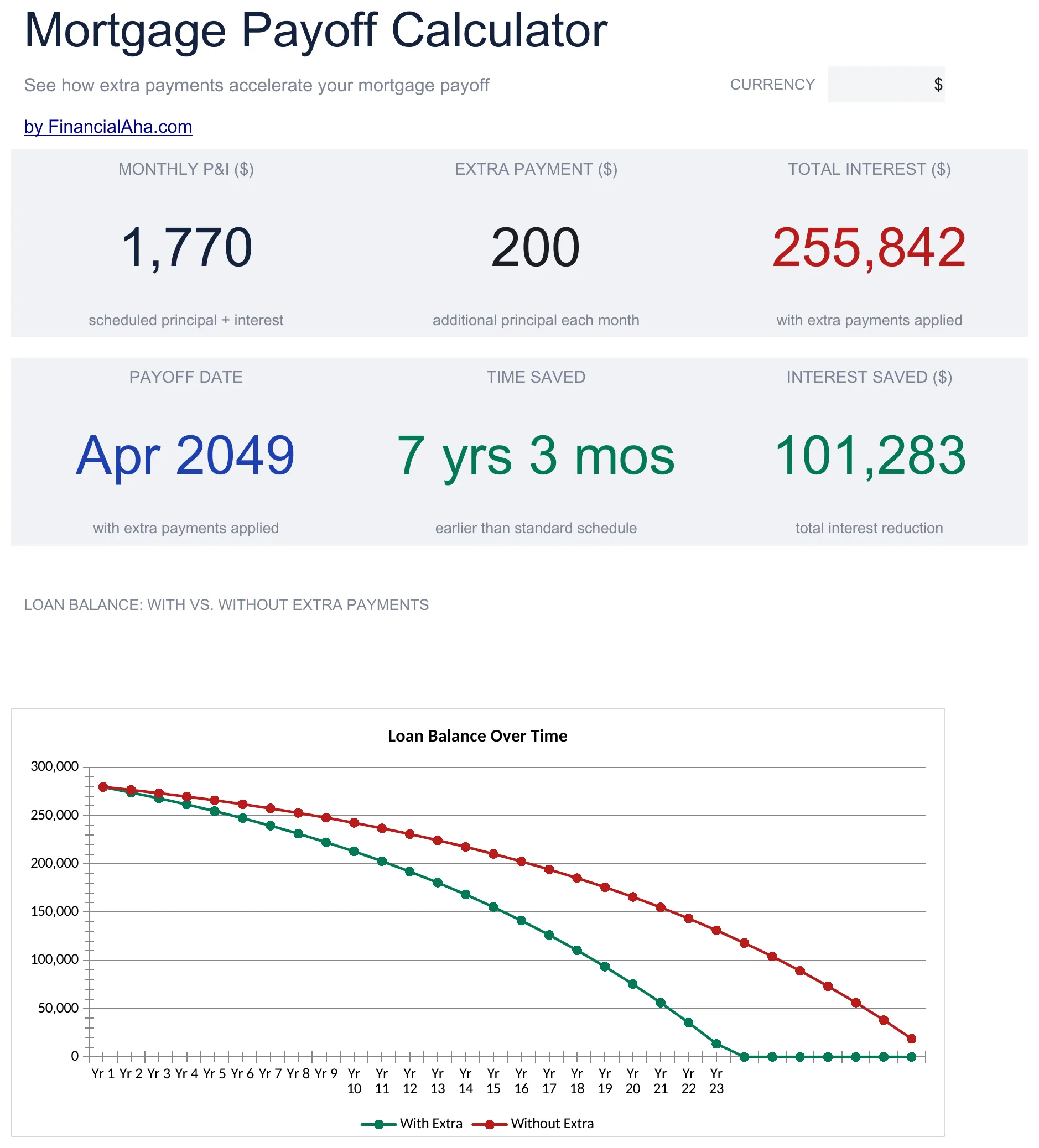
The Mortgage Payoff Calculator (Essentials tier): an extra $200 a month against this balance pulls the payoff forward more than seven years and cuts total interest by six figures. Works in Google Sheets and Excel, a one-time purchase with no subscription.
When to Pay Extra
Extra mortgage payments make more sense in certain situations. Approaching retirement, having a high mortgage rate (7%+), valuing the peace of mind from owning outright, or having a risk-averse preference all point toward accelerated payoff.
Investing instead might make more sense with a mortgage rate below 5-6%, retirement accounts not yet maxed, no emergency fund in place, or higher-interest debt that costs more than the mortgage. The trade-off comes down to a 6.5% guaranteed return (mortgage payoff) versus an uncertain 8-10% (market returns). Risk tolerance and personal circumstances matter as much as pure math.
If your rate is high compared to current offerings, refinancing might be worth exploring before committing to extra payments. The Mortgage Refinance Calculator shows whether refinancing saves money after accounting for closing costs.
More on Housing & Mortgages
- Mortgage Refinance Calculator: When Does Refinancing Make Sense? - The breakeven calculation for swapping to a lower rate
- Home Affordability Calculator: How Much House Can You Afford? - Calculate a comfortable purchase price based on income, debts, and down payment
- Down Payment Calculator: How Much to Save for a Home - How much to target, the tradeoffs of different percentages, and building a savings plan
Related
- Mortgage Payoff Calculator template - the extra-payment math in one editable dashboard ($19, Essentials tier)
- Mortgage Payment Calculator - calculate monthly payments for different loan amounts and rates
- Mortgage Refinance Calculator - see if refinancing saves money at current rates
- Financial Planning Template - list the mortgage with your other debts and project assets, debt and cash flow to a chosen end year
- Net Worth Tracker - log the mortgage balance next to the home value month by month and watch net worth and the debt-to-assets ratio move
Frequently asked questions
Do extra payments lower my monthly payment?
No. Extra payments reduce principal and shorten the loan term, but the required monthly payment stays the same. You just make fewer payments overall.
How do I make sure an extra payment goes to principal and not next month's bill?
Not every servicer applies extra money to principal automatically. Many let you mark a payment as principal-only online or add a note when you pay. Confirming how your servicer handles it keeps the extra amount reducing the balance rather than sitting as a prepaid future payment.
Can extra payments help me drop PMI sooner?
Extra principal lowers the balance faster, which can reach the loan-to-value threshold where private mortgage insurance is removed sooner. The exact threshold and the request process depend on the lender and the loan type.
Should I make extra payments if I'm selling within 5 years?
Extra payments may not make as much sense since you'll recover the equity at sale anyway. The interest savings are smaller over a short period.
Do mortgages have prepayment penalties?
Most modern mortgages don't have prepayment penalties, and small extra principal payments rarely trigger one. Checking your loan documents (look at the Note and any Addendum) confirms this for your specific loan.
Sources
- Primary Mortgage Market Survey - Freddie Mac
- Can I be charged a penalty for paying off my mortgage early? - Consumer Financial Protection Bureau
About this article
Interest and payoff figures recomputed on 2026-09-10 for a $300,000 loan at 6.5% over 30 years using standard amortization math Prepayment-penalty details checked against the Consumer Financial Protection Bureau; the example rate is benchmarked to the Freddie Mac Primary Mortgage Market Survey Template sheets, inputs and outputs checked on 2026-09-10 against the shipped Mortgage Payoff Calculator workbooks (Free: Payoff; Essentials: Dashboard, Mortgage Setup, Amortization Schedule) Last reviewed September 2026.