Refinancing makes sense when you stay in the home past the breakeven point, which is closing costs divided by monthly savings. Divide $7,500 in closing costs by $171 saved each month and you break even in about 44 months; stay longer and every month after is savings, sell sooner and the refinance loses money. Closing costs typically run 2-5% of the loan, and a new full-length term can quietly add years of interest.
Refinancing is one of those financial moves that sounds simple - swap your old mortgage for one with a lower rate, save money. And sometimes it really is that straightforward. Other times, the closing costs eat the savings, or worse, the new loan adds years to your repayment without anyone mentioning it.
The only way to know which situation you’re in is to run the numbers. The Mortgage Refinance Calculator does exactly that. No signup required.
One Number Tells You Almost Everything
The breakeven period is the heart of any refinance decision:
Closing Costs / Monthly Savings = Months to Break Even
That’s it. If refinancing costs $8,000 and saves $200 per month, you break even in 40 months. Planning to stay longer than 40 months? The refinance likely works. Thinking of moving in two years? It doesn’t.
Everything else is just detail around this core calculation.
Walking Through a Real Scenario
Take a homeowner with $280,000 remaining on a 6.5% mortgage, 25 years left, paying $1,891/month in principal and interest.
A lender offers 5.5% on a new 25-year term. Closing costs: $7,500.
New payment: $1,719/month. That’s $171 in monthly savings.
Breakeven: $7,500 divided by $171 = 44 months, or about three years and eight months.
Total interest saved over the life of the loan, after subtracting closing costs: roughly $43,800.
If this person stays put for at least another three years and eight months, every month after breakeven is pure savings. If they’re already browsing Zillow for their next home, the refinance is a money-losing proposition.
The Closing Cost Reality
Refinancing is not free, and “no-closing-cost” refinances aren’t free either. As the CFPB explains, a lender that waives upfront costs typically recovers them through a higher rate or a larger loan balance. Here’s what typically shows up on the settlement statement:
| Cost | Typical Range | |------|--------------| | Appraisal | $300 - $600 | | Title search and insurance | $700 - $2,000 | | Origination fee | 0.5 - 1% of loan | | Application fee | $300 - $500 | | Recording fees | $100 - $300 | | Prepaid interest | Varies |
Freddie Mac puts refinance closing costs at roughly 2-5% of the loan amount, so on a $250,000 loan they usually land between $5,000 and $12,500. Worth comparing a no-cost refinance at a slightly higher rate against a standard refinance with upfront costs. The calculator lets you test both scenarios.
Why a 1% Rate Drop Doesn’t Mean the Same Thing for Everyone
The old advice, “refinance when you can save a full percentage point,” ignores how much the loan balance matters.
| Remaining Balance | Monthly Savings on a 30-Year Term, 6.5% to 5.5% | |------------------|--------------------------------------| | $150,000 | ~$96 | | $250,000 | ~$161 | | $350,000 | ~$225 | | $500,000 | ~$321 |
At $150,000, saving $96/month against $6,000 in closing costs takes over five years to break even. At $500,000, the same rate drop saves $321/month, so $6,000 in costs comes back in under two years. Closing costs do climb with the loan size, which narrows the gap, but the balance still drives the math.
The Trap That Costs People Thousands
Here’s something lenders don’t always volunteer: if you’re seven years into a 30-year mortgage and refinance into a new 30-year mortgage, you’ve just signed up for 37 total years of payments.
The lower monthly payment feels like a win. But stretching the timeline means paying interest for seven extra years. Even at the lower rate, the total interest paid across both loans can end up higher than if you’d never refinanced at all.
The fix is simple: match (or shorten) your remaining term. Seven years into a 30-year? Refinance to a 23-year or 20-year term. The monthly payment stays closer to what you’re used to, and you capture the interest savings without adding years.
This is where running different term lengths through the calculator reveals what a single monthly payment comparison hides.
Cash-Out Refinancing: A Different Animal
Cash-out refinancing lets you borrow more than you owe and take the difference in cash. It can work for specific purposes - paying off high-interest credit cards, funding a renovation that adds real value.
But it increases your mortgage balance, resets amortization, and converts unsecured debt into debt backed by your home. CFPB data shows cash-out loans tend to carry higher rates, higher payments, and higher balances than other refinances, which raises the stakes. Using home equity to fund a vacation or a depreciating asset is a gamble worth thinking through twice.
The Quick Checklist
Refinancing tends to work when the rate drop is meaningful (not just 0.25%), the remaining balance is large enough that monthly savings are substantial, you’re staying long enough to pass breakeven, your credit qualifies you for the advertised rates, and you can cover closing costs without strain.
It tends not to work when the remaining balance is small, you’re close to selling, you’d extend the loan term significantly without realizing it, or closing costs are unusually high for your area.
Running It Yourself
The manual version takes six steps: get your current loan details, get a refinance quote, calculate the new payment, find the monthly savings, divide closing costs by savings, and compare that number to your timeline.
The Financial Planning Template does not run refinance math, but its Debt tab holds each loan with its balance, annual interest rate and minimum payment, and the Cashflow tab subtracts the total of those payments from monthly income. Updating the mortgage row after a refinance moves both.
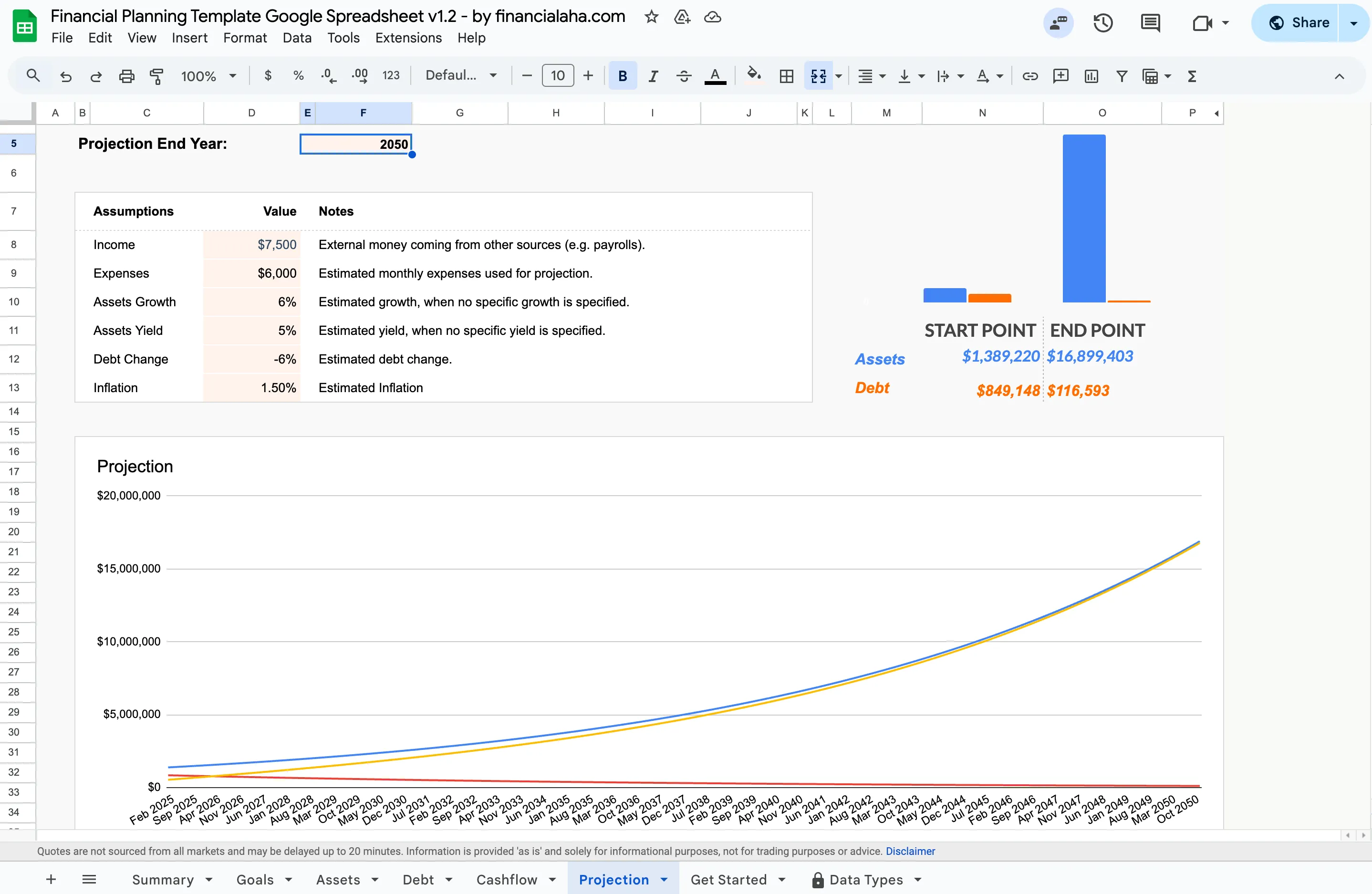
The Financial Planning Template (Premium tier) carries assets and debt forward month by month to a chosen end year, off six editable assumptions: income, expenses, assets growth, assets yield, debt change and inflation.
More on Housing & Mortgages
- Mortgage Payoff Calculator: Extra Payments Impact - How extra payments shorten your loan term and save on interest
- Home Affordability Calculator: How Much House Can You Afford? - Calculate a comfortable purchase price based on income, debts, and down payment
- Loan Payment Calculator: Understanding Amortization - How each mortgage payment splits between interest and principal over time
- Rent vs. Buy Calculator: The Real Comparison - The full cost comparison between renting and buying, including opportunity cost
Related
Frequently asked questions
What's a good rule of thumb for refinancing?
The old 1% rule (refinance if you can save 1% or more) is a starting point. But the real answer depends on closing costs and how long you'll keep the home. Calculate the breakeven period for your specific situation.
Does refinancing reset my loan to 30 years?
It can, which is a common trap. If you're 10 years into a 30-year mortgage and refinance to a new 30-year term, you'll be paying for 40 total years. Consider a 20-year or 15-year refinance to avoid extending the timeline.
What are typical refinance closing costs?
Usually 2-5% of the loan amount - covering appraisal, title insurance, origination fees, and other costs. On a $250,000 loan, expect $5,000-$12,500.
Can I refinance with bad credit?
It's possible but more difficult. Lower credit scores mean higher rates, which may not produce enough savings to justify the costs.
Is a no-closing-cost refinance actually free?
No. The CFPB notes that a lender covering the closing costs usually recovers them through a higher interest rate or a larger loan balance. It shifts the cost rather than removing it, so it can still make sense if you plan to move before the higher rate outweighs the savings.
How is the breakeven point affected if I roll closing costs into the loan?
Rolling costs into the balance means no cash out of pocket, but you finance those costs at the new rate and your loan amount rises. The breakeven math still holds: divide the total costs by the monthly savings, then compare that to how long you plan to keep the home.
Sources
- Understanding the Costs of Refinancing - Freddie Mac
- Is there such a thing as a no-cost or no-closing cost loan or refinancing? - Consumer Financial Protection Bureau
- CFPB Mortgage Report Finds Jumps in Closing Costs and Growing Proportion of Cash-Out Refinances - Consumer Financial Protection Bureau
About this article
Closing-cost ranges checked against Freddie Mac's refinancing-cost guidance and Consumer Financial Protection Bureau consumer resources. Payment, savings and break-even figures recomputed on 2026-09-10 with the standard fixed-rate amortization formula and matched against the on-site Mortgage Refinance Calculator. Financial Planning Template tabs, inputs and outputs checked on 2026-09-10 against the shipped Financial Planning Google Sheet (Summary, Goals, Assets, Debt, Cashflow, Projection tabs). Last reviewed September 2026.