To decide whether to rent out or sell a property, compare the net sale proceeds invested elsewhere against rental cash flow plus appreciation over your holding period. The factor that most often settles it is the capital gains exclusion: if the home was your primary residence for 2 of the last 5 years, up to $250,000 (single) or $500,000 (married) of gain is tax-free, and converting to a rental starts that window closing.
You’ve got a property you’re no longer living in. Maybe you moved for work. Maybe you inherited it. Maybe life just went in a different direction. Now there are two choices: rent it out, or sell it and put the money somewhere else.
Both are reasonable. Neither is obviously wrong. But they lead to very different financial outcomes depending on your specific numbers, and one factor that many people overlook can swing the entire decision.
The Rent vs. Sell Calculator compares both paths side by side. No signup required.
The Factor Most People Discover Too Late
If you lived in the home as your primary residence for at least two of the last five years, you can exclude up to $250,000 in capital gains (single) or $500,000 (married) from taxes when you sell. This exclusion is one of the most valuable tax benefits available to homeowners.
But it has an expiration date. Convert the property to a rental, and the five-year window starts closing. Wait too long, and a property with $200,000 in gains suddenly comes with a $30,000 to $40,000 tax bill that didn’t need to exist.
This timeline pressure is often the deciding factor rather than rental income, appreciation, or investment returns. When the exclusion applies and the gains are significant, the numbers tend to point toward selling before the window closes.
Running the Numbers Both Ways
Here’s a real scenario to make this concrete:
Property: Worth $350,000. Remaining mortgage: $180,000. Equity: $170,000.
Selling
| Item | Amount | |------|--------| | Sale price | $350,000 | | Agent commission (6%) | -$21,000 | | Closing costs | -$3,000 | | Mortgage payoff | -$180,000 | | Capital gains tax | $0 (exclusion applies) | | Net proceeds | $146,000 |
Invest that $146,000 at a 7% average return: roughly $287,000 after ten years. No tenants, no maintenance calls, no vacancy months.
Renting
| Monthly Item | Amount | |-------------|--------| | Rental income | $2,200 | | Mortgage (P&I) | -$1,200 | | Property taxes | -$350 | | Insurance | -$125 | | Maintenance (1%/year) | -$292 | | Vacancy allowance (5%) | -$110 | | Property management (10%) | -$220 | | Net monthly cash flow | -$97 |
Negative cash flow. This surprises a lot of people, but it’s common in markets where home prices are high relative to rents. The property’s return isn’t coming from monthly income; it’s coming from appreciation, and that’s a bet on the future.
After Ten Years of Renting (3% Annual Appreciation)
Property value grows to about $470,000. Mortgage drops to roughly $140,000. Equity reaches $330,000, minus about $31,000 in selling costs and $11,600 in cumulative negative cash flow. Net position: approximately $287,000.
Almost identical to selling and investing. Except one path involved a decade of being a landlord.
When Selling Tends to Win
The capital gains exclusion is available and the gains are meaningful. This is the big one. A tax-free gain of $150,000+ is hard to replicate through rental income.
The rent-to-value ratio is weak. When monthly rent falls well below 1% of the property’s value, cash flow is thin or negative. The property’s return then depends almost entirely on appreciation, which is never guaranteed.
You’d be a long-distance landlord. Managing a property remotely almost always means hiring a property manager at 8-12% of rent. That cost alone can flip a marginally positive cash flow to negative.
You need the capital. If the equity would fund a home purchase elsewhere, eliminate debt, or serve a specific financial goal, selling provides immediate liquidity that renting doesn’t.
When Renting Tends to Win
Healthy rental income. If rent comfortably covers all expenses with money left over (rent-to-value above 0.8-1%), the property generates real income while building equity through appreciation and mortgage paydown.
Strong local appreciation trends. In markets with genuine growth fundamentals, holding a property offers leveraged returns. A 3% appreciation on a $350,000 home is $10,500, a meaningful return on $170,000 in equity.
Favorable tax treatment. Rental properties offer depreciation deductions that reduce taxable income even while the property appreciates, and mortgage interest and operating expenses are also deductible. The trade-off comes later: the IRS recaptures that depreciation at a rate of up to 25% when you eventually sell.
Capital gains tax would be large. If the primary residence exclusion doesn’t apply and selling would trigger a significant tax bill, holding and renting can be the more tax-efficient path.
The Landlord Question
Spreadsheets don’t capture what it’s actually like to own rental property. Tenant screening, lease management, maintenance emergencies, vacancy gaps, late rent, and the occasional difficult eviction. Property management outsources most of this, but the cost erodes cash flow.
Some people find rental income worth the involvement. Others discover that “passive income” from real estate is a term best used loosely.
Worth being honest about which camp you’d fall into before committing to a decade-long strategy.
Modeling the Decision
The Financial Planning Template is where either outcome gets recorded alongside the rest of your money. A rental goes on the Assets tab as a Real Estate row with its value, annual yield and annual growth, invested sale proceeds go there as their own asset row, and the mortgage sits on the Debt tab with its balance, annual interest rate and minimum payment. The Projection tab then carries whichever version you enter out to a chosen end year, using assumptions for income, expenses, asset growth, asset yield, debt change and inflation. It doesn’t compare renting against selling, which is what the calculator above does.
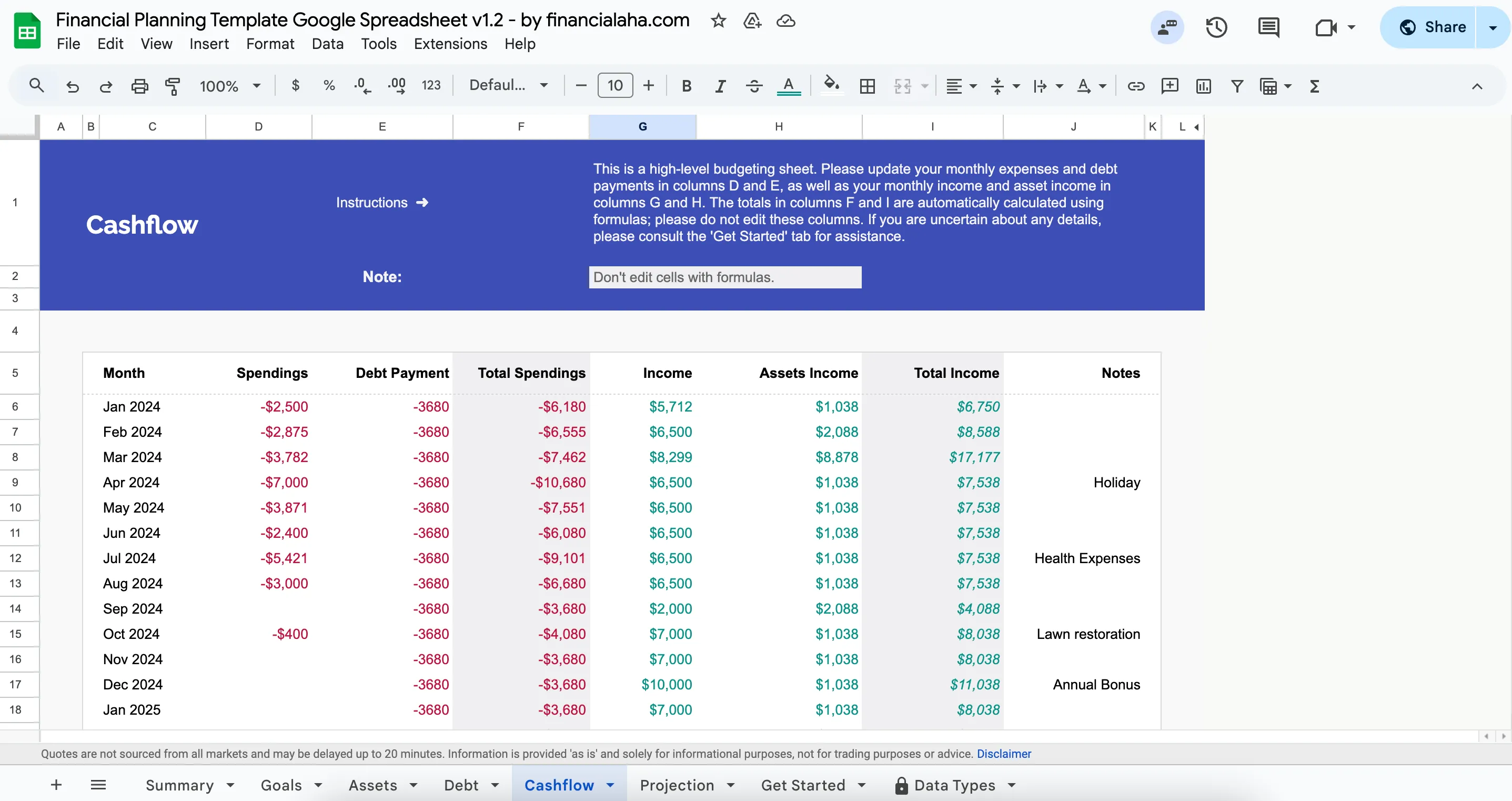 The Financial Planning Template (Premium tier) tracks month-by-month income, asset income, and expenses, so rental cash flow or invested sale proceeds can sit alongside the rest of your money.
More on Housing & Mortgages
- Rent vs. Buy Calculator: The Real Comparison - The full cost comparison between renting and buying, including opportunity cost
- Mortgage Refinance Calculator: When Does Refinancing Make Sense? - The breakeven calculation for swapping to a lower rate
- Home Affordability Calculator: How Much House Can You Afford? - Calculate a comfortable purchase price based on income, debts, and down payment
Related
Frequently asked questions
How do I know if my property would be a good rental?
The 1% rule is a rough filter: if monthly rent is at least 1% of the property value, it may work as a rental. A $300,000 home would need to rent for $3,000+/month. Most markets fall below this, meaning cash flow is tight.
What about capital gains tax on selling?
If it's been your primary residence for 2 of the last 5 years, gains up to $250,000 (single) or $500,000 (married) are excluded under IRS Section 121. This exclusion is valuable and time-limited, because converting to a rental starts the five-year clock closing.
What if I'm relocating and want to keep the house?
The capital gains exclusion timeline is worth weighing. If you convert to a rental and later sell beyond the five-year window, the primary-residence exclusion no longer applies and the gain becomes taxable. Selling before the window closes keeps the tax-free treatment on the table.
Can I try renting and sell later?
Yes, but converting to a rental changes the tax treatment. Depreciation you claim while renting is recaptured when you eventually sell, taxed as unrecaptured Section 1250 gain at a rate of up to 25%.
Does a 1031 exchange help if I sell a rental?
A 1031 like-kind exchange lets you defer capital gains and depreciation recapture by rolling the proceeds into another investment property within strict deadlines. It applies to investment property, not a primary residence, so it becomes relevant only after the home has been converted to a rental.
How is negative monthly cash flow still worth it for some owners?
When rent falls short of expenses, the return has to come from somewhere else: appreciation and mortgage paydown build equity over time even while the monthly ledger runs slightly negative. Whether that trade holds depends on local price growth, which is never guaranteed.
Sources
- Topic no. 701, Sale of your home - Internal Revenue Service
- Publication 523, Selling Your Home - Internal Revenue Service
- Topic no. 409, Capital gains and losses - Internal Revenue Service
About this article
Capital gains exclusion thresholds ($250,000 single / $500,000 married) and the 2-of-5-year primary-residence rule verified against IRS Topic 701 and Publication 523 Depreciation recapture rate (up to 25% on unrecaptured Section 1250 gain) verified against IRS Topic 409 Financial Planning Template tabs, inputs and outputs checked on 2026-09-10 against the shipped Financial Planning Google Sheet (Summary, Goals, Assets, Debt, Cashflow, Projection tabs) Rent vs. Sell Calculator inputs, outputs and worked example checked on 2026-09-10 against the on-site calculator component Last reviewed September 2026.