
YNAB costs $109/year. If the price or the zero-based method is the sticking point, the closest replacement that removes the subscription is a Google Sheets budget template you own outright, rebuilding the same categories, targets, and budget-vs-actual tracking for a one-time purchase. The best app alternatives are Monarch Money ($99/year) for the fullest feature set, Goodbudget (free tier) for envelope budgeting, and Quicken Simplifi (about $48/year) for the cheapest automated tracking.
YNAB (You Need A Budget) has been the gold standard for zero-based budgeting for years. But at $109/year with a method that takes real commitment to learn, it’s not for everyone. Whether the price feels steep or the philosophy doesn’t click, there are solid alternatives worth exploring.
Quick picks: To drop the subscription entirely, FinancialAha’s budget templates rebuild the same categories-and-targets workflow in Google Sheets as a one-time purchase, with no bank connection and full privacy. For the closest full-featured app, Monarch Money ($99/year) adds bank syncing. For envelope budgeting specifically, Goodbudget offers a free tier. For the cheapest automated tracking, Quicken Simplifi runs about $48/year.
I’ve spent time with most of these, and here’s what actually stands out.
Spreadsheet Budget Templates
This might sound like a step backward, but hear me out. A well-built spreadsheet does everything YNAB does for budgeting: categories, budget-vs-actual tracking, running totals, all without the subscription.
The Monthly Budget Template handles what most YNAB users care about: setting spending targets by category and tracking where money actually goes. The Annual Budget Template adds a 12-month view that YNAB doesn’t natively offer, which is useful for seeing seasonal patterns.
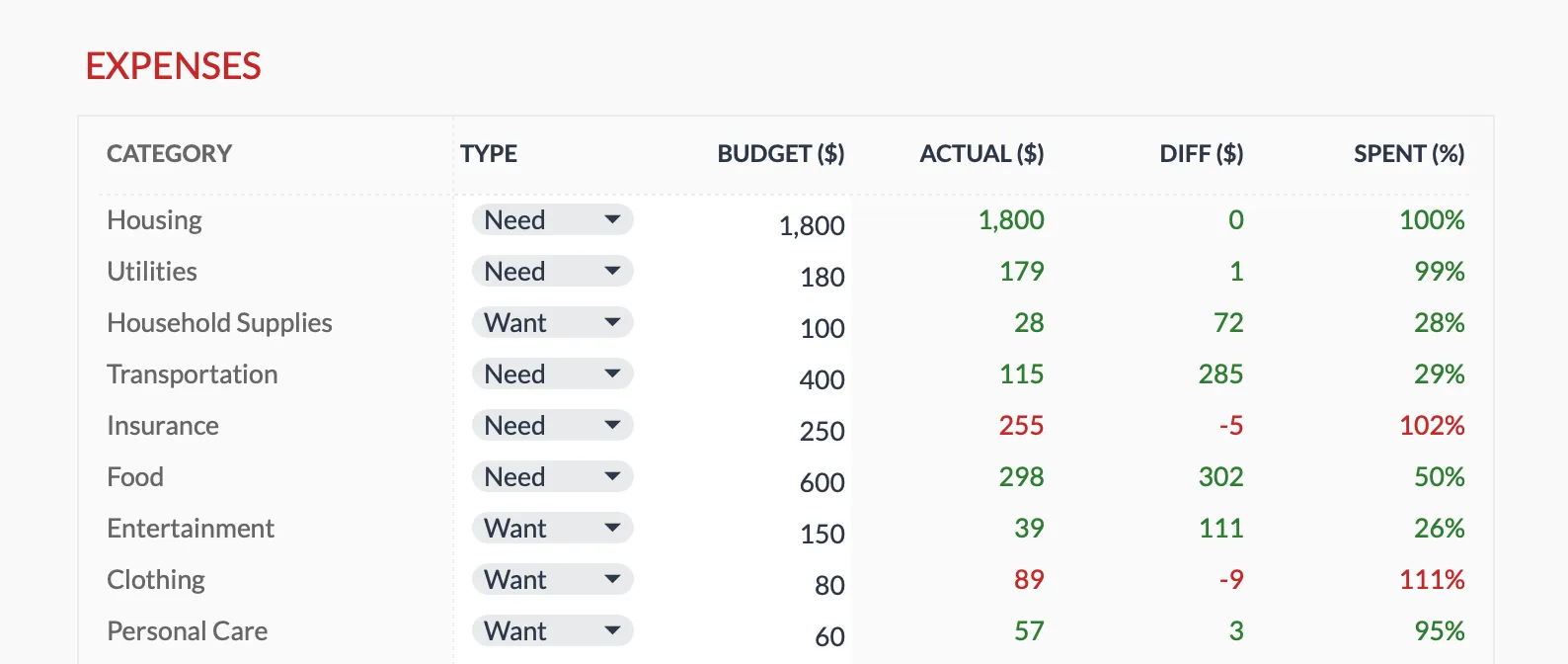 Budget-vs-actual by category in FinancialAha’s Monthly Budget Template (Premium tier), the same planned-versus-spent view YNAB users rely on, without a subscription or bank link.
The trade-off is obvious - no automatic bank syncing, no mobile app for on-the-go logging. But the privacy benefits are real (no bank credentials shared), it’s a one-time purchase, and your data lives in Google Sheets where it can’t disappear if a company changes direction.
Monarch Money
If you want the closest full-featured app experience, Monarch is probably it. Built by a former Mint product manager, it handles zero-based budgeting, automatic transaction imports, and has a clean interface that doesn’t feel cluttered.
At $99/year, it’s slightly cheaper than YNAB. The joint account support makes it particularly popular with couples. Cash flow forecasting is a nice addition that YNAB lacks. The learning curve is gentler too - Monarch doesn’t force you into a specific methodology the way YNAB does.
The downside? Still a subscription. Still requires bank linking. Still dependent on a company staying in business (though Monarch seems stable so far).
Goodbudget
This one follows the envelope budgeting method, which is philosophically similar to YNAB’s approach. You divide money into virtual envelopes and spend from each category until it’s gone.
The free tier gives you 10 envelopes and basic reporting - enough to see if the method works for you. The paid version ($10/month or $80/year) adds unlimited envelopes, multiple devices, and more history. No bank syncing at all, which is either a feature or a limitation depending on your perspective.
Goodbudget works well for people who liked YNAB’s philosophy but want something simpler and cheaper. The mobile app is solid, and manual entry keeps you aware of every transaction.
EveryDollar
Created by Ramsey Solutions, EveryDollar follows zero-based budgeting principles. The free version works without bank linking - you manually enter transactions and assign every dollar to a category.
The premium version ($79.99/year, or $17.99/month) adds automatic bank imports. The interface is straightforward, perhaps the most beginner-friendly option here. It follows Dave Ramsey’s budgeting philosophy closely, which works well for debt payoff but may feel restrictive for people who don’t follow that framework.
Quicken Simplifi
Simplifi takes a different approach than YNAB entirely. Instead of assigning every dollar a job, it uses a spending plan that shows money in vs. money out with a simple visual dashboard.
At about $48/year on the annual plan (billed yearly, with monthly billing at a higher rate), it’s the most affordable subscription option here. Automatic bank syncing works reliably. The spending plan approach feels less demanding than zero-based budgeting - it tells you how much is safe to spend rather than requiring you to pre-plan every category.
This works for people who found YNAB’s methodology exhausting but still want app-based tracking with automation.
PocketGuard
The “in my pocket” feature shows how much money is truly available to spend after accounting for bills, savings goals, and necessities. It’s a simpler take on budgeting that doesn’t require categorizing everything.
A 7-day free trial lets you try it before paying, but there is no permanent free tier. PocketGuard Plus runs $12.99/month or $74.99/year and unlocks a debt payoff plan, custom categories, and more detailed reports. The approach appeals to people who want a quick answer to “how much can I spend today?” rather than the detailed category management YNAB provides.
How to Think About the Switch
YNAB’s biggest value isn’t really the software - it’s the methodology. Giving every dollar a job forces intentional spending decisions. Any tool that helps you do that works.
If the method clicks but the price doesn’t, Goodbudget or EveryDollar’s free tier follow similar principles. If you want automation without the high cost, Simplifi or PocketGuard deliver that at lower price points. If you want full control and data ownership, spreadsheets handle the tracking while you bring the discipline.
Some people find that switching from YNAB to a spreadsheet actually improves their budgeting. The manual process of entering numbers and reviewing categories creates awareness that auto-syncing can actually reduce. Others prefer the convenience of apps and find manual entry unsustainable.
Neither approach is wrong. It depends on what keeps you engaged with your finances over the long term.
If dropping the subscription is the goal, the shortest path is the Monthly Budget Template: the categories, targets, and budget-vs-actual view are already wired, so the first budget is a matter of typing in your own numbers rather than building the sheet from scratch. FinancialAha’s templates are used by 1,000+ customers in 65+ countries who wanted YNAB’s method without the recurring cost. For a deeper look at the trade-off itself, Budget Spreadsheets vs Apps walks through where each one pulls ahead.
Quick Comparison
| Tool | Cost | Pricing Model | Bank Sync | Data Privacy | Method | Mobile App | Best For |
|---|---|---|---|---|---|---|---|
| YNAB | $109/yr | Subscription | Yes | Bank credentials shared | Zero-based | Yes | Committed zero-based budgeters |
| Monarch Money | $99/yr | Subscription | Yes | Bank credentials shared | Flexible | Yes | Couples, full-featured app |
| Goodbudget | Free / $80/yr | Freemium | No | No bank data | Envelope | Yes | Envelope budgeting fans |
| EveryDollar | Free / $80/yr | Freemium | Paid only | Free: private / Paid: bank linked | Zero-based | Yes | Dave Ramsey followers |
| Simplifi | $48/yr | Subscription | Yes | Bank credentials shared | Spending plan | Yes | Low-effort tracking |
| PocketGuard | $75/yr (7-day trial) | Subscription | Yes | Bank credentials shared | Available-to-spend | Yes | Quick “can I spend this?” answer |
| FinancialAha Templates | One-time | One-time purchase | No | Full privacy, data in your Google Drive | Flexible | Via Google Sheets app | Privacy-conscious, spreadsheet users |
Head-to-Head Comparisons
- YNAB vs Spreadsheet Budgeting - The app vs spreadsheet tradeoff
- EveryDollar vs YNAB - Two zero-based budgeting apps compared
- YNAB vs Monarch Money - Feature and pricing comparison
- Tiller vs YNAB - Spreadsheet automation vs dedicated app
Related
- Monthly Budget Template - Category-based budget tracking
- Mint Alternatives After the Shutdown
- Budget Spreadsheets vs Apps
Frequently asked questions
Why do people leave YNAB?
The most common reasons are price (YNAB costs $109/year) and the steep learning curve. Some users also prefer automatic tracking rather than YNAB's manual, zero-based approach where every dollar needs to be assigned a job before spending.
Is there a free alternative to YNAB?
Yes. Goodbudget offers a free tier with limited envelopes, EveryDollar has a free version without bank syncing, and spreadsheet templates in Google Sheets provide full budget functionality with no ongoing cost.
Can a spreadsheet really replace YNAB?
For many people, yes. Spreadsheet budget templates handle income tracking, expense categories, and budget-vs-actual comparisons. The main difference is that spreadsheets don't sync with your bank automatically, but plenty of former YNAB users actually prefer the manual approach.
What is the closest app to YNAB?
Goodbudget uses a similar envelope budgeting method. Monarch Money offers zero-based budgeting features with automatic bank syncing. EveryDollar also follows a zero-based philosophy, created by the Ramsey Solutions team.
Which YNAB alternatives work without linking a bank account?
Goodbudget, EveryDollar's free version, and Google Sheets budget templates all run on manual entry and never ask for bank credentials. Monarch Money, Quicken Simplifi, and PocketGuard rely on automatic bank syncing, so they need a linked account to work as intended.
How much does leaving YNAB actually save?
YNAB is $109/year, so a switch that removes the subscription saves that amount every year it would otherwise renew. Free apps like Goodbudget's tier drop the cost to zero; a one-time spreadsheet template is a single purchase, so it pays for itself inside the first year and the renewals stop after that.
Sources
- YNAB Pricing - You Need A Budget
- Monarch Money Pricing - Monarch Money
- Goodbudget Plans and Pricing - Goodbudget
- EveryDollar Budgeting App - Ramsey Solutions
- Quicken Simplifi - Quicken
- PocketGuard Pricing - PocketGuard
About this article
Competitor prices for YNAB, Monarch Money, Goodbudget, EveryDollar, Quicken Simplifi, and PocketGuard were checked against each company's live pricing page. The budget-vs-actual figures shown reflect the Monthly Budget Template's actual expenses tab. Last reviewed August 2026.