UAE
Net Worth Tracker for the UAE
See your full financial position across countries - UAE bank accounts, property, gratuity accrual, home-country assets, and all debts in one consolidated view.
In Depth
Gratuity, Global Assets, and the Multi-Currency Balance Sheet
One distinctive aspect of tracking net worth in the UAE is that assets are often spread across several countries and currencies. Bank accounts, property and investments in a home country sit alongside local UAE savings and, in many cases, an international brokerage account. Converting everything to a single currency, whether AED or a home currency, gives a clearer overall picture, though exchange rate movements can create apparent gains and losses that have nothing to do with actual financial progress.
End-of-service gratuity builds with every year of employment yet stays invisible until the job ends. Estimating its current value from years of service and basic salary, then carrying it on the net worth sheet, keeps a significant entitlement from being overlooked. Where an employer uses the DIFC DEWS scheme, running since 2020, or the national alternative savings scheme opened to employers in 2023, the entitlement is already held in an invested account with a readable balance, which removes the estimation step.
The absence of capital gains tax simplifies UAE net worth tracking in one specific way: the full market value of an investment is the asset, with no deferred tax obligation reducing it. In countries that tax capital gains, unrealised gains carry a future bill the headline portfolio figure hides. The caveat is that a UAE balance sheet often spans jurisdictions, and assets held elsewhere stay subject to the rules of the country they sit in, so the simplification applies to the UAE side rather than to the whole sheet.
UAE
Net Worth in the UAE: What to Track
UAE residents often hold assets across several countries and currencies. A net worth tracker brings everything into one view, regardless of where the assets sit.
End-of-service gratuity is a hidden asset
Accrued end-of-service gratuity grows with every year of service but does not appear in a bank account until employment ends. Estimating the current value from years of service and basic salary, then listing it as an asset, gives a fuller picture. Where an employer has joined the DIFC DEWS scheme, in place since 2020, or the national alternative end-of-service savings scheme available since 2023, the entitlement already sits in an invested account with a statement to read off.
Assets are often spread across countries
Many UAE residents keep property, bank accounts and investments in their home country alongside local assets. A tracker that captures everything, converted to a single currency for comparison, shows the full picture. Current exchange rates make the conversion consistent from one update to the next.
Property in the UAE can be a significant asset
For anyone who has bought property in the UAE, market value minus the outstanding mortgage is the equity figure. Dubai property prices move, so conservative valuations based on recent comparable transactions tend to produce a steadier net worth line.
No capital gains tax means investment growth carries no deferred bill
The UAE does not tax capital gains for individuals, and there is no wealth or inheritance tax. The full market value of a holding is the asset, with no deferred tax liability behind it. Business activity is treated separately: a natural person running a business can fall within the 9% corporate tax regime above AED 1 million of turnover, though personal investment income and personal real estate investment income are excluded from that test. Assets held in other countries remain subject to the rules where they sit.
Get the Template
Getting Started
Configuring the Net Worth Tracker for UAE Expat Life
List all assets with current balances
Enter local bank accounts, savings, UAE and international investments, property market value, estimated end-of-service gratuity or the balance of an employer savings scheme, insurance cash value, gold, and anything held in your home country.
Capture debts in the UAE and abroad
Include the outstanding mortgage, car loan, personal loans, credit card balances, and any debts in your home country. A complete list is what makes the net worth figure accurate.
Set the display currency to AED
Select AED from the currency picker in the header. For assets held in other currencies, convert to AED at the current exchange rate when entering values.
Update local assets monthly, overseas quarterly
Monthly updates work well for most people. Log new balances and the template recalculates net worth. For assets in other countries or currencies, quarterly updates are often more practical.
Track the trend over time
Net worth tracking is a way to see whether the tax-free years are showing up on the balance sheet rather than only in the income figure. Watching the trajectory over months and years turns a vague sense of progress into a number.
See It In Action
What the template looks like
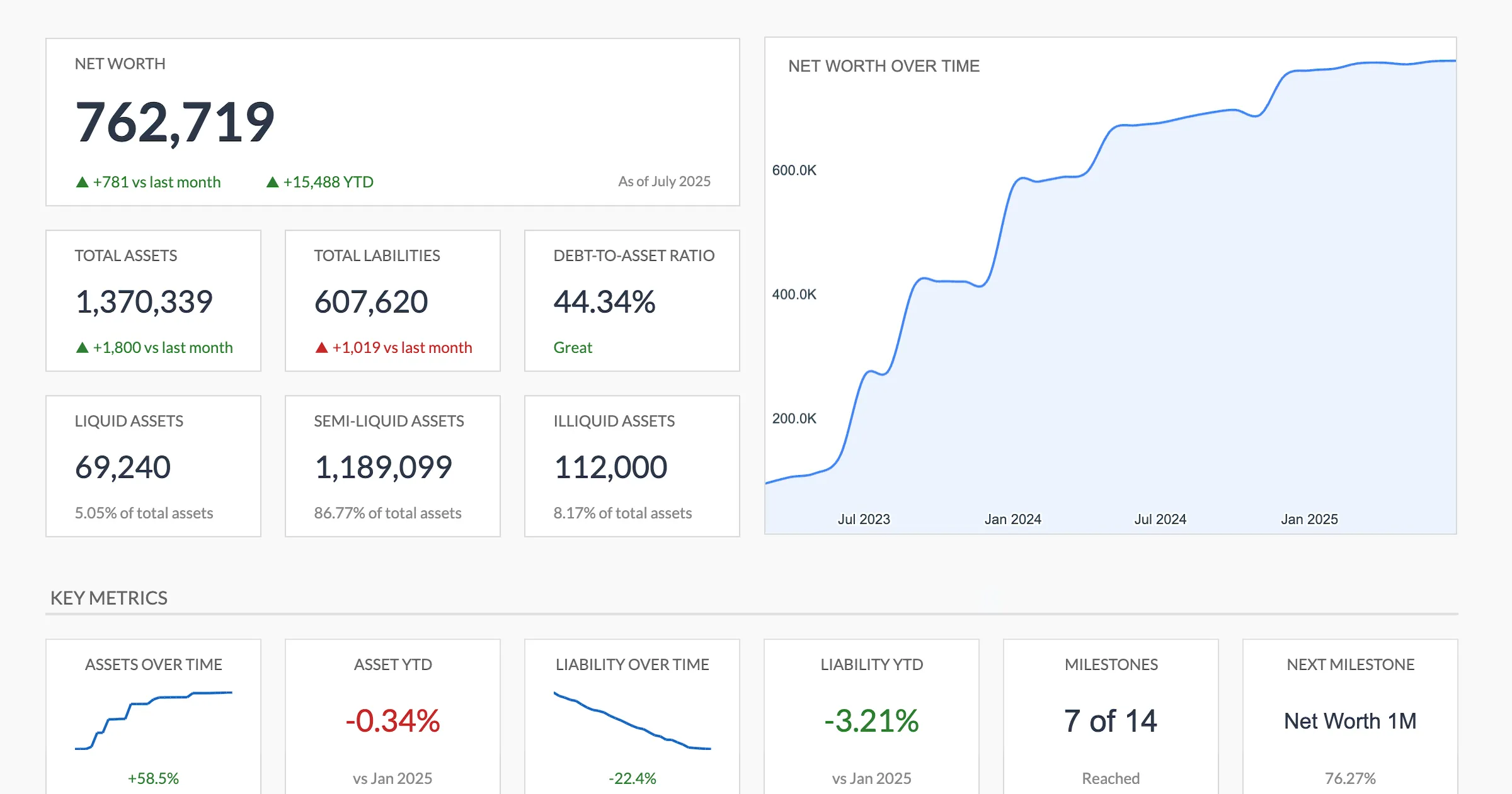
Browse through the template to see the dashboard, the entry sheets, and the summaries it produces, all adaptable to your local financial setup.
- Built-in currency selector
- Calculations update automatically
- Visual summaries of your numbers
- No setup required
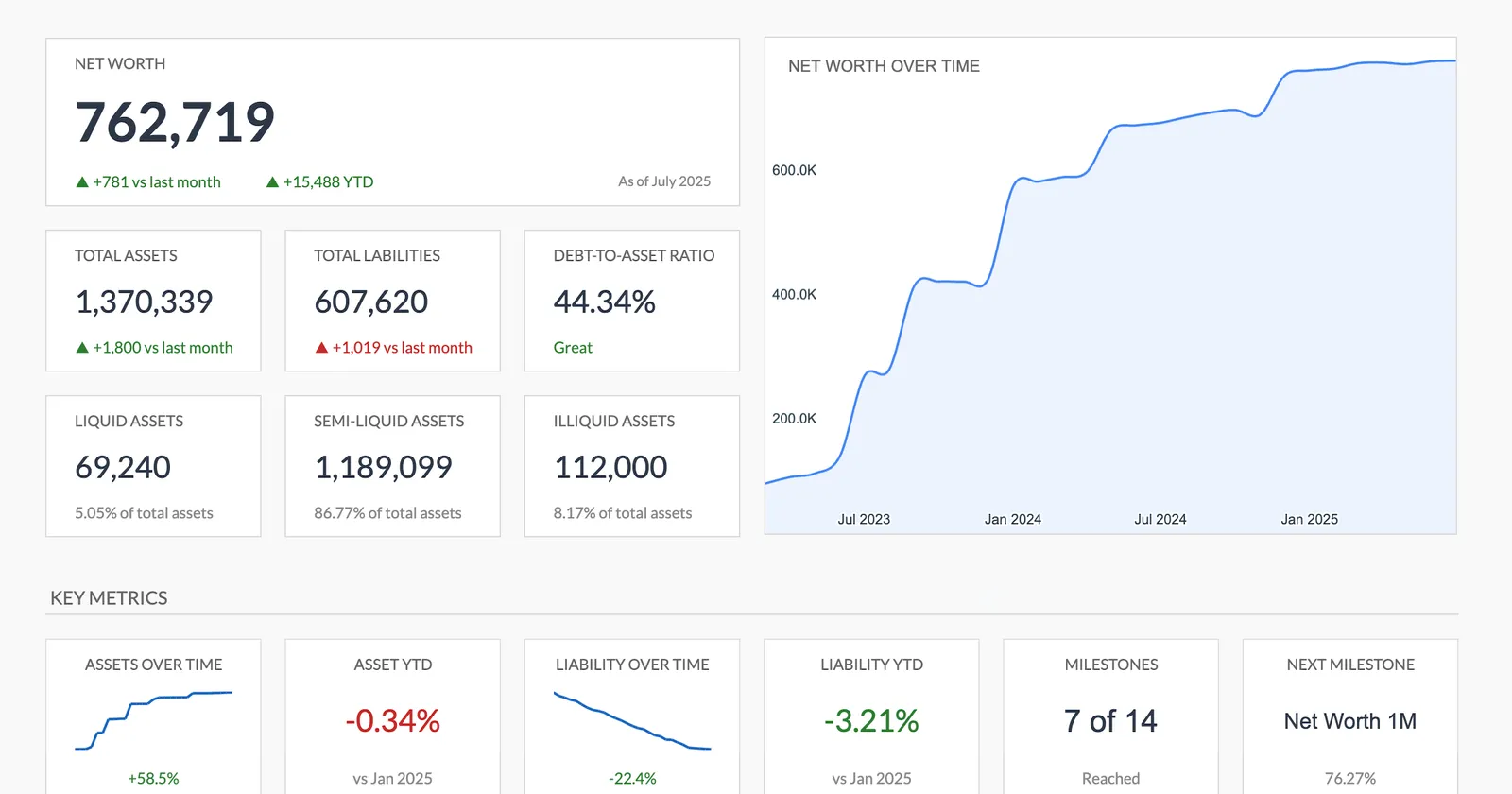
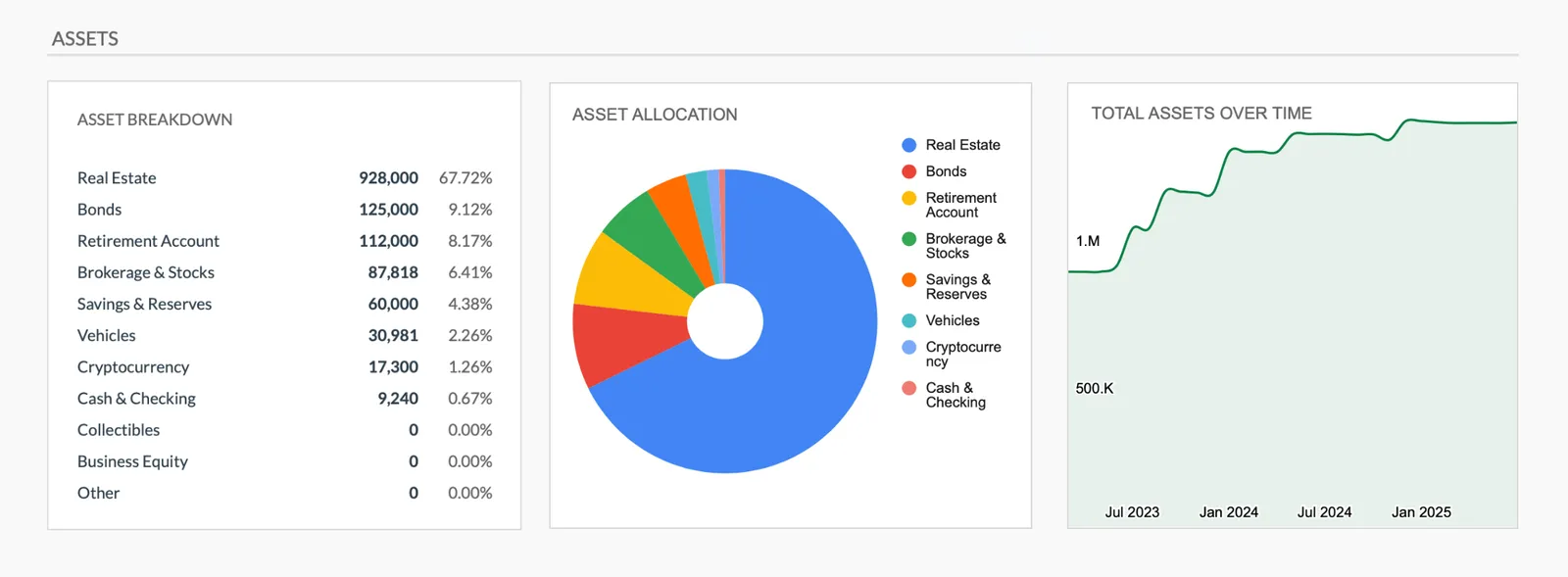
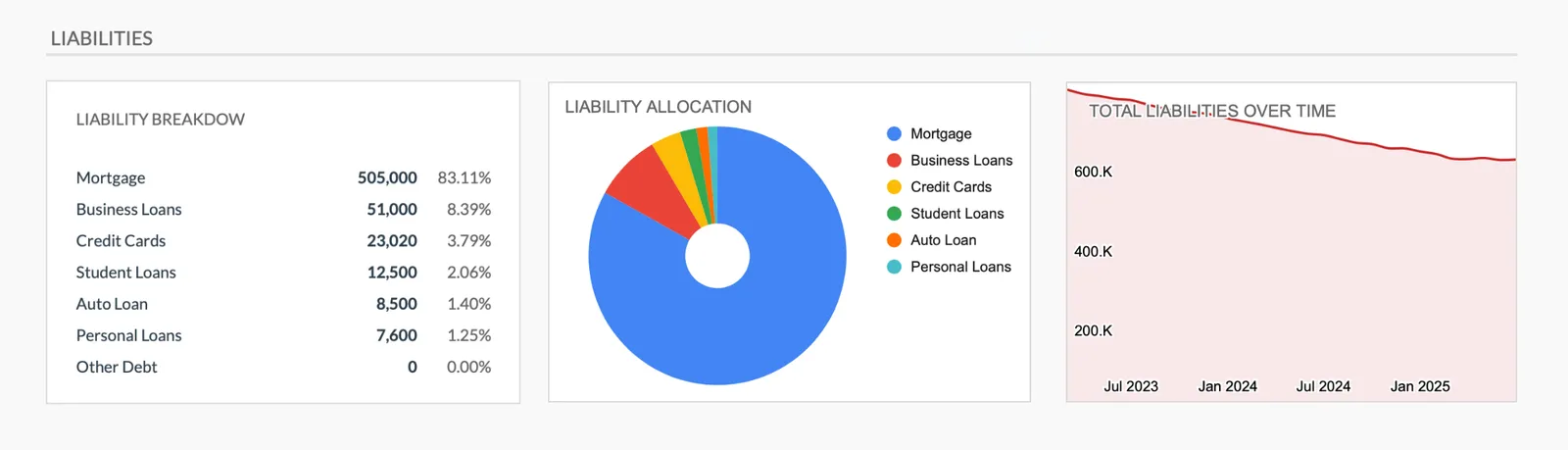

Track your net worth over time with charts
Breakdown of all your assets
Track all debts and liabilities
Key financial health indicators
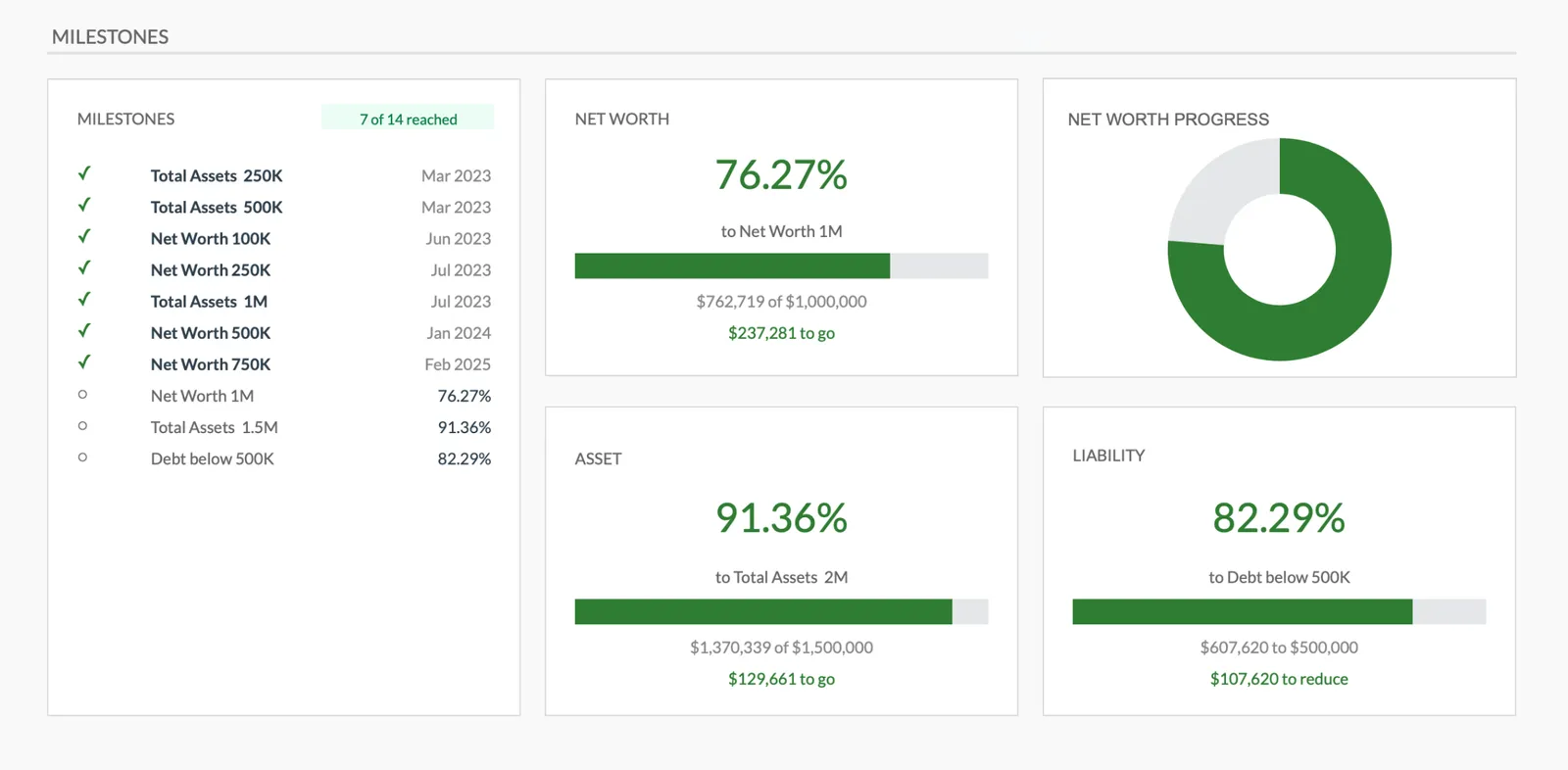
Set and celebrate net worth milestones
Common Questions
Net Worth Tracker for the UAE - FAQ
Should I include end-of-service gratuity?
It is an entitlement that builds as you work, so many people do include it. The statutory calculation is 21 days of basic salary per year for the first five years of service and 30 days a year after that, with the total capped at two years' pay. Where the employer has moved to a funded savings scheme, the account balance replaces the estimate. Refreshing the figure when basic salary changes keeps it current.
How do I track assets in multiple currencies?
Convert all values to a single currency, either AED or your home currency, when entering them. Updating exchange rates monthly or quarterly is usually enough. The template displays everything in one currency for easy comparison.
Should I include my home country property?
Including it gives a complete picture. Use the estimated current market value minus any outstanding mortgage. If the property is in a different currency, convert to your chosen tracking currency at the current exchange rate.
What if I'm leaving the UAE soon?
A snapshot taken before departure records what the position looked like at the point of transition. Items worth listing include the gratuity payout or savings scheme balance, refundable deposits such as housing and DEWA, and relocation costs. UAE bank accounts are generally tied to residency, so many are closed or converted once a visa is cancelled, which is worth confirming with the bank in advance.
How frequently should I refresh my multi-country net worth?
Monthly suits local assets. For assets in other countries, quarterly updates are practical. Consistency matters more than frequency, since updating on the same date each period makes trends easier to read.
Can't find the answer you're looking for? Contact our team
Explore More
Free Tools for the UAE
Ready to get started?
Download instantly and start managing your finances, or contact us to design a custom template package for your needs.
Tax rules, rates, and contribution limits change, and official publications can themselves lag behind the law in force. We review these figures on a best-effort basis against sources we consider authoritative, but we cannot guarantee they are current, complete, or that better sources do not exist, and nothing here is tax, legal, or financial advice. For decisions, the relevant government authority is the reference.