
A monthly budget review takes about 15 to 20 minutes. Update your numbers, then calculate five figures: income, expenses, net savings, savings rate, and each category's budget vs. actual. Flag any category more than 10 to 15 percent off plan, note one thing to change, and carry it into next month. Do it in the first few days of the new month, while the data is fresh.
Budgeting isn’t just planning - it’s reviewing. A monthly review reveals what actually happened, why it differed from expectations, and how to adjust going forward.
Built-in comparison: The Monthly Budget Template includes budget vs. actual comparison that makes reviews easy.
Here’s a systematic approach to monthly budget reviews.
Why Monthly Reviews Matter
Close the Loop
Without review, budgeting is just wishful planning. Setting a budget and never checking whether you hit it provides no useful feedback. Review connects intentions with results, turning abstract plans into actionable insights.
Learn Patterns
Over time, reviews reveal spending patterns that aren’t visible in any single month. You start noticing seasonal variations - heating costs in winter, higher entertainment spending in summer. You identify consistent trouble spots where reality never quite matches the plan.
Adjust and Improve
Each review provides data to make next month’s budget more realistic and effective. Maybe groceries always runs over by $50 - that’s useful information. Either the budget needs adjusting or the shopping habits do.
Catch Problems Early
A month of overspending is manageable - you can compensate the following month. Six months of unnoticed drift creates a crisis. Reviews catch problems while they’re still small enough to fix easily.
When to Review
Timing
The first few days of the new month work best for reviewing the previous month. Data is fresh, and you have time to apply lessons to the current month’s spending. For example, review March spending between April 1 and April 3. While reviewing, check April’s budget setup too.
Duration
Different depths of review serve different purposes. A quick review takes 15 to 20 minutes and covers the essentials. A detailed review takes 30 to 45 minutes and digs into specific categories. Quarterly deep-dives deserve about an hour to look at trends across multiple months.
Most months, a quick review is sufficient. Save the detailed analysis for when you notice concerning patterns or want to make significant changes.
The Review Checklist
Update Final Numbers
Before analyzing anything, ensure your data is complete. Verify all transactions are logged, categories are assigned correctly, pending transactions have cleared, and income is recorded accurately. Analysis based on incomplete data leads to wrong conclusions.
Calculate Key Metrics
A few key numbers tell most of the story. Calculate these for every review.
| Metric | Formula | This Month |
|---|---|---|
| Total income | Sum of all income | $ |
| Total expenses | Sum of all spending | $ |
| Net savings | Income - expenses | $ |
| Savings rate | Net savings / income | % |
Compare Budget vs. Actual
This is where the real insight emerges. For each category, compare what you planned to what actually happened.
| Category | Budget | Actual | Variance |
|---|---|---|---|
| Housing | $1,500 | $1,500 | $0 |
| Groceries | $400 | $455 | +$55 |
| Dining out | $200 | $285 | +$85 |
| Transportation | $300 | $275 | -$25 |
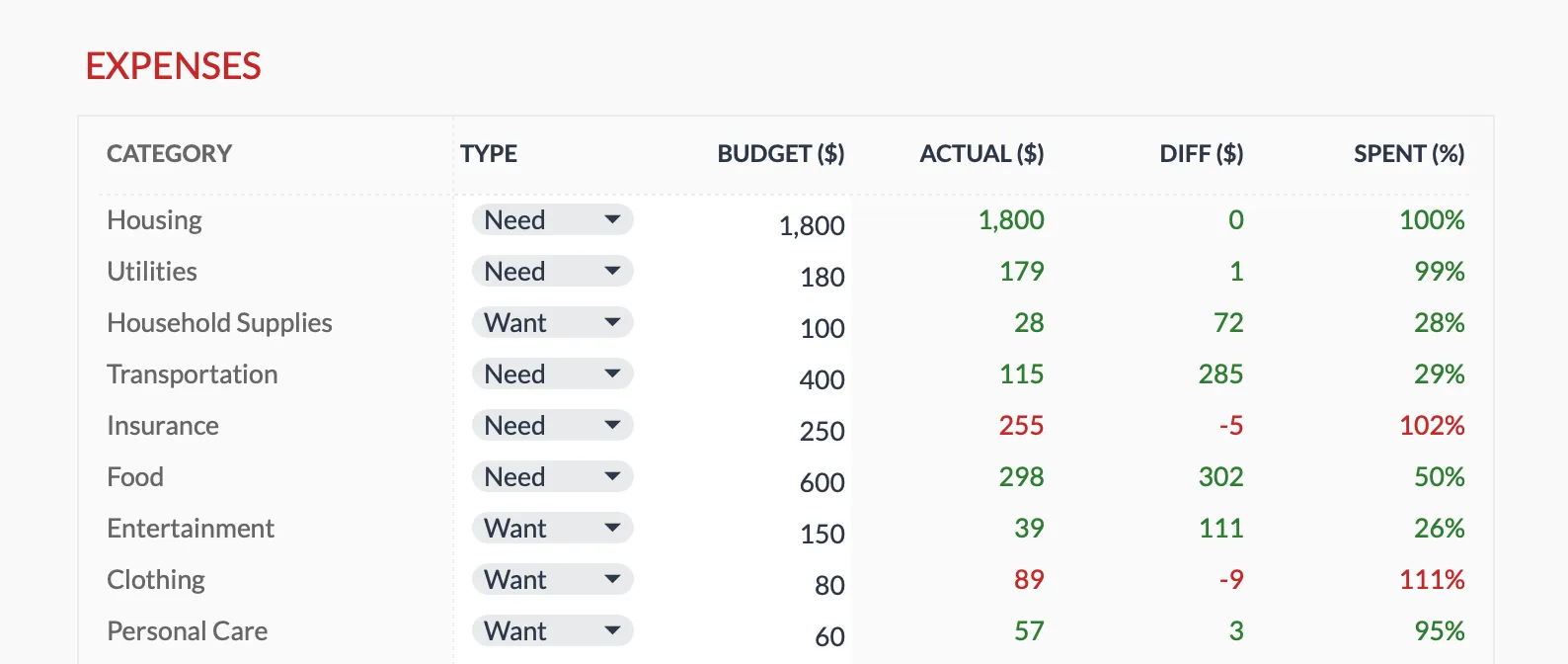
The Monthly Budget Template (Premium tier) builds this budget-vs-actual view for you, so the variance column fills in as you log transactions.
Identify Significant Variances
Flag any category more than 10 to 15 percent over or under budget - these deserve attention. Small variances happen naturally and don’t require investigation. Large consistent variances indicate either unrealistic budgets or behavior that needs examination.
Plan Adjustments
Based on your review, update next month’s approach. Maybe a budget line item needs increasing to match reality. Maybe a specific behavior needs attention. The point of review is action, not just observation.
Key Questions to Ask
About Overspending
When you’re over budget overall, ask whether this was planned, maybe because you knew about an extra expense in advance, or genuinely unexpected. Identify which categories drove the overage. Consider whether the spending was necessary or optional. Think about whether next month can compensate.
For specific category overages, dig deeper. Was the budget unrealistic from the start? Was there a one-time expense that won’t recur? Is this a recurring problem that happens every month? What would prevent the same overage next month?
About Underspending
Coming in under budget sounds good, but it’s worth examining. Was it good discipline, or was the budget set unrealistically high? Did you defer spending you actually needed to do? Should next month’s budget be adjusted to reflect reality?
About Income
Income deserves attention too. Did income match expectations? If there was irregular income like a bonus or side gig earnings, how was that extra money used? Windfalls spent carelessly don’t improve your financial position.
About Savings
Savings performance is ultimately what matters most. Did you hit your savings target? Where did savings go - emergency fund, retirement, other goals? Is your current savings rate sustainable, or does it require unsustainable sacrifices?
Category Deep-Dives
Variable Categories (Need Most Attention)
Variable spending categories fluctuate month to month and deserve the most attention during reviews.
For groceries, consider whether cost per week was consistent or varied widely. Were there unusually expensive trips? If spending increased, is it price inflation or behavior change?
For dining and entertainment, look at the number of restaurant visits and average spending per visit. Were there special occasions that drove spending up, or is the total a reflection of routine habits?
Transportation analysis includes separating gas price changes from consumption changes. Were there unusual trips or repairs? Did commute patterns change?
For shopping, distinguish necessary purchases from impulse buys. Separate one-time items from emerging patterns. Make sure returns are credited.
Fixed Categories (Quick Check)
Fixed categories such as housing, utilities, and subscriptions need less scrutiny but still deserve a quick check. Did they match expectations? Were there any rate changes you need to account for going forward? Did any new subscriptions start that weren’t in your original budget?
Tracking Trends Over Time
3-Month View
A rolling three-month view reveals trends that single-month snapshots miss. Compare the current month to the previous two to spot direction. A budget dashboard in Google Sheets can chart this rolling view automatically so the trend is visible at a glance:
| Category | Jan | Feb | Mar | Trend |
|---|---|---|---|---|
| Groceries | $420 | $445 | $455 | ↑ Increasing |
| Dining | $250 | $310 | $285 | ↑ Variable high |
| Gas | $180 | $175 | $165 | ↓ Decreasing |
Seasonal Patterns
Some spending naturally varies by season. Heating costs climb in winter months. Vacation spending peaks in summer. Gift spending concentrates in November and December. Insurance may have quarterly or annual renewal spikes. Recognizing these patterns helps set realistic expectations and avoid unnecessary concern when spending rises for predictable reasons.
Annual Tracking
A 12-month summary provides perspective on long-term patterns. Tracking income, expenses, and savings across the year shows whether you’re making progress or drifting. The annual budget review checklist covers the once-a-year version of this pass.
| Month | Income | Expenses | Savings |
|---|---|---|---|
| Jan | $5,200 | $4,100 | $1,100 |
| Feb | $5,200 | $4,350 | $850 |
| Mar | $5,200 | $4,200 | $1,000 |
What to Do With Findings
For Next Month’s Budget
If groceries consistently runs $50 over, you have two choices: increase the budget to accept reality, or create a specific plan to reduce spending and change behavior. Both are valid responses. What doesn’t work is keeping an unrealistic budget and repeatedly failing to meet it.
Plan for known upcoming expenses. If a quarterly insurance payment hits next month, budget for it now. If summer vacation is coming, start setting money aside.
Set improvement goals for the coming month. Pick one category to focus on - trying to fix everything at once usually means fixing nothing.
For Behavior Change
When you identify problem areas, dig into triggers. What caused the overspending? Stress? Social occasions? Boredom? Understanding the trigger helps create effective guardrails like spending alerts, separate accounts for problem categories, or planned alternatives to spending triggers.
For Financial Goals
Connect each month’s savings to your bigger picture. How does this month’s savings move you toward your emergency fund, debt payoff, or other goals? Seeing the connection between monthly behavior and long-term goals makes the daily discipline feel more meaningful.
Review Templates
Quick Review (15 minutes)
A quick review hits the essentials. Check whether total income matched expectations, whether total expenses came in under or over budget, and whether you achieved your savings target. Identify any category that was significantly over budget and note one thing to improve next month.
Detailed Review (30+ minutes)
A detailed review expands on the quick version with category-by-category analysis. Document what went well, what was challenging, what adjustment you’ll make next month, and how you’re progressing toward larger goals. This creates a record you can reference in future months.
Tools for Reviews
Monthly Budget Template
The Monthly Budget Template includes built-in budget vs. actual comparison, category variance calculations, and monthly summary metrics. These features make the review process straightforward - the template does the math so you can focus on analysis.
Monthly Expense Tracker
The Monthly Expense Tracker provides category totals ranked by share of spending, metrics such as daily average and largest expense, and charts of how income, expenses and savings are distributed. There is no budget column, so it answers where the money went rather than how it compared to plan. It’s simpler than the full budget template but still supports effective reviews.
Common Review Mistakes
Skipping the Review
Setting a budget without ever reviewing defeats the purpose. The review is where learning happens. Schedule it as a recurring appointment - if it’s not on your calendar, it won’t happen consistently.
Only Looking at Total
Coming in “under budget overall” can hide problem categories. A $200 overage in dining might be masked by $200 under in a category you actually needed to spend on. Review at the category level, not just the total.
Being Too Harsh
One over-budget month isn’t failure - it’s data. Context matters. Before judging a month harshly, look for patterns over 3 or more months. Consistent overages need attention. Single-month anomalies often don’t.
Not Making Changes
Review without action is just data collection. If every review ends the same way but nothing changes, the review isn’t serving its purpose. Each review should inform at least one adjustment, even a small one.
Perfectionism
Don’t spend hours analyzing small variances. A $15 overage in transportation doesn’t need forensic investigation. Focus on significant items that actually impact your financial progress.
Monthly Review Habits
Build the Routine
Consistency makes reviews easier. Same time each month - maybe the first Sunday. Same location. Same sequence of steps. When the process is familiar, it takes less than 30 minutes and doesn’t require willpower to start.
Make It Sustainable
Keep the process simple enough to maintain long-term. Focus on insights rather than perfection. Celebrate wins and learn from misses without turning the review into punishment. The goal is understanding and improvement, not judgment.
Involve Partners
If you share finances with a partner, review together. Both people see the same data. Discuss priorities openly. Align on next month’s approach before it starts. Joint reviews prevent the frustration that comes from misaligned expectations.
Related
- Monthly Budget Template - Built-in review features
- Monthly Expense Tracker - Simple category totals
- Annual Budget Review Checklist
- Budget Dashboard in Google Sheets
- Budget Templates for Visual Thinkers - Reading the same review numbers as charts and progress bars
Monthly budget reviews turn budgeting from static planning into an ongoing feedback loop. For your next review, start with the Quick Review (15 minutes) checklist above, then move up to the Detailed Review only in the months where a pattern is worth digging into. Once the monthly rhythm is set, the annual budget review checklist is the natural next step for a full year-end pass.
Frequently asked questions
What if I hate reviewing?
A 10-minute quick review still beats skipping it. Some people narrow it to two or three questions rather than a full analysis: did income land where expected, did total spending stay near plan, and did any category blow past its budget.
How detailed should my tracking be for a review to work?
Detailed enough to answer the questions you care about, and no further. Splitting out every coffee only helps if that is a category you are trying to understand; otherwise a single 'dining out' line does the job.
What if I'm over budget every single month?
Persistent overages usually point to one of two things: spending running higher than planned, or a budget set below what the category actually costs. Three or more months of real spending is where a realistic target tends to show up.
Should I review if nothing changed?
Yes - consistency is worth noting. A quick confirmation that things are on track reinforces good habits and catches potential problems early.