
Free budget templates cover basic income and expense tracking for $0. Paid ones (our Monthly Budgeting and Annual Budgeting Planner templates are $29 one-time) add dashboards, conditional formatting, a twelve-month plan-versus-actual grid, and tested formulas that take hours to build. Paying makes sense when your setup time is worth more than the price; free is enough for simple monthly tracking or testing the habit first.
Free budget templates work fine for basic tracking. Premium templates save hours of setup. Whether that’s worth $15-50 depends on your needs and spreadsheet skills.
We sell templates, so our bias is obvious. We think ours are worth the cost. But here’s an honest breakdown of when free works just fine - and when paying makes sense.
Template option: The Monthly Budgeting Template includes allocation charts, goal progress bars, variance figures that turn green or red, and a built-in Instructions sheet, the kind of work that takes hours to build from scratch.
What Free Templates Offer
Free templates provide a starting point that works for many people. Understanding what’s included helps set expectations.
Basic structure comes standard. Income and expense categories, simple formulas, basic layout. For someone who just wants to start tracking spending, this covers the fundamentals.
Zero risk means you can try without commitment. Download, test, delete if it doesn’t work. There’s no friction to experimentation.
Good sources exist throughout the web. We publish a set of free budget templates covering monthly, weekly, and percentage-split budgets. The Google Sheets template gallery provides several options built into the platform, and countless personal finance blogs share templates their creators have built and refined.
What Paid Templates Offer
Premium templates justify their cost through features and time savings that free options typically lack.
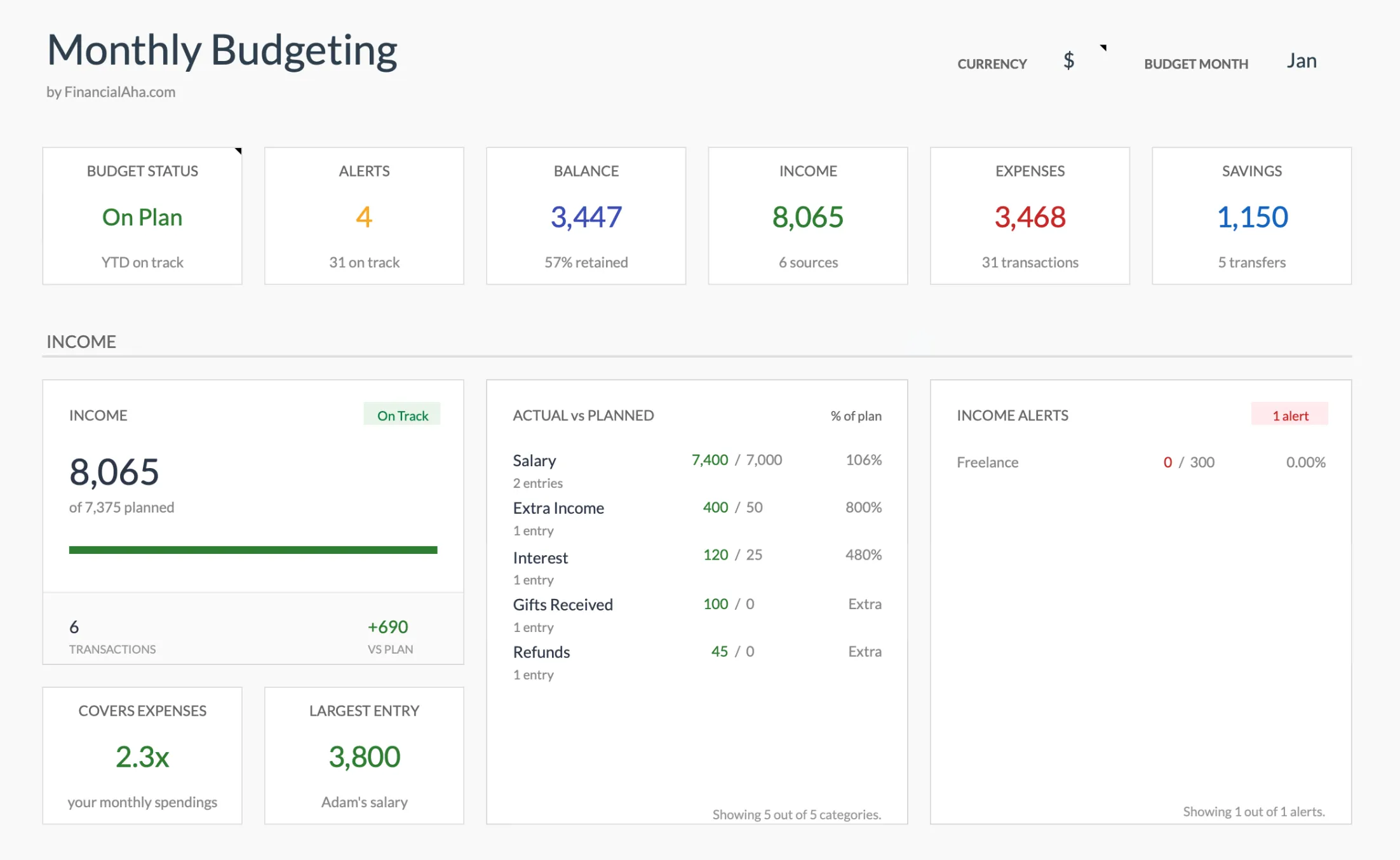 The dashboard in our Premium Monthly Budgeting Template: status tiles, progress bars, and actual-versus-planned figures that update automatically as you enter transactions.
Advanced automation includes progress tracking, dashboards that visualize spending patterns, and formulas that handle the calculations for you. The Monthly Budgeting Template charts how income, expenses and savings are allocated, the Retirement Financial Planning Spreadsheet compares conservative, base case and optimistic projections side by side, and the Net Worth Tracker totals every account and liability automatically.
Polish matters for ongoing use. Professional design makes templates easier to use. Conditional formatting highlights problems automatically - overspent categories turn red, healthy categories stay green. Intuitive navigation reduces friction during daily use.
Documentation saves troubleshooting time. An Instructions sheet inside the file explains each tab column by column, and premium purchases include email support, so you’re not alone when something doesn’t work as expected.
Tested functionality means bugs have been identified and fixed before you encounter them. Edge cases, the unusual situations that quietly break formulas, have been handled. Free templates rarely receive this level of testing.
The Cost Spectrum
Prices vary significantly across the market. Here’s what to expect at different price points.
| Type | Typical Price |
|---|---|
| Free (basic) | $0 |
| Budget premium | $15-29 |
| Comprehensive systems | $29-60 |
Higher price doesn’t always mean better quality. A $50 template might be overcomplicated for your needs while a $15 option fits perfectly.
When Free Works Fine
Free templates suffice for many situations. There’s no shame in starting simple.
Free works when your needs are simple - basic monthly tracking of income and expenses. Free works when you can build additional features yourself if needed. Free works when you’re testing whether spreadsheet budgeting suits you - no point paying before confirming the approach fits. Free works when every dollar matters significantly and even $20 feels like a meaningful expense.
When Paid Makes Sense
Premium templates provide value in other situations.
Paid makes sense when building from scratch would take hours and your time has value. Paid makes sense when you want dashboards, a twelve-month view, visual progress bars, and other features that require significant formula work. Paid makes sense when you’d rather spend $29 than 5+ hours setting up, testing, and debugging a homemade system. Paid makes sense when you want something tested and documented, with support available if things break.
Our Honest Take
Being direct about where our templates fit - and where they don’t.
Our templates make sense if you want a complete, tested system ready to use, if time savings justify a one-time cost, or if you want documentation and clear design with support available.
Our templates don’t make sense if your needs are simple and basic tracking suffices, if you enjoy building your own systems and find the process satisfying, or if you’re testing whether spreadsheet budgeting works for you at all.
One Approach to Consider
A staged approach reduces risk and ensures you pay only for what provides value.
Start with our free budget templates to test the concept. Use them for 1-2 months. Identify what’s missing or frustrating. Then decide based on experience, moving up to a premium template such as the Monthly Budgeting Template only if the gaps consistently get in your way.
Worth noting: a one-time cost spreads across years of use. Our Premium Monthly Budgeting and Annual Budgeting Planner templates are $29 each, so amortized over even two years that lands at a little over a dollar a month, and it keeps working for as long as the file does.
Related
- Monthly Budgeting Template - premium monthly tracking with a dashboard
- Annual Budgeting Planner - twelve months of planned versus actual
- Monthly Expense Tracker - the simplest of the three, a clean spending log
- YNAB vs. Spreadsheet Budgeting
- Budget Spreadsheets vs. Apps
- Best Free Budget Templates vs Paid - where a free template stops being enough
- Best Budget Spreadsheet Templates for Google Sheets - the roundup of options behind this comparison
Frequently asked questions
Are expensive templates actually better?
Not necessarily. Price doesn't guarantee quality. Some expensive templates are overcomplicated, while simpler, cheaper options often cover what most people need.
Does it make sense to buy multiple templates?
Usually not. One comprehensive system tends to be easier to maintain than juggling several templates. A bundle can be worth it when you genuinely need different tools, such as a monthly budget plus an annual planner.
Can I start with a free template and move to a paid one later?
Yes. A common pattern is using a free template for a month or two, noting what feels missing, then buying a premium template once the gaps are clear. There is no data lock-in with spreadsheets, so nothing is wasted by starting free.
What do paid budget templates usually include that free ones don't?
The recurring differences are visual dashboards, conditional formatting that flags overspent categories, multi-month or multi-year views, setup documentation, and formulas that have been tested against edge cases. Free templates give you the basic income and expense structure without most of that.
About this article
Template sheets, inputs and outputs checked on 2026-09-10 against the shipped Monthly Budgeting (Summary, Budget Plan, Transactions, Goals, Instructions), Annual Budgeting Planner (Summary, Annual Plan) and Net Worth Tracker (Summary, Assets) Google Sheets, and prices against the current product catalog. Last reviewed September 2026.