Set aside roughly 1% to 4% of your home's value a year for maintenance: about $3,000, or $250 a month, on a $300,000 home. Newer homes sit near 1%, while homes past 30 years often need 3% to 4%. Building a dedicated sinking fund keeps the money ready when a furnace, roof, or water heater eventually fails.
A broken furnace costs $5,000 to $15,000 to replace, and unlike renters, homeowners foot the bill. Upkeep is a recurring household cost the U.S. Bureau of Labor Statistics tracks in its Consumer Expenditure Survey, so setting aside 1% to 4% of your home’s value each year avoids financial stress when repairs hit.
Plan for it: The Annual Budgeting Planner helps you plan for home maintenance alongside other irregular expenses.
The 1% Rule
The most common approach to home maintenance budgeting is simple: set aside 1% of your home’s purchase price annually for maintenance. For a $300,000 home, that’s $3,000 per year or $250 monthly. This provides a baseline that works for many situations.
When 1% is typically enough: newer construction (built within 10 years), good condition at purchase, mild climate, and no major deferred maintenance.
When you need more: older homes (30+ years) often require 2-4%, deferred maintenance exists, harsh climate (extreme heat, cold, humidity), or aging major systems (HVAC, roof, water heater) are approaching end of life.
Alternative Budgeting Methods
The 1% rule is common, but other approaches exist. The square-foot method sets aside $1 per square foot annually, so a 2,000-square-foot home means $2,000/year or $167/month. The 10% rule allocates 10% of total monthly housing expenses to maintenance: if mortgage, taxes, and insurance total $1,950, the maintenance allocation is $195/month ($2,340/year).
| Method | $300,000 Home (2,000 sq ft) | |--------|----------------------------| | 1% Rule | $3,000/year | | Square Foot | $2,000/year | | 10% Rule | ~$2,300/year |
For a typical home, these methods produce similar results. Use whichever makes most sense for your situation.
Factors Affecting Maintenance Costs
Several factors influence actual maintenance costs beyond the basic formulas. Home age matters most: homes 0-10 years old typically need 1%, while 30+ year homes often require 3-4% or more as systems approach end-of-life.
| Age | Typical Maintenance % | |-----|----------------------| | 0-10 years | 1% | | 10-20 years | 1-2% | | 20-30 years | 2-3% | | 30+ years | 3-4%+ |
Geographic location affects costs through climate, humidity, and regional labor rates. New England, Mountain States, and coastal areas (with salt and humidity damage) tend higher. South Central regions trend lower.
More features mean more maintenance. Pools run $3,000-6,000/year. Large yards require lawn care and irrigation. Multiple HVAC systems multiply maintenance needs. Older roofs require higher replacement reserves.
Major Expenses to Plan For
Some systems cost more than others. Understanding lifespan and replacement costs helps with long-term planning.
HVAC systems last 15-25 years with replacement costs of $5,000-15,000 and annual maintenance of $150-300. Roofs last 20-50 years depending on material, with replacement running $8,000-25,000+. Water heaters last 8-12 years (tank) or 20+ years (tankless), costing $1,000-3,500 to replace.
Budget for eventual appliance replacement: refrigerators (10-15 years), dishwashers (9-12 years), washer/dryers (10-14 years), and stoves/ovens (13-15 years). Exterior painting runs $3,000-8,000 every 5-10 years, plus driveway and deck maintenance over time.
Building Your Home Maintenance Fund
Building a maintenance fund follows a straightforward process. Choose a budgeting method (1%, square foot, or 10%) and calculate your annual target, then divide by 12 for the monthly contribution. Many homeowners keep home maintenance money in a separate account, a sinking fund approach that makes it less likely the money gets spent elsewhere. The Net Worth Tracker holds the home’s value in the Real Estate section of its Assets sheet and the mortgage balance on the Liabilities sheet, so the house and the savings you set aside for it both feed the same net worth figure.
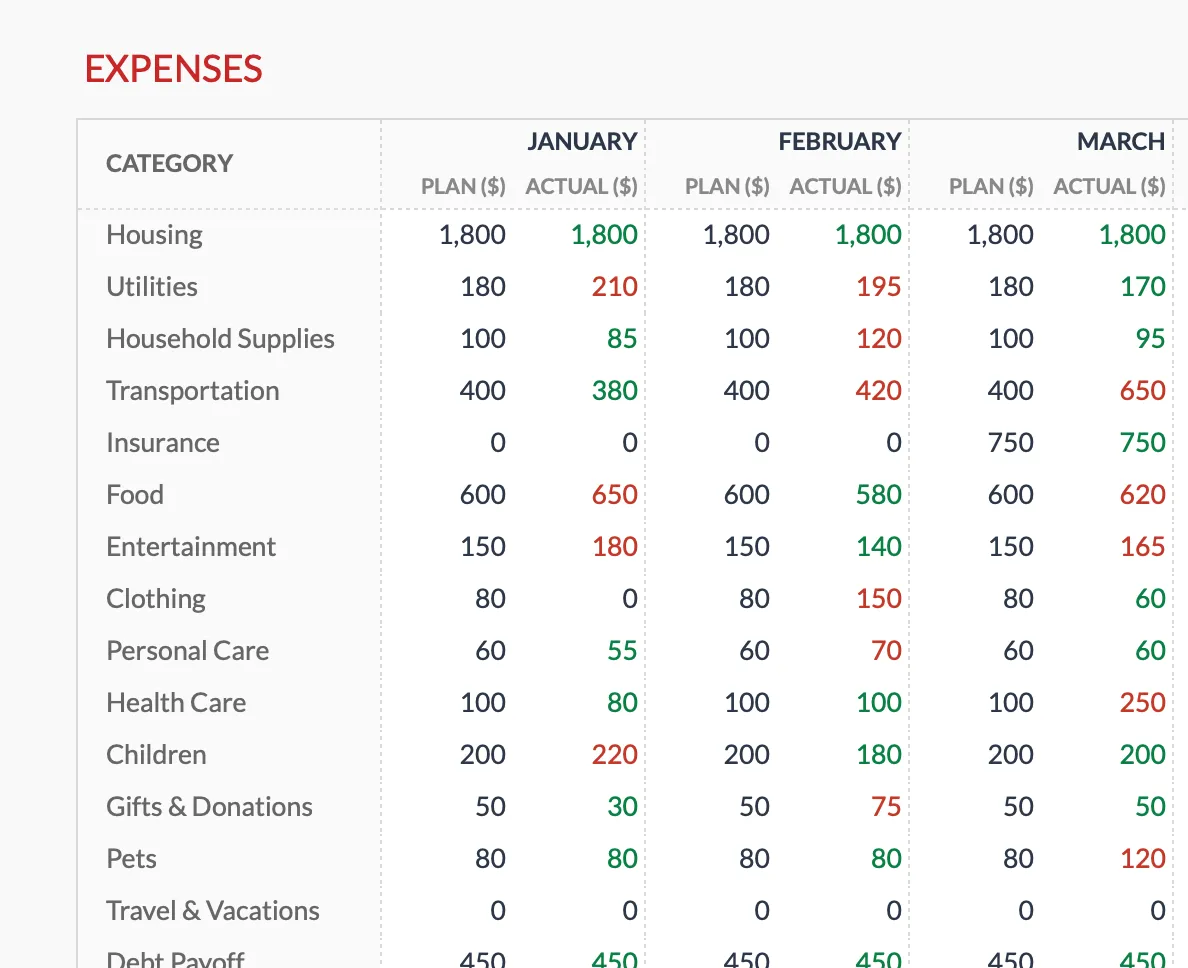 The Annual Budgeting Planner (Premium tier) tracks planned versus actual spending by category across all 12 months. Categories are edited on its Categories tab, so a maintenance line can sit alongside Housing and Utilities.
Some homeowners start with $2,000 to $5,000 in the fund to cover unexpected repairs while building toward full funding. When the fund is drawn down for a repair, continuing the monthly contribution rebuilds it.
What Home Maintenance Covers
Not all home spending is maintenance. Regular preventive maintenance includes HVAC filter replacement and tune-ups, gutter cleaning, landscaping, pest control, chimney cleaning, and appliance maintenance. Repairs cover plumbing fixes, electrical repairs, roof patching, appliance repairs, and foundation issues. Replacements include major systems at end of life, appliances that can’t be repaired, and flooring or fixtures.
What’s NOT included: upgrades and improvements (new kitchen counters), cosmetic changes (painting to change color), and additions or renovations. Maintenance restores or maintains function. Improvements add value or change aesthetics, and a larger project belongs in its own home renovation budget with phase costs and a contingency line rather than the maintenance fund.
Seasonal Maintenance Checklist
A seasonal approach keeps maintenance manageable and prevents expensive emergency repairs. In spring: HVAC service before cooling season, gutter cleaning, check roof for winter damage, exterior inspection, and test the sprinkler system. Summer tasks include checking and cleaning the AC, inspecting deck/patio, checking caulking on windows, and lawn care.
Fall means HVAC service before heating season, another gutter cleaning, winterizing outdoor plumbing, checking insulation, and cleaning the chimney. Winter focuses on monitoring for ice dams, checking weather stripping, testing smoke/CO detectors, and checking for drafts.
When Your Fund Isn’t Enough
Even with planning, major repairs can outpace savings. Options include drawing on your emergency fund if the maintenance fund is depleted, a home equity line of credit (HELOC), 0% financing offers if available, or contractor payment plans.
Worth avoiding high-interest credit cards for large repairs when other options exist. Deferring critical maintenance often makes problems worse and more expensive. Work requiring licensed professionals (electrical, structural, HVAC) typically needs professional service rather than DIY attempts.
Tracking Home Maintenance
Keeping records pays off over time. Track service dates, repair descriptions, costs, contractor information, and warranty details. Benefits include predicting when systems need replacement, documenting for future home sale, identifying recurring issues, and budgeting more accurately based on actual history.
Related
- Net Worth Tracker - Track home value and mortgage balance
- Annual Budgeting Planner - Full year planning
- Monthly Budget Template - Monthly allocations
- Sinking Funds Explained
- Emergency Fund Calculator
- Budget for Irregular Expenses
Home maintenance costs are inevitable; the question is whether you’re prepared. Pick a method, size the annual number, and route the monthly amount into a dedicated sinking fund. The Annual Budgeting Planner gives that line a home next to the rest of your budget, and Sinking Funds Explained walks through the same set-aside approach for other lumpy costs like car repairs and insurance premiums.
Frequently asked questions
What if I can't afford 1%?
Even $100 a month builds reserves over time. Many homeowners fund a general emergency fund first, then add a separate maintenance line once that base is in place.
Should I have separate funds for different systems?
One combined fund works for most homeowners. Separate tracking in a spreadsheet for major systems is an option if you want more detailed planning.
Does a home warranty replace a maintenance fund?
Home warranties cover specific failures with their own limitations and deductibles. They supplement a maintenance fund rather than replacing it, since routine upkeep and out-of-scope repairs still come out of pocket.
What about new construction?
New homes have fewer immediate maintenance needs, and a builder warranty may cover early defects, but 1% is still a reasonable target for building reserves toward future replacements.
Should the 1% be based on my purchase price or current market value?
The 1% rule is usually tied to purchase price for simplicity. Because land does not need maintenance, some homeowners base the figure on the structure's replacement cost instead, which can differ from market value in high-land-cost areas.
What happens in a year with no repairs?
Unused money stays in the fund and rolls forward. Maintenance costs are lumpy year to year, so a quiet year simply builds the balance you will draw on when a major system reaches end of life.
Sources
- Consumer Expenditure Surveys - U.S. Bureau of Labor Statistics
About this article
Template sheets, inputs and outputs checked on 2026-09-10 against the shipped Annual Budgeting Planner (Summary, Annual Plan, Annual Financial Goals, Categories tabs) and Net Worth Tracker (Summary, Assets, Liabilities, Milestones tabs) Google Sheets. The 1% and square-foot figures are common budgeting heuristics rather than official standards; worked examples use an illustrative $300,000, 2,000-square-foot home. Last reviewed September 2026.