
The 50/30/20 rule splits after-tax income into 50% needs, 30% wants, and 20% savings, and it takes a monthly check-in. Zero-based budgeting assigns every dollar to a category so income minus planned expenses equals zero, at the cost of ongoing tracking. Percentages suit variable income and budgeting beginners; zero-based suits tight budgets, debt payoff, and people who want line-by-line control. Neither is better - the one you keep using wins.
Two budgeting methods come up repeatedly in personal finance discussions: the 50/30/20 rule and zero-based budgeting. Both have devoted followers. Both work - for certain people, in certain situations.
The difference isn’t which one is “better.” It’s which one matches how you think about money and how much time you want to spend managing it.
The 50/30/20 Rule: Budgeting by Percentages
The 50/30/20 rule divides after-tax income into three buckets:
- 50% for needs - Housing, utilities, groceries, insurance, minimum debt payments, transportation to work
- 30% for wants - Dining out, entertainment, hobbies, subscriptions, travel, non-essential shopping
- 20% for savings - Emergency fund, retirement contributions, extra debt payments, investment accounts
The appeal is simplicity. Instead of tracking 47 categories, you track three. Instead of agonizing over whether to allocate $127 or $143 to entertainment, you check whether your “wants” spending stays under 30%.
In dollars, the split is easy to picture. On $4,500 of after-tax income, 50/30/20 sets aside $2,250 for needs, $1,350 for wants, and $900 for savings. You never decide in advance that rent is exactly $1,200 and groceries are exactly $400. You only check that everything in the needs column lands somewhere near $2,250, and that the other two buckets hold their share.
If you want to see your own numbers, the Budget Calculator splits any take-home figure into the three buckets instantly:
Where 50/30/20 Works Well
Variable income. Freelancers, commission-based workers, and seasonal employees often find percentage-based budgeting more practical. When income fluctuates, fixed dollar amounts become meaningless. Percentages scale automatically.
High earners. Someone earning $150,000 doesn’t need to track every dollar the way someone earning $35,000 might. The 50/30/20 framework provides guardrails without requiring obsessive categorization.
Budgeting beginners. Three categories are easier to maintain than thirty. For people who have never stuck with a budget, starting simple increases the chance of building the habit.
People who dislike detail work. Some people find granular expense tracking draining. If the alternative to 50/30/20 is no budget at all, the simpler method wins.
Where 50/30/20 Falls Short
High-cost-of-living areas. In cities like San Francisco, New York, or London, housing alone can exceed 50% of income. The framework assumes a cost structure that doesn’t exist everywhere. It is not only a big-city problem, either: across all U.S. households, housing and transportation together made up 50 percent of total spending in 2024, and that is before groceries, insurance, or utilities enter the needs bucket.
Debt payoff situations. Someone aggressively paying down student loans or credit card debt may need to allocate 40% or more to debt - far exceeding the 20% savings bucket.
Low incomes. When income barely covers necessities, the “30% for wants” category may be unrealistic. The framework works better above certain income thresholds.
People who need accountability. The broad categories can hide overspending. “Wants” is vague enough to justify almost anything.
Zero-Based Budgeting: Every Dollar Has a Job
Zero-based budgeting takes the opposite approach. Instead of broad percentages, every dollar of income gets assigned to a specific category before the month begins. Income minus planned expenses equals zero - hence the name.
If you earn $4,500 after taxes, you might allocate $1,200 to rent, $400 to groceries, $150 to utilities, $300 to car payment, and so on until every dollar is accounted for. Nothing is left unassigned.
Where Zero-Based Budgeting Works Well
Tight budgets. When there’s no margin for error, knowing exactly where every dollar goes matters. Zero-based budgeting forces awareness that looser systems don’t.
Debt payoff focus. Assigning specific amounts to debt payments, rather than hoping something is left over, accelerates payoff timelines.
Impulse spending issues. The discipline of pre-assigning money makes unplanned purchases more visible. There’s no “miscellaneous” bucket to absorb random spending.
Detail-oriented people. Some people genuinely enjoy tracking and optimizing. Zero-based budgeting rewards that tendency.
Couples with different spending styles. When partners need to agree on money allocation, explicit dollar amounts reduce ambiguity. “We budgeted $200 for dining out” is clearer than “we’re in the ‘wants’ category.”
Where Zero-Based Budgeting Falls Short
Time requirements. Creating and maintaining a detailed budget takes hours per month. For some people, this time investment isn’t sustainable.
Variable income. When you don’t know what you’ll earn, assigning every dollar becomes guesswork. Percentages handle variability better.
Lifestyle changes. Major transitions such as a new job, a new city, or a new family situation require rebuilding the entire budget. The detailed structure becomes a liability during unstable periods.
Perfectionism traps. Some people abandon zero-based budgeting when they can’t make the numbers perfect. A “good enough” approach often outlasts a “perfect” one.
Comparing the Two Methods
| Factor | 50/30/20 | Zero-Based | |--------|----------|------------| | Time required | Low - monthly check-in | High - ongoing tracking | | Flexibility | High - broad categories | Low - specific allocations | | Accountability | Moderate | High | | Variable income | Handles well | Struggles | | Debt payoff | Basic support | Strong support | | Learning curve | Minimal | Moderate | | Maintenance | Easy | Demanding |
Neither method is inherently superior. The best budget is one you’ll actually use.
A Hybrid Approach
Many people end up combining elements of both methods. One common pattern:
- Use 50/30/20 as a high-level framework to check overall allocation
- Apply zero-based thinking within the “needs” category where fixed expenses dominate
- Keep “wants” as a flexible bucket without detailed subcategories
- Track savings goals specifically within the 20%
This captures the structure of zero-based budgeting where it matters most, namely fixed expenses and savings, while preserving flexibility everywhere else.
Questions to Help You Choose
How much time are you willing to spend on budgeting? If the answer is “as little as possible,” lean toward 50/30/20. If you don’t mind regular check-ins and enjoy optimization, zero-based budgeting rewards the effort.
Is your income stable or variable? Stable income suits zero-based budgeting. Variable income works better with percentages.
Are you paying down significant debt? Aggressive debt payoff benefits from the specificity of zero-based budgeting. The 50/30/20 approach treats debt payoff the same as other savings.
Have you successfully maintained a budget before? If previous budgets failed due to complexity, start simpler with 50/30/20. You can always add detail later.
Do you need accountability or flexibility? Zero-based budgeting creates accountability through specificity. 50/30/20 provides flexibility through broad categories. Most people lean toward one or the other.
Getting Started
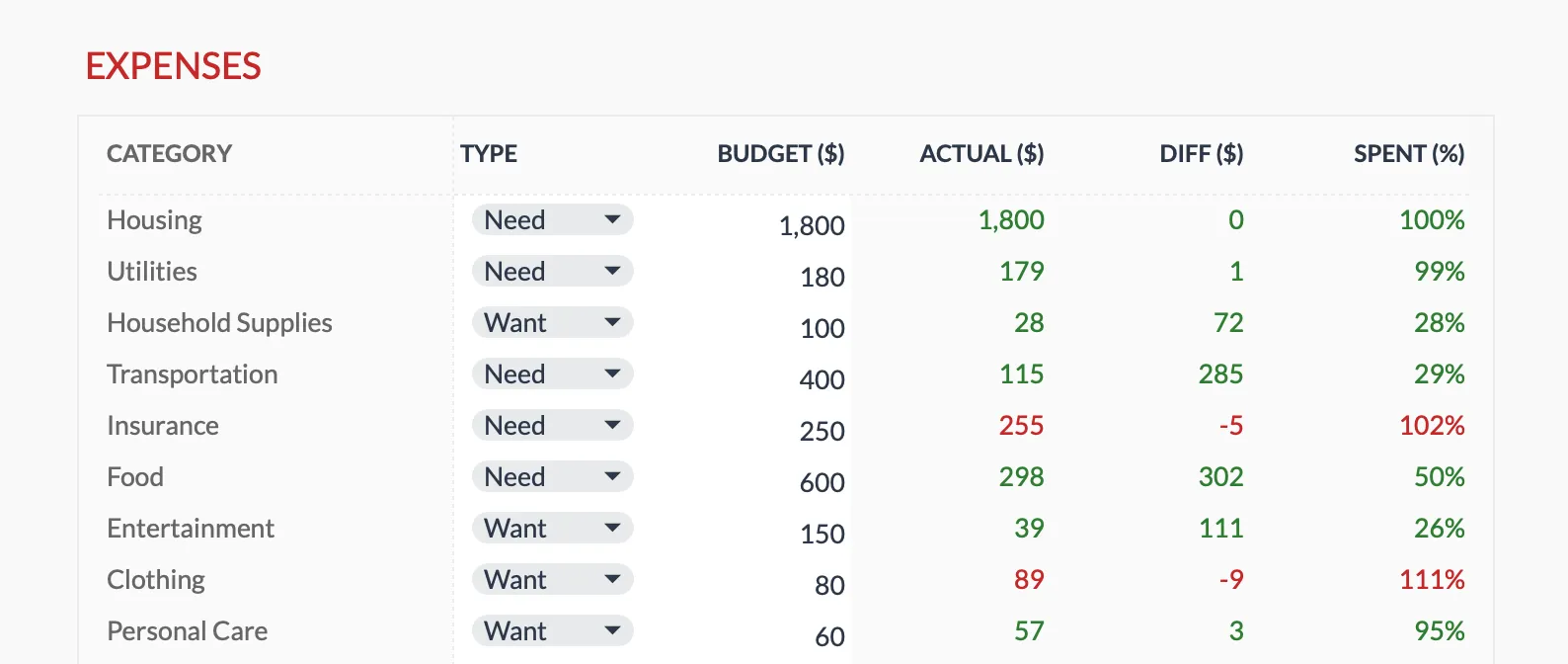
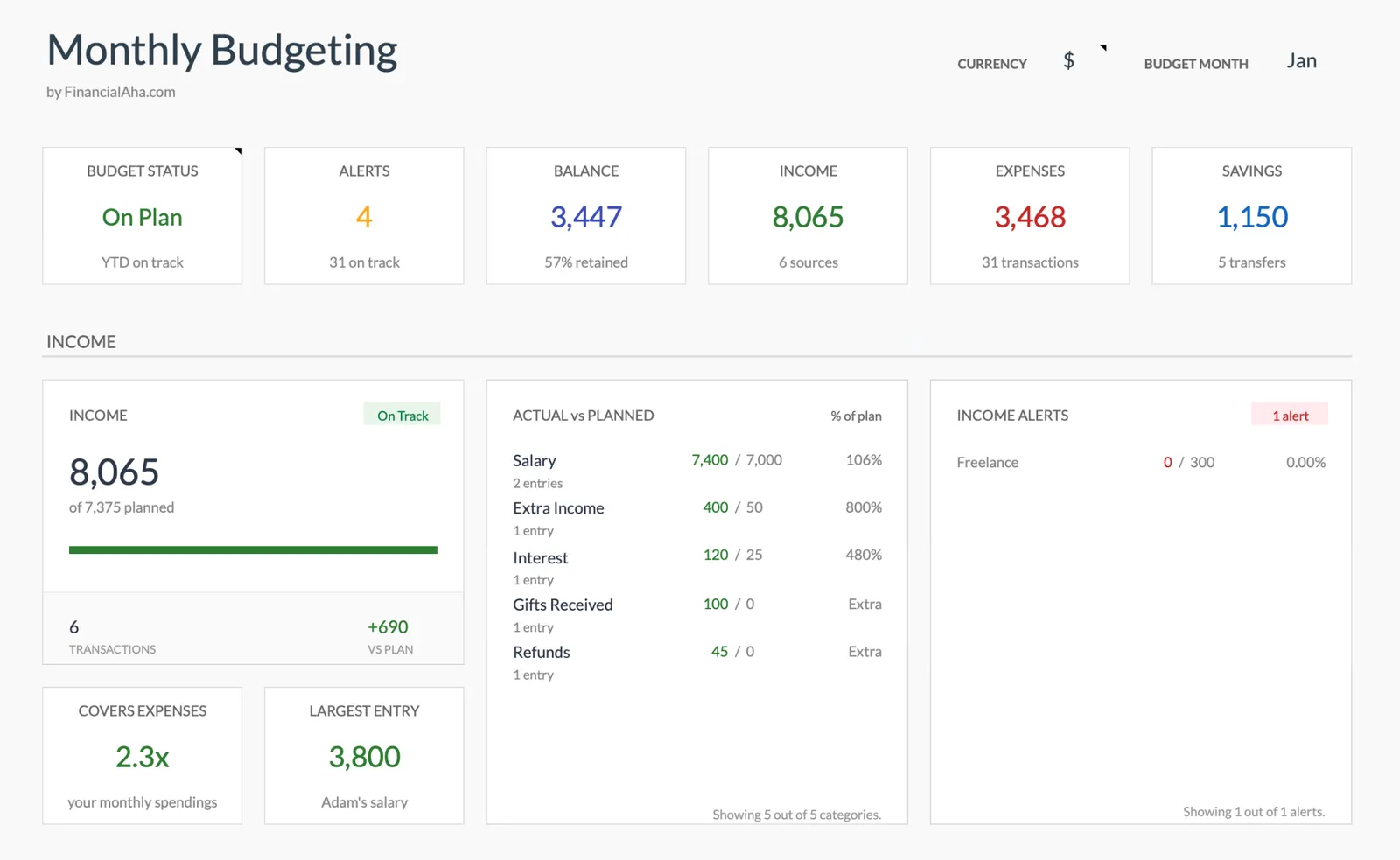
Both methods work in spreadsheets. The Monthly Budget Template shows both views at once rather than asking you to pick a mode. On the Budget Plan sheet you tag each expense category as Need or Want from a dropdown and type a budget figure next to it. Actual spending fills in from the transactions you have logged, with the difference in dollars and the percent of budget spent in the columns beside it.
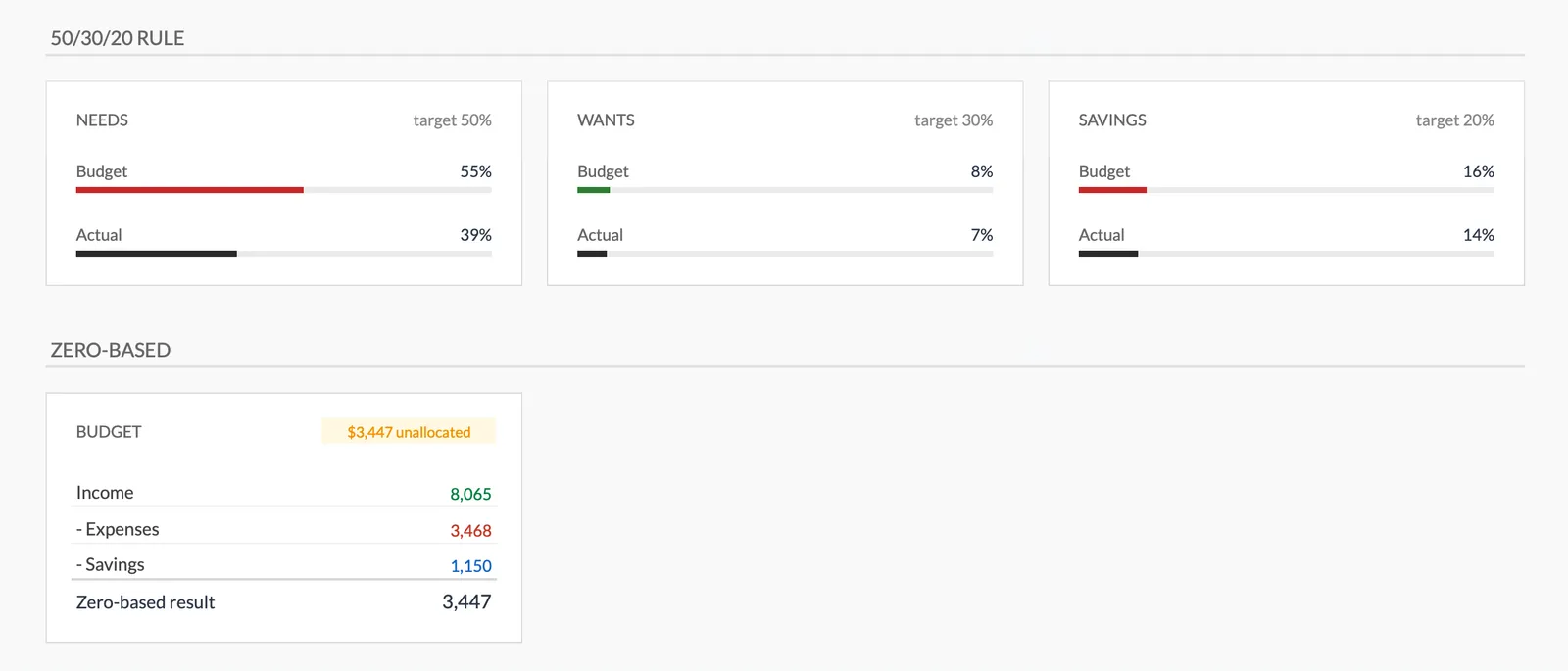
The Summary sheet then reads that same plan two ways. A 50/30/20 block shows needs, wants, and savings as percentages of income against the 50%, 30%, and 20% targets, with budgeted and actual figures on separate bars. Below it, a zero-based block subtracts expenses and savings from income and reports what is left as the zero-based result, labelled as unallocated whenever it is not zero. Both blocks are computed from the one budget you entered, so there is no switch between methods and no second set of categories to maintain.
For people who want to start with pure expense tracking before committing to either method, the Monthly Expense Tracker provides a simpler starting point. Both templates use compatible categories, so you can graduate from tracking to budgeting without starting over. If you would rather build the sheet yourself first, our walkthrough on how to create a monthly budget in Google Sheets covers the formulas from scratch.
The Method Matters Less Than the Habit
Debates about 50/30/20 versus zero-based budgeting can obscure the main point: any systematic approach to tracking money beats no system at all.
Pick a method that seems reasonable given your situation. Try it for two or three months. If it’s working, keep going. If it’s not, adjust. The goal isn’t to find the theoretically optimal budgeting method - it’s to build the habit of paying attention to where money goes and whether that matches your priorities.
Most people who successfully budget for years have modified whatever method they started with. The framework is a starting point, not a destination.
Related
- Monthly Budget Template - per-category budget targets on the Budget Plan sheet, with 50/30/20 and zero-based blocks on the Summary
- Budget Calculator - free tool that splits your take-home pay into needs, wants, and savings
- Budget Calculator: 50/30/20 and Beyond - the percentage frameworks side by side, including 80/20 and 60/20/20
- Envelope Budgeting in the Digital Age - a third method that caps each category rather than splitting by percentage
- How to create a monthly budget in Google Sheets - build the calculations yourself, step by step
- How to budget your money: a monthly and annual approach - pairing the month view with the year view
Frequently asked questions
Do the 50/30/20 percentages use gross or after-tax income?
After-tax income - the money that actually lands in your account. Taxes and payroll deductions come out before the 50/30/20 split is applied, so the percentages are calculated on take-home pay, not your gross salary.
Which categories count as needs versus wants?
Needs are expenses you can't easily skip: housing, utilities, groceries, insurance, transportation to work, and minimum debt payments. Wants are the discretionary layer: dining out, streaming, hobbies, travel, and upgrades. The tricky cases (a phone plan, a gym membership) are usually part need, part want, and where you draw the line is a personal call.
Can you switch from 50/30/20 to zero-based budgeting later?
Yes. Many people start with percentages to build the habit, then move to zero-based budgeting once they want tighter control or are focused on debt payoff. Because both methods track the same categories, the spending history you have already collected carries straight over.
Is zero-based budgeting the same as living paycheck to paycheck?
No. Zero-based budgeting means every dollar has an assigned job, including dollars assigned to savings, investing, and debt payoff. A zero balance on paper is the plan being complete, not your bank account being empty at month end.
What happens when you overspend one 50/30/20 bucket?
Nothing automatic - the framework is a guideline, not a lock. If wants run past 30% one month, the usual response is to pull the extra from another bucket or accept a lower savings rate that month, then reset the following month. Persistent overspending in one bucket is the signal that the split needs adjusting to your real cost of living.
Sources
- Consumer Expenditures - 2024 - U.S. Bureau of Labor Statistics
- Housing and transportation accounted for 50 percent of household spending in 2024 - U.S. Bureau of Labor Statistics, The Economics Daily
About this article
Average U.S. household spending shares checked against the Bureau of Labor Statistics Consumer Expenditure Survey for 2024. Template sheets, inputs and outputs checked on 2026-09-10 against the shipped Monthly Budgeting Google Sheet (Summary 50/30/20 and zero-based blocks, Budget Plan, Categories) and the shipped Monthly Expense Tracker Google Sheet (Summary, Transactions, Categories). Last reviewed September 2026.