Ireland
Net Worth Tracker for Ireland
Consolidate your pension fund, property equity, credit union shares, An Post savings, and loans into a single net worth view you control in Google Sheets.
In Depth
Where Credit Unions and Property Meet the Balance Sheet
Ireland has one of the highest credit union membership rates in the world, and for many people those regular shares represent real savings that often go unmentioned in financial conversations. Including credit union balances alongside bank accounts and investment portfolios gives a more honest picture of where money actually sits. The same applies to An Post State Savings products, whose returns fall outside DIRT and quietly compound over time.
Property dominates most Irish net worth calculations, in a market where prices have moved beyond pre-crisis levels. The Property Price Register publishes actual sale prices by area, which gives a more grounded estimate than an aspirational online valuation. Subtracting the outstanding mortgage from a realistic market value shows equity, and for many homeowners that single number drives the majority of their net worth figure.
Pension funds are the other major piece, yet they are easy to overlook because the money is not accessible until retirement age. With auto-enrolment live since January 2026 and occupational scheme coverage growing, more people carry meaningful pension balances than they may realize. Tracking pension value alongside accessible assets creates two useful views: total net worth, and what is actually available today.
Ireland
Net Worth in Ireland: What to Track
Irish wealth is typically held in property, pensions, and savings. A net worth tracker brings all of these into one view for a clearer understanding of where you stand.
Property is central to Irish net worth
Home ownership is culturally important in Ireland, and property often represents the largest asset. Tracking home value, based on the Property Price Register for comparable sales or on online estimates, minus the mortgage balance shows your equity. With residential prices having moved past their pre-2008 peak, this component can be significant.
Pension funds are growing in importance
Auto-enrolment began on 1 January 2026 through the My Future Fund scheme, so pension coverage is expanding. Existing pension holders may have substantial funds accumulated through occupational schemes or PRSAs. Including pension values in net worth gives the complete picture, though the money is not accessible until retirement age, typically from 60.
Credit union savings are uniquely Irish
Ireland has one of the highest credit union membership rates in the world. Credit union savings, regular shares, and term deposits are real assets worth including in net worth tracking. Many Irish households hold savings across both credit unions and banks.
Mortgage debt is the primary liability
For homeowners, the mortgage is typically the largest liability. Irish mortgage terms often run 25-35 years, and tracker mortgages linked to ECB rates have been a distinctive feature of the market. Watching the mortgage balance decline over time is one of the clearest measures of financial progress.
Get the Template
Getting Started
Adapting the Net Worth Tracker for Ireland
List all assets
Enter bank accounts, credit union savings, pension fund value, An Post State Savings products, investment accounts, property value, and any other assets. Use current values from your latest statements.
Enter all debts and credit union loans
Include mortgage balance, car loan, personal loans, credit card balances, credit union loans, and any other debts. A comprehensive list is what makes the net worth figure accurate.
Set the currency to EUR
Choose EUR from the currency setting at the top of the dashboard. The math applies in any currency.
Pick a consistent update cadence
Monthly updates for bank and savings balances, quarterly for pension and property values. Pension values come from your pension provider, and property values can be estimated from recent local sales.
Track progress over time
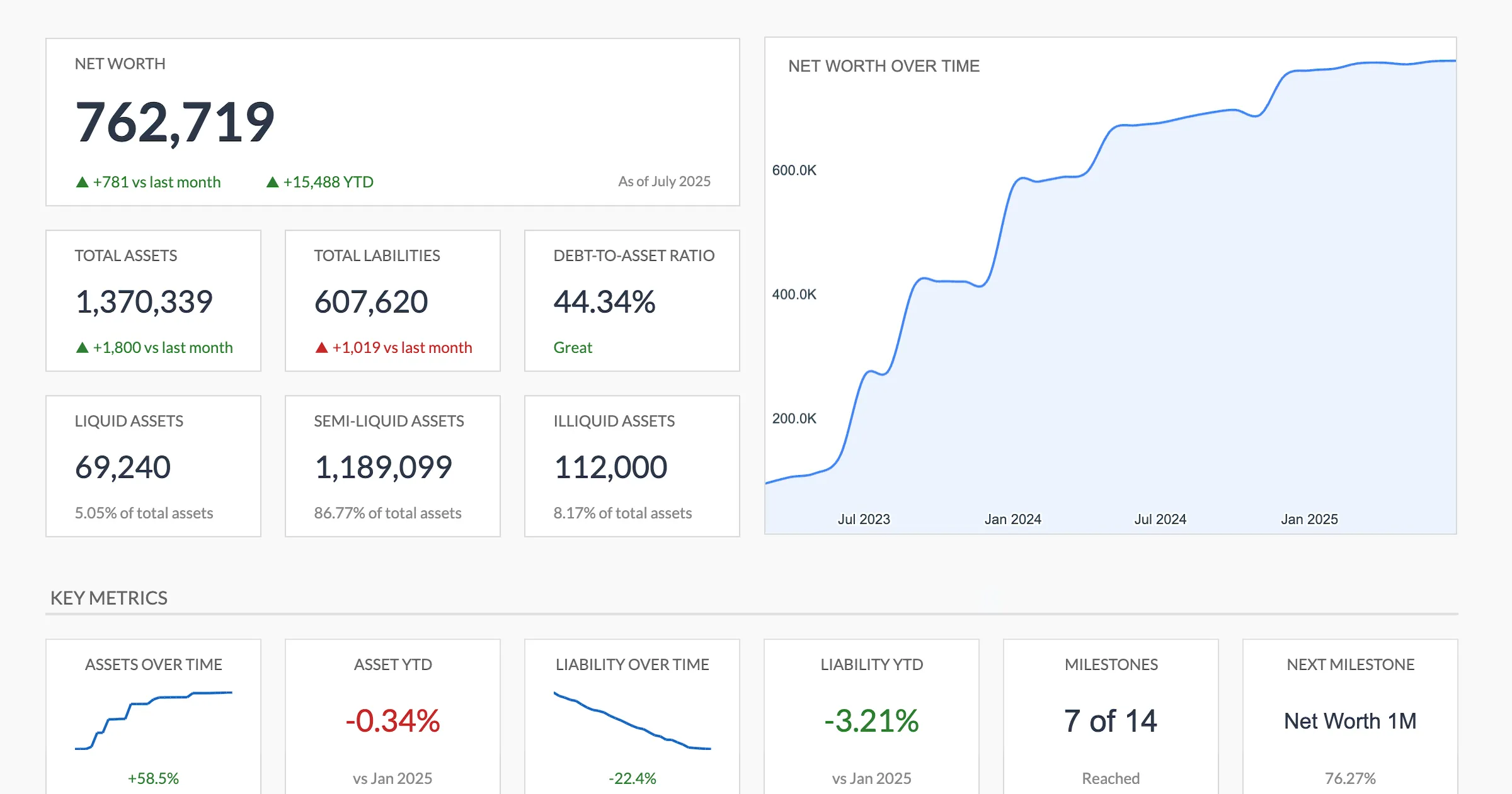
The template shows your net worth trend month by month. For most people, net worth grows slowly at first, especially while mortgage payments are mostly interest, then accelerates as investment returns compound and mortgage principal reduces.
See It In Action
What the template looks like
Browse through the template to see the dashboard, the entry sheets, and the summaries it produces, all adaptable to your local financial setup.
- Built-in currency selector
- Calculations update automatically
- Visual summaries of your numbers
- No setup required
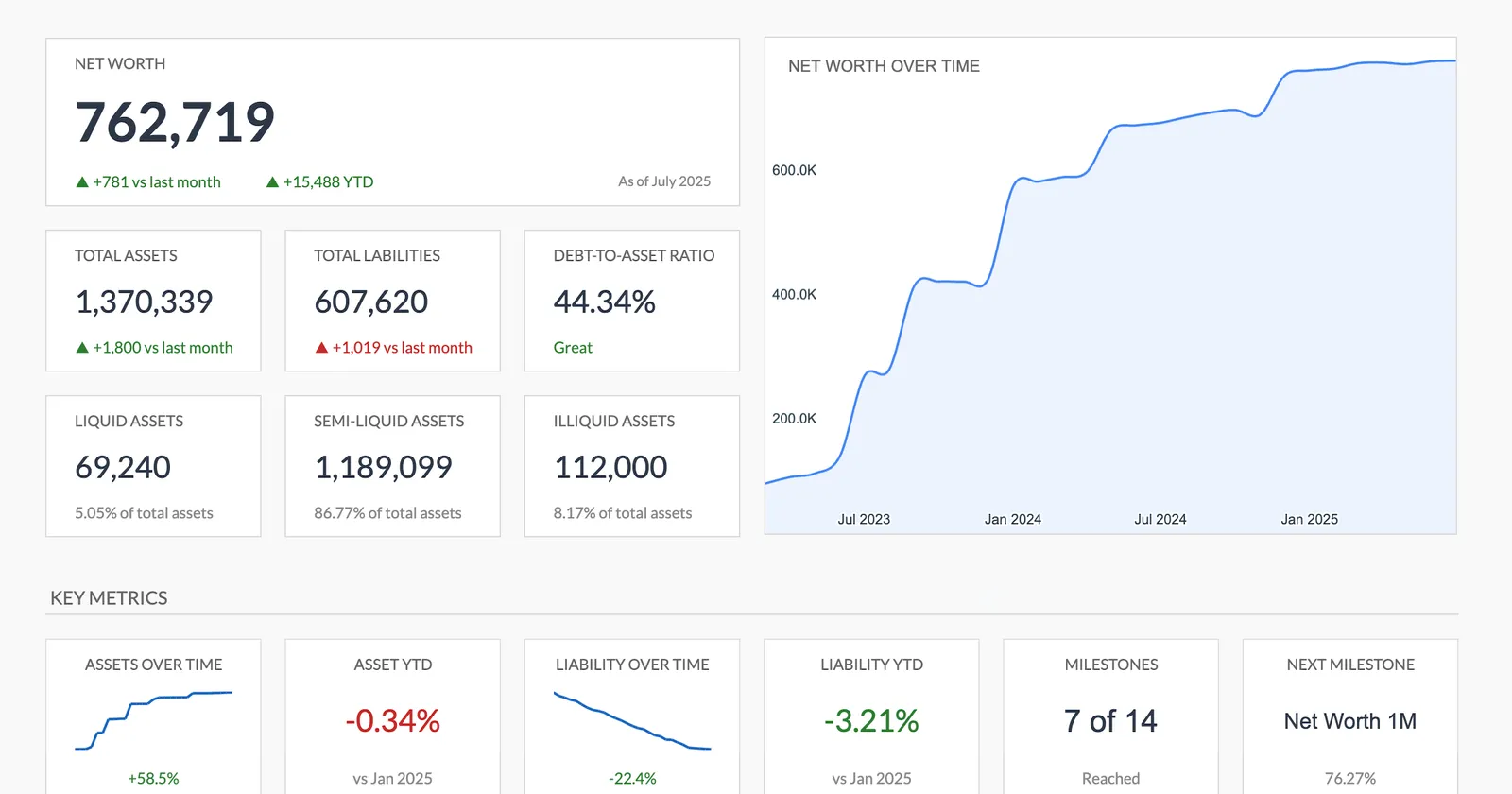
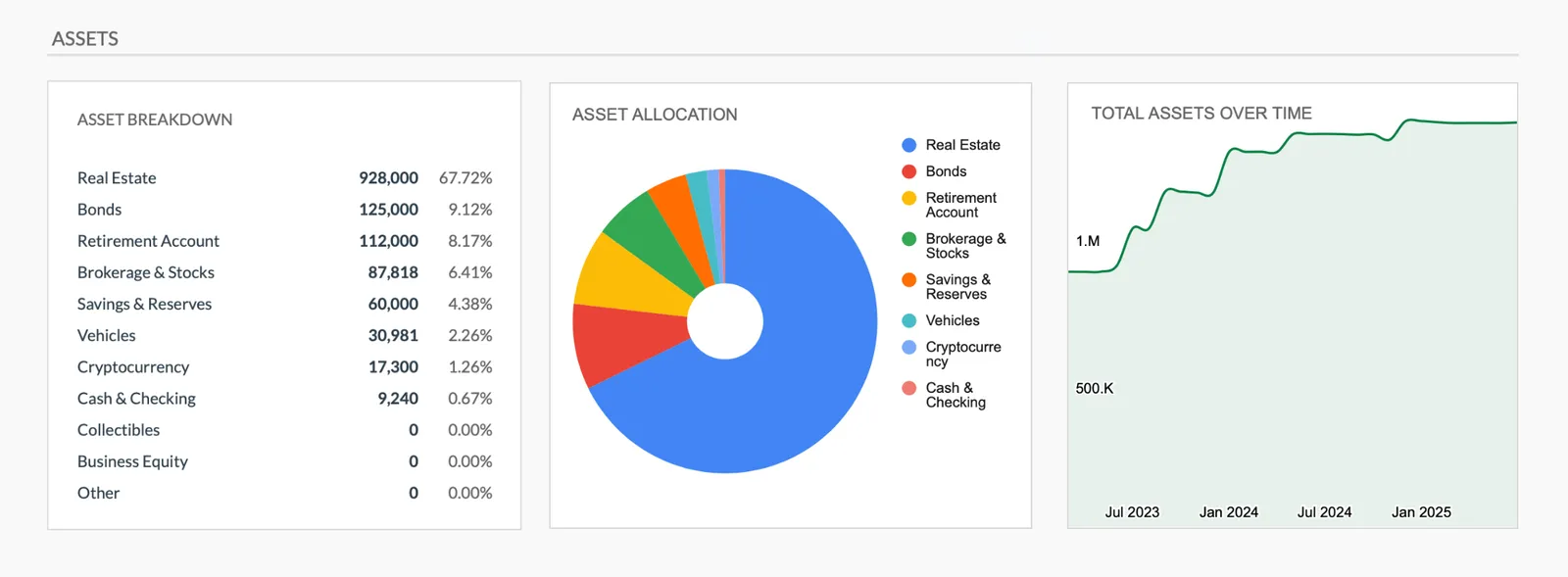
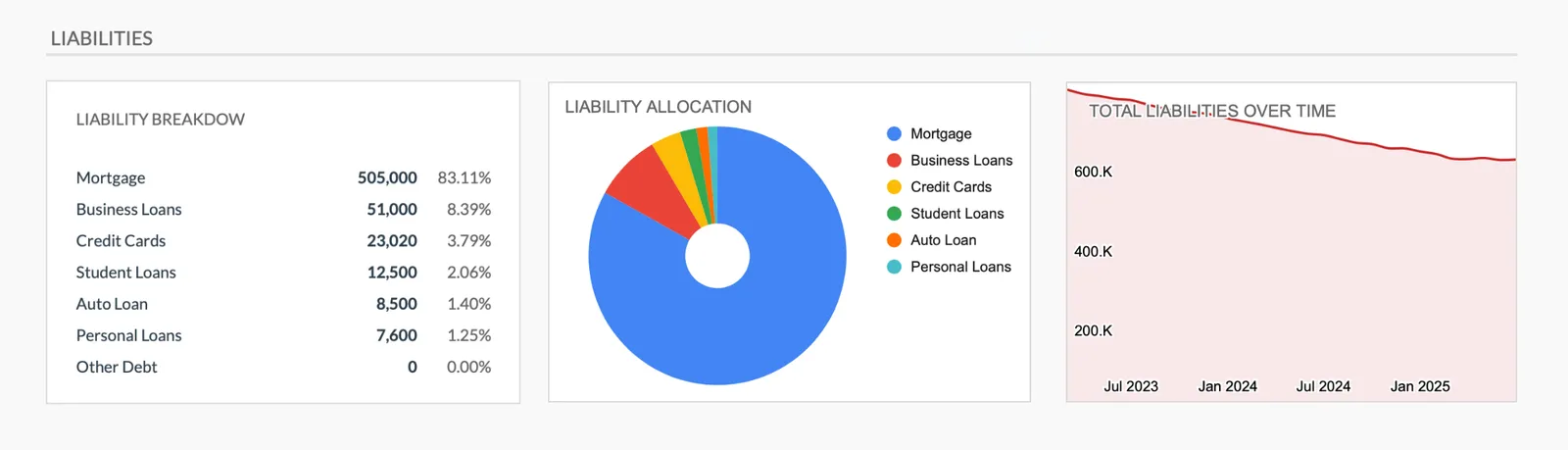

Track your net worth over time with charts
Breakdown of all your assets
Track all debts and liabilities
Key financial health indicators
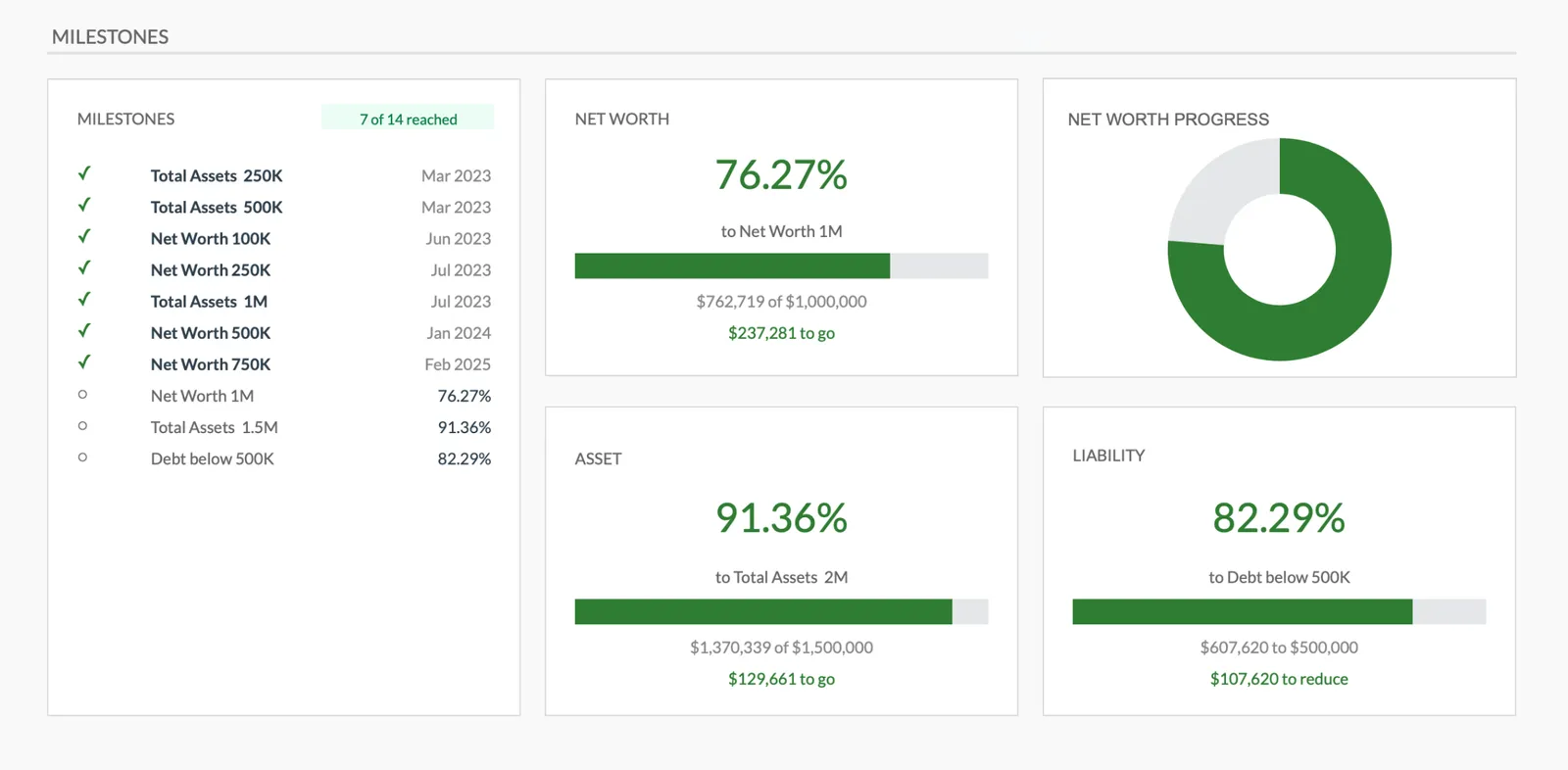
Set and celebrate net worth milestones
Common Questions
Net Worth Tracker for Ireland - FAQ
Should I include my pension?
Pension funds are a real asset, and including them gives a complete picture. Since pensions are not accessible until retirement age, some people also track an "accessible net worth" figure that excludes the pension.
What's the right way to estimate my home value in Ireland?
The Property Price Register (propertypriceregister.ie) shows actual sale prices in your area. Online tools from Daft.ie or MyHome.ie also provide estimates. A realistic figure updated annually is enough for tracking purposes.
Should I include credit union shares?
Credit union regular shares are savings, and they count as an asset just like bank deposits. Include the current balance. Credit union term deposits or special savings products belong there too.
What about An Post savings?
State Savings products (Savings Bonds, Savings Certificates, Prize Bonds, National Solidarity Bonds) are assets, so include them at their current value. Returns on State Savings sit outside DIRT, so the stated rate is what is actually paid.
How does Irish net worth compare internationally?
CSO (Central Statistics Office) data shows median Irish household net worth has grown substantially in recent years, driven mainly by property values, and Irish median household wealth sits above the euro area median in the ECB's Household Finance and Consumption Survey. The template focuses on tracking your own progress rather than making comparisons.
Can't find the answer you're looking for? Contact our team
Explore More
Free Tools for Ireland
Ready to get started?
Download instantly and start managing your finances, or contact us to design a custom template package for your needs.
Tax rules, rates, and contribution limits change, and official publications can themselves lag behind the law in force. We review these figures on a best-effort basis against sources we consider authoritative, but we cannot guarantee they are current, complete, or that better sources do not exist, and nothing here is tax, legal, or financial advice. For decisions, the relevant government authority is the reference.