Canada
Retirement Planning Template for Canada
Map out your retirement across RRSP, TFSA, CPP, OAS, employer pension, and projected expenses in a Google Sheets template you own.
In Depth
CPP Timing, RRIF Conversion, and the Canadian Retirement Equation
Canadian retirement income comes from more sources than many people initially realize. CPP, OAS, RRSP and RRIF withdrawals, TFSA withdrawals, and possibly an employer pension each operate under different tax rules and timing constraints. The way these pieces interact, particularly around the OAS recovery tax threshold and tax bracket management, is where much of the complexity lives.
The decision of when to start CPP is one of the larger financial choices Canadians face near retirement. Taking it at 60 means a permanent 36% reduction from the age-65 amount, while deferring to 70 provides a 42% increase, so the age-70 payment is roughly double the age-60 one. For someone in good health with other income to bridge the gap, deferral can mean more lifetime income, but there is no single correct answer: health, other income, and cash flow needs all factor in.
TFSA withdrawals in retirement play a quietly powerful role that is easy to overlook. Unlike RRSP or RRIF income, TFSA withdrawals do not count as income for OAS clawback purposes and do not push you into higher tax brackets. For retirees with significant RRIF mandatory minimums, the TFSA can provide supplemental income without the tax consequences. This is one reason some financial planners consider the TFSA the most flexible account in the Canadian registered system.
Provincial healthcare covers physician and hospital services, but prescription drugs, dental, and vision care remain out-of-pocket costs for most retirees unless covered by a supplemental plan. These costs tend to increase with age, making them an important line item in any retirement spending projection. Some provinces offer pharmacare programs for seniors, but coverage and eligibility vary.
Canada
Retirement Planning in Canada: Key Factors
Canadian retirement planning involves government programs (CPP, OAS), registered accounts (RRSP, TFSA), and potentially employer pensions. Understanding how these work together is key.
CPP and OAS provide a meaningful income base
The maximum CPP retirement benefit at age 65 is $1,507.65 a month for 2026, though most people receive less based on their contribution history, with new beneficiaries averaging around $800. OAS pays up to about $742 a month at 65 for those aged 65 to 74 in 2026. Together, full entitlements come to roughly $27,000 a year. CPP can start as early as 60 at a reduced rate or be deferred to 70 for an increase of 42% over the age-65 amount.
RRSP is the primary retirement savings vehicle
RRSP contributions reduce current taxes, and the funds grow tax-deferred until withdrawal. At age 71, the RRSP must be converted to a RRIF (Registered Retirement Income Fund) and begin mandatory withdrawals. The drawdown plan, meaning when and how much to withdraw, shapes the lifetime tax picture considerably.
TFSA complements the RRSP for retirement flexibility
TFSA withdrawals are tax-free and do not count toward the income used for the OAS recovery tax, unlike RRSP and RRIF withdrawals. For retirees, that makes the TFSA a source of income that stays clear of the clawback, which starts at net income above $95,323 for 2026.
Employer pensions vary widely
Some Canadians have defined benefit pensions (guaranteed income based on years of service and salary) through employers or government. Others have defined contribution plans, group RRSPs, or no employer pension. The type and quality of employer pension significantly affects how much additional personal saving is needed.
Get the Template
Getting Started
Setting Up for Canadian Retirement Planning
Enter current retirement account balances
List RRSP, TFSA, employer pension (current value or projected benefit), non-registered investments, and any other retirement savings. Current values are your starting point for projections.
Estimate CPP and OAS benefits
Check your CPP estimate through My Service Canada Account. For OAS, use the full benefit amount if you expect to have 40+ years of Canadian residency. Enter the age you plan to start each benefit.
Set RRSP, TFSA, and pension contribution amounts
Enter how much you contribute annually to RRSP, TFSA, and any employer pension (including employer match). This drives the growth projections. Include any planned increases as your income grows.
Project retirement expenses
Estimate monthly retirement spending in today's dollars: housing, food, healthcare (prescription drugs, dental, vision not covered by provincial health), travel, and hobbies. Provincial healthcare coverage means basic medical costs are lower than in the US, but supplemental needs vary.
Test different scenarios
Try different retirement ages, CPP claiming ages of 60, 65, or 70, and spending levels. CPP at 70 pays roughly double the age-60 amount, since 60 carries a 36% reduction and 70 a 42% increase against the age-65 figure. Seeing the numbers side by side makes the tradeoff concrete.
See It In Action
What the template looks like
Browse through the template to see the dashboard, the entry sheets, and the summaries it produces, all adaptable to your local financial setup.
- Built-in currency selector
- Calculations update automatically
- Visual summaries of your numbers
- No setup required
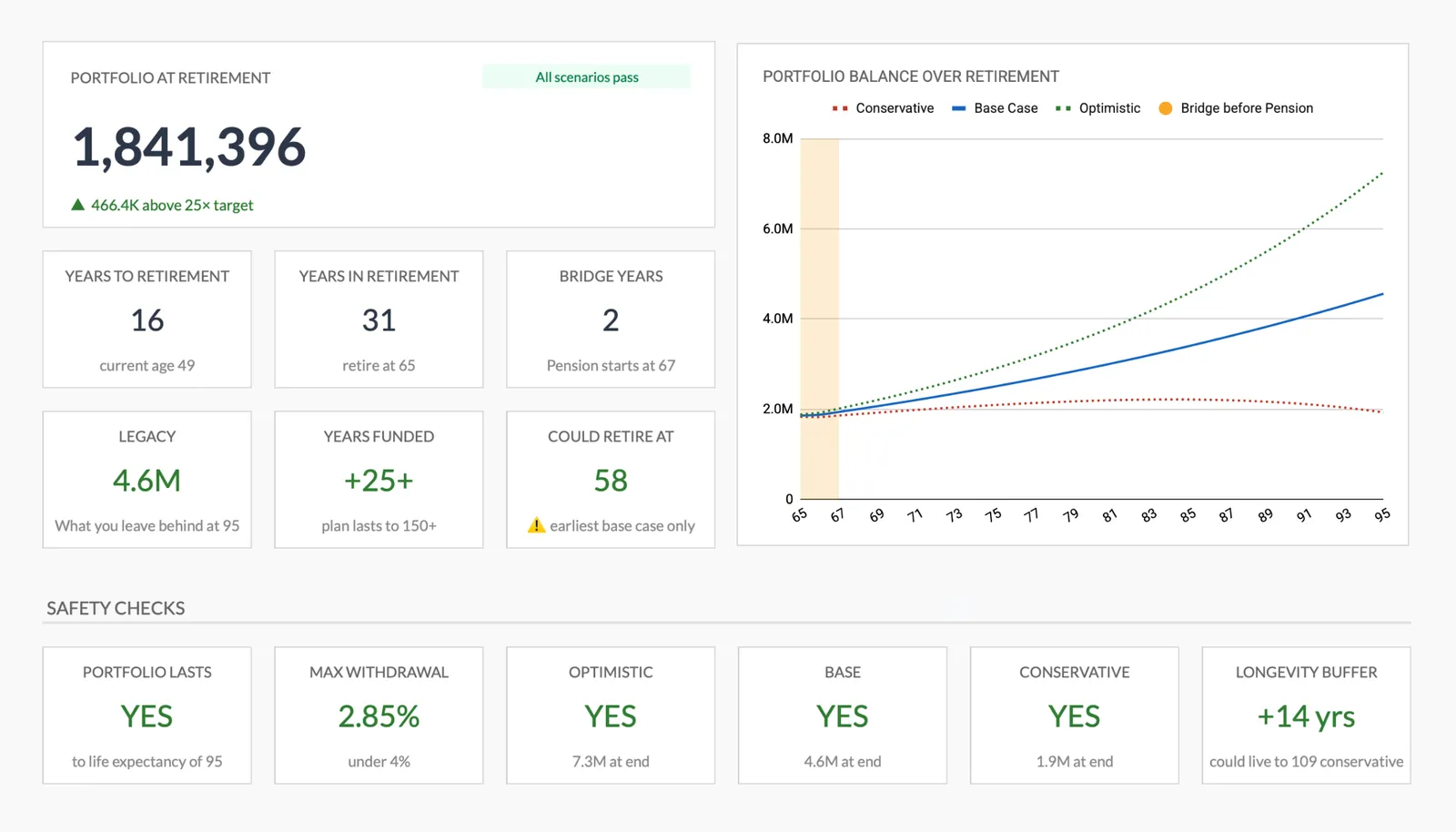
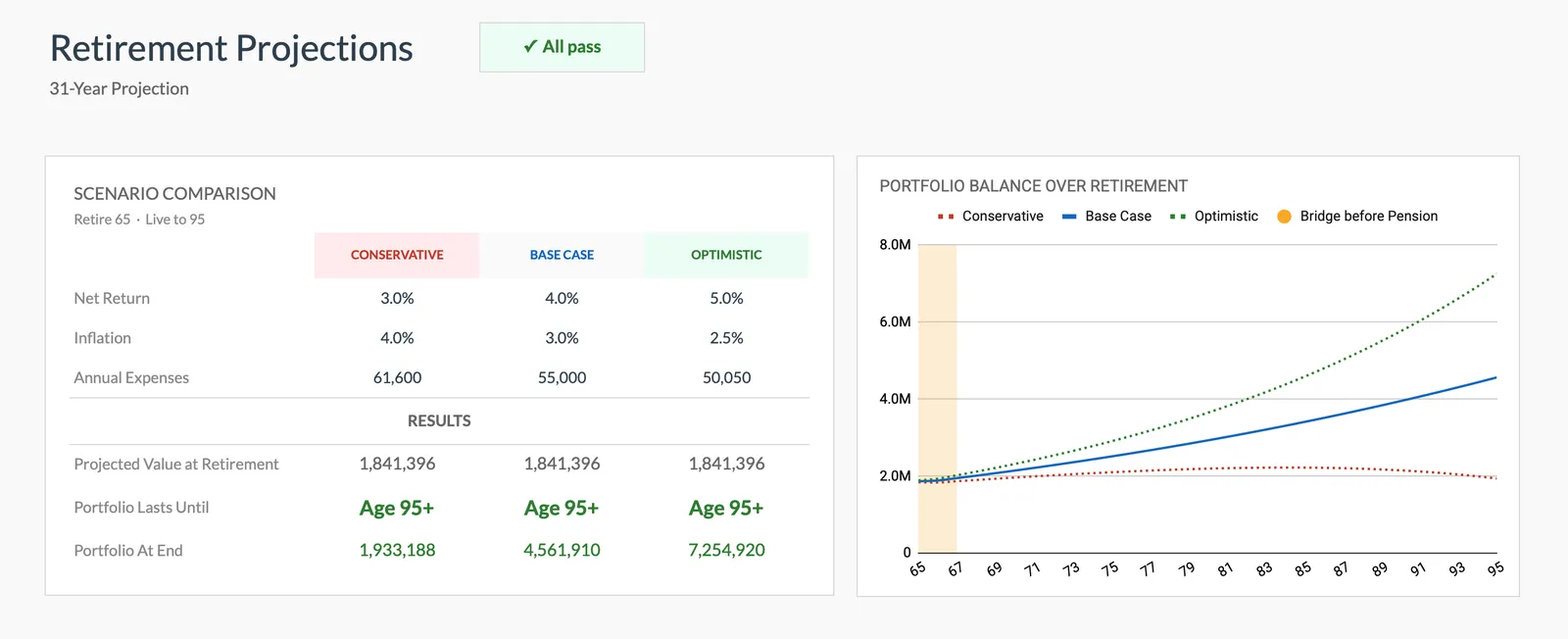
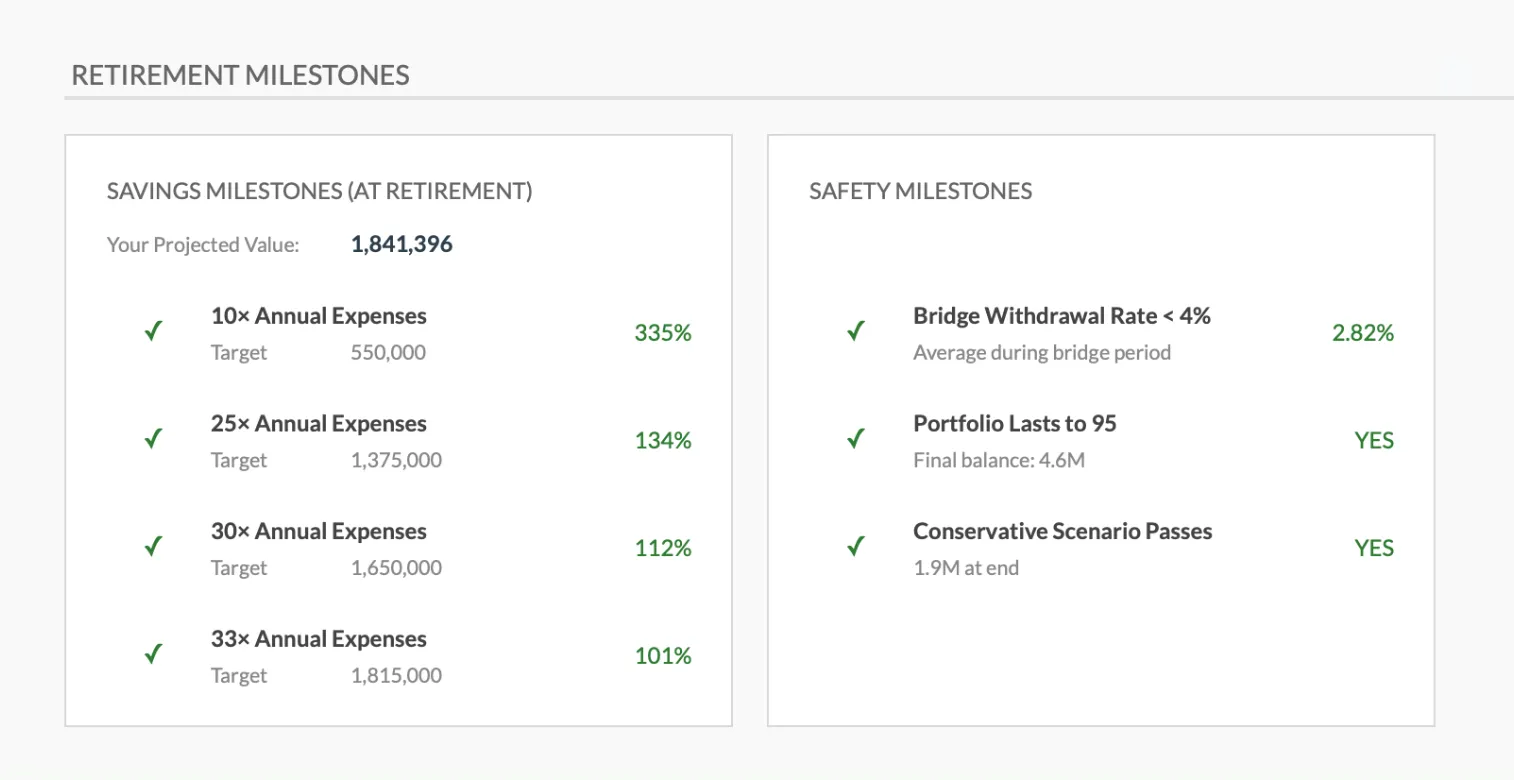
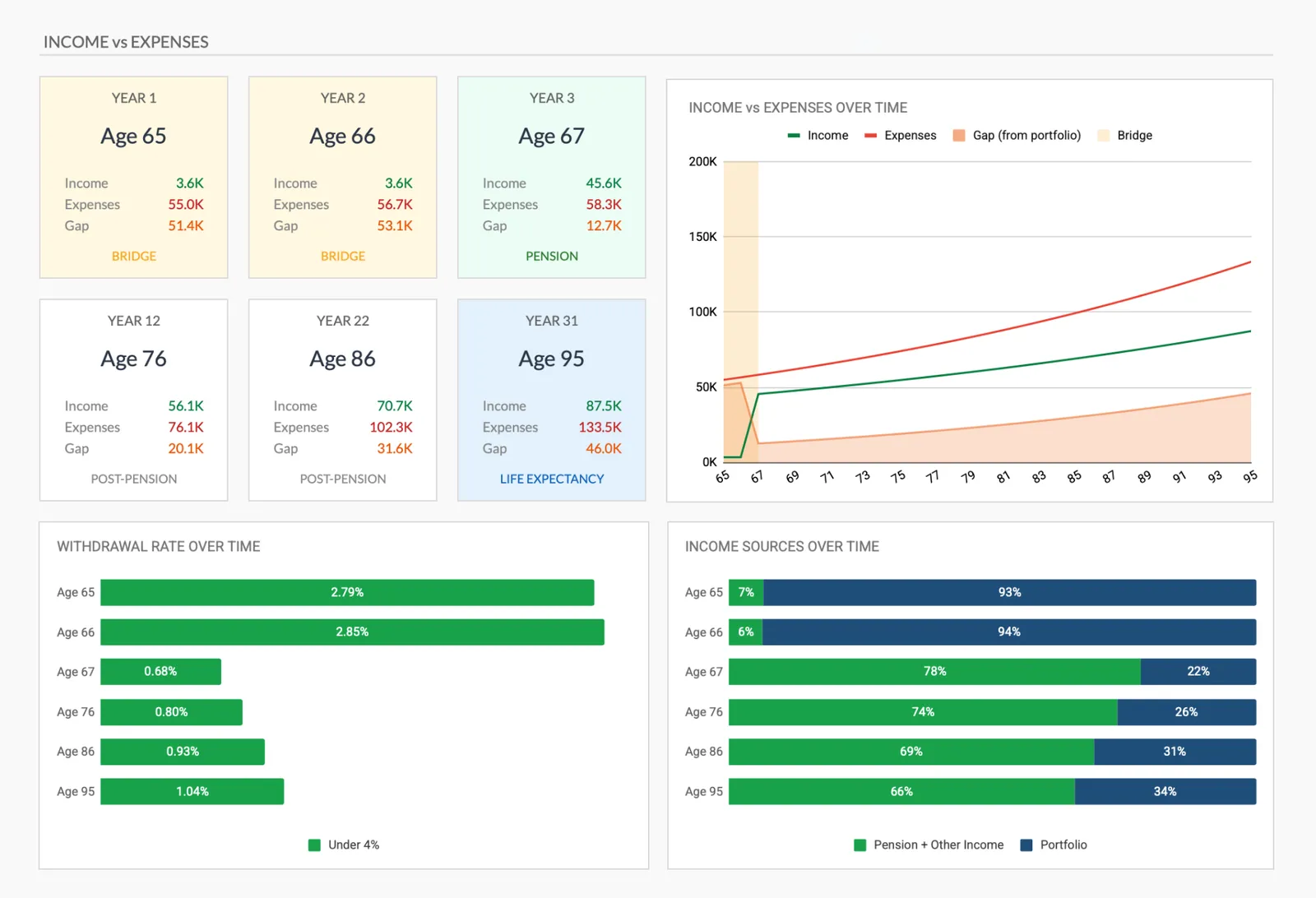
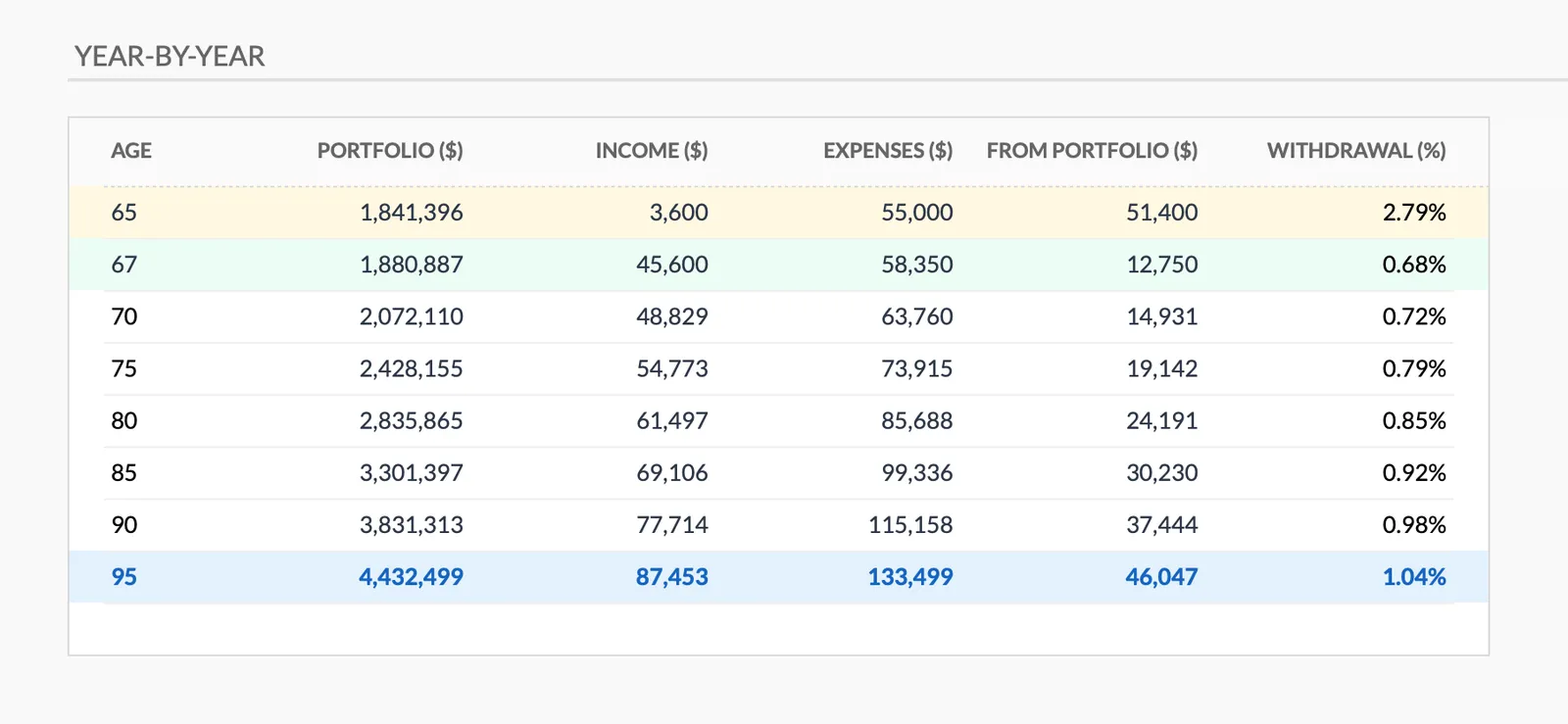
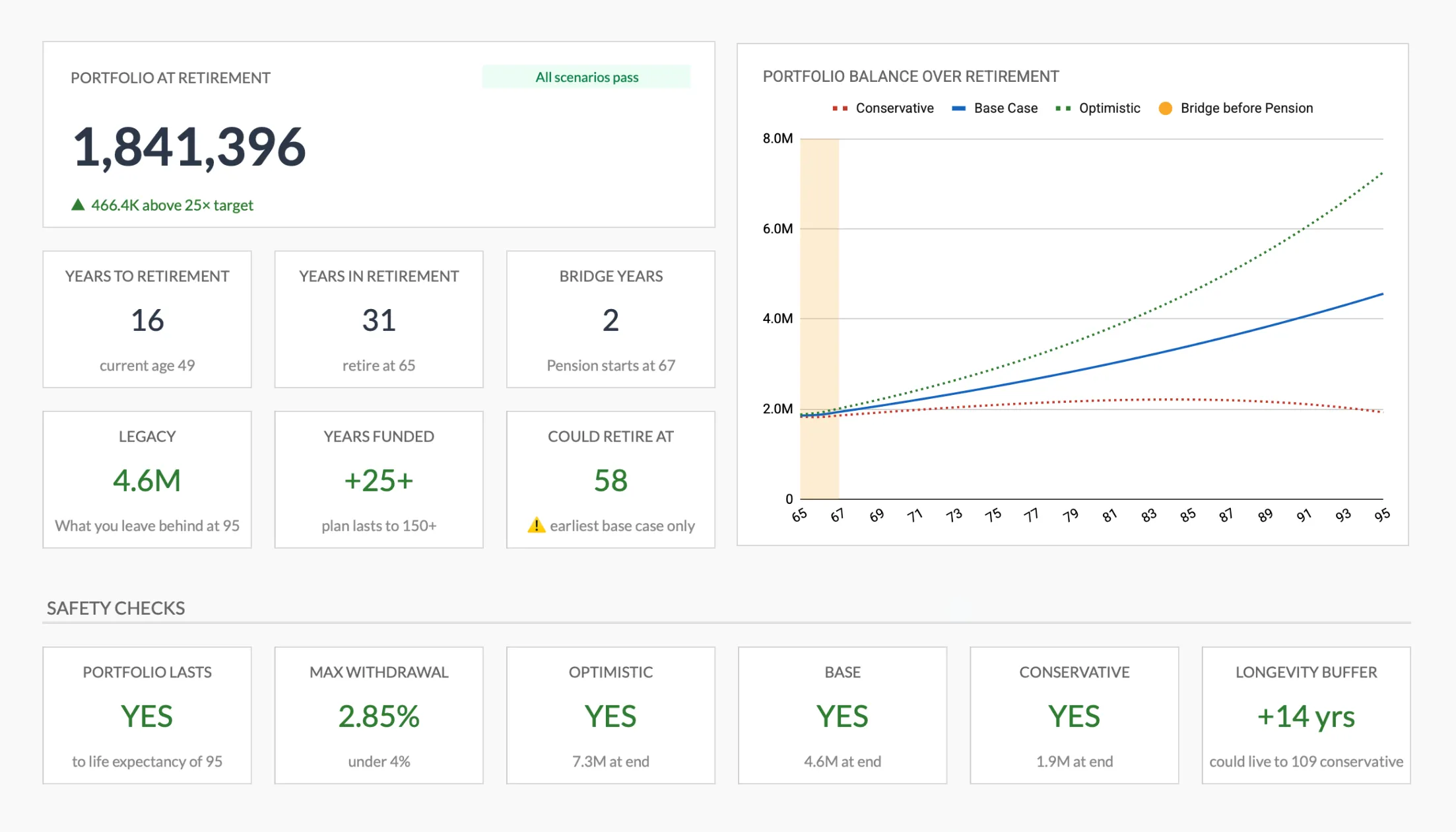
Complete retirement overview with projections
Project your retirement savings growth
Track progress toward retirement goals
Plan your retirement income against expenses
Detailed year-by-year retirement projection
Common Questions
Retirement Planning Template for Canada - FAQ
When should I start taking CPP?
CPP can start as early as 60, reduced by 0.6% per month before 65, or as late as 70, increased by 0.7% per month after 65. Starting at 70 gives about 42% more than at 65, and roughly double the amount available at 60. Health, other income sources and cash flow needs all feed into the choice, and circumstances vary widely.
How much do I need to retire in Canada?
It depends on spending, location, and government benefit entitlements. One common starting point is to work out annual retirement expenses, subtract expected CPP and OAS income, then size the savings needed to cover the gap, often using a 4% withdrawal rate as a rough guide. On that arithmetic, someone needing $25,000 a year beyond CPP and OAS would be looking at roughly $625,000 in savings.
Will OAS be clawed back?
OAS is reduced once individual net income exceeds $95,323 for 2026. For each dollar above the threshold, OAS is reduced by 15 cents, disappearing entirely at around $155,000 of income for those aged 65 to 74. RRIF withdrawals count as income for this purpose while TFSA withdrawals do not, which is one reason higher-income retirees pay attention to the split.
What about healthcare costs in retirement?
Provincial healthcare covers doctor visits and hospital care, but not prescription drugs (for most provinces), dental, vision, or hearing aids. These costs increase with age. Some provinces offer drug coverage programs for seniors. Private health insurance or employer retiree benefits can fill gaps.
Should I convert my RRSP to a RRIF early?
Conversion is required by December 31 of the year you turn 71. Some people convert earlier to start gradual withdrawals and manage tax brackets, while others delay to keep growth tax-deferred longer. Which makes sense depends on other income sources and the wider tax picture, and the template holds the balances and projected income those comparisons rest on.
Can't find the answer you're looking for? Contact our team
Explore More
Free Tools for Canada
Ready to get started?
Download instantly and start managing your finances, or contact us to design a custom template package for your needs.
Tax rules, rates, and contribution limits change, and official publications can themselves lag behind the law in force. We review these figures on a best-effort basis against sources we consider authoritative, but we cannot guarantee they are current, complete, or that better sources do not exist, and nothing here is tax, legal, or financial advice. For decisions, the relevant government authority is the reference.