Free Debt-to-Income Calculator Spreadsheet Template for Google Sheets & Excel
Seven inputs at the top, four results underneath: the housing ratio, the all-debts ratio, and how each sits against a limit you set. The Free Debt-to-Income Calculator spreadsheet template gives you five lines for monthly commitments, reports both ratios to one decimal place, and keeps its How to Use guide on a second tab. One file, Google Sheets or Excel. No macros, no VBA.
The FinancialAha Free Debt-to-Income Calculator Spreadsheet Template is a one-sheet workbook for Google Sheets and Excel, with a How to Use guide on a second tab. It works as a Free Debt-to-Income Calculator Excel template and a Free Debt-to-Income Calculator Google Sheets template from the same download. Your income and each debt payment go in, and out come the housing ratio, the all-debts ratio, and how they sit against a limit you set yourself. No macros, no VBA.
Inside the workbook
What's inside the FinancialAha Free Debt-to-Income Calculator spreadsheet template
The FinancialAha Free Debt-to-Income Calculator Spreadsheet Template runs on a single working sheet, with the instructions on a tab of their own. It works in both Microsoft Excel and Google Sheets and here is what the Free Debt-to-Income Calculator spreadsheet holds.
01of 01
DTI
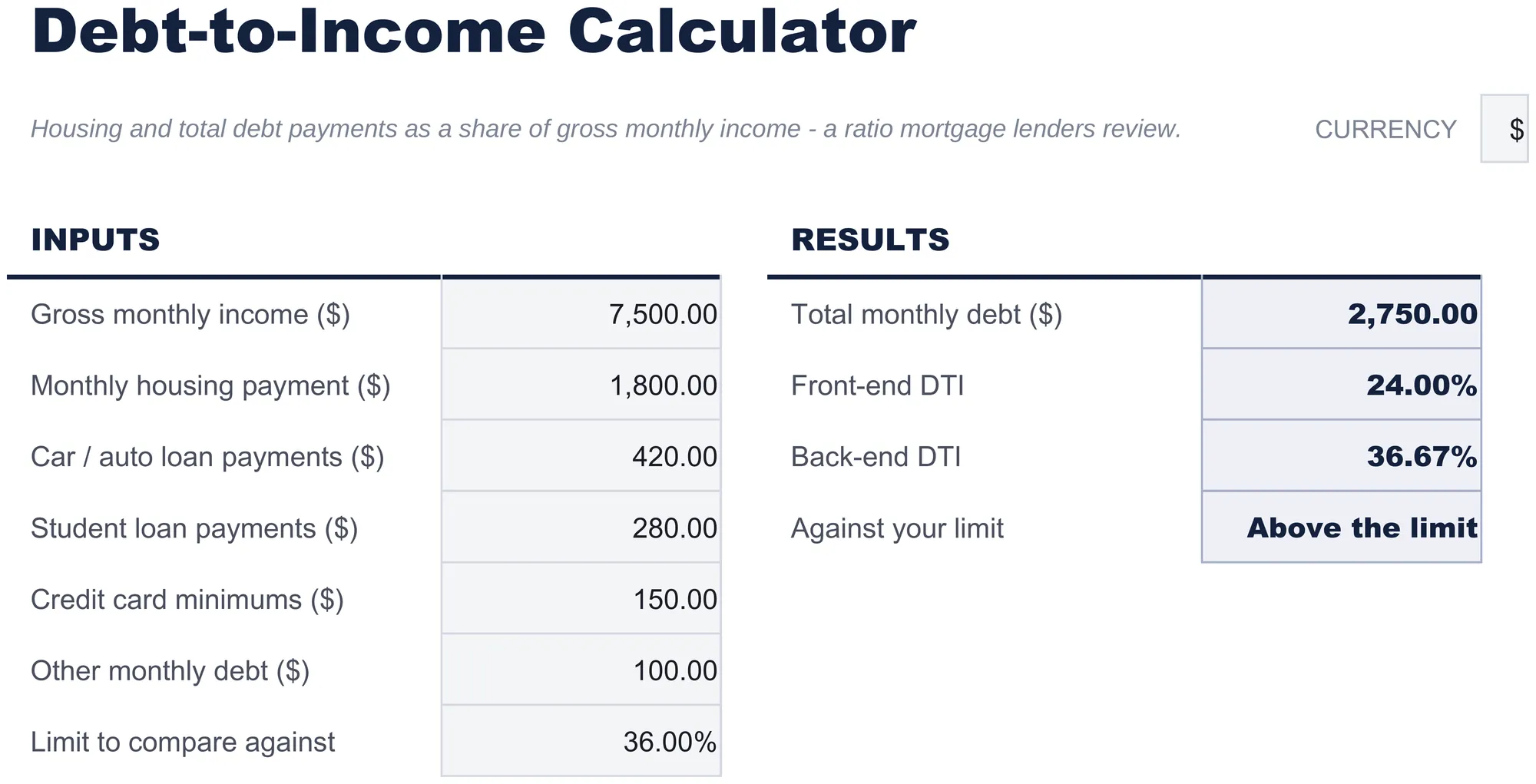
Seven inputs on the left, four results on the right. Gross monthly income first - before tax, since that is the figure the ratio is measured against - then the housing payment and each other monthly commitment on its own line: the car, the student loan, the card minimums and anything else.
Two ratios come back. The front-end one is housing against income; the back-end one is everything against income, and it is the figure most conversations are actually about. Both are reported to one decimal place rather than rounded to something tidy, because the difference between thirty-six and thirty-seven percent is exactly the sort of thing that matters here.
The last input is the one worth noticing: the limit you want to compare against. It is a field rather than a fixed number, because lenders and loan programmes use different figures and the one that applies to you is the one your lender quotes. The result reports whether you are within or above that limit and stops there - it does not tell you whether the number is good.
Enter no income and the ratios say so rather than showing an error, which is the state the sheet arrives in before you have filled it out.
DTI
Included guide
How to Use
A step-by-step guide on its own tab, covering how to replace the sample values, how the two ratios differ, and how to change the currency. Because it ships inside the file, the instructions travel with the template wherever it is opened.
Works in both Google Sheets and Excel
Free Debt-to-Income Calculator Spreadsheet template for Google Sheets
Upload the Free Debt-to-Income Calculator Spreadsheet Template to Drive, right-click it, and choose "Open with Google Sheets". This Free Debt-to-Income Calculator Google Sheets template needs no conversion step and nothing gets rewritten on the way in - the ratios recalculate exactly as they do in Excel.
Free Debt-to-Income Calculator Google Sheets template setup
A shared copy of the Free Debt-to-Income Calculator Google Sheets template suits two people applying together, since both incomes and both sets of commitments go into the same ratio.
Running the Free Debt-to-Income Calculator Google Sheet
The Free Debt-to-Income Calculator Google Sheet is worth revisiting when a debt is cleared or a payment changes, since either moves the back-end ratio immediately.
Free Debt-to-Income Calculator Spreadsheet template for Excel
The Free Debt-to-Income Calculator spreadsheet Excel download is a plain .xlsx. Excel opens this Free Debt-to-Income Calculator Excel template directly, with no import step and no compatibility prompt, and every result updates the moment an input changes. There are no macros and no VBA in the file, so it opens without a security warning.
The same Free Debt-to-Income Calculator Excel template opens in Excel on Windows, Excel on Mac, and Excel for the web. It is also the identical file you would upload to Drive, so there is no separate Free Debt-to-Income Calculator spreadsheet download to choose between.
The Free Debt-to-Income Calculator spreadsheet Excel file carries no macros and no VBA, so Excel opens it without a trust prompt.
Opening the Free Debt-to-Income Calculator spreadsheet Excel file
Nothing in the Free Debt-to-Income Calculator Excel template is version-specific, so this Free Debt-to-Income Calculator spreadsheet Excel workbook behaves identically in Excel on Windows, Excel on Mac, and older builds.
What the Free Debt-to-Income Calculator spreadsheet template tracks
Seven inputs and four results. This is what the Free Debt-to-Income Calculator Spreadsheet Template holds, with gross monthly income at the top and each commitment on its own line beneath it:
Student loan payments
the required payment rather than what you choose to pay, sitting alongside the housing payment, the car, the card minimums and anything else a lender would count
Against your limit
the comparison the sheet returns, measured against a limit you enter rather than one it assumes
Above the limit
what it reads when the all-debts ratio exceeds that figure, with nothing said about whether the number is good
Compare builds
FinancialAha Debt-to-Income Calculator spreadsheet template: Free and Essentials compared
Within or exceeds (FHA); within, borderline or exceeds (conventional)
Maximum payment by threshold
–
Four thresholds
Handles zero income
Says so
Returns zero
Charts
–
2
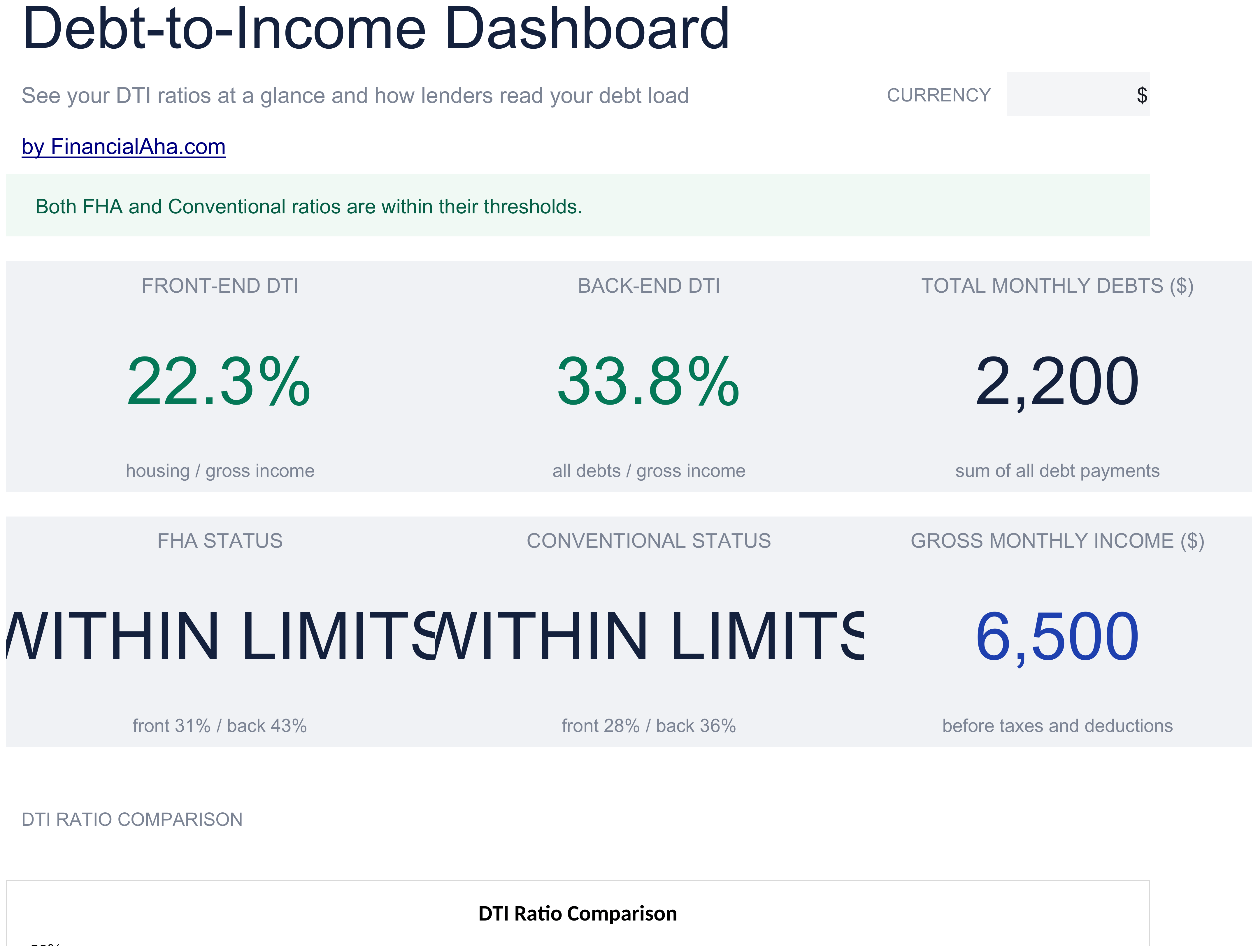
The FinancialAha Free Debt-to-Income Calculator Spreadsheet Template gives you both ratios and compares them against a limit you choose. The Essentials Debt-to-Income Calculator Spreadsheet Template for Google Sheets and Excel sets them against named programme limits instead - the FHA pair, the conventional pair and a stretch figure some lenders allow, with both figures written beside each comparison, so the conventional verdict can come back borderline rather than only within or over - and works out the maximum housing payment each of those thresholds would allow given your income and your other debts. It splits personal loans from other debts, and adds a dashboard with two charts.
Notes on working in the Free Debt-to-Income Calculator spreadsheet template
Total monthly debt adds the five commitment rows, and the back-end ratio divides that by gross income.
The front-end ratio is housing alone against income; the back-end is everything against it.
The limit is an input rather than a fixed number, and the sheet reports within or above it against whatever you set.
An income of zero asks for one rather than dividing by it.
The dropdown beside the title relabels the money rows. It changes the label and nothing else.
How the Debt-to-Income Calculator template works
The Free Debt-to-Income Calculator Spreadsheet Template takes gross monthly income and each monthly commitment on its own line, then returns two ratios: the front-end one, which is housing against income, and the back-end one, which is everything against income and the figure most lender conversations are actually about. Both are reported to one decimal place, because the difference between thirty-six and thirty-seven percent is exactly the sort of thing that matters here. The last input is the limit you want to compare against - a field rather than a fixed number, because lenders and loan programmes use different figures and the one that applies to you is the one your lender quotes. The result reports whether you are within or above it and stops there.
When this template helps
01
You are about to apply for a mortgage and want the figure a lender will calculate.
02
You want to see what clearing one debt does to the ratio.
03
A lender has quoted a limit and you want to check where you stand against it.
04
You are comparing your position before and after a planned purchase.
Tips to get the most out of it
Gross income is the figure to use - before tax, before deductions.
Card minimums count rather than what you actually pay, which is how a lender reads them.
A cleared debt moves the back-end ratio the moment it comes off, so the sheet answers a what-if as readily as a what-is.
Common mistakes to avoid
Using net income, which makes the ratio look worse than a lender would calculate it.
Entering what you pay on a card rather than the minimum due.
Leaving out an obligation like child support, which a lender counts.
Reading a ratio inside a limit as an approval. It is one input among several.
How to Use the Free Debt-to-Income Calculator Spreadsheet Template
Every template starts with deep research into how people actually track the topic. We design the layout, build the formulas, and polish the design until it feels like something we would use ourselves. Along the way, we use AI to stress-test the calculations: unusual inputs, edge cases, and formula behavior, checked until the numbers hold.
Excel
Sheets
Privacy by default
Your numbers stay in your own file
Formula-driven
All calculations update automatically
Dual compatible
Works in Excel and Google Sheets
Sample data included
See the template in action right away
Frequently Asked Questions
What is the difference between the free and Essentials Free Debt-to-Income Calculator spreadsheet template?
Free is a single-sheet starter template with sample data and a How to Use guide. Essentials ($19) is the fuller build, with more worked out for you rather than typed. This template has no Ultimate build. What each tier holds differs by template - the comparison table on every template page lists it exactly.
Which Free Debt-to-Income Calculator spreadsheet template should I download?
Essentials is the fuller build of this template for ongoing use, and the comparison table on this page lists exactly what it adds. The Free version is a good fit for one-off planning or trying out the layout.
Can I upgrade the Free Debt-to-Income Calculator spreadsheet template later?
Yes. Essentials is a one-time $19 purchase with no subscription. What it adds depends on the template: some builds gain capacity and a dashboard, others richer detail in the same layout. The comparison table on this page lists the differences exactly.
Is the FinancialAha Free Debt-to-Income Calculator Spreadsheet Template a Google Sheets template?
Yes. Upload the file to Drive and choose "Open with Google Sheets". Nothing needs rewriting in the Free Debt-to-Income Calculator Google Sheets template, and the ratios recalculate exactly as they do in Excel.
Is the FinancialAha Free Debt-to-Income Calculator Spreadsheet Template an Excel template?
Yes. The download is a plain .xlsx, so the Free Debt-to-Income Calculator Excel template opens directly in Excel with no import step. There are no macros and no VBA.
Will the FinancialAha Free Debt-to-Income Calculator spreadsheet Excel file open in older versions of Excel?
Yes. The Free Debt-to-Income Calculator spreadsheet Excel workbook ships as a plain .xlsx, so it opens identically in current Excel and in builds that predate dynamic arrays.
What is the difference between the front-end and back-end ratios in the Free Debt-to-Income Calculator spreadsheet?
The front-end ratio is the housing payment against gross income. The back-end ratio is every monthly debt payment against it, and that is the figure most lender conversations are about.
Why does the Free Debt-to-Income Calculator spreadsheet make me enter the limit myself?
Because lenders and loan programmes use different figures, and the one that applies to you is the one your lender quotes. The sheet compares against what you enter and reports whether you are within or above it - it does not tell you whether a ratio is good.
Should I use gross or net income in the Free Debt-to-Income Calculator spreadsheet?
Gross - before tax and deductions. That is the figure the ratio is conventionally measured against, and using net income makes the result look worse than a lender would calculate.
Is the Free Debt-to-Income Calculator spreadsheet template safe to download?
Yes. No macros, no tracking. The file is a plain .xlsx that opens directly in Excel or Google Sheets.
How do I open the Free Debt-to-Income Calculator spreadsheet template in Google Sheets?
Upload the .xlsx file to Google Drive, then open it with Google Sheets. All formulas and formatting will be preserved.
Can I use the Free Debt-to-Income Calculator spreadsheet template for commercial work?
All free templates are released under CC BY 4.0 (Creative Commons Attribution). You can use, modify, and share them freely - including for commercial purposes - as long as you credit FinancialAha.com. They are provided as-is and do not constitute financial advice.