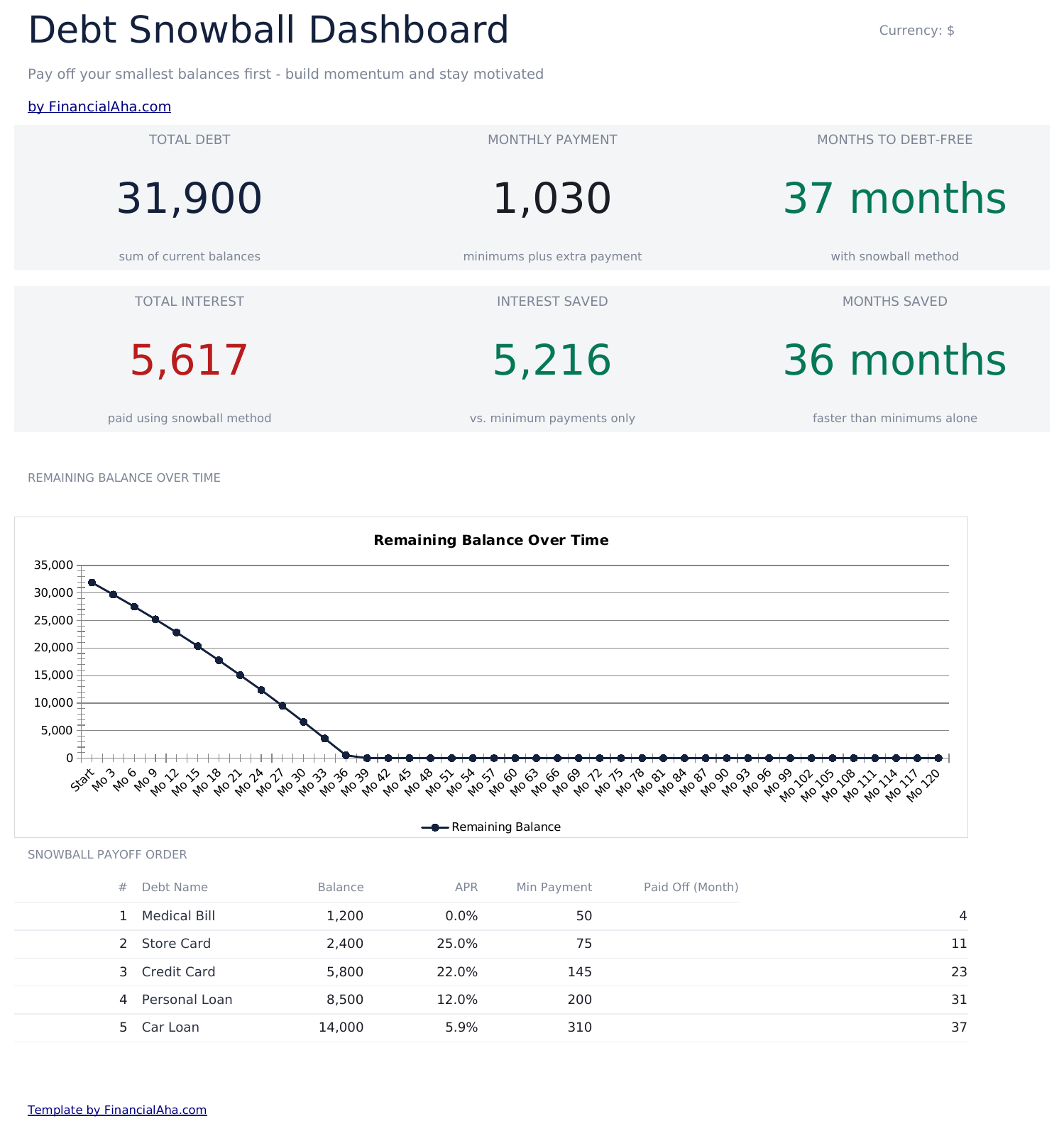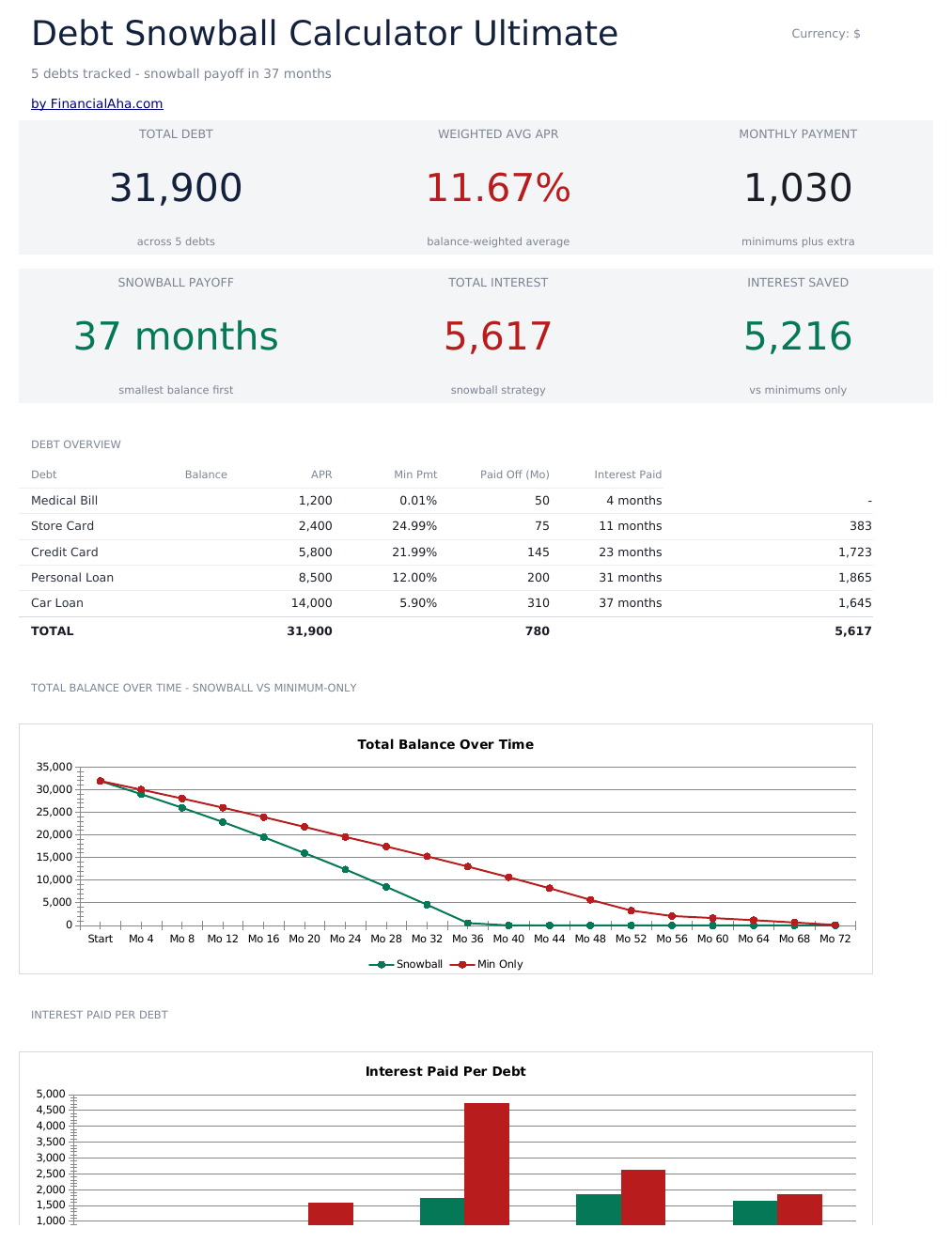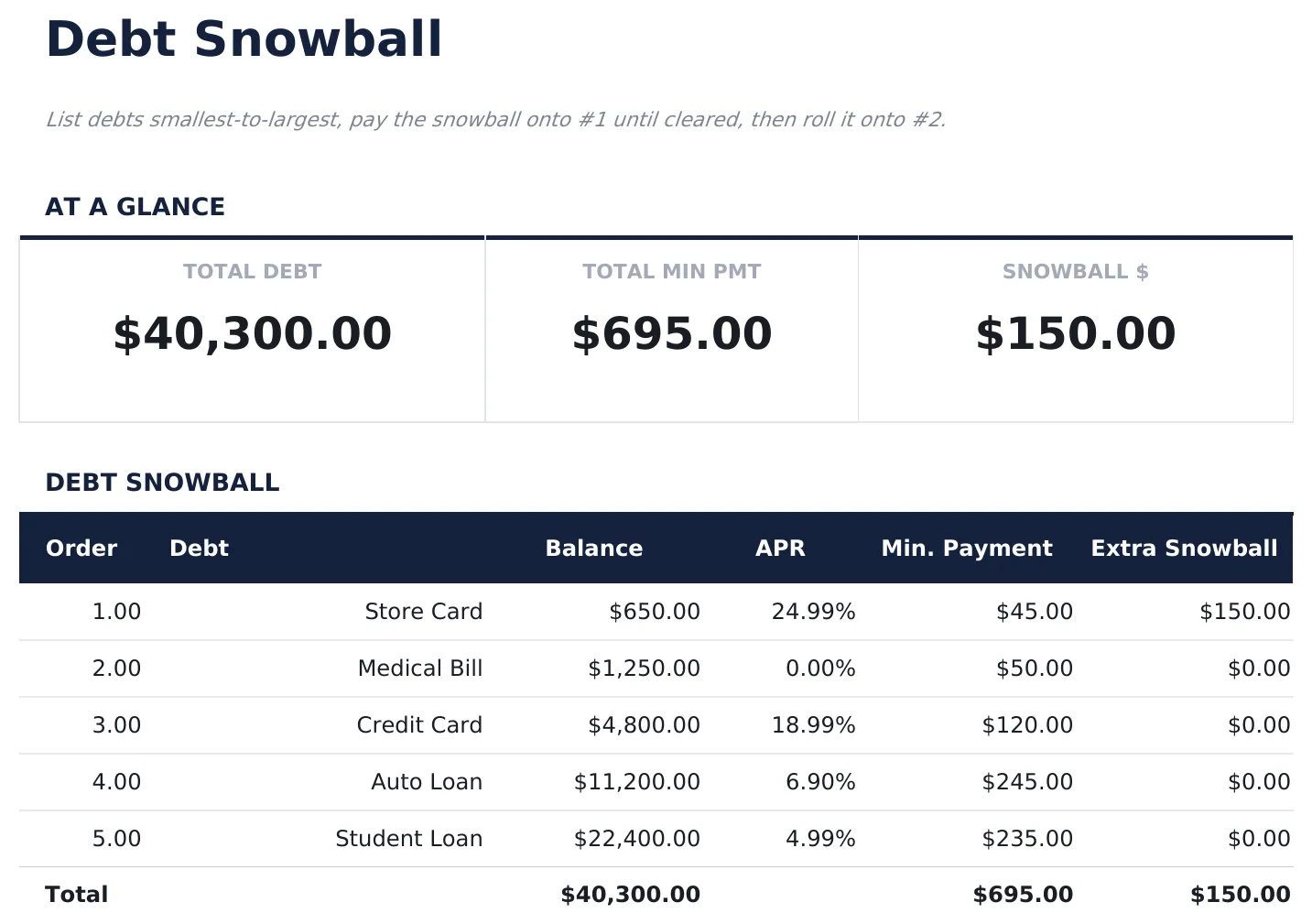
- "Debts (Snowball)" sheet with labeled columns and pre-filled sample rows you can overwrite
- Column totals update automatically as you log new entries
- Consistent layout - no setup, no pivot tables, no macros
- Step-by-step "How to Use" guide included in a second sheet
- Works in Microsoft Excel, Google Sheets, and LibreOffice Calc - no setup or sign-up
Free Debt Snowball Spreadsheet Template
List your debts from smallest to largest - the snowball method tackles the smallest first.
Essentials $12 Ultimate $19 Free See comparison
Free, Essentials, and Ultimate - what's the difference?
Essentials Debt Snowball
- Everything in Free
- Dashboard with snowball progress showing debts eliminated, current target, and projected freedom date
- Debt setup sheet sorted by balance from smallest to largest with rate and minimum payment fields
- Snowball schedule with rollover payments that automatically redirect freed-up funds to the next debt
- Payoff date projections per debt showing exactly when each individual account reaches a zero balance
Ultimate Debt Snowball
- Everything in Essentials
- Track up to 15 debts sorted by balance from smallest to largest with rate, minimum payment, and creditor details
- Dashboard with 6 KPIs: total debt, debts remaining, debts eliminated, next target debt, projected freedom date, and snowball payment amount
- Rollover payment tracking showing how freed-up payments from paid-off debts cascade into the next target
- Month-by-month elimination schedule with individual debt timelines and running snowball payment totals
How the Debt Snowball template works
List debts smallest-to-largest, pay the snowball onto #1 until cleared, then roll it onto #2. The snowball method: pay minimums on every debt, then pour every extra dollar onto the smallest balance until it is gone. Roll that payment into the next smallest, and so on.
When this template helps
You want a simple log of debts (snowball) without connecting accounts or learning a new app.
You need a record for taxes, reimbursement, or a quarterly review.
You prefer one row per entry so you can sort, filter, and total later.
You want something that opens in Excel, Google Sheets, or LibreOffice with no setup.
Tips to get the most out of it
- Pure math says highest APR first (the "avalanche"). The snowball wins by momentum - early wins keep you motivated.
- Stop using credit cards while snowballing, or you will be running on a treadmill.
Common mistakes to avoid
- Logging sporadically. A tracker only works if entries are consistent - weekly at minimum for most categories.
- Changing column labels after entering data. The formulas reference columns by position; renaming is fine, but moving columns breaks the totals.
- Letting the sheet balloon. When the row count gets unwieldy, archive older entries to a second file.
How to Use This Debt Snowball Template
Frequently Asked Questions
What is the difference between Free, Essentials, and Ultimate?
Free is a single-sheet starter template (sample data + How to Use guide). Essentials ($12) adds a dashboard, charts, expanded categories, and pre-filled subcategories. Ultimate (when available) adds multi-entity tracking, scenario analysis, and power-user reporting across 6-7 interconnected sheets.
Should I upgrade to Essentials?
Upgrade to Essentials if you want a dashboard with charts, more categories, larger capacity, and a more polished spreadsheet for ongoing use. The Free version is a good fit for one-off planning or trying out the layout.
Is Essentials worth $12?
Essentials is a one-time $12 purchase with no subscription. It typically adds a full dashboard, 30-50% more categories or rows than the Free version, and richer formulas. Most buyers upgrade after using the Free version for a few weeks and hitting its limits.
What is included in the free version?
The free Debt Snowball is a single-sheet template with sample data and a "How to Use" guide. It covers the essentials. The Essentials version ($12) adds a dashboard, larger capacity, and extended categories; Ultimate (when available) adds multi-entity tracking and ultimate-grade reporting.
Can I add more rows?
Yes. Copy the last sample row and paste below. Totals in the header recalculate automatically to include the new rows.
Does it work on Google Sheets?
Yes. Open the file from Google Drive (right-click and choose "Open with Google Sheets") - formulas are compatible.
Is the file safe to download?
Yes. No macros, no sign-up, no tracking. The file is a plain .xlsx that opens directly in Excel, Google Sheets, or LibreOffice Calc.
How do I open this in Google Sheets?
Upload the .xlsx file to Google Drive, then open it with Google Sheets. All formulas and formatting will be preserved.
What license is this template under?
All free templates are released under CC BY 4.0 (Creative Commons Attribution). You can use, modify, and share them freely - including for commercial purposes - as long as you credit FinancialAha.com. They are provided as-is and do not constitute financial advice.