
A 10-week summer job at $13/hour for 30 hours a week grosses about $3,900. FICA takes a flat 7.65 percent ($298), and federal withholding usually comes back as a refund because earnings land under the $15,750 standard deduction, so roughly $3,400 to $3,600 reaches the account. The setup that teaches the most is small: a 6-column weekly sheet, a save/spend/share split the family picks, and a short end-of-summer review.
A teenager’s first paycheck is one of the cleaner teaching moments in personal finance. Real money is involved, but the stakes are low enough that mistakes are cheap. The work below is mostly yours as a parent: set up the structure, have two or three conversations, step back. The article on age-appropriate money lessons for kids covered preschool through high school; this one zooms in on the summer-job window.
Why a first job is a teaching moment
The structure matters more than the dollars. A teen who earns $3,900 over a summer and spends most of it has still learned what most adults had to learn the hard way: gross is not net, money disappears faster than expected, and a sheet that tracks the gap is more useful than a sheet that hides it.
Three things a summer paycheck teaches that no conversation can: the gap between gross and net (7.65 percent vanishes into FICA before any spending happens), pacing (a pile of money looks bigger in week one than week ten), and trade-offs (three meals out is one tank of gas). The job does not need to be lucrative - 10 weeks at $11 to $15 per hour with 15 to 30 hours per week is enough material.
From offer to paycheck: what gets withheld and why
Take a clean baseline example. A teen earns $13/hour, works 30 hours a week for 10 weeks. Gross pay is $3,900. Here is what typically comes out:
| Line item | Rate | Amount | Notes |
|---|---|---|---|
| Gross pay | - | $3,900 | 10 weeks at $13 x 30 |
| Social Security | 6.2% | $241.80 | Employee share |
| Medicare | 1.45% | $56.55 | Employee share |
| FICA total | 7.65% | $298.35 | Federal payroll taxes |
| Federal income tax withholding | varies | $0 to ~$200 | Depends on W-4 |
| State income tax withholding | varies | $0 to ~$100 | Depends on state |
| Net pay (typical) | - | ~$3,400 to $3,600 | What lands in the account |
For a teen looking at that table, two things matter:
FICA is not refundable. Social Security and Medicare are withheld at 7.65 percent (6.2 percent Social Security plus 1.45 percent Medicare) regardless of total income for the year. That money funds those programs and does not come back at tax time. It is real tax paid, not a placeholder.
Federal income tax withholding usually is refundable at this income level. For 2025, the standard deduction for a single filer is $15,750, which is also the gross-income point at which a single dependent must file. A teen earning under that threshold owes no federal income tax, and whatever was withheld comes back as a refund the following spring when they file. They may still need to file a return to get it back. The IRS student information page is the starting point if it gets more complicated (multiple jobs, scholarships, unearned income above $1,350).
To run a specific paycheck through the same withholdings, the take-home pay calculator takes gross pay for the period plus the federal, state and local rates, then breaks the deductions out line by line, including the 6.2 percent and 1.45 percent FICA rows:
The W-4 conversation
The W-4 is the form an employer hands a new hire on day one. For a summer-only worker whose annual income will land under the standard deduction, the practical effect of filling it out is small (any over-withholding comes back as a refund). The conversation matters anyway because the form will show up at every future job.
Worth walking through together:
- What “exempt” means. A worker who had no tax liability last year and expects none this year can claim exempt on line 4(c) by writing “Exempt.” A teen with summer-job earnings under $15,750 typically qualifies. Result: no federal income tax withheld. If they end up owing tax, they pay it at filing time.
- Why some skip exempt anyway. A teen who treats a tax refund as a forced savings mechanism (the IRS holds the money, then mails it back) might prefer to leave the W-4 standard. A preference, not a rule.
Many states have their own W-4 with the same logic and lower stakes. The federal form is shorter than it looks; a single read-through together usually covers it.
The simple spreadsheet: 6 columns and a weekly cadence
A teen does not need 14 categories and a Roth-IRA-projection tab. The minimum viable budget sheet has six columns and one row per week:
| Week | Hours | Gross | Net (after FICA, withholding) | Save | Spend | Share |
|---|---|---|---|---|---|---|
| 1 | 30 | $390 | $360 | $144 | $180 | $36 |
| 2 | 28 | $364 | $336 | $134 | $168 | $34 |
| 3 | 32 | $416 | $384 | $154 | $192 | $38 |
Hours and gross come off the pay stub. Net is what hit the account. Save, Spend, and Share are however the family decides to split the net (more on that in the next section). The whole sheet fits on one tab; 10 rows plus a totals row covers a typical summer. An optional second tab for an expense log (date, what, amount, category) helps a teen answer “where did the spend pile go?” later on.
For a pre-built sheet rather than a blank one, the free Student Budget template is the closest fit, though it is organized by category rather than by week. It runs on one sheet with Category, Budgeted, Actual, and Difference columns, income rows for a part-time job, financial aid and parent support, and student expense rows including food, transportation, phone, and coffee and snacks. A summer-job teen can ignore the financial-aid row and use the rest directly.
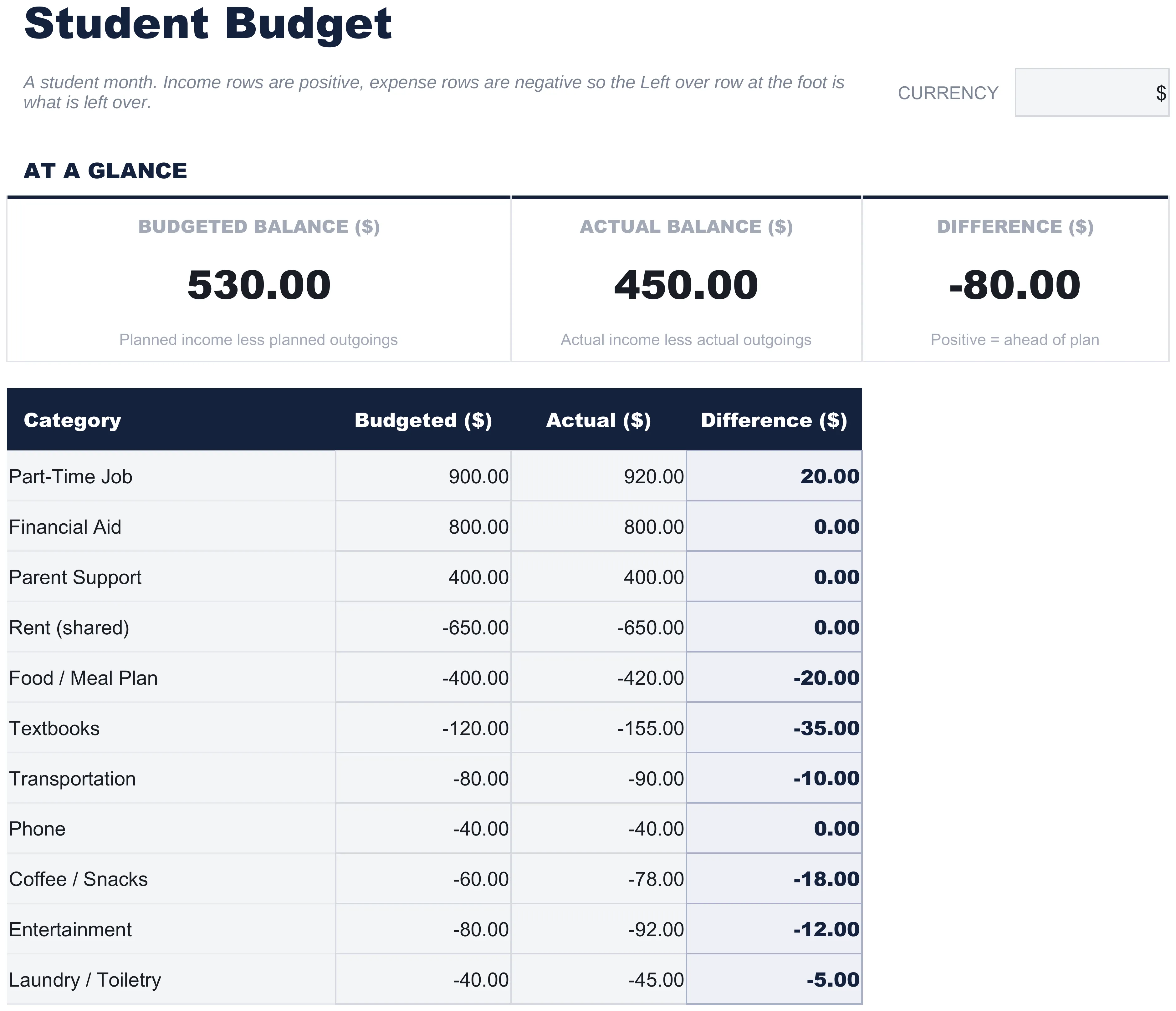 The free FinancialAha Student Budget template: one sheet, a line per category, planned beside actual. A working teen can reuse the income and expense rows and ignore the financial-aid line.
The save / spend / share framework
The framework is older than personal finance content marketing. Some portion of each paycheck goes to savings, some to spending, some to charity or gifts to others.
Two common starting splits families pick:
| Split | Save | Spend | Share | Reading |
|---|---|---|---|---|
| 50/40/10 | 50% | 40% | 10% | Saving-heavy; works when the teen has a near-term goal (car, college fund) |
| 60/30/10 | 60% | 30% | 10% | More saving-heavy; usually requires that “spending” not include essentials like gas and phone |
Other families pick 30/60/10 or 25/65/10 - more spend-heavy splits that work when the teen is paying for their own gas, phone, or social life. There is no correct percentage. The number that matters is the one your family will keep.
A few things that tend to make the framework hold up:
- What counts as “spend.” If gas and phone come out of the spend pile, the percentage reflects that.
- Timing of transfers. Same-day or Friday transfers to savings, and a monthly transfer to the share destination, keep the save and share lines from drifting. Money sitting in checking has a habit of leaving.
- A week-4 check-in. If the percentages are wrong by then, families adjust. The Week-1 decision was a guess; the Week-4 data is real.
Banking setup
Most banks offer a teen-friendly checking and savings account that runs alongside a parent account. Three common setups:
- Joint account with a parent. Parent sees transactions, can transfer in and out. Lowest friction; least independence. Common for ages 13 to 17.
- Custodial account. Account in the teen’s name; parent is custodian until they turn 18 or 21 (varies by state). The teen runs it day-to-day.
- Standalone account at 18. Available the day the teen turns 18, no parent involvement needed.
The banking choice matters less than having a separate savings sub-account where the “save” pile lands. Moving it out of checking is what makes the save percentage real. Direct deposit takes about 10 minutes to set up on day one and removes a step that paper-check teens often skip for weeks.
The “first big purchase” question
Most teens with a summer job have something specific they want to buy: a car, a phone upgrade, concert tickets, a trip with friends. Whether the purchase comes out of the spend pile or a separate save-for-something fund is where the framework gets tested. If a first car is the goal, running the full cost of owning one, including insurance, fuel, and maintenance rather than the sticker alone, keeps the target honest.
Two patterns families fall back on:
- Save-for-it fund inside the save pile. Part of the savings rate goes to the goal. A 50/40/10 split where half the save line lands in a $1,400 used-car fund keeps the saving habit and the waiting visible side by side. The same day-by-day tracking shows up in the 90-day summer savings challenge if a teen wants the goal on its own sheet.
- Stretch purchase from spend. Smaller goals like $200 headphones or a $150 concert ticket come out of the spend pile by skipping other discretionary buys for a few weeks. Closer to the real-adult version, useful at lower price points.
A defined target with a defined timeline tends to produce different behavior than “I’ll see how much I have left.”
Roth IRA for a working teen
Earned income from a summer job qualifies a teen to contribute to a Roth IRA. A custodial Roth IRA is the version for under-18 earners; the parent is custodian until the teen reaches the age of majority in their state, then the account converts to a standard Roth in the teen’s name.
The mechanics:
- Annual contribution limit is the lesser of total earned income or $7,000 (2025). A teen with $3,900 earned can contribute up to $3,900.
- Contributions are after-tax. At a teen’s typical income (under the standard deduction), the after-tax dollar and the gross dollar are usually the same, so the Roth structure costs nothing in current tax.
- Money grows tax-free. Contributions (not earnings) can be withdrawn at any time without penalty - so a $2,000 contribution that is later needed for college can be pulled back out.
Whether a custodial Roth fits is a family decision. Reasons families open one: the long compounding window, the tax structure aligning with low-income years, and the educational value of the teen watching an account grow. Reasons families skip it: the teen wants the money now, or the family does not have an existing brokerage relationship. The option exists; the family chooses.
The end-of-summer review
The most useful part of the exercise is the conversation at the end. Three numbers, three questions:
| Number | Source | Question |
|---|---|---|
| Total gross earnings | Sum of “Gross” column | What did 10 weeks of work add up to? |
| Total saved | Sum of “Save” column | Where is that money sitting now? |
| Total spent | Sum of “Spend” column | What is one specific thing it bought? |
The numbers will usually be smaller than the teen expected. That is fine. The shape of the conversation, a real total against a real plan, is what carries into future jobs. A short written note from the teen (three sentences: what worked, what surprised them, what would change) holds onto the lesson while the summer is still fresh.
Which template fits a working teen
The simplest setup needs no purchase: a Google Sheet with six columns, one row per week, does the job. For families who want the structure pre-built or want a budget the teen can keep using after summer ends:
- Student Budget (free) - Income rows (part-time job, parent support, aid if applicable) and student expense categories pre-laid-out. Closest fit for a working teen.
- Monthly Expense Tracker - One month of transactions with category, name, date, and amount, and a Summary that ranks categories by amount and by share of the total. The simplest tracking template.
- Monthly Budget Template - Adds planned-vs-actual columns. Useful for a teen heading into a longer-running after-school job who wants category targets.
The free Student Budget file works in Microsoft Excel, Google Sheets, and LibreOffice Calc. The two paid templates are Google Sheets templates you copy into your own Drive. None of the three connects to a bank account, and the paid ones are one-time purchases.
Related
Frequently asked questions
What does a 16-year-old need from a budget?
Less than an adult does. The point at this age is the habit and the math - seeing the gap between gross and net, knowing where money goes when it does not get tracked, and learning the save/spend/share split.
Will my teen have to pay taxes?
Federal income tax withholding depends on the W-4 they fill out. Many teens making under the standard deduction owe no federal income tax and get withholding refunded. Social Security and Medicare (FICA) are withheld at 7.65 percent regardless.
What is the save / spend / share split?
A common framework for younger budgeters: a portion to savings, a portion to spending, a portion to charity or gifts. The percentages are a family decision. Common starting points are 50/40/10 or 60/30/10.
Should they open a Roth IRA?
Earned income qualifies. The decision involves family preferences, the teen's interest, and access to a custodial Roth IRA. The article describes how it works; the family chooses whether it fits.
Can a teen contribute to a Roth IRA if a parent still claims them as a dependent?
Being claimed as a dependent does not block a Roth IRA. Eligibility hinges on the teen having earned income for the year, not on whether someone else claims them. The contribution is capped at the lesser of that earned income or the annual limit.
What if the summer job pays cash or issues a 1099 instead of a W-2?
Then no employer withholds FICA, but the earnings are self-employment income and self-employment tax can apply once net earnings pass $400 for the year. There is no W-4 in that case; the tax is settled at filing. Worth flagging before assuming the paycheck is tax-free.
Sources
- Topic no. 751, Social Security and Medicare withholding rates - Internal Revenue Service
- Publication 501, Dependents, Standard Deduction, and Filing Information - Internal Revenue Service
- Retirement topics - IRA contribution limits - Internal Revenue Service
- Students - Internal Revenue Service - Internal Revenue Service
About this article
Withholding rates, the standard deduction and dependent filing thresholds, and the IRA contribution limit are checked against IRS Topic 751, Publication 501, and the IRS retirement-topics page. Template details checked on 2026-09-10 against the shipped free Student Budget workbook (Student Budget and How to Use sheets), the Monthly Expense Tracker Google Sheet (Summary, Transactions, Categories) and the Monthly Budgeting Google Sheet (Budget Plan), plus the paycheck calculator component. Last reviewed September 2026.