
Your Social Security benefit comes from your 35 highest-earning years run through a progressive formula. An average earner (around $65,000 a year) lands near a $2,439 monthly benefit at full retirement age 67. Claiming at 62 cuts that by about 30%; waiting until 70 adds 24%, a swing of roughly $1,300 a month.
If you’ve ever looked at your pay stub and wondered what you’re getting for that 6.2% Social Security tax, the answer is: a monthly check in retirement, calculated from your earnings over a career. The formula behind that check is public, the math is knowable, and the claiming age you choose can swing the monthly amount by more than $1,300.
The Social Security Calculator starts from the benefit figure your Social Security statement shows for full retirement age, then compares what claiming at 62, 67 or 70 pays each month and over a lifetime. No signup required.
How the Benefit Formula Actually Works
Social Security doesn’t just look at your last few years of income or your highest salary. It uses your 35 highest-earning years, adjusted for wage inflation, and runs them through a progressive formula.
Step 1: Calculate your average. The Social Security Administration takes your 35 best years of earnings (indexed to account for wage growth over time), adds them up, and divides by 420 (that’s 35 years x 12 months). The result is your Average Indexed Monthly Earnings, or AIME.
If you’ve worked fewer than 35 years, zeros fill the gaps. Those zeros drag down the average meaningfully - more on that below.
Step 2: Apply the benefit formula. The PIA (Primary Insurance Amount) calculation is deliberately progressive, replacing a higher percentage of lower earnings:
- 90% of the first $1,226 of AIME
- 32% of AIME between $1,226 and $7,391
- 15% of AIME above $7,391
(These bend points are 2025 figures and adjust annually.)
Step 3: Adjust for claiming age. The PIA is what you’d receive at full retirement age (67 for anyone born in 1960 or later). Claiming earlier permanently reduces the benefit. Claiming later permanently increases it.
Putting Numbers to It
Take someone with average career earnings around $65,000/year, giving them an AIME of roughly $5,400.
PIA calculation:
- 90% x $1,226 = $1,103
- 32% x ($5,400 - $1,226) = $1,336
- PIA: approximately $2,439/month
Now, the claiming age decision:
| Age | Monthly Benefit | Annual | Change from FRA | |-----|----------------|--------|-----------------| | 62 | ~$1,707 | $20,484 | -30% | | 65 | ~$2,114 | $25,368 | -13% | | 67 | ~$2,439 | $29,268 | Full benefit | | 70 | ~$3,024 | $36,288 | +24% |
The spread between 62 and 70 is about $1,300/month. Over a 20-year retirement, that’s roughly $316,000 in additional benefits.
To run these numbers against your own figures, enter your benefit at full retirement age along with your current age and a life expectancy estimate:
The Claiming Age Dilemma
This is the question that dominates Social Security planning conversations, and there’s no single right answer because it depends on something nobody knows: how long they’ll live.
The breakeven math. Someone claiming at 62 collects smaller checks but starts collecting 8 years earlier than someone waiting until 70. The crossover point, where total lifetime benefits from waiting exceed total benefits from claiming early, falls around age 80. Live beyond that, and waiting pays more in total. Die before that, and early claiming was the better financial move.
When claiming early makes more sense. Health issues that suggest a shorter life expectancy. Immediate need for income. No other resources to bridge the gap between retirement and age 70. A reduced benefit that still covers essential expenses.
When waiting tends to pay off. Good health and family history of longevity. Other income sources to cover expenses in the meantime. A desire to maximize the guaranteed inflation-adjusted income stream. A spouse who would benefit from higher survivor benefits.
Neither choice is a mistake. They’re tradeoffs with different risk profiles.
The Working Years Factor
Because the formula uses 35 years, having fewer working years means zeros in the calculation. This affects more people than you might expect - anyone who took time off for caregiving, education, career changes, or extended unemployment.
Someone with 30 years of $60,000 earnings has five zeros averaged in. Each zero pulls the AIME down, reducing the monthly benefit by potentially several hundred dollars. Working five additional years to replace those zeros with actual earnings can meaningfully increase the benefit.
On the other hand, someone with 40+ years of work history only benefits from additional years if current earnings are higher than the lowest year already in the calculation. At some point, additional working years barely move the number.
Spousal Benefits
A spouse can receive up to 50% of the higher earner’s PIA, regardless of their own work history. If the spouse also has their own earnings record, Social Security pays the higher of the two - their own benefit or the spousal benefit. Not both.
This matters most in single-earner households or where one spouse earned significantly more than the other. The spousal benefit provides a floor that doesn’t require the lower-earning spouse to have worked 35 years themselves.
What Social Security Doesn’t Cover
For average earners, Social Security replaces roughly 40% of pre-retirement income. For higher earners, the replacement rate is lower because of the progressive formula (that 15% rate on earnings above the second bend point).
The gap between Social Security and actual retirement expenses has to come from somewhere. A quick way to estimate the savings needed:
Someone who needs $4,000/month in retirement with a $2,400 Social Security benefit has a $1,600/month shortfall. Using the 4% rule as a rough guide, covering that gap requires about $480,000 in savings ($1,600 x 12 / 0.04).
The Retirement Financial Planning Template works that gap from the other side. Its Inputs tab takes one monthly pension figure, the age that pension starts, any other income, and your annual expenses, then draws the difference between expenses and income from a single combined savings balance.
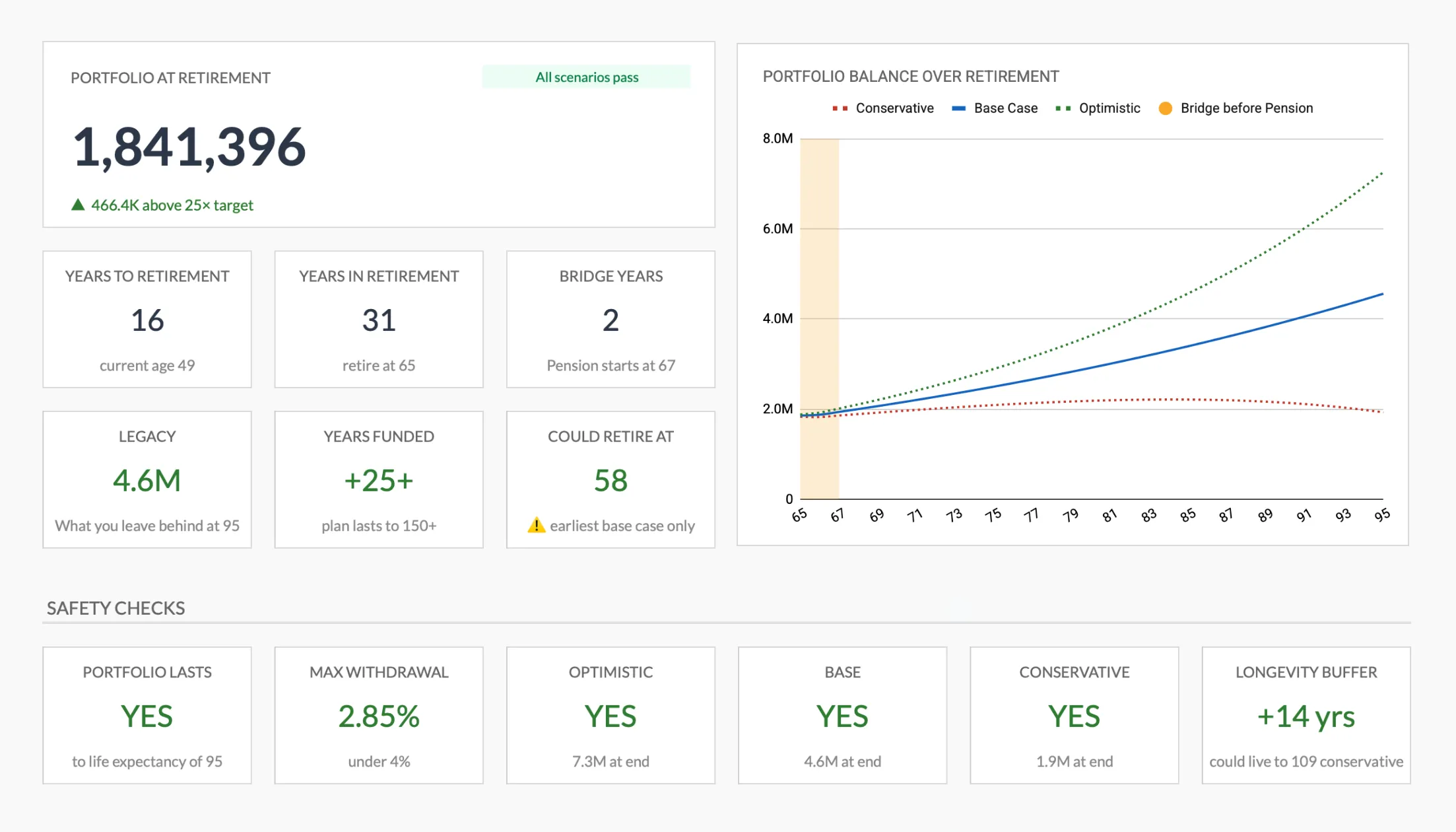 The Retirement Financial Planning Template (Premium tier) projects your portfolio balance across conservative, base case and optimistic scenarios, with the bridge years before pension income starts shaded.
The Solvency Question
It comes up in every conversation about Social Security: will it still exist when I retire?
The short version: the retirement trust fund is projected to run short in the early 2030s. But “shortfall” doesn’t mean “zero.” Even without any legislative changes, ongoing payroll taxes would fund approximately 75-80% of scheduled benefits. Benefits would likely be reduced, not eliminated.
Whether reforms happen before or after the shortfall, and what those reforms look like, is a political question, not a mathematical one. For planning purposes, some people use their full estimated benefit. Others discount it by 20-25% as a conservative assumption. Running the calculator at both levels gives a range to plan around.
More on Retirement Planning
- Retirement Calculator: Planning for the Future - How to estimate total retirement needs and the gap Social Security may not cover
- Savings Calculator: How Your Money Grows - How compounding builds the savings that cover the gap Social Security leaves
Related
Frequently asked questions
When can I start collecting Social Security?
The earliest is age 62, but benefits are permanently reduced (by about 30% from full retirement age). Full retirement age is 66-67 depending on birth year. Delaying past full retirement age increases benefits by 8% per year up to age 70.
Does Social Security keep up with inflation?
Yes. Benefits receive annual cost-of-living adjustments (COLAs) based on the Consumer Price Index. The adjustment varies year to year.
Can I work and collect Social Security?
Yes, but before full retirement age, benefits are temporarily reduced if earnings exceed certain limits. After full retirement age, there's no reduction regardless of earnings.
Are Social Security benefits taxable?
Sometimes. If your combined income (adjusted gross income, plus nontaxable interest, plus half of your benefits) rises above certain thresholds, up to 85% of benefits can be subject to federal income tax. Some states tax benefits, others do not. A benefit calculator estimates the gross monthly amount, not the after-tax figure.
How do I see my actual earnings record and benefit estimate?
The Social Security Administration publishes your indexed earnings history and a personalized benefit estimate through a free my Social Security account at ssa.gov. Those figures are the most accurate starting point; a calculator fills in from assumptions when you do not have them at hand.
Will Social Security be around when I retire?
The trust fund faces a projected shortfall, but benefits are unlikely to disappear entirely. Most projections show the system could still pay 75-80% of scheduled benefits even without reform. Planning for reduced benefits is a reasonable precaution.
Sources
- Primary Insurance Amount (PIA) bend points - Social Security Administration
- Benefit formula (PIA) - Social Security Administration
- Early or late retirement: benefit reduction - Social Security Administration
- Delayed retirement credits - Social Security Administration
- Cost-of-living adjustment (COLA) - Social Security Administration
- A Summary of the 2026 Annual Reports (Trustees Report) - Social Security Administration
About this article
PIA bend points, the early-claiming reduction and delayed-retirement credit percentages are checked against the Social Security Administration's published 2025 figures. The worked benefit example is recomputed from the SSA PIA formula for an AIME of roughly $5,400 at full retirement age 67. Calculator inputs and outputs, and the Retirement Financial Planning Template's income inputs, were checked on 2026-09-10 against the shipped calculator component and the Retirement Planning workbook (Summary, Inputs and Projections tabs). Last reviewed September 2026.