
A practical guide to setting financial goals mid-year - including assessment of current progress, goal prioritization, and creating achievable plans for remaining months.
Mid-year goal setting has a real advantage over January resolutions: you have actual data. You know your real income, spending, and savings - no guessing. The shorter time frame forces prioritization, which often produces better results than trying to change everything at once.
Planning tools: The Financial Planning Template holds your target figures on a Goals tab and projects assets and debt out to a year you pick, while the Monthly Budget Template splits each month’s savings across goal rows.
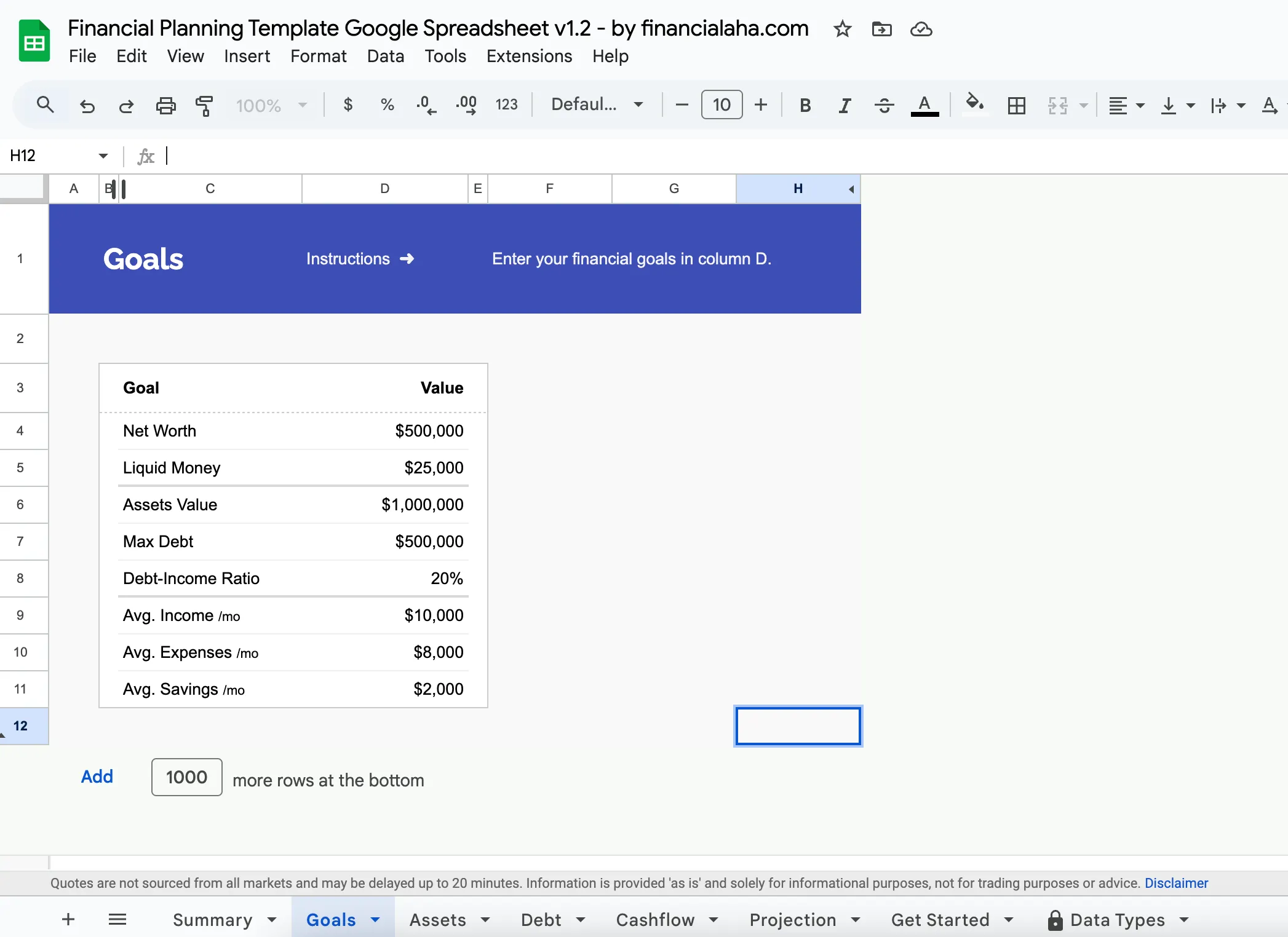
The Goals tab in the Financial Planning Template (Premium) holds eight fixed targets, and the Summary tab marks each one as met or not.
What Actually Changed Since January?
Before setting goals, gather the real numbers from January through now:
| Metric | Year to Date | Monthly Avg | Projected Year Total |
|---|---|---|---|
| Income | $36,000 | $6,000 | $72,000 |
| Spending | $30,000 | $5,000 | $60,000 |
| Savings | $6,000 | $1,000 | $12,000 |
Also check: debt paid down, current balances, and where savings are actually going.
The 1-2-3 Method
Choose:
- 1 major goal (gets most attention)
- 2 supporting goals (progress without full focus)
- 3 habits to maintain (don’t let these slip)
Example:
- Major: Pay off $3,000 credit card
- Supporting: Build emergency fund to $2,000, reduce dining out
- Maintain: Continue 401(k) contributions, track expenses weekly, monthly budget review
Still deciding which goals deserve the major slot? Our list of 5 financial goals worth considering is a useful starting point.
Make Goals Specific
Vague: “Save more money” Specific: “Save $500/month for 6 months = $3,000 in emergency fund by December 31”
Vague: “Pay off debt” Specific: “Pay extra $400/month on credit card to eliminate $2,400 balance by year end”
Calculate Monthly Requirements
Goal: $6,000 emergency fund by December Current: $2,500 Gap: $3,500 Months remaining: 7 Monthly requirement: $500/month
If the monthly number isn’t realistic, adjust the goal or timeline.
To see how a monthly contribution grows toward a target, including any interest a high-yield account adds along the way, run the numbers below.
Setting a Target on an Irregular Income
The math above assumes a steady paycheck. When income varies month to month (freelance work, commission, seasonal hours), a fixed monthly requirement can stall in a lean month. One approach is to base the target on the average of your three lowest months so far this year rather than your best months, then treat anything above that baseline as an extra push toward the goal. Percentage-based targets also travel better than dollar amounts: committing a share of each payment, whatever its size, keeps progress moving without a fixed number that a slow month can’t meet.
Create an Action Plan
| Element | Detail |
|---|---|
| Number | $2,400 credit card balance |
| Timeline | 6 months (July-December) |
| Method | $400/month extra payment |
| Tracking | Monthly balance check |
| Obstacles | Holiday spending, unexpected expenses |
| Adjustments | If miss a month, add $200 to next 2 months |
Track Progress
Monthly Check-In
Review progress toward each goal, what’s working, and what needs adjustment. If you are juggling several targets at once, a dedicated savings goal tracker spreadsheet keeps each one visible in a single view. A quarterly rhythm works too: a Q2 check-in is a natural point to measure progress against the plan you set in January.
Visual Progress
Emergency Fund: $2,500 → $6,000
[████████░░░░░░░░░░░░] 42%
Mid-Year Adjustments
Behind on savings: Reduce the goal to something achievable, extend the timeline, find one expense to cut, or add a temporary income source.
Ahead of plan: Increase the goal, add a secondary goal, or accelerate the timeline.
Circumstances changed: Recalculate based on new reality. Flexibility isn’t failure.
Simple Goal Tracker
| Goal | Target | Current | % Complete | Monthly Need |
|---|---|---|---|---|
| Emergency Fund | $6,000 | $2,500 | 42% | $500 |
| Credit Card | $0 | $2,400 | 0% | $400 payment |
The quickest next step is to pull your own year-to-date numbers into a single table like this one. The Financial Planning Template works from a fixed set of eight targets rather than custom rows: net worth, liquid money, assets value, max debt, debt-income ratio, and average income, expenses and savings per month. The Summary tab marks each one met or not once the asset and debt rows are current.
Related
- Financial Planning Template - Fixed targets and a long-range projection
- Monthly Budget Template - Allocate toward goals
- Net Worth Tracker - Milestones marked reached with a date
- 5 Financial Goals Worth Considering - Ideas for the major slot
- Emergency Fund Calculator - Size a savings target
Frequently asked questions
Is it too late to set financial goals mid-year?
Any time is a good time to improve finances. Mid-year has advantages - real data and forced prioritization. Starting now beats waiting for January.
How many goals is too many?
For most people, 2-3 focused goals work better than 5+ scattered ones. Deep progress on a few goals beats shallow effort on many.
What if my goals aren't achievable in the remaining months?
Set the goal for what's achievable by year-end, then continue into next year. Progress matters more than arbitrary deadlines.
How do I decide whether to tell others about my goals?
Research is mixed. Some people do better with accountability, others feel accomplishment just from announcing and then lose motivation. Know yourself and choose accordingly.
Should I prioritize debt payoff or savings for the rest of the year?
The 1-2-3 method lets one major goal run alongside supporting ones, so many people work a debt payoff and a small savings buffer at the same time rather than sequencing them. Others clear high-interest debt first, then redirect that payment into savings. The comfortable split usually comes down to the interest rate on the debt and how much cash cushion feels safe.
How do I keep year-end goals on track through the holidays?
Holiday spending is the most common reason a fourth-quarter goal slips, which is why it is worth writing into the plan as an expected obstacle rather than a surprise. One approach is to set the monthly requirement slightly higher from July to October so November and December carry a smaller load, then track the balance the same way the rest of the year.
About this article
Template references checked on 2026-09-10 against the shipped Financial Planning Google Sheet (Goals, Summary, Projection tabs) and the Monthly Budgeting Goals sheet. Dollar figures throughout are illustrative examples, not survey data. Last reviewed September 2026.