
A per-child school supplies spreadsheet built from the school's supply list typically lands between $50 and $200 per K-12 kid, with the spread driven by grade level, required tech, and brand choices. The NRF's 2025 survey puts the average family supplies spend at $143.77. One row per child, with columns for quantity, have-on-hand, to-buy, and estimated price, keeps several kids from blurring into one pile of receipts, while a tax-holiday flag and shared-item math catch the savings most families miss.
The supply lists arrive in late summer. A PDF from the teacher, a kit the school sells, or a poster taped near the office. The list answers the “what.” A small spreadsheet answers the “how much,” “per which kid,” and “did we already buy half of this last spring.” The NRF’s 2025 survey puts the average K-12 family’s supplies spend at $143.77, but that single number hides a wide per-kid range, roughly $50 to $200, driven by grade level, required tech such as a scientific or graphing calculator, headphones, or sometimes a tablet, and brand choices.
Why a per-child structure matters
Two kids on one supply line is how families lose track. A $30 calculator for one, a $12 set of markers for the other, a shared box of pencils. By September it is a pile of receipts and a vague sense that it was more than last year.
One row per child fixes that. Column headers are categories from the school’s list; rows are kids; totals show up at the bottom and on the right. Works for one kid, three kids, or a teacher-parent household where the adult also has classroom supplies to track.
Parsing the supply list into spreadsheet rows
The school’s list is the input. The translation is mechanical:
- Each item on the list becomes a row.
- Quantity is a column (the list often says “4 folders” or “two packs of pencils”).
- A “have on hand” column captures what is already in the closet from last year.
- A “to buy” column is the difference.
- Estimated unit price and a total round it out.
Five columns. The categories below organize the rows.
Common supply categories
Most K-12 lists break into the same six buckets:
- Writing supplies. Pencils, pens, erasers, sharpeners, highlighters, dry-erase markers. The single largest count of items, the smallest unit cost.
- Paper. Spiral notebooks, composition books, loose-leaf, graph paper, folders, dividers, sticky notes. Where the per-kid difference between grades shows up most (3 folders in 2nd grade vs 8 in 8th).
- Organization. Binders, pencil pouches, planner or agenda, expandable file. Often the most durable line - good ones carry over 2 to 3 years.
- Art. Crayons, colored pencils, markers, glue sticks, scissors, rulers, watercolors. Concentrated in K-5; thins out in middle school and high school.
- Tech. Headphones, USB drives, scientific or graphing calculators, sometimes a required tablet or laptop. The category that swings the total.
- Miscellaneous. Tissues, hand sanitizer, baby wipes, gallon zip bags. These are usually “for the classroom,” not for the kid - some lists separate them, some do not.
A simple layout, two kids:
| Item | Category | Kid A qty | Kid A unit $ | Kid A total | Kid B qty | Kid B unit $ | Kid B total |
|---|---|---|---|---|---|---|---|
| #2 pencils (24-pack) | Writing | 1 | $4 | $4 | 1 | $4 | $4 |
| Composition notebooks | Paper | 4 | $2 | $8 | 6 | $2 | $12 |
| Crayola 24 crayons | Art | 1 | $3 | $3 | 0 | - | $0 |
| Scientific calculator | Tech | 0 | - | $0 | 1 | $14 | $14 |
A totals row at the bottom. A “have on hand” toggle that zeros the line if the item carries over.
Brand vs generic - the “brand worth it” column
Families have strong, mixed opinions here. Some items are noticeably different by brand; others perform the same at half the price. It depends on the item and the kid.
A few patterns parents tend to settle into:
- Markers and crayons. Brand-name often performs differently from generic on smooth coverage and washability. Some families find the gap worth paying for; others do not.
- Scissors and rulers. Brand and generic both work; the kid loses them at the same rate either way.
- Glue and tape. Some specific products (like a particular glue stick) have a following with teachers. Worth a one-time test.
- Folders and notebooks. Paper weight differences are real but small. Most kids do not notice.
- Backpacks and lunch boxes. The category with the widest durability gap. A $15 backpack that lasts one year and a $45 backpack that lasts three are roughly the same per-year cost.
The “brand worth it?” column is a yes/no a household fills from experience. After two or three years, the column starts to drive the planned-vs-actual gap.
Multi-child sharing
Three or more kids changes the math in places that are not on the list:
- Calculators, rulers, protractors, compasses. Often used in one class per year. Can rotate between siblings if the timing works.
- Glue, tape, sticky notes. A bulk pack split between kids costs less than two individual packs.
- Backpacks and lunch boxes (younger kid). Hand-me-downs work when the older kid is over them but they are still in good shape.
- Art supplies. A shared art bin at home covers most of what the supply list asks for in K-2.
A “shared with” column on each row turns the per-child total into a more realistic per-purchase total. The kid’s row keeps the assignment; the household total stops double-counting.
State sales-tax holidays
Many states run a sales-tax holiday on school supplies in late July or early August. Eligible items, dollar caps, and dates vary. A few patterns:
- Most fall on a Friday-through-Sunday weekend, late July through mid-August.
- Items typically eligible: school supplies under a per-item cap (often $20 to $50), clothing under a cap (often $100), and in some states, computers and tablets under a cap ($750 to $1,500).
- The Federation of Tax Administrators maintains a running list of state holidays and rules each year.
A “tax-eligible?” column on the spreadsheet flags which planned purchases line up with the state’s holiday window. At 6.5% sales tax, a $215 supply run skips about $14; a $1,275 cart with electronics skips $83. The cap rules decide the rest.
The back-to-school template covers the broader clothing-and-electronics side of tax-holiday planning. The supplies sheet just needs the eligible-or-not flag.
The Educator Expense Deduction (for teacher-parents)
Worth knowing if there is a teacher in the household. The IRS allows eligible educators to deduct up to $300 of unreimbursed classroom expenses as an above-the-line adjustment to income on Schedule 1. Married couples both teaching get up to $600 combined, $300 each.
Eligibility:
- Kindergarten through grade 12.
- Teacher, instructor, counselor, principal, or aide.
- At least 900 hours during the school year at a school providing elementary or secondary education.
Eligible expenses:
- Books, supplies, and classroom materials.
- Computer equipment, software, and services used in the classroom.
- Professional development courses.
- Athletic supplies (for PE/health courses).
- Personal protective equipment and disinfectant.
Because it is above-the-line, a teacher takes it whether they itemize or take the standard deduction. A “for my classroom” column on the teacher-parent’s row totals qualifying expenses through the year. At a 22% marginal rate, a fully used $300 deduction is worth roughly $66 in federal tax savings. Receipts have to support it - keeping the spreadsheet next to a receipts folder is the practical version.
Year-over-year comparison
A second tab labeled with last year’s total per kid is the single most useful add after year one. Year-two planned numbers are calibrated, not guessed. By year three, they tend to land within 10 to 15 percent.
Three places where year-one actuals usually beat year-one plans:
- Fees and activity supplies that show up in September. Lab fees, field trip deposits, gym uniforms. Not on the original supply list.
- Tech replacements that get pushed forward. A pair of headphones that “still works” until week three. A calculator that someone else in the class has and the kid wants.
- Mid-year replacements. Pencils, glue sticks, folders. The kid losing or chewing through supplies is a real line. Some families add a small reserve to the planned total (often 10 to 15%) so a January re-order is already accounted for.
A short post-September note tucked into the spreadsheet, covering what was spent, what got missed, and what to change, surfaces again next July.
Templates that fit
A standalone supplies sheet does the job for most families. For households that want the August spend sitting next to the rest of the month’s money, a budget template is the next step up.
- Monthly Expense Tracker - For “where did the August money actually go.” Add a school supplies category on the Categories sheet, log each receipt in Transactions with a name, date and amount, and it lands in the month’s expense total.
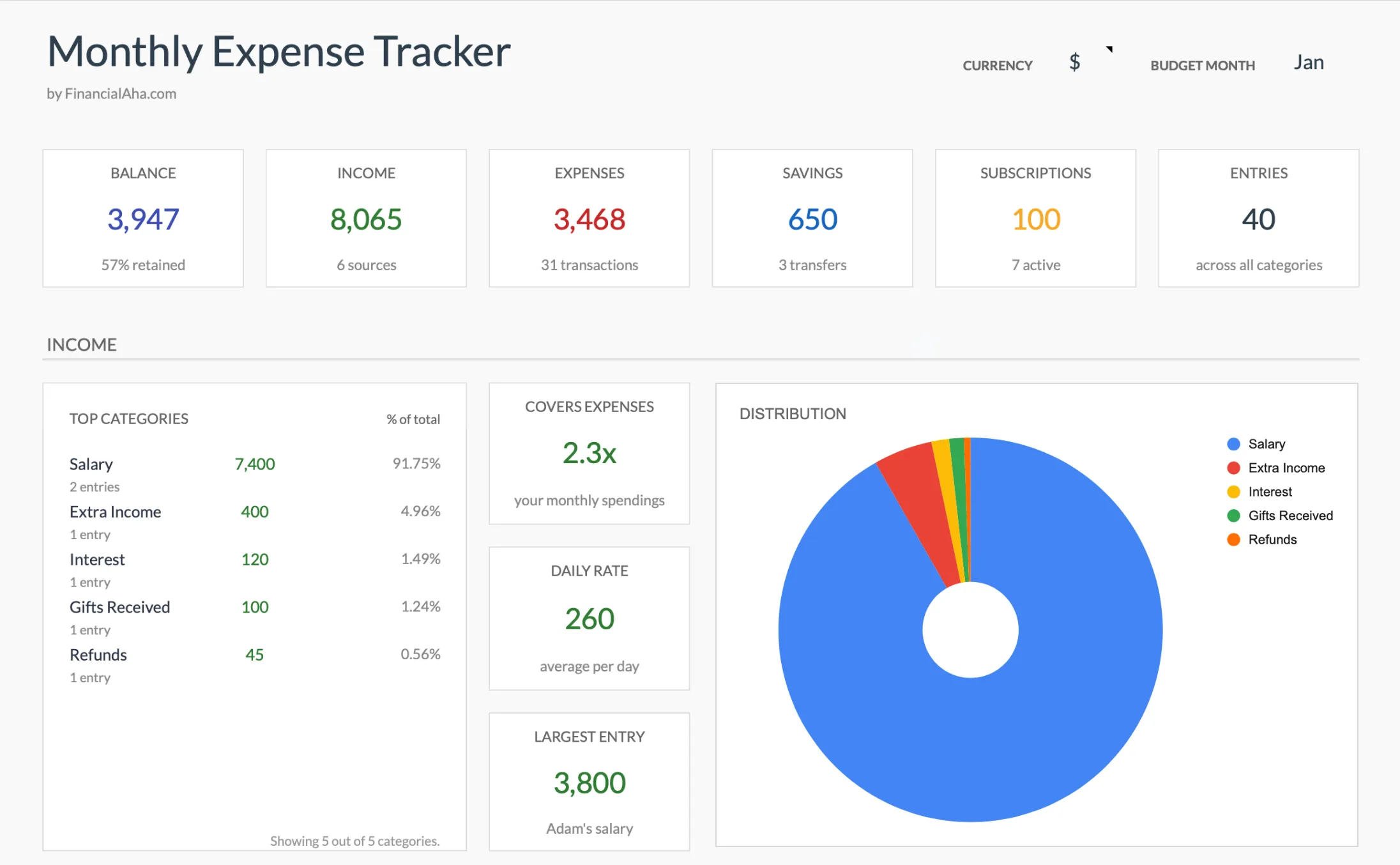 The Monthly Expense Tracker (Premium tier) summary view. It covers one month at a time, so a school supplies category feeds the expense total and the entry count here, alongside the rest of that month’s spend.
- Household Budget (free) - Free, one month of household money on a single sheet. The fixed rows include Childcare / School, Household Supplies and Family Activities, with spare blank rows to type into and Budgeted, Actual and Difference columns on each.
- Monthly Budget Template - Planned versus actual by category for the month. Children, Clothing and Household Supplies sit among the 17 expense categories, and each row carries a difference figure and a percent-spent figure.
The free Household Budget works in Microsoft Excel, Google Sheets, and LibreOffice Calc; the two paid templates are Google Sheets files. None of them connect to a bank account, so every figure is typed in, and the paid templates are one-time purchases.
Related
Frequently asked questions
How much should I budget for school supplies?
Per-child K-12 supply costs typically run $50 to $200, with the wide range driven by grade level, school requirements (a specific calculator, headphones, sometimes a tablet), and preferences on brands. The NRF's 2025 survey puts the average family supplies spend at $143.77, but that average hides the per-kid spread. The spreadsheet builds the number from the actual supply list rather than a national average.
Is the school's pre-packaged supply kit cheaper than buying à la carte?
Sometimes, sometimes not. The kit trades convenience for control: it can include items already in the closet from last year and lock in brands the household would swap. Pricing the same list in the spreadsheet, then setting the kit price against the 'to buy' total, is the honest comparison.
What about tax-free shopping?
Many states have a sales-tax holiday on school supplies for one weekend in late July or August, with eligible items and dollar caps that vary by state. The Federation of Tax Administrators publishes each year's dates and rules. A 'tax-eligible?' column flags which planned purchases line up with the window.
How do I handle classroom-donation items that aren't for my own kid?
Tissues, hand sanitizer, and gallon zip bags are often 'for the classroom' rather than for one child. Keeping them on a separate line, or a shared row rather than a per-child one, stops them from inflating an individual kid's total.
Are these supplies tax-deductible?
For most parents, no. Teachers can deduct up to $300 of unreimbursed classroom expenses through the federal Educator Expense Deduction. Some states offer a separate education credit; rules vary by state.
Sources
- Back-to-School Season Begins Early for Majority of Shoppers - National Retail Federation
- Topic No. 458, Educator Expense Deduction - Internal Revenue Service
- Sales Tax Holidays - Federation of Tax Administrators
About this article
Supplies spending averages checked against the National Retail Federation's 2025 back-to-school survey. Educator Expense Deduction figures checked against IRS Topic No. 458; state sales-tax-holiday details against the Federation of Tax Administrators' list. Template claims checked on 2026-09-10 against the shipped Monthly Expense Tracker (Summary, Transactions, Categories tabs), Monthly Budgeting (Budget Plan, Transactions, Categories, Goals tabs), and the free Household Budget workbook. Last reviewed September 2026.