
The number that actually compares camps is per-week-all-in, not the sticker tuition. A spreadsheet lines up 2 to 4 camps across five cost categories (tuition, transport, gear, tuck-shop extras, and any lost work hours) so the real gap shows up. Day camp can qualify for the Dependent Care FSA when both parents work; overnight camp generally does not, per IRS Publication 503. Sibling discounts, shared gear, and the FSA reimbursement are where the totals shift most.
Late June is when families with young kids start finalizing camp plans, sometimes for this summer, sometimes for next. The question is rarely “should we send them” - that decision is usually settled. The question is “which option, and what does it actually cost?” Brochure prices answer the first half. A spreadsheet answers the second.
Why camp deserves its own spreadsheet
Eight weeks at a day camp at $400/week ($3,200) and four weeks at a sleepaway at $1,350/week ($5,400) look close on paper. Once gear and transportation come in, the gap can swing either direction.
According to the American Camp Association, day camp typically runs $50 to $500 per week and overnight camp runs $1,000 to $2,000 per week, with specialty programs at the top end of each. A spreadsheet narrows that wide range to the specific weeks, vendors, and gear list in front of you.
A $5,000 to $8,000 summer is large enough to deserve its own budget line. Many families spread it across the year with a sinking fund rather than absorbing it in one month. The article on budget categories most people forget called this out for irregular costs in general; camp is one of the bigger ones.
The 5 cost categories
Tuition is the visible number. Four other categories quietly catch up to it.
| Category | What goes here | Typical range |
|---|---|---|
| Tuition | Per-week or per-session fee charged by the camp | $50 to $2,000/week |
| Transport | Gas, mileage, bus fee, drop-off trips per week | $20 to $200/week |
| Gear | Trunk, sleeping bag, water bottle, specialty equipment | $0 to $400 first year |
| Extras | Tuck-shop, photo packages, end-of-session gifts, swim tests | $20 to $200/session |
| Opportunity cost | Lost work hours for drop-off, pickup, late-start days | Varies |
Two of the five usually surprise first-time families: gear and extras. Gear hits hardest the first year; a returning family reuses most of it. Extras tend to be under-budgeted because each line item is small.
Opportunity cost is the most divisive line. Some families count lost work hours as a real cost; others treat it as a wash because the alternative (a child at home) has its own time cost. The spreadsheet lets you toggle it on or off.
Tuition vs total cost
A worked example. Two camps for one 8-year-old, July 2026:
| Line | Camp A: Day camp | Camp B: Sleepaway |
|---|---|---|
| Tuition | 4 weeks x $375 = $1,500 | 2 weeks x $1,400 = $2,800 |
| Transport | 20 round trips x $8 gas = $160 | 2 round trips x $40 = $80 |
| Gear | $80 (water bottle, swim gear) | $310 (trunk, sleeping bag, flashlight, stamps) |
| Extras | Lunches $120, end-of-session shirts $40 | Tuck $80, photos $35, laundry $25 |
| Subtotal | $1,900 | $3,330 |
| Per-week-all-in | $475 | $1,665 |
Per-week-all-in is the comparable number. Camp A is $475 per child-week; Camp B is $1,665. Tuition alone made the gap look like $1,400 vs $2,800 (2x). All-in, the gap is 3.5x.
Camp A and Camp B sell different things; the table is not an argument for one or the other. The point is that the comparable number is rarely the sticker price.
The Dependent Care FSA angle for day camp
This is a category where the rules matter more than the strategy. From IRS Publication 503:
“The cost of sending your child to an overnight camp isn’t considered a work-related expense.”
But:
“The cost of sending your child to a day camp may be a work-related expense, even if the camp specializes in a particular activity, such as computers or soccer.”
Translation: day camp can qualify for the Dependent Care FSA (and the Dependent Care Tax Credit), overnight camp generally does not. The qualifying condition is that the care enables both parents (or a single parent) to work or look for work. Specialty day camps (soccer, coding, art) count if the day-camp condition is met.
The dollar mechanics:
- Dependent Care FSA: up to $7,500/year per household ($3,750 if married filing separately) of pre-tax dollars set aside for qualifying care, starting in 2026. The cap was $5,000 from 1986 through 2025; the One Big Beautiful Bill Act raised it under IRC Section 129. Day camp tuition counts; gear and extras do not.
- Dependent Care Tax Credit: if not using an FSA, a credit on qualifying expenses up to $3,000 for one child or $6,000 for two or more. The credit percentage scales with AGI; Publication 503’s rate table has the figure for your income and filing year.
Households generally use one or the other, not both for the same dollars. Which one comes out ahead depends on tax bracket and AGI - the math is in Publication 503’s worksheets.
For the spreadsheet: a column flagging each tuition line as “FSA-eligible (day camp)” or “Not eligible (overnight)” totals the eligible amount and compares it to the $7,500 cap. A household in the 22% federal bracket that runs the full $7,500 of day-camp tuition through an FSA shelters roughly $2,224 in combined federal tax (22%) and FICA (7.65%) on payroll-funded contributions, before state tax. At the old $5,000 cap the shelter was about $1,482, so the OBBBA change is worth roughly $740 a year for a household using the full new room. Exact number depends on the rest of the return.
Multi-child math
Two kids changes the picture in three ways:
- Sibling discounts - many overnight camps offer 5 to 15 percent off the second child. Day camps less commonly. Worth asking; it does not show up on the brochure.
- Shared gear - a trunk, a sleeping bag, a flashlight. A second child reuses most of it. Camp clothing labels, water bottles, and personal items do not share well.
- Transport scales sub-linearly - one drop-off trip per day, regardless of how many kids ride in the car. Splits the per-child transport cost in half (or more, for three-plus kids).
Worked example, two kids at the same overnight camp, 2 weeks:
| Line | One child | Two children | Per-child |
|---|---|---|---|
| Tuition | $2,800 | $5,320 (5% sibling discount on second) | $2,660 |
| Transport | $80 | $80 (same trips) | $40 |
| Gear | $310 | $410 (reuse most, add second water bottle, sleeping bag) | $205 |
| Extras | $140 | $260 (each kid has tuck) | $130 |
| Total | $3,330 | $6,070 | $3,035 |
Per-child total drops from $3,330 to $3,035 - about a 9% per-kid saving from sibling discount, shared gear, and shared transport. Worth knowing when weighing camp against split arrangements (one kid at camp, one with a relative).
Specialty camps and what they add
Sports, STEM, arts, language immersion - the structure is the same as a generic day or overnight camp, but some line items shift:
| Specialty | Typical add-on cost | Notes |
|---|---|---|
| Sports (tennis, soccer, hockey) | $50 to $400 in equipment | Sometimes provided; often not for older kids |
| STEM (robotics, coding) | $0 to $200 in materials | Usually included in tuition; check |
| Arts (theater, music) | $50 to $300 in materials/instrument rental | Performance fees occasionally extra |
| Language immersion / travel | $200 to $2,000+ for travel | If overseas, passport and travel insurance |
Specialty programs often run at the higher end of the per-week range. The math is the same, just with a heavier gear line.
The comparison view: 2 to 4 camps side by side
Columns for each camp option, rows for each cost category, totals at the bottom. The columns reveal which camps cost more in places that are not on the brochure.
A simple 4-column layout:
| Cost row | Camp A | Camp B | Camp C | Camp D |
|---|---|---|---|---|
| Weeks attending | 4 | 2 | 6 | 3 |
| Tuition (total) | 1,500 | 2,800 | 1,800 | 1,200 |
| Transport | 160 | 80 | 240 | 90 |
| Gear (first-year) | 80 | 310 | 50 | 150 |
| Extras | 160 | 140 | 120 | 90 |
| Subtotal | 1,900 | 3,330 | 2,210 | 1,530 |
| FSA-eligible? | Yes (day) | No (overnight) | Yes (day, specialty) | Yes (day) |
| FSA-eligible $ | 1,500 | 0 | 1,800 | 1,200 |
| Per-week-all-in | 475 | 1,665 | 368 | 510 |
| Per-week after FSA savings (22% federal + 7.65% FICA) | 364 | 1,665 | 279 | 391 |
The bottom two rows do the comparing. A household in the 22% bracket using an FSA pays an effective $279/week for Camp C versus $1,665 for Camp B - that is a different conversation than the brochure prices suggest.
What the spreadsheet does not capture
Three things stay out of the math:
- Experience and fit. A child who hates camp at any price is a sunk cost; a child who comes back wanting to be a counselor is hard to put a dollar value on.
- Friend groups. Camp B at 1.6x the per-week of Camp A might be where best friends are going. Worth its own line in family decision making, just not in the spreadsheet.
- Skill development. A 6-week intensive in a sport, instrument, or language usually does not have an equivalent at half the cost. What’s being bought is harder to capture than the per-week number alone.
Family-decision inputs, not budget inputs.
Year-over-year tracking
Two columns: planned and actual. A family that estimates $3,500 and spends $4,200 has useful information for next year - the miss is usually in extras and a forgotten gear item. By year three, most families’ estimates land within 5% of actual.
A three-line post-summer note (what we paid, what we missed, what we’d do differently) tucked into the spreadsheet surfaces again next May when planning starts.
Get the template
Camp budgeting fits into the same categories the rest of your monthly budget uses:
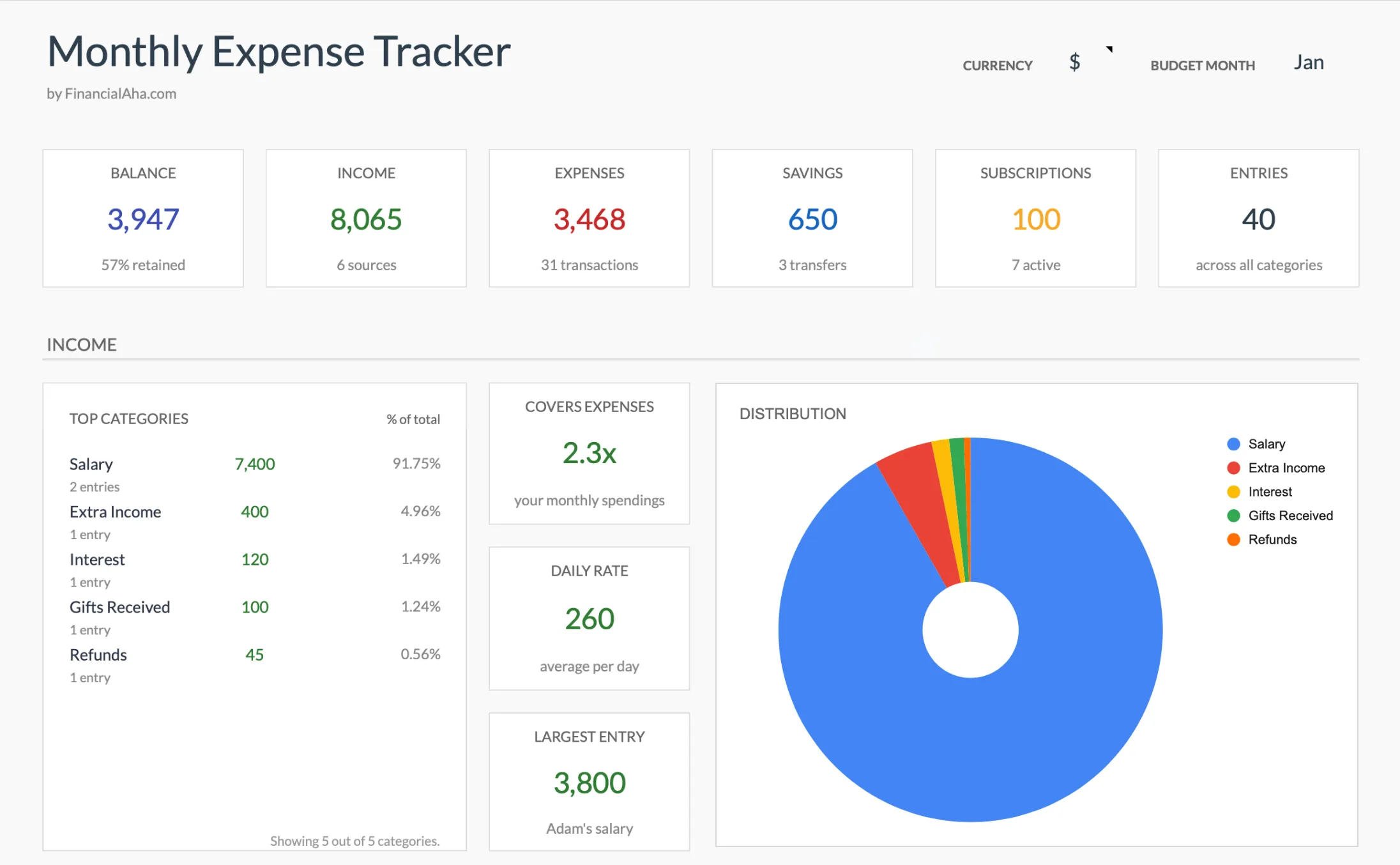
The Monthly Expense Tracker (Premium) summary dashboard - a camp line sits inside the same monthly view as the rest of your spending.
- Monthly Expense Tracker - A Google Sheet that rolls one month of transactions into income, expenses, savings, subscriptions, and top categories, so a camp payment sits next to the rest of that month’s spending. Works alongside a standalone camp comparison sheet.
- Baby Budget Planner (Essentials) - If camp is the next chapter after the baby-budget years, the same one-time vs. recurring structure carries over.
The Monthly Expense Tracker is a Google Sheet. The Baby Budget Planner works in Microsoft Excel, Google Sheets, and LibreOffice Calc. No setup required in either, and your figures stay in your own copy.
Related
- Sinking Funds Explained: Budget for Big Expenses
- Teaching Kids About Money: Age-Appropriate Lessons
- Back-to-School Budget Template (K-12 + College) for 2026 - The other big seasonal kid-cost run, once camp wraps
- School Supplies Budget Spreadsheet (Per-Child Breakdown) - Per-child supply-list math for the back-to-school stretch
- 15 Budget Categories Most People Forget
Frequently asked questions
Why a spreadsheet for camp?
Day camp, sleepaway camp, and specialty camps have wildly different total costs once gear, transportation, extras, and lost workdays are included. The sticker price is only part of the picture.
What are the hidden costs people miss?
Camp gear (trunk, sleeping bag, water bottle, specialty equipment) often runs $150 to $400 for first-time families. Transport to/from drop-off in rural locations adds gas and time. Tuck shop allowances, photo packages, and end-of-session gifts each add $20 to $100.
Does the dependent care FSA cover camp?
Day camp expenses can qualify for the Dependent Care FSA if the camp lets the parent work; overnight camp generally does not. IRS Publication 503 has the specifics. The spreadsheet flags eligible vs ineligible columns.
How do I compare a $400/week day camp vs $1,350/week sleepaway?
Per-week-after-gear-and-transport is the comparable number. The spreadsheet calculates both and shows it. Family value preferences for the experiences are separate from the math.
Can I use both the Dependent Care FSA and the tax credit for the same camp?
Not for the same dollars. Money run through a Dependent Care FSA reduces the expenses you can count toward the Dependent Care Tax Credit. Most households use one or the other; which one comes out ahead depends on income and filing status, and Publication 503's worksheets walk through the comparison.
Are registration deposits and cancellation fees part of the cost?
Often, and they rarely appear on the headline price. Many camps take a non-refundable deposit at sign-up and charge a fee to cancel or switch weeks. A deposit-and-cancellation line in the sheet keeps those from becoming a surprise.
Sources
- Publication 503, Child and Dependent Care Expenses - Internal Revenue Service
About this article
Dependent Care FSA and day-camp versus overnight-camp eligibility rules checked against IRS Publication 503. Cost ranges and worked examples are illustrative planning figures, not price quotes from any specific camp. Template sheets, inputs and outputs checked on 2026-09-10 against the shipped Monthly Expense Tracker Google Sheet (Summary, Transactions, Categories, Instructions) and the Essentials Baby Budget Planner workbook (Dashboard, Budget, How to Use). Last reviewed September 2026.