
The HSA is the only account with three tax breaks at once: a deduction going in, tax-free growth, and tax-free withdrawals for medical costs. For the 2026 tax year you can contribute up to $4,400 with self-only coverage or $8,750 with family coverage. Left invested rather than spent, a maxed self-only HSA could grow past $538,000 over 30 years at an 8% return, all reachable tax-free for healthcare.
Most people think of a Health Savings Account as the place where they stash money to cover a doctor visit or a prescription. That’s a perfectly fine use. But it’s a bit like using a Swiss Army knife exclusively as a bottle opener - functional, sure, but you’re ignoring most of what it does.
The HSA is the only account in the U.S. tax code that offers a tax deduction going in, tax-free growth while invested, and tax-free withdrawals for qualified expenses. No other account, not the 401(k), not the Roth IRA, not anything else, matches all three.
The HSA Calculator shows what happens when you treat this account as a long-term investment tool. No signup required.
Breaking Down the Triple Tax Advantage
Benefit one: contributions are tax-deductible. Every dollar you put into an HSA reduces your taxable income. In the 22% federal bracket, a $4,400 contribution saves $968 in federal tax alone.
Benefit two: growth is tax-free. Investments inside the HSA compound without any annual tax drag. No tax on dividends. No tax on capital gains. No tax on interest. Year after year, the full return stays in the account, instead of losing a slice to the IRS each time a fund pays out.
Benefit three: withdrawals for medical expenses are tax-free. When you use HSA money for qualified medical costs, nothing is owed. Not income tax, not capital gains tax, nothing.
A 401(k) gives you benefits one and two, but you pay income tax on withdrawals. A Roth IRA gives you benefits two and three, but contributions aren’t deductible. The HSA is the only account that does all three at once.
There’s Also a Hidden Fourth Benefit
On a $4,400 contribution, that’s an extra $337 in tax savings. Combined with federal and state income tax savings, the total tax benefit of a full 2026 self-only HSA contribution can look like this:
| Tax Bracket | Federal Savings | FICA Savings | State (5%) | Total | |------------|----------------|-------------|-----------|-------| | 12% | $528 | $337 | $220 | $1,085 | | 22% | $968 | $337 | $220 | $1,525 | | 24% | $1,056 | $337 | $220 | $1,613 | | 32% | $1,408 | $337 | $220 | $1,965 |
At higher brackets, a single year’s HSA contribution generates close to $2,000 in tax savings. That’s real money, and it recurs every year you contribute.
2026 Contribution Limits
The IRS resets these amounts each year. For the 2026 tax year:
| Coverage | Annual Limit | With Catch-Up (55+) | |----------|-------------|---------------------| | Self-only | $4,400 | $5,400 | | Family | $8,750 | $9,750 |
Both employee and employer contributions count toward these limits. The extra $1,000 catch-up kicks in the year you turn 55.
The Long-Term Investment Play
Here’s where things get interesting. Some people (and this is a deliberate strategy, not a loophole) pay current medical expenses out of pocket, keep the receipts, and let their HSA balance grow invested for years or even decades. There’s no deadline for reimbursement. A medical expense from 2026 can be reimbursed from the HSA in 2046.
What does that look like? The figures below start from an empty account, add $4,400 at the start of each year, hold the contribution flat at today’s self-only limit, and assume an 8% return:
| Years | Total Contributed | HSA Balance | |-------|------------------|-------------| | 5 | $22,000 | $27,900 | | 10 | $44,000 | $68,800 | | 20 | $88,000 | $217,500 | | 30 | $132,000 | $538,300 |
Over half a million dollars, all available tax-free for medical expenses. Given that Fidelity’s 2026 Retiree Health Care Cost Estimate puts the healthcare bill for a single 65-year-old at about $185,500, a well-funded HSA can cover a substantial portion of those costs without touching other retirement savings.
Run your own numbers in the calculator below. It also takes a current balance, an income tax rate and a FICA rate, and it caps the contribution at the limit for the coverage type you pick:
HSA vs. FSA: They Sound Similar, They’re Not
The Flexible Spending Account (FSA) shares a few surface-level features with the HSA, which causes confusion. In practice, they’re very different animals:
| | HSA | FSA | |---|-----|-----| | Rolls over | Yes, indefinitely | Use-it-or-lose-it (limited rollover) | | Portable | Yours forever | Tied to employer | | Investable | Yes | No | | 2026 limit | $4,400 / $8,750 | $3,400 | | Requires HDHP | Yes | No |
The IRS caps health FSA contributions at $3,400 for 2026, a limit set separately from the HSA. The FSA’s main advantage is that it doesn’t require a high-deductible health plan. For anyone already on an HDHP, the HSA outperforms the FSA in every meaningful way.
Who Qualifies
HSA eligibility requires enrollment in a qualifying high-deductible health plan. For 2026, the IRS thresholds are:
- Self-only coverage: deductible of at least $1,700, out-of-pocket max no more than $8,500
- Family coverage: deductible of at least $3,400, out-of-pocket max no more than $17,000
You also can’t be enrolled in Medicare or claimed as a dependent.
What Happens at 65
When Medicare kicks in, new HSA contributions stop. But the existing balance stays yours.
Medical withdrawals remain completely tax-free, same as always. Non-medical withdrawals lose their 20% penalty (that penalty only applies before 65) but get taxed as ordinary income. So after 65, the HSA functions a lot like a traditional IRA for non-medical spending, while keeping its full tax-free status for healthcare.
Given that healthcare costs tend to be highest in the later decades of life, having a dedicated tax-free pool specifically for those expenses is unusually useful, and it sits alongside whatever a retirement calculator says you’ll need from the rest of your savings.
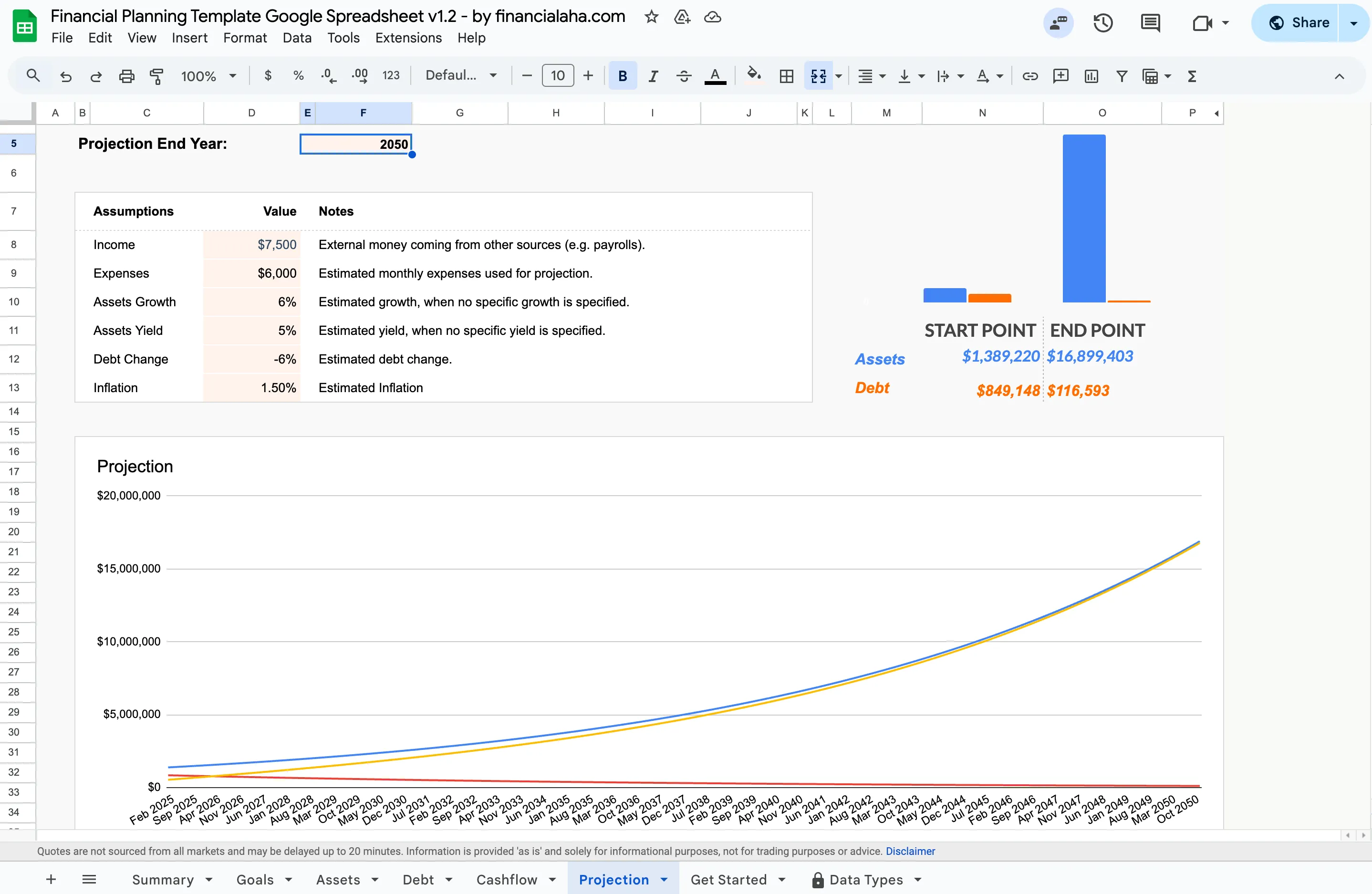
The Financial Planning Template (Premium tier) projects total assets and debt out to an end year you set, 2050 in this example, the same long-horizon view that makes the case for treating an HSA as an investment rather than a spending account.
The Financial Planning Template lists each holding on its Assets sheet with a value, an annual yield and an annual growth rate. The Annual Tax Planner Template logs deductions by category and applies a rate you set to the total, which is where a contribution deduction would show up.
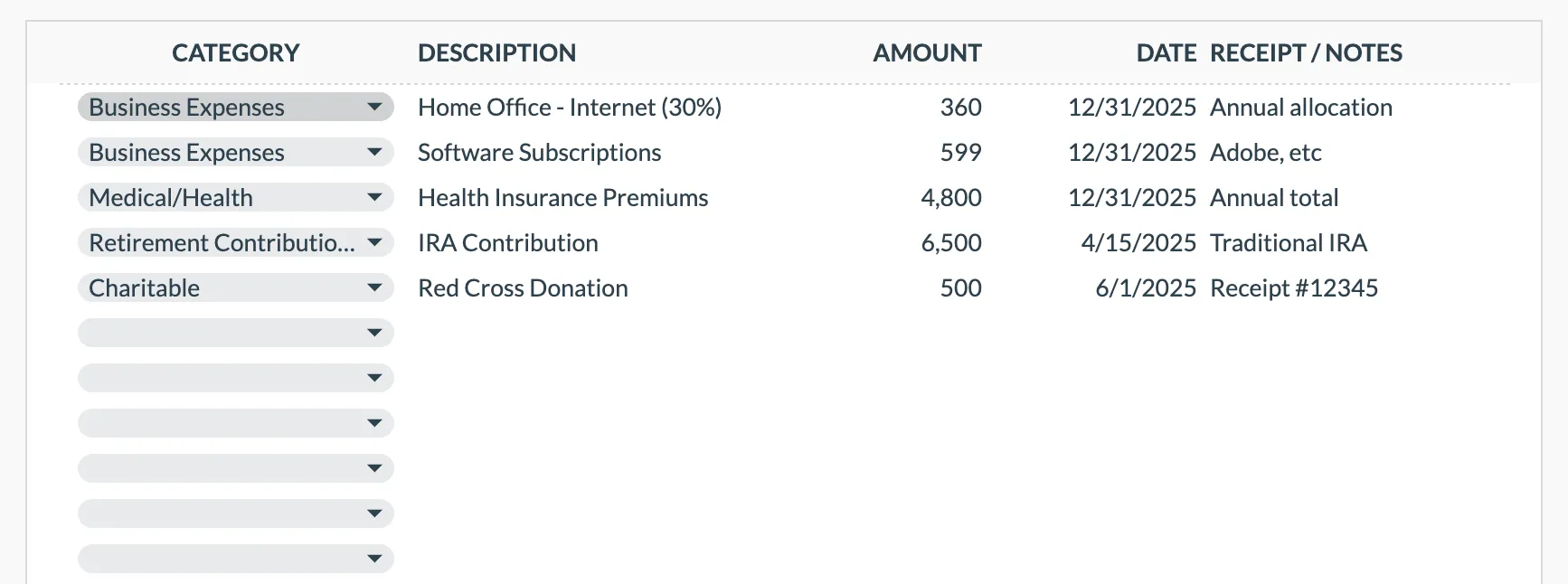
The Annual Tax Planner (Premium tier) logs deductible contributions by category, which is how you’d track an HSA deduction next to your other write-offs.
Related
- HSA Calculator - project your own balance across contribution, return, and years invested
- Income Tax Calculator: Understanding Your Tax Bill - how federal income tax works and where the HSA deduction lands
- After-Tax Return Calculator - compare tax-free HSA growth against a taxable account
- Retirement Calculator - size the rest of what you’ll need in retirement
- Financial Planning Template - list every holding with its own value, yield and growth rate
Frequently asked questions
Can I contribute to an HSA and a 401(k) in the same year?
Yes. HSA and 401(k) limits are entirely separate, so a full HSA contribution does not reduce how much you can put in a 401(k) or IRA. The only requirement for the HSA side is being enrolled in a qualifying high-deductible health plan and not being on Medicare.
What counts as a qualified medical expense for tax-free HSA withdrawals?
The IRS lists qualified expenses in Publication 502 - doctor and dentist visits, prescriptions, vision and hearing care, most copays and deductibles, and many over-the-counter items. Insurance premiums generally do not qualify, with narrow exceptions such as COBRA, long-term care, and Medicare premiums after 65. Keeping receipts matters because there is no deadline to reimburse yourself for an expense paid out of pocket.
What happens if I use HSA money for a non-medical expense before 65?
The non-qualified amount is added to your taxable income and hit with a 20% additional tax. That 20% penalty is specific to HSAs and is steeper than the 10% early-withdrawal penalty on IRAs and 401(k)s. It disappears once you turn 65, though non-medical withdrawals are still taxed as ordinary income after that.
What happens to my HSA if I change jobs or health plans?
The HSA is yours permanently. It's not tied to your employer or health plan. If you switch to a non-HDHP, you can't contribute more but the existing balance remains and can still be used or invested.
Can I use my HSA after age 65?
Yes. After 65, HSA withdrawals for any purpose are penalty-free (though non-medical withdrawals are taxed as income, similar to a traditional IRA). Medical withdrawals remain completely tax-free.
Sources
- Rev. Proc. 2025-19 (2026 HSA and HDHP inflation-adjusted amounts) - Internal Revenue Service
- Rev. Proc. 2025-32 (2026 health FSA contribution limit) - Internal Revenue Service
- Publication 969: Health Savings Accounts and Other Tax-Favored Health Plans - Internal Revenue Service
- How to plan for rising health care costs (2026 Retiree Health Care Cost Estimate) - Fidelity Investments
About this article
Contribution, catch-up, and HDHP figures checked against IRS Revenue Procedure 2025-19 for the 2026 tax year; the health FSA limit against Revenue Procedure 2025-32. Retirement health-care figure taken from Fidelity's 2026 Retiree Health Care Cost Estimate. Calculator inputs, outputs and growth formula checked on 2026-09-10 against the shipped HSA Triple Tax Advantage Calculator; template claims checked the same day against the Financial Planning Google Sheet (Assets, Projection tabs) and the Annual Tax Planner (Dashboard, Deductions tabs). Last reviewed September 2026.