Homeowners carry six cost categories renters never deal with at this scale: mortgage principal and interest, property tax, homeowners insurance, HOA or condo fees, whole-house utilities, and a maintenance reserve. Most of the difficulty is timing, since annual tax and insurance bills have to land inside a monthly budget, which is why a year-long structure fits ownership better than a month-at-a-time view.
The jump from renting to owning is rarely just “rent is now mortgage.” A National Association of Home Builders analysis of American Housing Survey data put average annual owner operating and maintenance costs in New England around $13,000, more than double the $6,300 figure for the East South Central region. The cost lines that drive that gap are the ones a renter’s budget never had to carry: property tax, insurance, utilities sized to a whole house, and a maintenance reserve. Our Annual Budget Template and Monthly Budget Template both open with Housing, Utilities, Insurance and Taxes & Fees already in the expense list, and a Categories sheet where any of the 17 expense rows can be renamed or replaced.
Below: which categories change, the math behind the maintenance reserve, the timing problem with annual bills, and how a year-long structure handles all of it.
What changes when you buy
A renter’s budget has rent, renter’s insurance, electric, internet, and maybe water and gas. Five lines, all monthly, all roughly stable.
An owner’s budget has more lines, several of them annual or semi-annual, and most of them larger than the renter version:
| Category | Renter | Owner |
|---|---|---|
| Housing payment | Rent (monthly) | Mortgage principal + interest (monthly) |
| Property tax | Included in rent | Annual or semi-annual, $2K to $15K+ |
| Insurance | Renter’s, ~$200/year | Homeowners, $1,200 to $3,500/year |
| HOA / condo fees | Rarely | Monthly or quarterly, $0 to $800/month |
| Utilities | Some, smaller | All of them, larger |
| Maintenance | Landlord’s problem | Owner’s problem, ~1 to 4% of home value/year |
| Major capital | Never | Roof, HVAC, water heater, etc. |
Mortgage payment composition: PITI
Most lenders quote a monthly payment that bundles four things. The shorthand is PITI:
- P - Principal (paying down the loan balance)
- I - Interest (cost of borrowing)
- T - Taxes (property tax)
- I - Insurance (homeowners insurance)
Whether T and I are inside the monthly payment depends on whether the loan has an escrow account. If yes, the lender collects the annual tax and insurance bills as monthly add-ons and pays them on your behalf. If no, those bills come directly to you and you handle them yourself.
The budget structure shifts based on that one detail. With escrow, the mortgage line in the budget already covers tax and insurance, and the line item shows up as one number per month. Without escrow, mortgage is principal and interest only, and property tax and insurance are separate sinking funds.
A quick test: pull a recent mortgage statement. If it lists “escrow deposit” or shows tax/insurance disbursements, the loan escrows. Most loans with less than 20 percent down are required to. Many others escrow by default because lenders prefer it.
To see what the full PITI number looks like for a given loan amount, rate, tax bill, and premium, the mortgage payment calculator breaks it into the four parts:
Property tax and the timing problem
Property tax catches new owners off guard most often. Two issues:
-
The amount is large. A common range across US counties is 0.5 to 2.5 percent of assessed value annually. On a $400,000 home, that is $2,000 to $10,000 per year. High-tax states like New Jersey, Illinois, and parts of New York and Texas push beyond that.
-
The timing is annual or semi-annual. Most counties bill once or twice a year. A monthly budget that does not pre-allocate gets hit by a $4,000 line item in November and breaks.
If the loan escrows, the lender handles the timing. If not, the budget carries a property tax sinking fund: annual amount divided by months until due, contributed each month, drawn down when the bill arrives. How to Set Up Sinking Funds in Google Sheets covers the mechanics.
Counties also reassess on a cycle (yearly in some states, every three to five years in others), and tax bills move with assessments. A 10 percent assessment jump means a 10 percent tax jump. The budget line tends to drift unless it gets an annual look against the most recent bill.
Homeowners insurance and the annual review
The Insurance Information Institute reports US homeowners insurance averaged roughly $1,400 to $1,700 in recent years, with substantial regional variation - hurricane and wildfire zones run multiples higher. The budget line is whatever the policy declarations page shows, not a national average.
Two budget moves matter:
The annual renewal review. Premiums climb. A line that says “homeowners insurance: $1,600” and stays unchanged for six years while the actual bill creeps to $2,400 is a budget that has lost touch. Comparing the renewal notice to last year’s catches creeping increases that compound over five and ten year periods.
Coverage vs cost. Cheaper policies usually mean higher deductibles or lower replacement-cost limits. The trade-off shows up only when a claim hits. The budget can hold either choice; it cannot replace the coverage decision.
For older homes or homes in disaster-prone regions, separate flood, earthquake, or umbrella policies add lines. Each is its own annual or semi-annual bill flowing through the budget.
HOA dues and the special-assessment risk
HOA, condo association, or co-op fees range from $0 (no HOA) to $800+ per month (high-end condos with amenities). They are predictable: you know the dollar amount, you know the cadence.
The risk is the special assessment. When the roof needs replacing, the parking lot needs repaving, or the elevator fails, the HOA may levy a one-time charge across all units. A $4,000 special assessment is not unusual; some run to $20,000 or more in older buildings.
Two ways to handle this in a budget:
-
A small monthly buffer. $25 to $100 per month into a “HOA reserves” sinking fund covers the smaller assessments without disruption. It will not cover a $15,000 elevator replacement, but it absorbs the more common smaller hits.
-
The HOA reserve study. Most associations publish a reserve study showing how funded the long-term capital reserves are. A 30 percent funded reserve in a 40-year-old building is a flag that special assessments are likely coming. The budget cannot prevent them, but knowing the timeline lets the reserve fund grow ahead of the hit.
Utilities sized for a whole house
The first 90 days of utility bills are the calibration period. Apartment-to-house jumps of 2x or 3x are common for electric and water, driven by more square footage to heat and cool, yard irrigation, trash service that used to be included, and higher-tier internet or security plans.
Typical owner utility lines:
| Utility | Typical monthly range (US) |
|---|---|
| Electric | $80 to $250 |
| Natural gas (where available) | $40 to $150 |
| Water and sewer | $40 to $120 |
| Trash and recycling | $20 to $50 |
| Internet | $50 to $90 |
Ranges vary widely by region, climate, and home size. A two-bedroom condo in a mild climate sits at the low end; a 3,500 square-foot house in a cold winter or hot summer climate sits at the high end. A useful re-baseline point comes around month three, when enough real bills exist to replace the renter-era estimates that often run too low. Those heating-and-cooling swings are one of the main patterns covered in seasonal budgeting, where a sinking fund spreads the gap across the year.
The maintenance reserve
The category that gets the most attention in homeowner budgeting guidance, and the one with the loosest math.
Common rules of thumb:
| Rule | What it says | Result for a $400,000 home |
|---|---|---|
| 1% rule | 1% of home value per year | $4,000/year, ~$333/month |
| 2% rule | 2% of home value per year | $8,000/year, ~$667/month |
| Square-foot rule | $1 per square foot per year | 2,000 sq ft = $2,000/year |
| Age-adjusted | 1% for under-10-year homes, 4% for over-30-year homes | $4,000 to $16,000/year |
These are descriptions of common practice, not financial recommendations. Older homes, harsher climates, and deferred-maintenance situations push the number higher. A pre-1960 home with original mechanicals can run closer to 4 to 8 percent of value annually in years when a major system fails.
The reserve works best as a rolling sinking fund: contribute monthly, draw down when expenses hit, top up when it gets low. Unlike property tax (a known annual hit), maintenance arrives randomly. A quiet year may use 20 percent of the reserve; a year with an HVAC failure and a leaking roof may exceed it. If the reserve depletes faster than contributions for two years running, the contribution rate is too low.
What the reserve covers vs what it does not:
| Covered by reserve | Separate line items |
|---|---|
| Routine: gutter cleaning, HVAC service, pest control | Major capital: roof replacement, HVAC replacement |
| Minor repairs: leaking faucet, broken appliance, drywall patch | Renovations: kitchen, bathroom, additions |
| Seasonal: snow removal, lawn care, mulch | Property tax, insurance, HOA |
For larger projects, a project-specific budget is the better fit - the Home Renovation Budget Spreadsheet walks through the structure for phase tracking and contingencies.
Major capital replacement timeline
The category long-term owners care about more than first-year owners. Major systems wear out on roughly predictable cycles:
| System | Typical useful life | Replacement cost range |
|---|---|---|
| Roof (asphalt shingle) | 20 to 30 years | $8,000 to $25,000 |
| HVAC (furnace + AC) | 15 to 25 years | $7,000 to $20,000 |
| Water heater (tank) | 8 to 15 years | $1,400 to $3,200 |
| Water heater (tankless) | 15 to 25 years | $2,500 to $6,500 |
| Major appliances | 10 to 18 years | $600 to $2,500 each |
| Exterior paint | 7 to 12 years | $4,000 to $12,000 |
| Driveway (asphalt) | 15 to 25 years | $3,000 to $10,000 |
A house bought with a 15-year-old roof has a 5-to-15-year horizon for replacement, which is enough time to fund part or all of the bill through the maintenance reserve. A capital replacement table, one row per system with install date, expected lifespan, and estimated cost, makes the next decade visible and sizes the monthly reserve contribution against what is coming.
The annual budget structure for owners
A monthly view handles the recurring lines: mortgage, HOA, utilities, contributions to sinking funds. The owner-specific complications are easier to see across all 12 months at once: annual tax and insurance, irregular maintenance, and capital replacements.
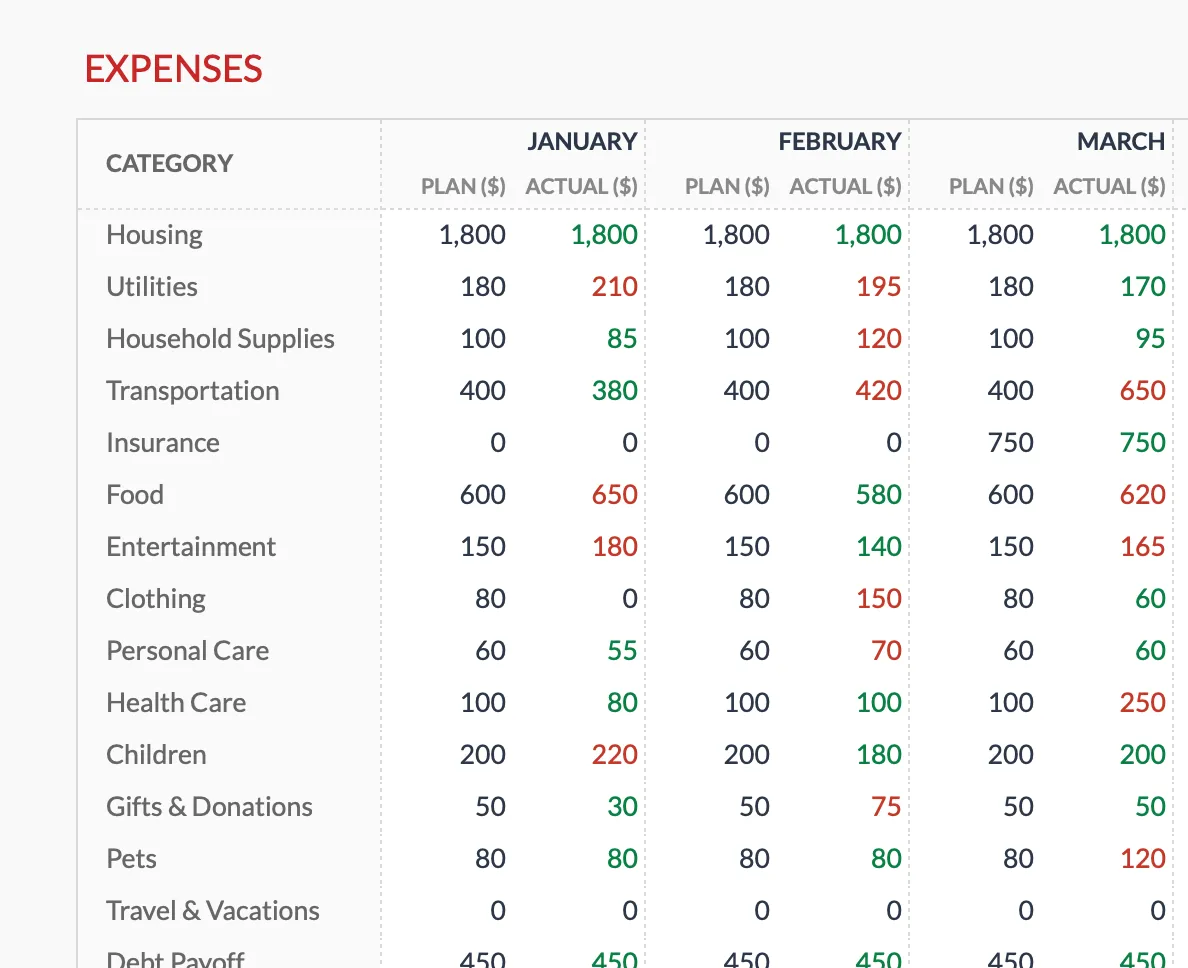
The Annual Budget Template (Premium tier) lays plan-vs-actual out month by month, so an annual bill like insurance shows up in the month it actually lands rather than smeared across the year.
A workable structure has three layers:
- Monthly recurring: mortgage (PITI or P+I), HOA, utility lines, internet, baseline maintenance contribution.
- Sinking funds: property tax (if not escrowed), homeowners insurance (if not escrowed), HOA special-assessment reserve, separate insurance policies.
- Capital replacement table: one row per major system, install date, expected life, estimated cost, planned replacement year.
The monthly layer handles the day-to-day. A year-long grid shows the irregular bills landing in the right months. A capital table kept alongside it shows what is coming over 5, 10, and 15 year horizons. A monthly-only template covers the first layer; the second and third are easier to read once every month sits on one screen.
Templates that fit
- “I want a year-long view of all the homeowner categories.” Annual Budget Template at $29 once. A 12-month plan-versus-actual grid for every category, with difference, monthly average and year-to-date totals, plus a Summary tab that counts the categories running past the thresholds set on the Setup sheet. Insurance and Taxes & Fees are standard rows, so an annual bill sits in the month it lands.
- Monthly visibility on the recurring bills. Monthly Budget Template at $29 once. Budget targets per category including Housing, Utilities and Insurance, a Transactions sheet that fills in the actuals, and a Summary dashboard with 50/30/20 and zero-based views.
- A household-focused layout with shared bills. Household Budget Template. Pre-built household categories including mortgage, utilities, and insurance, designed for shared living and dual incomes.
Related
Frequently asked questions
How much should I budget for maintenance?
Common rules of thumb are 1 to 3 percent of home value annually for maintenance and capital repairs, with newer homes at the low end and older homes higher. A $400,000 home would budget roughly $4,000 to $12,000 per year for maintenance, smoothed across months.
What is escrow and is it in my budget?
Many mortgages collect property tax and insurance monthly along with principal and interest, holding them in an escrow account and paying the annual bills. If your mortgage escrows, those line items are inside your mortgage payment. If not, they are separate sinking funds.
How often do utilities surprise new homeowners?
Most. The size jump from apartment to house often doubles or triples electric and water. The first 90 days of bills are the calibration period; budget conservatively until you have three months of actuals.
What about HOA dues and special assessments?
HOA dues are predictable. Special assessments (for roof, pool, or parking-lot repaving) are not. A small reserve in your budget reduces the shock when one hits.
Is the maintenance reserve the same as an emergency fund?
They tend to serve different jobs. A maintenance reserve is sized against the house (roughly 1 to 4 percent of value per year) and funds expected wear like HVAC service, appliance repairs, and eventual system replacement. An emergency fund covers income shocks such as a job loss. Some homeowners keep them as separate buckets so a broken water heater does not draw down the money set aside for a lost paycheck.
Do I need the annual template, or is the monthly one enough?
A monthly template handles the recurring lines (mortgage, HOA, utilities). The annual view earns its keep for the irregular pieces, because it lays every category across all 12 months, so a tax or insurance bill sits in the month it lands while the year-to-date total still adds up. Owners with escrowed tax and insurance and no HOA often manage on a monthly layout; owners juggling several sinking funds usually find the year-long grid easier to read.
Sources
- Operation Costs per Dollar Value Lower for New Homes - NAHB Eye on Housing
- Facts + Statistics: Homeowners and renters insurance - Insurance Information Institute
About this article
Operating-cost and insurance figures drawn from the linked NAHB and Insurance Information Institute analyses. Template sheets, categories and outputs checked on 2026-09-10 against the shipped Annual Budgeting Google Sheet (Summary, Annual Plan, Annual Financial Goals, Categories, Setup) and Monthly Budgeting Google Sheet (Summary, Budget Plan, Transactions, Goals, Categories, Setup). Last reviewed September 2026.