
Monarch Money is $99/year with no free tier. Lower-cost app alternatives include Quicken Simplifi ($3.99/month the first year), YNAB ($109/year), Copilot ($95/year), and free Empower for investment and net worth tracking. To drop the subscription entirely, FinancialAha's Google Sheets templates ($29 one-time) cover budgeting, net worth, and financial planning with no bank connection needed.
Monarch Money has built a solid reputation since launching as a Mint alternative. The clean interface, automatic bank syncing, and features designed for couples make it popular. But at $99/year with no free tier, some people wonder what else is out there.
Quick picks: For a similar app at lower cost, Quicken Simplifi runs $3.99/month billed annually for the first year ($47.88), then Quicken’s standard rate after that. For zero ongoing cost with full privacy, FinancialAha spreadsheet templates (one-time purchase) handle budgeting, net worth, and financial planning in Google Sheets with no bank connection needed. For free options, Empower covers investment and net worth tracking and Goodbudget handles envelope budgeting. For the full comparison, see FinancialAha vs Monarch Money.
Why People Look Beyond Monarch
The reasons tend to fall into a few buckets. Price is the obvious one - $99/year adds up, especially if budgeting is something you’re just getting started with. Privacy is another - linking bank credentials to any third party carries inherent risk. And some people simply prefer more control over how their finances are organized than any pre-built app allows.
None of these make Monarch a bad product. They just mean it’s not the right fit for everyone.
Spreadsheet Templates
The biggest surprise for many former app users is how capable a well-designed spreadsheet can be. The Financial Planning Spreadsheet handles net worth tracking, a multi-year projection, and eight financial goal targets. The Monthly Budget Template covers the day-to-day budget tracking that most people use Monarch for.
What you gain: complete privacy (data stays in your Google account), full customization, no recurring costs, and data that’s truly yours forever. What you give up: automatic transaction imports and the polished mobile experience.
Investment holdings can be tracked too. In the Financial Planning sheet’s Assets tab, the GOOGLEFINANCE function pulls live stock and fund prices straight into the sheet, so a portfolio updates without a bank connection.
For couples, one of Monarch’s selling points, Google Sheets naturally supports shared access. Both partners can view and edit the same spreadsheet in real time, which accomplishes the same goal differently.
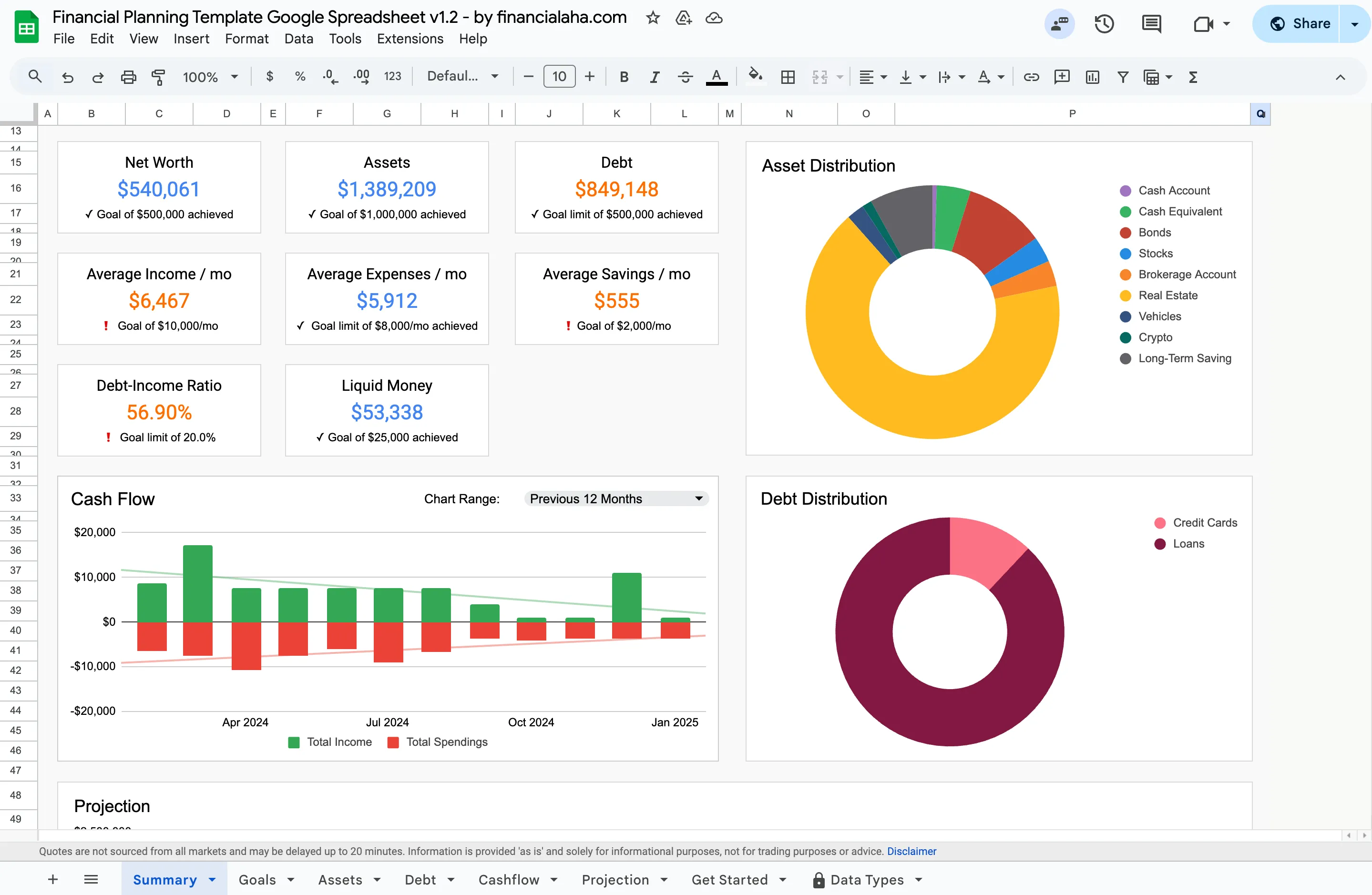
The Financial Planning Spreadsheet (Premium tier) summary dashboard: net worth, assets, debt, and cash flow in one view, with a multi-year projection on its own tab. This is the area where app-based tools like Monarch stay comparatively basic.
Here is how the two approaches compare directly:
| Monarch Money | Google Sheets (FinancialAha) | |
|---|---|---|
| Price | $99/year | $29 one-time |
| 5-year cost | $495 | $29 |
| Bank connection | Required for auto-import | Not needed |
| Transaction entry | Automatic | Manual |
| Data storage | Monarch’s servers | Your Google Drive |
| Customization | Limited to app options | Complete, edit any formula |
| Net worth tracking | Yes | Yes |
| Long-term projections | Basic | To a chosen end year, six assumptions |
| Investment tracking | Yes, via bank sync | Yes, via GOOGLEFINANCE |
| Mobile | Native app | Google Sheets app |
YNAB
If Monarch feels too passive, YNAB goes the opposite direction. Every dollar gets assigned a purpose before you spend it. It’s more demanding but users consistently report that the methodology itself changes their relationship with money.
At $109/year it’s actually more expensive than Monarch. The learning curve is steeper. But YNAB’s community and educational resources are extensive, and the approach works particularly well for people dealing with irregular income or trying to break paycheck-to-paycheck cycles.
The philosophical difference matters here. Monarch tracks what happened. YNAB plans what will happen. Different tools for different mindsets. If the method appeals but the price does not, the YNAB vs Monarch comparison and our roundup of YNAB alternatives cover the trade-offs in more detail.
Quicken Simplifi
Simplifi offers the most similar experience to Monarch at a lower price: $3.99/month billed annually for the first year ($47.88), renewing at the standard rate (currently $6.99/month billed annually, about $83.88/year). Automatic bank imports, spending categories, bill tracking, and savings goals all work as expected.
The spending plan view is arguably more intuitive than Monarch’s dashboard for people who just want to know “am I on track this month?” The interface is clean and uncomplicated. For straightforward budget tracking with automation, Simplifi delivers solid value.
Where it falls short compared to Monarch: the investment tracking is less detailed, joint account support isn’t as seamless, and the reporting tools are more basic. But for core budgeting, the price difference is meaningful.
Copilot Money
Built for the Apple ecosystem, Copilot has developed a following for its design and usability. The interface feels modern and the transaction categorization is generally accurate.
At $95/year it’s priced similarly to Monarch. The weekly spending summaries and real-time balance updates create a helpful awareness of where money goes. Net worth tracking is included. It now runs on iPhone, iPad, Mac, and a web app, though there is still no Android version, so heavy Android users are the ones left out.
For people in the Apple ecosystem who prioritize clean design and don’t need joint access, Copilot is worth a look.
Empower Personal Dashboard
Free, which immediately stands out. Empower focuses on investment tracking and net worth monitoring more than daily budgeting - a different emphasis than Monarch.
The investment analysis tools genuinely exceed what most paid apps offer. Portfolio allocation, fee analysis, retirement planning projections - this is where Empower shines. The budgeting features exist but feel secondary.
The catch: Empower makes money through wealth management services and will periodically reach out about those services. For many users, ignoring the sales outreach in exchange for free portfolio tracking is a fair trade. The Empower vs Monarch comparison goes deeper on where each one leads.
PocketGuard
The simplest option on this list. PocketGuard answers one question well: “How much can I spend right now?” It looks at your income, subtracts bills and savings commitments, and shows what’s left.
After a free trial, the Plus plan ($12.99/month or $74.99/year) adds debt payoff planning and bill negotiation features. For people who found Monarch’s full dashboard more than they needed, PocketGuard’s focused approach feels refreshing.
Making the Choice
The honest answer is that the “right” tool is whichever one you’ll actually use consistently. A $99/year app used daily beats a free spreadsheet that sits untouched, and vice versa.
A few things worth considering: How important is automatic bank syncing to you? Some people rely on it, others find that manual entry makes them more mindful. Do you need joint access? Some tools handle this better than others. How long do you plan to track your finances? Subscriptions compound over time, while one-time purchases don’t.
If you’re leaving Monarch, export your data first. Most alternatives accept CSV imports, and having your transaction history makes the transition smoother.
If the subscription itself is what you’re done with, the spreadsheet path is the one that ends the recurring cost. The Financial Planning Spreadsheet covers the net worth and projection work where apps stay thin, and the FinancialAha vs Monarch comparison lays the two side by side feature by feature. The templates are a one-time $29 purchase used by 1,000+ customers across 65+ countries.
Related
- Financial Planning Spreadsheet - comprehensive financial tracking
- Monthly Budget Template - budget tracking without subscriptions
- Net Worth Tracker - asset and liability tracking
- FinancialAha vs Monarch Money - the full feature-by-feature comparison
- Mint Alternatives After the Shutdown - where former Mint users landed
- Monarch Money vs Rocket Money: Which Fits Which User - the head-to-head against the app people cross-shop most
- Quicken Simplifi Alternative in a Spreadsheet - the lowest-cost app option, rebuilt as a sheet you own
Frequently asked questions
How much does Monarch Money cost?
Monarch Money costs $99/year or $14.99/month. There's no free tier - after the trial ends, you need a paid subscription to continue using the service.
Is there a free alternative to Monarch Money?
Empower Personal Dashboard offers free investment and net worth tracking, and Goodbudget has a free envelope-budgeting tier. Google Sheets spreadsheet templates provide comprehensive budget and finance tracking for a one-time cost with no subscription.
Which Monarch Money alternative is the cheapest?
Empower Personal Dashboard is free for investment and net worth tracking. Among paid apps, Quicken Simplifi is usually the lowest at $3.99/month for the first year. A one-time spreadsheet template ($29) carries no renewal, so over a few years it works out cheaper than any subscription.
Can I track investments without connecting my bank?
Yes. In Google Sheets, the GOOGLEFINANCE function pulls live stock and fund prices into the sheet, so a portfolio updates without linking any account. You enter your holdings once and the values refresh on their own.
What does Monarch Money do that spreadsheets don't?
Monarch's main advantage is automatic bank transaction importing - your spending appears without manual entry. It also offers a polished mobile app and joint access for couples. Spreadsheets require manual data entry but offer more customization, complete privacy, and no recurring costs.
Can I export my Monarch Money data?
Yes, Monarch allows CSV exports of your transaction data. This makes switching to a spreadsheet or another tool relatively straightforward since you can import historical transactions.
Sources
- Quicken Products and Pricing Comparison - Quicken
- PocketGuard Pricing - PocketGuard
- YNAB Pricing - YNAB
- Copilot Money Pricing - Copilot
- Monarch Money Pricing - Monarch Money
About this article
Competitor prices were checked against each company's official pricing page (Monarch, Quicken Simplifi, YNAB, Copilot, PocketGuard). Template prices, sheets and features checked on 2026-09-10 against FinancialAha product data and the shipped Financial Planning (Summary, Goals, Assets, Debt, Cashflow, Projection) and Monthly Budgeting (Summary, Budget Plan, Transactions, Goals, Categories) Google Sheets. Last reviewed September 2026.