
In the Federal Reserve's 2024 SHED survey, 55% of US adults said they had three months of expenses set aside, ranging from 24% of households under $25,000 to 75% of those earning $100,000 or more. SHED reports coverage rates rather than average dollar balances, so this article pairs it with BLS Consumer Expenditure data to turn 'three to six months of expenses' into dollar targets by income quintile, roughly $8,800 to $37,600 for three months.
Most “average emergency fund” articles repeat one of two industry stats and call it done. The numbers below come straight from the Federal Reserve SHED 2024 report and the BLS Consumer Expenditure Survey for 2024, released September 2025. Both are public, both are methodologically transparent, and both are more granular by income bracket than the secondary summaries you usually see.
One note on framing. SHED reports coverage rates (the share of households at three months of expenses set aside) rather than average dollar balances by bracket. There is no single clean “average emergency fund” number that survives serious methodology scrutiny, because reported balances vary widely and the public survey questions are framed around coverage, not totals. The tables below combine the SHED coverage data with BLS expenditure data so readers can translate “three months” into a dollar figure that matches their own income tier. Use the tables as you would any other public data set.
What the survey data is actually measuring
Two definitions to get out of the way before the tables.
“Emergency savings” in SHED. The Federal Reserve asks whether a respondent has “set aside money for three months of expenses in case of emergencies” and, separately, the largest unexpected expense they could cover using only their current savings. Both questions exclude retirement accounts, home equity, and credit lines, even when those would technically be accessible. The intent is to capture liquid, penalty-free cash, the kind held in a checking or high-yield savings account.
“Average expenditure” in BLS. The Consumer Expenditure Survey reports annual outflows per “consumer unit” (a household-equivalent, usually a family or a single adult with their own finances). The 2024 release covers calendar year 2024 and was published in September 2025. Quintile breakdowns are based on pre-tax income.
These two sources combine cleanly: SHED tells you what people have, BLS tells you what people spend. Together they let you translate “three months of expenses” into a dollar number for each income tier.
Three-month emergency fund by income bracket (SHED 2024)
The headline table. This is the share of adults who said they had three months of expenses set aside, broken down by family income.
| Family income | Share with 3 months of expenses saved |
|---|---|
| Less than $25,000 | 24% |
| $25,000 - $49,999 | 40% |
| $50,000 - $99,999 | 56% |
| $100,000 or more | 75% |
| All adults | 55% |
Source: Federal Reserve, SHED 2024, Savings and Investments chapter. Survey conducted October 2024.
Two things stand out in that spread.
The bottom-to-top spread is 51 percentage points, which is wider than almost any other financial-well-being measure in the same SHED survey. Liquidity is where income shows up most starkly.
The headline rate has barely moved: 55 percent in 2024, 54 percent in 2023, peak 59 percent in 2021. The pandemic-era boost from stimulus and forced saving has unwound, but not to a 2019 low.
What people could cover from savings alone
A second SHED question asks the largest unexpected expense someone could cover from current savings. The distribution for all adults in 2024:
| Largest expense coverable from savings | Share of adults |
|---|---|
| Less than $100 | 18% |
| $100 - $499 | 13% |
| $500 - $999 | 10% |
| $1,000 - $1,999 | 10% |
| $2,000 or more | 48% |
Source: Federal Reserve, SHED 2024, Savings and Investments chapter.
Roughly 31 percent of adults could not cover a $500 expense from savings alone. Sixty-nine percent said they could pay at least $500 from current savings.
A separate measure, the much-cited “$400 unexpected expense” question, asks how someone would pay an unexpected $400 bill. In 2024, 63 percent said they would cover it exclusively with cash, savings, or a credit card paid off at the next statement. That figure was unchanged from 2023 and down from 68 percent at the 2021 peak. Among those who could not, most would pay another way (loan, partial payment, asking family); a smaller share said they would not be able to pay at all.
What “3 to 6 months of expenses” costs in dollars
The “3 to 6 months” framework is a common rule of thumb. It’s only useful once you turn it into a dollar number. The table below uses BLS Consumer Expenditure Survey 2024 quintile data to do the translation.
| Income quintile (pre-tax) | Avg annual expenditure | 3 months | 6 months |
|---|---|---|---|
| Lowest 20% (under $29,932) | $35,046 | $8,762 | $17,523 |
| Second (up to $57,452) | $50,054 | $12,514 | $25,027 |
| Third (up to $94,511) | $66,900 | $16,725 | $33,450 |
| Fourth (up to $155,925) | $89,972 | $22,493 | $44,986 |
| Highest 20% ($155,925+) | $150,342 | $37,586 | $75,171 |
Source: BLS Consumer Expenditure Survey, 2024 release, September 2025. Quintile cutoffs are pre-tax annual income.
A couple of caveats before reading those columns straight.
The BLS averages include all expenditures, not just essentials. A household preserving cash during a job loss would cut dining out, travel, entertainment, and discretionary categories. Essential-only spending is typically 55 to 75 percent of total expenditure, depending on lifestyle and where someone lives. Multiplying the table above by 0.7 gives a rough “essentials only” version.
The lowest quintile spends more than it earns on average. The CES reports this consistently: the bottom 20 percent in pre-tax income often spends about as much as the second quintile because of transfers, family support, and drawing down assets. The $35,046 number is real spending, not a target.
To swap the national averages for your own essential monthly expenses, the calculator below returns the target at whatever months of runway you set.
A parallel reading from Bankrate
Bankrate runs an annual emergency savings survey that asks slightly different questions, and the directional findings line up with SHED.
In Bankrate’s early-2025 wave, about 41 percent of US adults said they would use savings to cover an unexpected $1,000 expense. The remainder said they would use a credit card (paid off over time), borrow from family, take out a personal loan, or skip the expense. About 27 percent of US adults reported having no emergency savings at all; another 30 percent had some, but less than three months of expenses.
The SHED and Bankrate numbers differ because the questions differ. SHED’s “three months of expenses set aside” is a coverage flag; Bankrate’s “would you use savings for a $1,000 expense” is a behavioral question. Both surveys point at the same population of households without sufficient liquid cash for a moderate shock - roughly a third of US adults, depending on definition.
How the recommendation maps to reality
The 3-to-6 months framework lives in two flavors:
- 3 months for dual-income, stable employment, low-debt households where one earner losing income is buffered by the other.
- 6 months for single-income households or those with less stable employment.
Some financial planners stretch the range to 9 to 12 months for self-employed, commission-only, or those approaching retirement.
Stacking the SHED data against the BLS dollar targets shows the structural difficulty. A third-quintile household (median-ish, around $75,000 pre-tax) running the 6-month version of the framework lands at roughly $33,450 in liquid savings. SHED’s “three months” question is binary, so it doesn’t capture how many of those 56 percent of middle-quintile adults sit at 3 months versus 6 versus 12.
For a household at the lowest quintile, the 3-month target of $8,762 is closer to what SHED’s “could cover at least $2,000 in unexpected expenses” group looks like (48 percent of adults overall). For the highest quintile, $37,586 is well above the $2,000 threshold the survey caps at, so the SHED distribution is less informative at the top end.
What the data does not tell you
The headline numbers come with three limits worth flagging.
Survey self-report. Both SHED and Bankrate ask people to estimate their own emergency savings. Reported balances usually run a bit lower than what bank-data-linked studies (like those from JPMorgan Chase Institute) measure, partly because people forget about smaller accounts.
No location adjustment. A $50,000 income in rural Mississippi buys substantially more runway than the same income in San Francisco. The BLS quintile expenditure averages smooth this out nationally; your local “3 months of expenses” number may sit well above or below the national table.
Snapshot, not trajectory. A household at $1,200 in emergency savings might be six months into rebuilding after a layoff, or six months into letting it drift down. The same dollar balance tells very different stories.
This is where tracking can help: a single number on a single survey doesn’t show direction. A monthly contribution log does.
Reading the numbers when your situation is different
A few common situations the averages don’t capture cleanly.
Variable income. Self-employed, commission, gig, or seasonal income usually pushes the target months higher. The relevant denominator is essential monthly expenses against the low end of expected income, not the average.
Dependents. Each additional dependent raises essential expenses (housing, food, healthcare) but doesn’t necessarily change the target months. The math shifts most for single-income households with dependents, where the planner ranges (3, 6, 9 months) stretch further to the right.
Access to low-cost credit. A funded HELOC, a 401(k) loan provision, or family backing can substitute for some portion of liquid savings in a true emergency. They’re not equivalent, but they shift the math.
Variable expenses. Households with a high proportion of fixed costs (mortgage, car payment, childcare) have less ability to cut in a downturn, which argues for a higher target. Households with mostly variable spending can flex down further.
None of these moves are prescriptive. They’re inputs to a calculation a tracker can make explicit.
Tracking your own number
The hardest part of the emergency fund question is honesty about essential monthly expenses. People often underestimate the number because subscription services, irregular bills, and insurance premiums don’t show up in mental math.
Two tracker approaches that surface the real number.
The free Emergency Fund Calculator takes four inputs, your essential monthly expenses, the months of runway you want covered, your current savings, and a monthly contribution. It returns the target fund size, the amount still missing, and how long reaching it takes in months and in years. The months figure is yours to set to 3, 6, 9, 12, or any other number rather than an assumption the file makes.
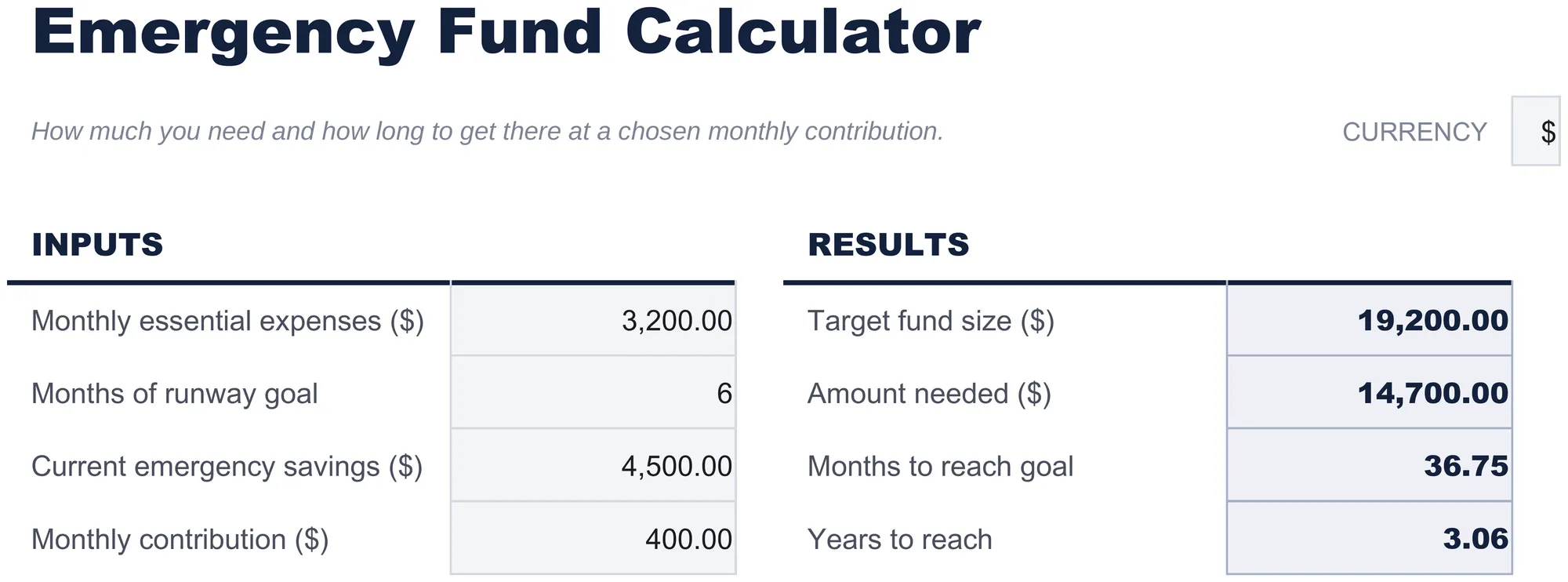
The free Emergency Fund Calculator (Free tier): four inputs on the left, four results on the right.
For people who want essential spending surfaced from real transactions, the Monthly Budget Template categorizes spending across 17 categories and includes savings-goal tracking with a progress bar for an emergency fund. The Monthly Expense Tracker is the simpler starting point if planned-vs-actual feels like too much structure. For the reasoning behind how many months to cover, the emergency fund calculator guide walks through the 3-6-9 framework in more depth.
Where the numbers come from
A short methodology note for anyone embedding these tables.
The SHED data is from the Federal Reserve’s annual Survey of Household Economics and Decisionmaking, fielded each October. The 2024 wave (released May 2025) had approximately 12,000 respondents weighted to be nationally representative of US adults. Margin of error on the headline figures is roughly +/- 1 percentage point. Full report and methodology here.
The BLS data is from the Consumer Expenditure Survey, an ongoing diary-and-interview survey of US consumer units. The 2024 release reports calendar year 2024 spending and was published September 2025. The income quintile breakdowns reflect pre-tax income. BLS news release and tables here.
Bankrate’s annual survey of emergency savings is a smaller industry survey (~1,000 respondents) conducted by a third-party polling firm. It’s useful for trend lines because Bankrate has run the same questions for many years. Latest report here.
Numbers above are rounded only where the source rounds. Where SHED reports 55 percent and Bankrate reports 41 percent, we use those figures as published rather than averaging them into a midpoint that doesn’t exist in either source.
From the averages to your own number
The tables describe the population; your own figure comes from your own essential spending. Take the third-quintile row as a worked example: three months of total spending sits near $16,725 and six months near $33,450, and trimming to essentials only (roughly 70 percent) brings those closer to $11,700 and $23,400. Swap in your own essentials figure and the Emergency Fund Calculator runs the same math at whatever months of runway you choose.
If you don’t yet know what your essential monthly expenses actually are, the Monthly Expense Tracker is the upstream step.
Related
Frequently asked questions
What counts as an emergency fund in survey data?
Federal Reserve SHED data treats 'cash or cash-equivalent savings set aside for unexpected expenses' as the emergency fund. It does not include retirement accounts or home equity, even if accessible.
Why don't the tables show average dollar amounts by bracket?
The Federal Reserve's SHED survey reports the share of households with three months of expenses set aside, not the average dollar balance. A combined view uses SHED for coverage rates and BLS expenditure data to translate 'three months' into a dollar figure by income tier. Both tables are in the article.
Does an emergency fund need to be cash?
Common interpretation is yes - immediately accessible without market risk or penalty. High-yield savings accounts qualify; brokerage accounts and 401(k)s generally do not. The trade-off is yield versus availability.
How do I find my own number?
Multiply your essential monthly expenses (housing, utilities, groceries, insurance, minimum debt payments, basic transportation) by the months you want covered. Logging a month of spending by category is what turns that essentials figure into a number rather than a guess.
Is the average emergency fund the same as the amount to aim for?
No. The survey figures describe what households actually hold, which is a snapshot of behavior, not a target. The 3-to-6-month framework describes a target. The two often diverge widely: many households sit below any common target, so the average holding is not a benchmark to match.
Why might my own target sit above the average for my income bracket?
Local cost of living, a high share of fixed costs like a mortgage or childcare, single-income households, and variable or seasonal income all push a target higher than the national bracket average. The BLS quintile figures are national and smooth these out, so a local number can land well above or below the table.
Sources
- Economic Well-Being of U.S. Households in 2024 - Savings and Investments - Federal Reserve
- Consumer Expenditure Survey News Release - U.S. Bureau of Labor Statistics
- Report on the Economic Well-Being of U.S. Households - Federal Reserve
- Annual Emergency Savings Report - Bankrate
About this article
Figures drawn from the linked Federal Reserve SHED report, BLS Consumer Expenditure Survey, and Bankrate's emergency savings report. Template claims checked on 2026-09-10 against the shipped Free Emergency Fund Calculator (Emergency Fund, How to Use sheets), the Monthly Budgeting Google Sheet (Budget Plan, Goals, Categories tabs), and the Monthly Expense Tracker Google Sheet (Summary, Transactions, Categories tabs). Last reviewed September 2026.