
US household median net worth is about $192,700 in the Federal Reserve's most recent Survey of Consumer Finances (2022 dollars). By age the median runs $39,000 under 35, $135,600 at 35-44, $247,200 at 45-54, and $364,500 at 55-64, peaking near $409,900 for 65-74. Means run roughly 4 to 5 times higher because top households pull the average up, so the median is the more representative comparison.
The honest disclaimer first: comparing yourself to age-bracket data is useful for orientation, not for goal-setting. Your number depends on income, geography, family situation, inheritance history, and a lot of luck. The data tells you where you stand statistically; it doesn’t tell you whether that’s good or bad for your circumstances.
Career timing alone can invert the comparison. A medical resident at 30 may hold deeply negative net worth with a decade of high earnings ahead, while a tradesperson the same age with $50,000 saved sits far higher in the bracket today on a flatter income curve. The bracket sees the balance sheet, not the shape of the years around it.
With that out of the way, here are the numbers and what to do with them.
The data: median net worth by age
These figures come from the Federal Reserve’s Survey of Consumer Finances (SCF), which is run every three years. The most recent published data is from 2022, and both columns below are the nominal 2022 dollars the Federal Reserve published rather than a rebased estimate.
| Age bracket | Median household net worth (2022 dollars) | Mean household net worth (2022 dollars) |
|---|---|---|
| Under 35 | $39,000 | $183,500 |
| 35 to 44 | $135,600 | $549,600 |
| 45 to 54 | $247,200 | $975,800 |
| 55 to 64 | $364,500 | $1,566,900 |
| 65 to 74 | $409,900 | $1,794,600 |
| 75 and over | $335,600 | $1,624,100 |
| All households | $192,900 | $1,063,700 |
A few things to notice.
Median is much lower than mean. That’s because high-net-worth households pull the average up dramatically. The median is the middle household; the mean is the average. For most people, the median is the more honest comparison.
Net worth peaks in late 60s, then declines. The 75-and-over bracket has lower numbers because retirees are drawing down savings and (unfortunately) some of the data captures end-of-life asset depletion.
The under-35 bracket spans 18 to 34. A 22 year old fresh out of school and a 33 year old in their tenth year of work are both in this bucket. The median masks enormous variance.
What “median” actually means
Median means half the households are above, half below. The 35-to-44 bracket median of $135,600 means half of US households in their late 30s and early 40s have net worth above that, half below.
A 38 year old with $135,000 in net worth is at the 50th percentile for their age. That’s not a goal, that’s a midpoint. Some readers find this deflating; some find it reassuring. Either reaction is fine.
A small example shows why the two measures diverge so far. If nine people hold $50,000 each and a tenth holds $10 million, the average across the group is $1,045,000 while the median stays at $50,000. Nine of the ten are nowhere near the average, and the household that clears it clears it by a wide margin.
Median vs mean by age
The gap between median and mean tells you about wealth concentration in each age group.
| Age | Mean / Median ratio |
|---|---|
| Under 35 | 4.7x |
| 35 to 44 | 4.1x |
| 45 to 54 | 3.9x |
| 55 to 64 | 4.3x |
| 65 to 74 | 4.4x |
| 75+ | 4.8x |
| All households | 5.5x |
The pattern is roughly U-shaped rather than a steady decline. The gap is widest at the two ends, at 4.7x under 35 and 4.8x at 75 and over, and narrowest in the mid-career 45-to-54 bracket at 3.9x. In the youngest group that reflects how little most people have accumulated set against a small number who already hold significant wealth from business exits, equity compensation, real estate or family transfer. In the oldest group it reflects decades of compounding pulling the top of the distribution further from the middle. The all-households ratio of 5.5x is higher than any single bracket because it stacks age differences on top of wealth differences.
When someone reports the “average” net worth for a 30 year old as $183,500, they’re using mean. The median is closer to $39,000. Both numbers are technically true. They tell different stories.
Where the data is incomplete
The SCF is high-quality but has known gaps:
- Top-end undersampling. Despite oversampling wealthy households, the very top of the distribution (top 0.1 percent and above) is hard to capture cleanly.
- Three-year update cycle. 2022 data is the most recent available, so the figures predate several years of inflation and the post-pandemic stock and real estate moves that changed the picture.
- Self-reported. Respondents report their own values, which means rounding, approximation, and selective memory.
- Excludes some assets. Defined-benefit pension present value is included only partially; some forms of business equity are reported imprecisely.
Take any specific number with a margin of error. The relative ordering (medians by age) is solid; the absolute amounts are approximate.
Higher percentiles
Median tells you about the middle. Some people want to know what the top quarter looks like, or where a specific number ranks by age.
| Age bracket | 25th percentile | 50th (median) | 75th percentile | 90th percentile |
|---|---|---|---|---|
| Under 35 | $3,900 | $39,000 | $152,600 | $372,200 |
| 35 to 44 | $19,100 | $135,600 | $415,000 | $1,049,700 |
| 45 to 54 | $51,300 | $247,200 | $800,000 | $1,973,600 |
| 55 to 64 | $81,800 | $364,500 | $1,122,200 | $2,960,900 |
| 65 to 74 | $87,000 | $409,900 | $1,176,100 | $2,997,400 |
| 75 and over | $93,600 | $335,600 | $975,200 | $2,699,000 |
The 90th percentile in the 35-to-44 bracket is over $1 million. This is what creates the wealth perception gap: the top 10 percent at any age has roughly an order of magnitude more than the median, which means social media and professional circles often skew the perception of “normal.”
If you’re at the 50th percentile, you’re average. If you’re at the 75th, you’re doing well. If you’re at the 25th, you’re catching up. None of these is a moral judgment; they’re just statistical facts.
How your number gets to where it is
Net worth is mostly a function of three things over time: income, savings rate, and how long you’ve been at it. A few things that move the needle measurably:
- Home ownership. For most households, primary residence equity is the largest single asset. The 45-to-54 median includes about 60 percent home equity on average.
- Retirement plan participation. People with workplace 401(k) plans accumulate retirement assets at much higher rates, partly from automatic enrollment and matching.
- Marriage. Married households have approximately twice the median net worth of single-person households at the same age, partly because of dual income and partly because of cost-sharing.
- Geography. Cost of living matters; same income produces very different net worth in San Francisco vs Cleveland. The average net worth by state breakdown shows how wide that regional spread runs.
- Inheritance. A small percentage of households receive significant transfers; the impact is concentrated.
Two things that don’t move it as much as people assume: investment selection (low-cost diversified portfolios produce similar results across the wealth distribution; gross underperformance is real but smaller than savings-rate effects), and budgeting style (zero-based vs traditional doesn’t change net worth much; just whether or not you’re tracking does).
The geography effect is mostly a housing effect. In expensive markets a household can carry a large net worth on paper and still be unable to reach any of it without selling and moving, while in cheaper markets the same income leaves more room to save each month because housing takes a smaller share of it. A $500,000 net worth in San Francisco and $500,000 in Indianapolis describe two different amounts of financial room, and the national brackets cannot tell them apart.
What changes bracket to bracket
The brackets are not scaled copies of each other. What sits inside the number changes as households move through them.
In the twenties, student debt often puts net worth below zero, which is ordinary for the stage rather than a warning sign. Balances are small enough that one year of saving moves the percentile noticeably.
In the thirties, income growth usually outpaces whatever was saved before it, and a home purchase shifts the composition of net worth from cash and investments toward equity that cannot be spent without moving. This is the decade where several net worth milestones people track before 40 tend to land.
The forties are peak earning years for many households, and they are also where household costs tend to rise fastest, so two people on the same salary can finish the decade in very different places.
In the fifties, catch-up retirement contributions open up. For 2026 the 401(k) catch-up for age 50 and over is $8,000, and a super catch-up of $11,250 applies to ages 60 through 63 under SECURE 2.0. College costs and long-term care planning often land in the same decade.
From 60 onward the question shifts from how fast the number grows to how long it lasts. Social Security timing, drawdown order and estate planning start to weigh more than contribution rate, which is part of why the 75-and-over median in the table above sits below the 65-to-74 median.
A mixed reaction to your own figure is common. Sitting above the median for your bracket but below the 75th percentile can feel reassuring and deflating in the same breath. The number is data, not identity.
What to do with the comparison
Three useful uses:
- Sanity check. If you’re 45 with a net worth of $5,000, the data tells you this is below the 25th percentile. That’s actionable; it’s a signal, not a sentence.
- Direction check. If you’re 35 with a net worth of $90,000 and you were at $20,000 at 30, your trajectory is healthy regardless of where you are vs the median.
- Conversation context. If you’re talking to a financial advisor, knowing that your $400K at 60 is around the median helps frame the discussion. Worth knowing what they’re working from.
Three less-useful uses:
- Comparing yourself to people in your social circle. They’re a biased sample.
- Setting a target based on the percentile you want. The percentile doesn’t drive behavior; consistent saving and investing does.
- Beating yourself up. Net worth is path-dependent and largely outside your control over short windows.
Benchmarks that account for income
Net worth by age holds constant the one variable that drives most of the spread, which is income. A few other benchmarks fold it back in.
Savings rate, the share of income that goes into savings and investments rather than spending, describes the trajectory instead of the position. Some financial planners treat 10 percent as a baseline, note that 15 to 20 percent accumulates noticeably faster, and put rates above 50 percent in early-retirement territory.
Retirement multiples tie a figure to salary rather than to age alone. Fidelity’s widely cited guideline is:
| Age | Salary saved |
|---|---|
| 30 | 1x |
| 40 | 3x |
| 50 | 6x |
| 60 | 8x |
| 67 | 10x |
Emergency fund coverage, counted in months of expenses, measures resilience rather than accumulation. Debt-to-income ratio measures how much of each paycheck is already committed before any of it can be saved. None of these capture individual circumstances fully, but they at least move with income instead of ignoring it.
Tracking your own number against the data
To place yourself on the tables above you first need your own figure. This calculator adds up what you own, subtracts what you owe, and returns a single net worth number you can read straight against the brackets:
The Net Worth Tracker is a monthly log of assets and liabilities with a net worth over time chart, so the comparison it makes is against your own earlier months rather than against a national bracket. Pulling one figure a month gives you a line you can hold beside the tables on this page whenever you want the wider context.
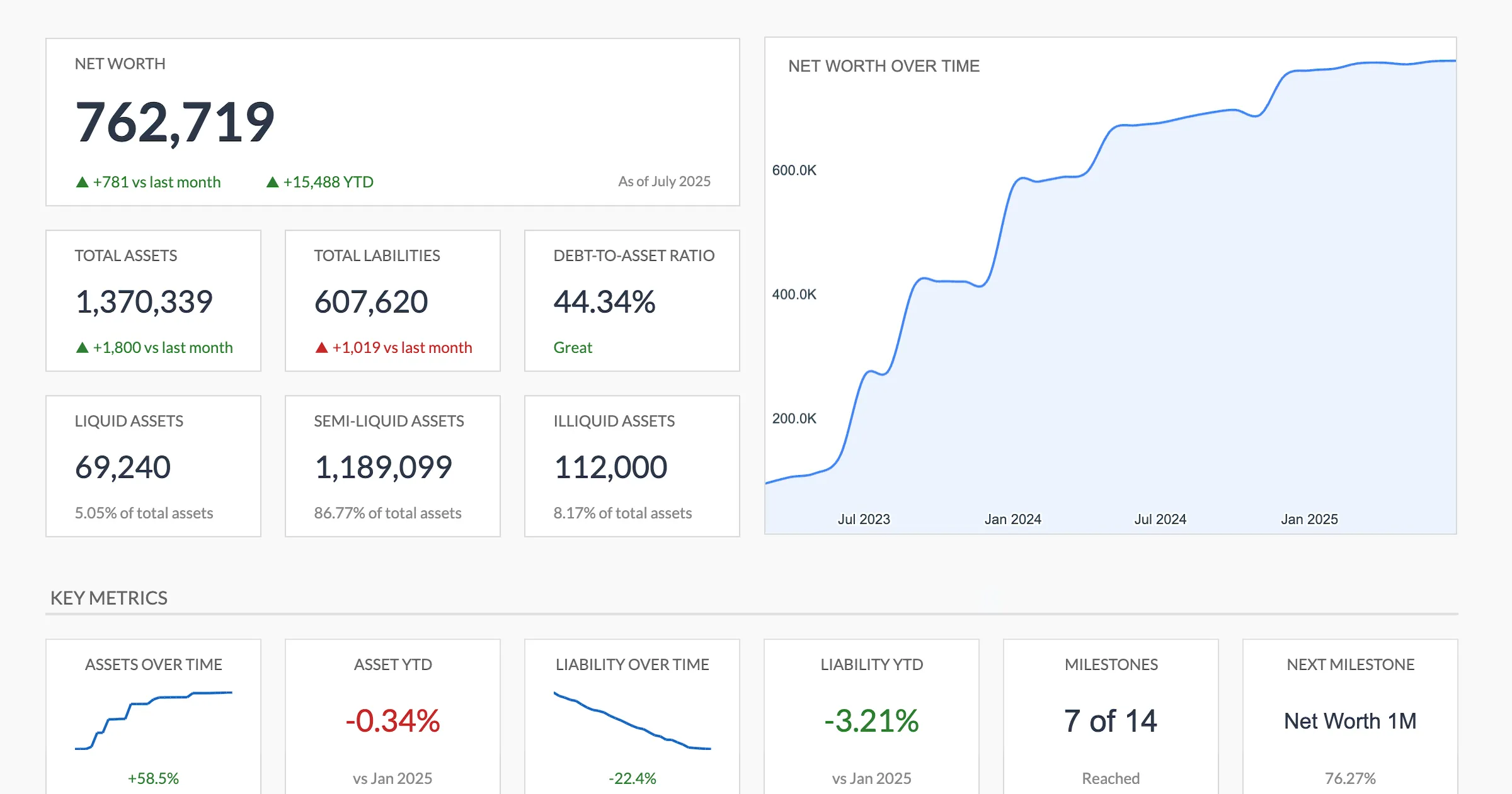 The FinancialAha Net Worth Tracker (Premium tier): a monthly log with a net-worth-over-time chart, liquidity breakdown and milestone tracking.
The bracket figures here change only when the Federal Reserve publishes a new survey, which is once every three years, so a bookmark and an annual look is usually enough for that half of the picture.
Where the data lives
Original source: Federal Reserve Survey of Consumer Finances. The bulletin (most recent: October 2023, covering 2022 data) is the citable summary. Next release expected in late 2026 covering 2025 data.
For methodology details, the SCF Codebook is publicly available. For anyone rebasing these figures into current dollars, the Bureau of Labor Statistics CPI-U series is the usual deflator.
For a different cut of the same question, our Net Worth by Generation analysis sets Boomers, Gen X and Millennials against each other at the same ages rather than at the same moment.
Get the template
- Net Worth Tracker - Monthly asset and liability log with a net worth over time chart, a liquidity split and milestone tracking.
- Financial Planning Spreadsheet - Assets, debt, goals and monthly cash flow in one file, with a projection that runs to an end year you set.
Related
Frequently asked questions
Why is the median so much lower than the mean?
Wealth distribution is highly skewed. A small number of very wealthy households pull the average up. Median (the middle household) is more representative of typical experience; mean (the arithmetic average) is heavily influenced by the top.
How does household vs individual net worth differ?
SCF reports household net worth, which combines married couples and any cohabiting financial unit. Individual net worth divides household by number of adults, roughly. For a single-earner household, the two are similar; for a dual-earner married household, individual is roughly half of household.
Is home equity included in these numbers?
Yes, the SCF includes primary residence as an asset and mortgage as a liability. For households without a primary residence, the data still applies; their net worth comes from other assets.
Do retirement accounts count toward net worth?
Yes. Balances in 401(k)s, IRAs and similar accounts are assets in the SCF figures, alongside bank accounts, taxable investments, vehicles and home equity. Debts of every kind come off the other side, including mortgages, student loans, auto loans and credit card balances.
What does it mean if I'm below the median for my age?
By definition about half of households are. The brackets describe a distribution rather than a target, and they say nothing about income, cost of living or how long someone has been earning. Some people find the direction of their own number year over year more informative than its position against a national bracket.
How accurate are the brackets if I'm in a high-cost-of-living city?
The numbers are national. SCF doesn't publish bracket data by metro area, but cost of living matters. Net worth in San Francisco or NYC tends to skew lower because of housing costs (less savings rate available), even though income is higher.
When does the next data update?
The Federal Reserve runs the SCF every three years. The most recent published is 2022 data (released October 2023). The next is 2025 data, expected to publish in late 2026.
How do I work out my own net worth to compare against these brackets?
Add up everything you own (cash, investment and retirement balances, home value, vehicles) and subtract everything you owe (mortgage, student loans, auto loans, credit card balances). The result is the figure that sits beside the brackets above. A net worth calculator or a tracking spreadsheet does the arithmetic and keeps the number month over month.
Do these figures count future Social Security or a pension?
Not directly. The SCF captures financial assets and property you hold now, not the present value of future Social Security benefits, and defined-benefit pensions are included only partially. Two households with identical measured net worth can face very different retirements once guaranteed income is added back in.
Sources
- Survey of Consumer Finances (2022) - Federal Reserve
- How Much Do I Need to Retire? - Fidelity
- 401(k) limit increases to $24,500 for 2026, IRA limit increases to $7,500 - IRS
- Consumer Price Index (CPI-U) - U.S. Bureau of Labor Statistics
About this article
Percentile points are computed from the Federal Reserve's SCF 2022 public summary extract (weighted); medians and means are the Fed's published figures, and the table matches the site's Net Worth Percentile Calculator exactly. Net worth medians, means and percentile brackets by age are taken from the Federal Reserve's 2022 Survey of Consumer Finances The 2026 401(k) catch-up figures were checked against the IRS contribution-limit announcement for 2026 Template sheets, inputs and outputs checked on 2026-09-10 against the shipped Net Worth Tracking Google Sheet (Summary, Assets, Liabilities, Milestones, Setup, Instructions tabs) and the Financial Planning Google Sheet (Summary, Goals, Assets, Debt, Cashflow, Projection tabs) Last reviewed September 2026.