
Net worth equals everything you own minus everything you owe. Add up cash, investments, retirement accounts, real estate, and vehicles, then subtract mortgages, loans, and credit card balances. The formula is one line; the work is gathering the numbers honestly the first time. This guide gives the categories, a worked example that totals to a real number, and a free calculator plus a Google Sheets tracker that run the math for you.
The formula is one line. The hard part is gathering the numbers honestly the first time.
Most first attempts come out wrong, and it is almost never the arithmetic. It is the 401(k) left behind at a job three years ago, the $1,800 borrowed from a family member and never written down, the car entered at what it cost rather than what it would sell for today.
This guide walks through the exact formula, the categories that belong in each side of the equation, the trickier judgment calls (cars, jewelry, vested-but-unexercised stock), and a worked example with named dollar amounts you can match against. If you only want the number now, the free Net Worth Calculator runs the arithmetic in your browser with the categories already laid out, and the Net Worth Tracker does the same math month over month so you get a trend instead of a single snapshot. By the end you’ll have a number and a way to keep it updated without thinking about it.
The formula
Net worth = Total assets minus Total liabilitiesThat’s it. There’s no version of this formula that’s more sophisticated. The complications come from what counts as an asset, what gets included as a liability, and how you value things that don’t have a market price.
In a spreadsheet, the formula in cell C50 looks like:
=SUM(Assets!B:B) - SUM(Liabilities!B:B)If the result is positive, you have a positive net worth. If negative, your liabilities exceed your assets, which is normal in your 20s if you have student loans and is a fixable situation regardless of age.
What counts as an asset
The categories below cover most people. The Net Worth Tracker template covers the same ground with eleven asset types of its own, running from Cash & Checking and Savings & Reserves through Real Estate and Retirement Account to Business Equity and Other.
Cash and cash equivalents
- Checking accounts
- Savings accounts
- Money market accounts and CDs
- Cash on hand (be honest, but don’t bother with anything under $200)
Investment accounts (taxable)
- Brokerage accounts
- Crypto holdings (use today’s value, accept that it’ll move)
- Treasury direct accounts
- 529 college savings accounts
- HSAs being used as investment accounts
Retirement accounts
- 401(k) and 403(b), including plans left at former employers
- Traditional IRA
- Roth IRA
- SEP IRA, SIMPLE IRA, solo 401(k)
- Pension lump-sum present value (if vested and quotable)
Real estate
- Primary residence (current market value, not what you paid)
- Rental properties (current market value)
- Land
Vehicles
- Cars, trucks, motorcycles (Kelley Blue Book private-party value)
- Boats, RVs (private-party value)
Other tangible
- Jewelry, collectibles, art (only if you’d actually sell, at realistic values)
- Cash value of a permanent life insurance policy
- Equity in a private business (use your last valuation if you have one, or skip)
Vested employer equity
- Vested RSUs at current share price
- Vested stock options (intrinsic value: current price minus strike, times shares)
- Skip unvested grants entirely
One filter keeps those “other” rows honest: if you wouldn’t sell something to raise cash in an emergency, it probably doesn’t belong on the list. Furniture, electronics, and clothes lose value too fast to mean anything here, and a collection only counts if you know its market and would realistically part with it.
For each row you list a description, a value, and the month the value belongs to. The month matters because real estate and vehicle values drift, and refreshing those annually rather than monthly is enough.
What counts as a liability
A liability is any debt you owe.
- Mortgage balance (not original loan amount)
- HELOC balance
- Auto loans and lease buyout amounts
- Student loans, federal and private
- Credit card balances (the actual balance, not the limit)
- Personal loans
- Buy-now-pay-later balances
- Medical debt in collections or on a payment plan
- Tax debt
- Business loans you’re personally liable for
- Money owed to family or friends (count it, even if interest-free)
Do not include monthly bills (rent, utilities, subscriptions) that you’ll pay on schedule. Those are expenses, not liabilities. A liability is a principal balance you owe, not a recurring payment.
A worked example
Marcus is 34. Here’s his net worth calculation, by category, as of April 2026.
Assets
| Category | Account | Value (USD) |
|---|---|---|
| Cash | Checking (Chase) | 4,200 |
| Cash | Savings (Ally HYSA) | 18,500 |
| Investment | Vanguard taxable | 41,800 |
| Investment | Coinbase BTC | 6,300 |
| Retirement | 401(k) (Fidelity) | 92,400 |
| Retirement | Roth IRA (Vanguard) | 28,100 |
| Real estate | Condo (Redfin estimate) | 380,000 |
| Vehicle | 2021 Honda Civic (KBB) | 19,500 |
| Vested equity | RSUs from employer | 14,200 |
| Total assets | 605,000 |
Liabilities
| Category | Account | Balance (USD) |
|---|---|---|
| Mortgage | Condo loan | 287,000 |
| Auto loan | Civic | 8,300 |
| Student loan | Federal | 14,200 |
| Credit card | Chase Sapphire | 1,400 |
| Total liabilities | 310,900 |
Net worth = $605,000 minus $310,900 = $294,100
Three minutes of arithmetic, decades of compounding to get there.
The same rows answer a second question. Take out the condo and the mortgage sitting against it and Marcus has $225,000 of non-home assets against $23,900 of non-mortgage debt, which is a liquid net worth of $201,100. The full figure shows his total financial position. The liquid figure shows what he could actually reach without selling the place he lives in. Both are worth writing down, because they move for different reasons, a distinction covered in net worth vs. liquid net worth.
What gets missed the first time
Four failure modes account for most wrong first numbers, and they sit alongside a longer list of net worth tracking mistakes worth knowing before you trust the total.
Old accounts. The 401(k) from a job you left, the HSA you stopped contributing to, the brokerage account you opened once and forgot. For many households, retirement balances are the single largest asset, so one forgotten plan can move the total by tens of thousands.
Small debts. An $800 card balance, a buy-now-pay-later plan with two payments left, $1,500 owed to a friend, a back tax bill. Each one looks too small to bother recording, and together they are the difference between a number you trust and one you quietly discount.
Purchase price standing in for current value. A car bought for $28,000 three years ago might sell for $17,000 today. The same logic applies to jewelry, electronics, and anything else entered at what it cost.
False precision. Rounding to the nearest hundred is enough. A portfolio moves more than that between the morning and the afternoon, so chasing exact figures adds work without adding accuracy.
The judgment calls
A handful of categories trip people up the first time.
Your primary residence. Two schools of thought. School A: include market value as an asset and mortgage as a liability. School B: exclude both because you can’t realistically liquidate without buying a new place. School A is standard. The Net Worth Tracker follows it, carrying Real Estate as an asset type and Mortgage as a liability type, and its Summary tab splits total assets into liquid, semi-liquid and illiquid, with real estate classified as semi-liquid by default. Both views are useful. Whichever school you follow, base the value on a recent comparable sale nearby rather than the top of a Zillow or Redfin range, and refresh it once a year. There is more on pinning down a defensible property figure in how to value real estate for net worth.
Your car. Include it, but use Kelley Blue Book private-party value and update annually. A car loses real value every year; tracking it monthly is overkill but ignoring it makes net worth look artificially low for someone with a $40,000 paid-off vehicle.
Equity in a private business. The most subjective line on the sheet. If the business couldn’t realistically be sold, one approach is to value it at the liquid assets it holds. If it could be sold, a rough revenue multiple for the industry gives a starting point. Whatever basis you pick, write it down so next year’s number is comparable.
Pre-tax retirement balances. A traditional 401(k) or IRA gets taxed on withdrawal, so some people discount those balances by the tax rate they expect in retirement. Most calculations use the gross balance for simplicity, and the template has no tax-adjustment field, so the figure you enter is the figure it totals. Either convention works as long as it doesn’t change month to month.
Future income (Social Security, pensions, expected raises). Don’t include. Net worth is a snapshot of what you have right now. Future expected income belongs in your retirement plan, not your balance sheet.
How often to recalculate
Monthly is the right cadence for most people. Each calculation takes about ten minutes once you’ve set up the template and know which logins to pull from. Quarterly is fine if your situation is stable. Weekly is too often and creates noise; market moves dominate the signal.
The reason monthly works is that it gives you a 12-point trend line per year. Three quarterly points is too few to see anything; weekly is fifty-two points of mostly market noise.
Setting up the spreadsheet
Five steps if you’re building from scratch.
- Create three sheets in one Google Sheets file: Assets, Liabilities, Dashboard.
- On Assets, put columns for Date, Category, Account, Value. Fill in your starting rows.
- On Liabilities, do the same.
- On Dashboard, write
=SUM(Assets!D:D) - SUM(Liabilities!D:D)for net worth, plus=SUM(Assets!D:D)and=SUM(Liabilities!D:D)for the components. - Each month, append a new column or row with the date and updated values. Keep history.
Or skip steps 1 through 4 and use the Net Worth Tracker, which ships with the tabs, the formulas, a net worth over time chart, and monthly columns you extend by inserting a new one each month.
Between building from scratch and a full template sits a middle path: several free net worth tracker spreadsheets are compared here, along with the point where a paid one starts to earn its price.
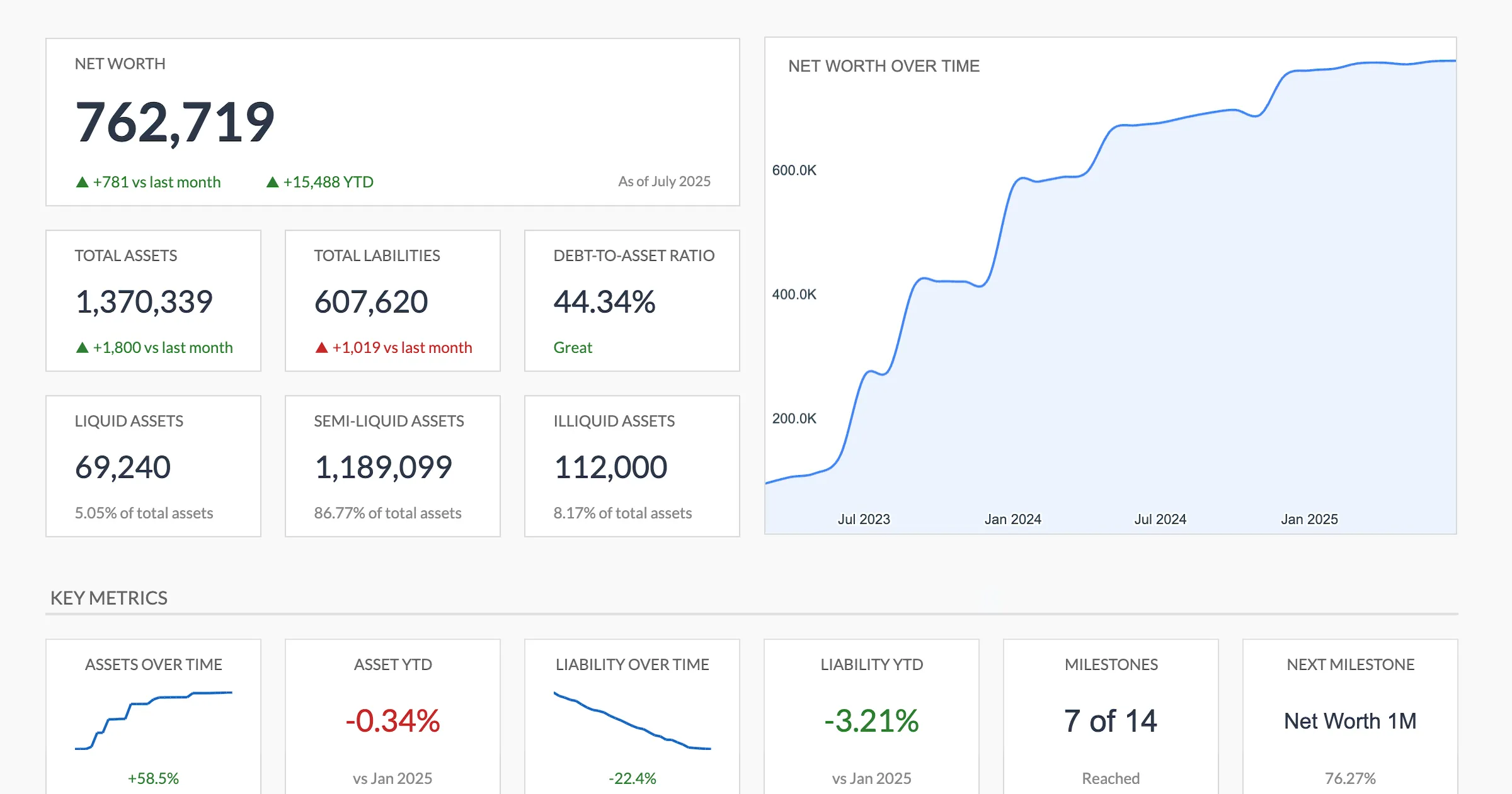
The Net Worth Tracker (Premium) dashboard. The same assets-minus-liabilities math from this guide, plotted month over month with the trend line the single number can’t show.
If you only want the number once, the free Net Worth Calculator walks the same categories in the browser. No signup, no spreadsheet.
What to do with the number once you have it
Honestly, not much, at first. The number is a baseline. The value comes from the second, third, and twelfth data points, when you can see direction.
Direction outranks size, and the gap is bigger than people expect. A $50,000 net worth growing by $15,000 a year is a stronger position than a $200,000 net worth falling by $10,000 a year. Any single snapshot tells you less than the slope does.
Some context that helps frame your number, from the Federal Reserve’s Survey of Consumer Finances. The 2022 wave, published in October 2023, is the most recent one available, and these are median household figures including home equity:
| Age of household head | Median net worth |
|---|---|
| Under 35 | $39,000 |
| 35 to 44 | $135,600 |
| 45 to 54 | $247,200 |
| 55 to 64 | $364,500 |
| All households | $192,900 |
These are medians for households, not individuals. Comparing yourself to age-bracket data is useful for orientation, less useful as a goal. Your number depends on your circumstances, your income trajectory, and a lot of luck. Direction matters more than absolute level.
For the full set of brackets, the mean-versus-median gap, and what the data leaves out, see Net Worth by Age.
Get the template
- Net Worth Tracker - Monthly asset and liability log with a net worth over time chart, a liquid, semi-liquid and illiquid split, and milestone tracking.
- Financial Planning Spreadsheet - Assets, debts, cash flow and a projection that runs to an end year you set, with net worth and goals on the summary.
Related
Frequently asked questions
Should I include my home in net worth?
Yes, by convention. List the current market value as an asset and the remaining mortgage balance as a liability. If you want to see how much of the total you could actually reach, the Net Worth Tracker splits total assets into liquid, semi-liquid and illiquid, using the classification set for each asset type on its Setup tab.
What about my partner's finances?
If you share finances, calculate household net worth jointly. If you keep finances separate, calculate yours alone. Either approach is valid; what matters is consistency over time so the trend line is meaningful.
How accurate do I need to be on home value?
Within 10 percent is fine for tracking purposes. Use Zillow's Zestimate, Redfin's estimate, or a recent comparable sale. Update annually rather than monthly. The number is approximate by nature.
Do I subtract future taxes from my 401(k) balance?
Most calculations use the gross balance, and the Net Worth Tracker has no tax-adjustment field, so it totals whatever balance you enter. Some people discount traditional 401(k) and IRA balances by the tax rate they expect in retirement, since withdrawals get taxed on the way out. Either convention holds up as long as you keep using the same one, because the trend is what you are reading.
Should crypto count if it's volatile?
Yes, at today's value. Accept that next month's number will be different. The volatility is the point of including it; you can't see your real exposure if it's not on the balance sheet.
Is a negative net worth bad?
No, it's a snapshot. A 25 year old with $40,000 in student loans and $5,000 in a Roth has a negative net worth, and that's normal. The trajectory matters more than the level. If your number is moving in the right direction, the snapshot will catch up.
Sources
- Changes in U.S. Family Finances from 2019 to 2022 (2022 Survey of Consumer Finances) - Federal Reserve
- Survey of Consumer Finances (SCF) - Federal Reserve
About this article
Median net worth figures are verified against the Federal Reserve's 2022 Survey of Consumer Finances (Changes in U.S. Family Finances from 2019 to 2022). The worked-example totals are recomputed from the asset and liability rows listed in the article. Product claims were checked on 2026-09-10 against the shipped Net Worth Tracker Google Sheet (Summary, Assets, Liabilities, Milestones, Setup tabs) and the Financial Planning Google Sheet (Summary, Goals, Assets, Debt, Cashflow, Projection tabs). Last reviewed September 2026.