Annual Tax Planner
Annual Tax Planner for High Earners
One annual tax planner you set up around a complex income mix: salary, equity, investment, and rental income in a single log, with deductions, withholding, and the balance still due.
In Depth
High Income, Higher Complexity - Tax Planning at Scale
Higher income introduces tax considerations that simply do not exist at lower earnings levels. The Net Investment Income Tax adds 3.8% on investment income above certain thresholds. The Alternative Minimum Tax can trigger unexpectedly when incentive stock options are exercised or large state tax deductions are claimed. Medicare surtaxes layer on additional costs. Each of these provisions has its own threshold and calculation, creating a multi-dimensional tax picture that benefits from year-round visibility.
Tax-loss harvesting becomes a meaningful strategy at higher income levels where capital gains are substantial. Selling investments at a loss to offset realized gains can reduce taxable income, but the wash sale rule prevents repurchasing substantially identical securities within 30 days. Tracking the timing of gains and losses throughout the year - rather than scrambling in December - allows for more thoughtful decisions about when to realize losses and which specific lots to sell.
Charitable giving strategies also shift at higher income levels. Donor-advised funds allow bunching multiple years of charitable contributions into a single tax year to exceed the standard deduction threshold. Donating appreciated securities directly avoids capital gains tax entirely while still providing a charitable deduction. These strategies require knowing the full tax picture - income, gains, and existing deductions - which is only possible with consistent tracking throughout the year.
The Challenge
Why High Earners Need Proactive Tax Planning
At higher income levels, the marginal impact of tax planning increases dramatically. The difference between proactive and reactive tax management can be tens of thousands of dollars.
Higher brackets magnify every decision
At the 32%, 35%, or 37% bracket, every unoptimized dollar costs more. Deductions missed, contributions not maximized, and timing mismanaged have outsized consequences.
Multiple income types require coordination
Salary, bonuses, RSU vesting, stock option exercises, investment income, rental income, and side businesses - each has different tax treatment and timing considerations.
Phaseouts limit common deductions
Income-based phaseouts reduce or eliminate deductions and credits that lower earners take for granted. Knowing which limitations apply prevents surprises.
AMT and NIIT add additional layers
Alternative Minimum Tax and Net Investment Income Tax apply at higher income levels. Without tracking, these additional taxes are discovered only at filing time.
Ready to take control of your high earner finances?
What You Get
Tax Tools for High-Income Filers
Eight income types on one dashboard
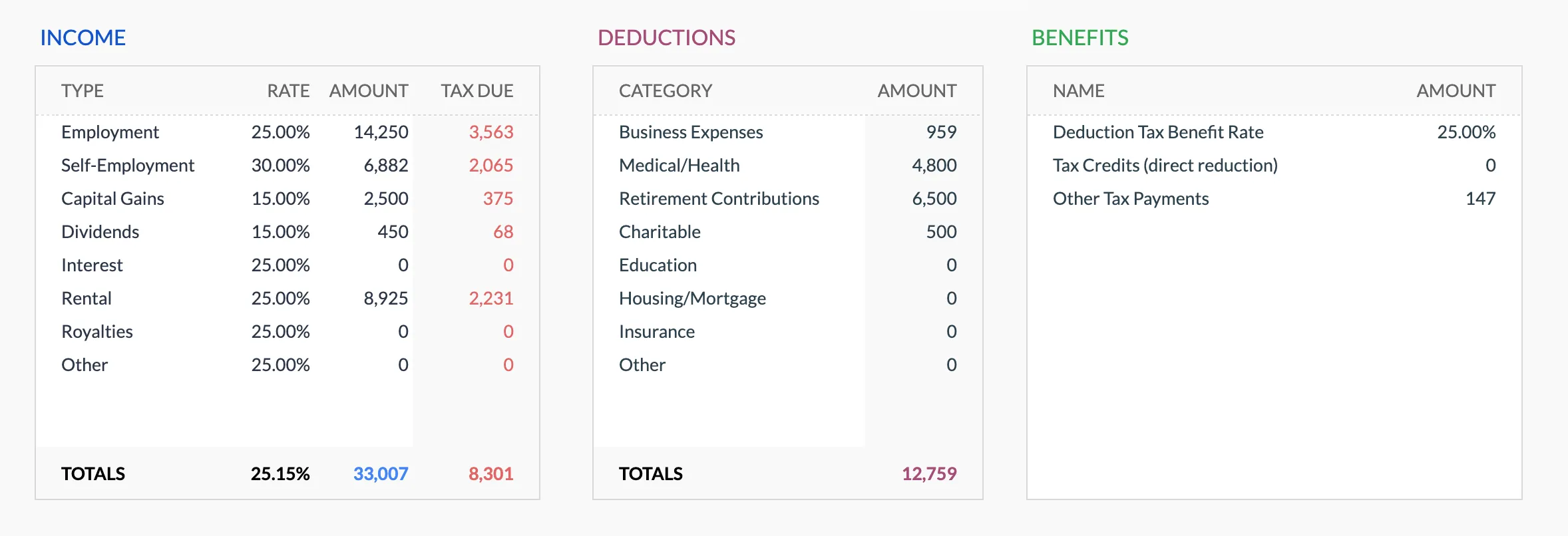
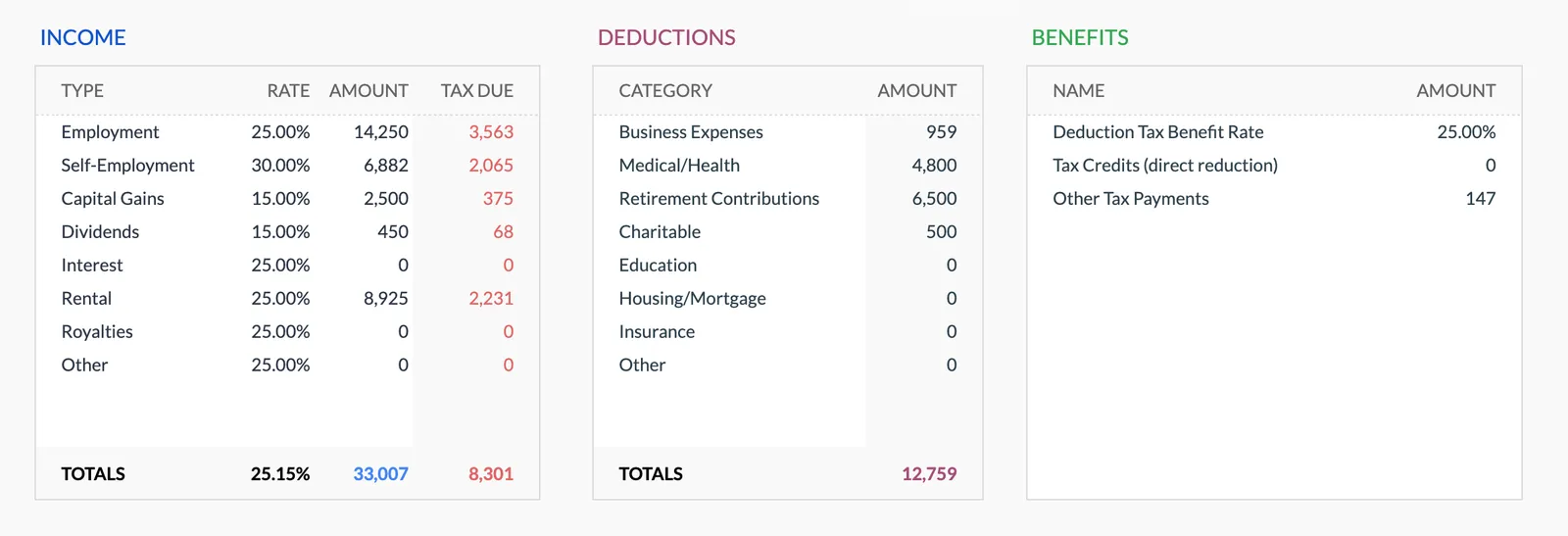
Employment, self-employment, capital gains, dividends, interest, rental, royalties, and other each carry their own rate and their own tax due line. Bonus and equity vesting go in as employment rows.
Major deductions in one list
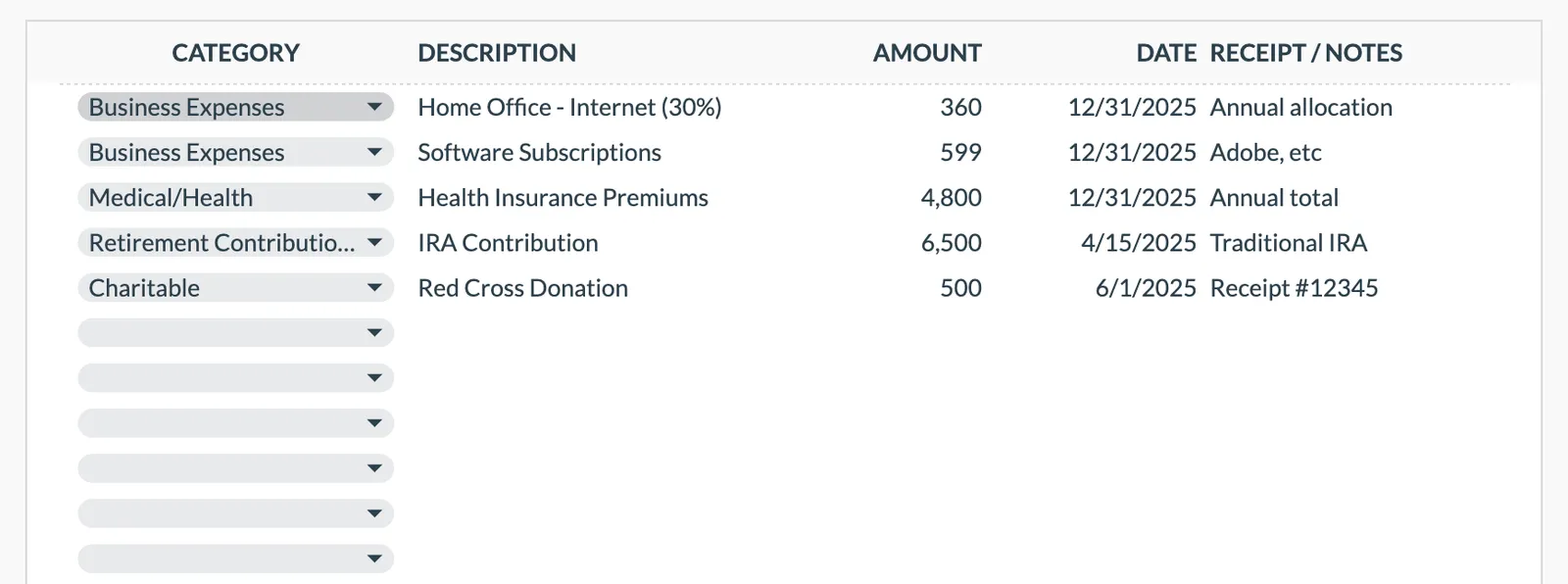
Charitable, Housing/Mortgage, Medical/Health, Insurance, and Education sit among the eight categories. The dashboard totals them and applies the deduction benefit rate you set.
Tax-advantaged contribution tracker
401(k), HSA, and IRA contributions go in under Retirement Contributions with the account named in the description. The dashboard totals the category for the year.
Withholding and estimated payment tracker
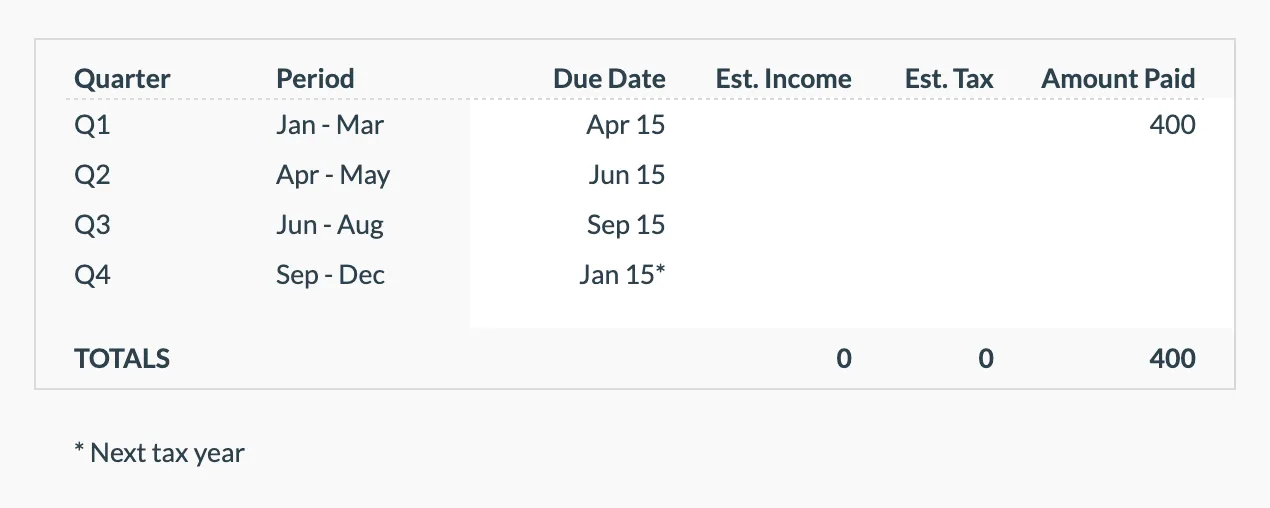
Monitor W-2 withholding alongside estimated payments. See whether your combined payments will cover your estimated liability.
Blended and effective rate figures
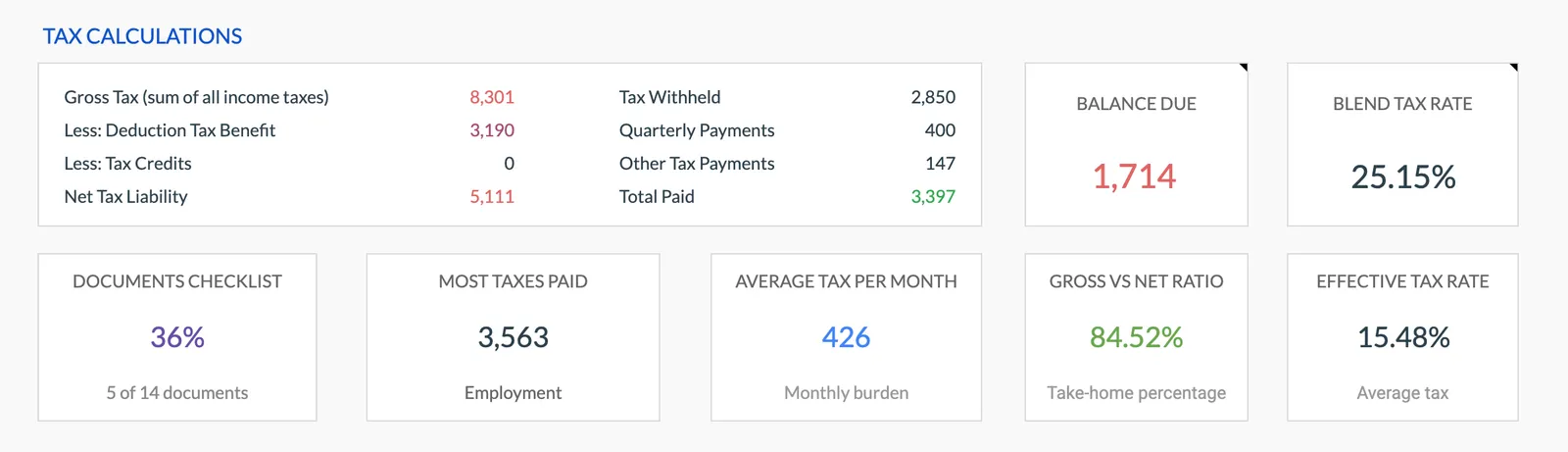
The dashboard shows the blended rate across all income types, the effective rate after deductions and credits, and the average tax per month. AMT and NIIT are not modelled.
A running tax figure through the year
Gross tax, deduction benefit, credits, net liability, total paid, and balance due all update as rows go in. The figures follow the rates you set rather than the tax code.
See It In Action
What the template looks like
Browse through the template to see how it handles income tracking, deductions, quarterly payments, and tax projections.
- Tax overview dashboard
- Income source tracking
- Deduction organization
- Quarterly payment planning
- Tax projection estimates
Annual tax overview with key figures
Detailed tax breakdown and projections
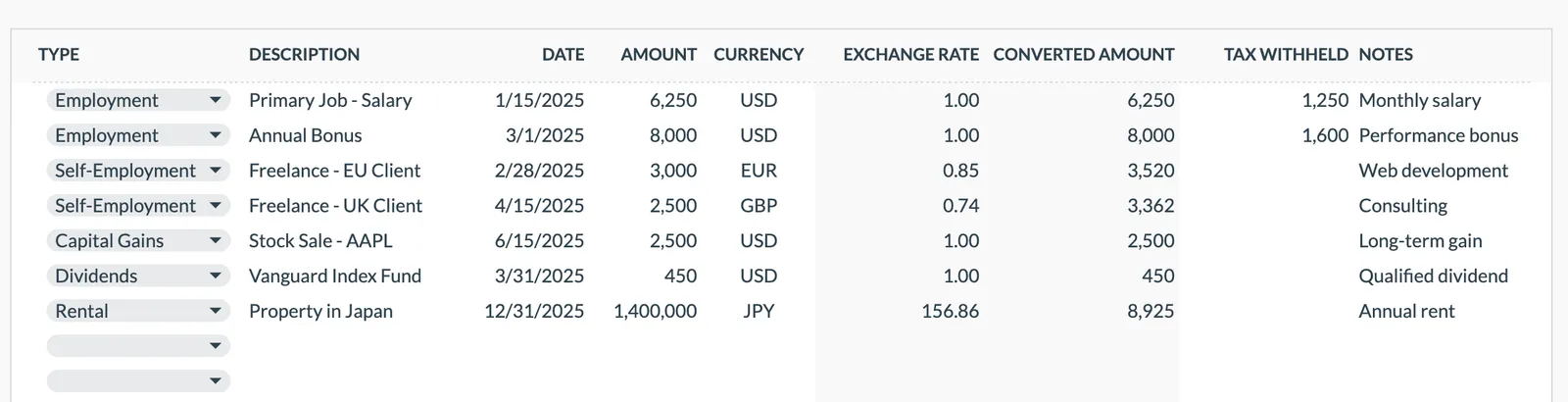
Track all income sources for tax purposes
Organize and track tax deductions
Plan and track quarterly estimated tax payments
Getting Started
Begin Planning for High-Income Tax Filing
Enter all income sources
List every income source with expected or actual amounts. Include salary, bonus projections, equity vesting schedule, and investment income.
Track deductions as they occur
Charitable donations, state tax payments, property taxes, mortgage interest - log each deductible expense.
Log tax-advantaged contributions
Enter 401(k), HSA, and IRA contributions under Retirement Contributions as they are made. The dashboard shows the category total, and the annual limits are ones you track yourself.
Review quarterly
Check your projected liability against withholding and estimated payments. Adjust if needed.
Review the Q4 picture
The balance due figure in Q4 shows where the year has landed. Any decisions it prompts are worth taking to a tax professional.
Common Questions
Tax Planner for High Earners- FAQ
Does this handle equity compensation?
There is no equity module. RSU vesting, option exercises, and ESPP purchases go in as employment or capital gains rows, with the detail in the description.
What about the AMT?
The planner does not model AMT. ISO exercises and large state tax payments can be recorded as rows and notes, but whether AMT applies is settled on the return.
Can I plan charitable giving?
Track charitable contributions year-to-date. At higher income levels, strategies like donor-advised funds and bunching deductions become relevant.
Does this replace a CPA?
No. The template organizes your tax data and provides projections. For strategy development and return preparation at high income levels, working with a tax professional is common.
How does this handle the SALT cap?
State and local tax payments go in as deductions. The planner does not apply the SALT cap, so if that limit affects you the capped figure is the one to enter.
What about tax-loss harvesting?
Realized gains go in as capital gains rows, and losses can be entered against them. The planner does not model harvesting, so that comparison happens outside it.
Can't find the answer you're looking for? Contact our team
Start tax planning as a high earner
One-time purchase. No subscription. Your financial data stays in your Google Drive.