Annual Tax Planner
Annual Tax Planner for Freelancers
Track freelance income, deductions, and quarterly estimated payments throughout the year - so tax season is data entry, not a scramble.
In Depth
The Tax Reality of Working for Yourself
Freelancing changes the tax equation in ways that catch many people off guard during their first year. Without an employer handling withholding, the full weight of income tax and self-employment tax lands on the freelancer. The 15.3% self-employment tax alone - covering both the employer and employee portions of Social Security and Medicare - represents a significant expense that does not exist in traditional employment. Some freelancers discover this only when they file their first return.
Quarterly estimated payments introduce a rhythm that runs counter to how most people think about taxes. Instead of one annual event, freelancers operate on a four-payment cycle with deadlines in April, June, September, and January. Missing these deadlines or underpaying triggers penalties that compound the cost. The challenge is that estimating income accurately requires knowing what the rest of the year looks like - something that is inherently uncertain in freelance work.
Deduction tracking tends to be where the gap between organized and unorganized freelancers shows up most clearly. A home office, professional software, health insurance premiums, and business travel all reduce taxable income - but only when documented. Many freelancers leave legitimate deductions on the table simply because they did not record expenses as they occurred. Year-round tracking turns tax season from a stressful reconstruction project into a straightforward data review.
The Challenge
Why Freelancers Need Year-Round Tax Tracking
Freelance income comes without tax withholding. Every dollar arrives gross, and the tax obligation is yours to calculate, track, and pay - four times a year.
No employer withholds taxes for you
Every client payment arrives without federal, state, or self-employment tax removed. If you do not set aside the right amount, tax season brings an unwelcome bill.
Quarterly estimated payments require planning
The IRS expects quarterly payments. Underpaying triggers penalties. But calculating the right amount requires knowing your income and deductions - information that changes throughout the year.
Deductions get lost without real-time tracking
Home office, equipment, software, travel, professional development, health insurance - freelancers have many potential deductions, but only if they track them as they happen.
Self-employment tax adds 15.3%
On top of income tax, freelancers pay both the employer and employee portions of Social Security and Medicare. This additional tax is often a surprise to new freelancers.
Ready to take control of your freelancer finances?
What You Get
Tax Planning Features for Freelance Income
Client payments in one income log
Each row takes a description, date, amount, currency, and any tax withheld. Client names go in the description, and the dashboard totals every row as self-employment income.
Deduction categories that cover freelance costs
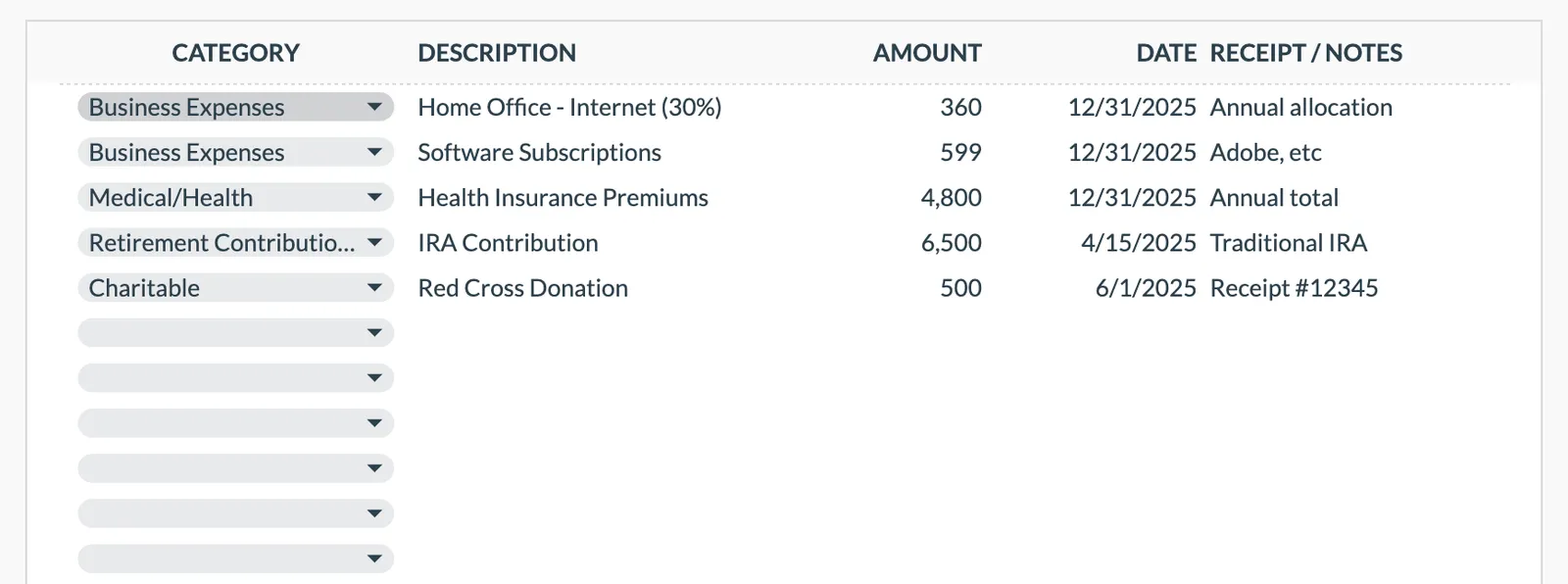
Eight categories ship with the sheet, among them Business Expenses, Medical/Health, Retirement Contributions, Insurance, and Education. Home office, software, and travel are typed as descriptions under Business Expenses.
Quarterly estimated payment tracker
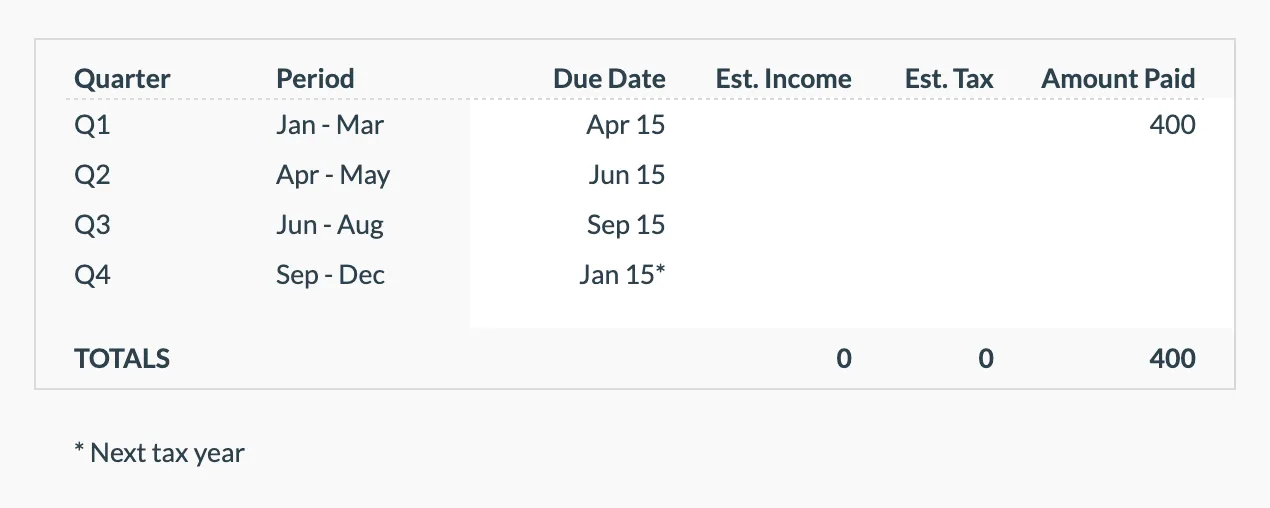
The four quarters arrive with their periods and due dates already set out. You fill in the estimated income, estimated tax, and amount paid for each one.
Self-employment income kept separate
Self-Employment is one of eight income types on the dashboard. It carries its own rate that you set and its own tax due line, next to employment and investment income.
Payment tracking
Record each estimated payment alongside tax withheld and any other payments. The dashboard totals what has been paid and shows the balance still due.
Annual tax picture for freelancers
Total income, total deductions, the tax due from the rates you set, and payments made. A single reference to work from or hand to a preparer.
See It In Action
What the template looks like
Browse through the template to see how it handles income tracking, deductions, quarterly payments, and tax projections.
- Tax overview dashboard
- Income source tracking
- Deduction organization
- Quarterly payment planning
- Tax projection estimates
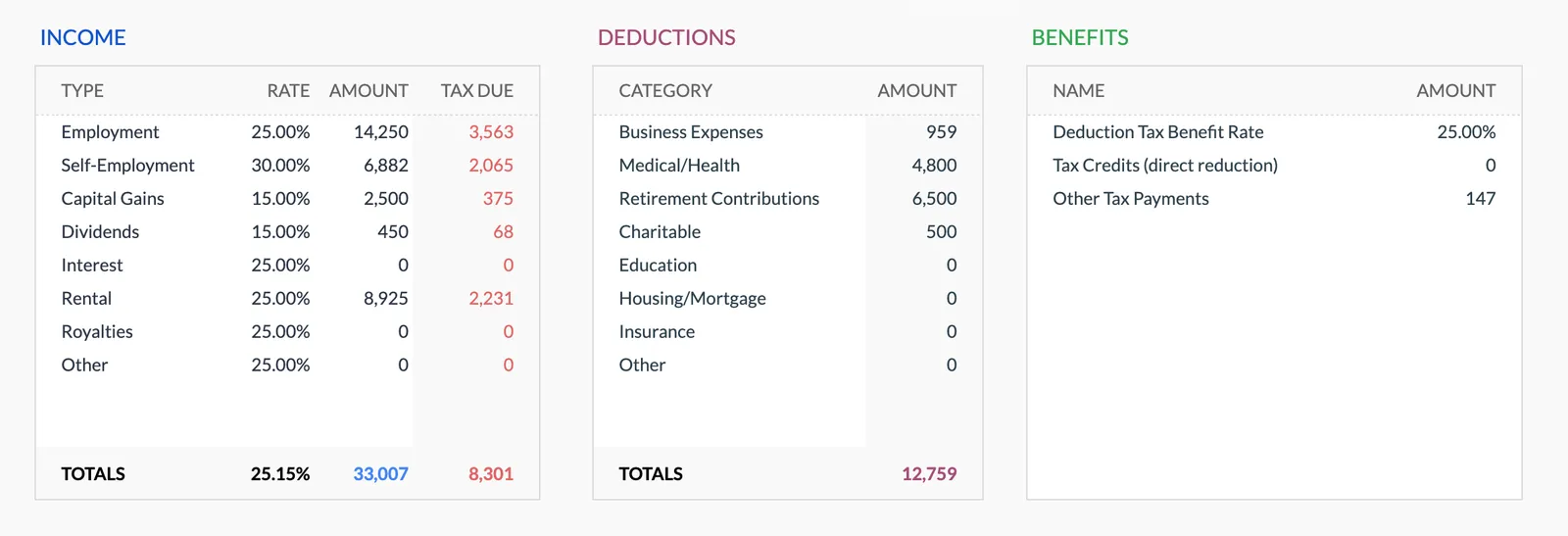
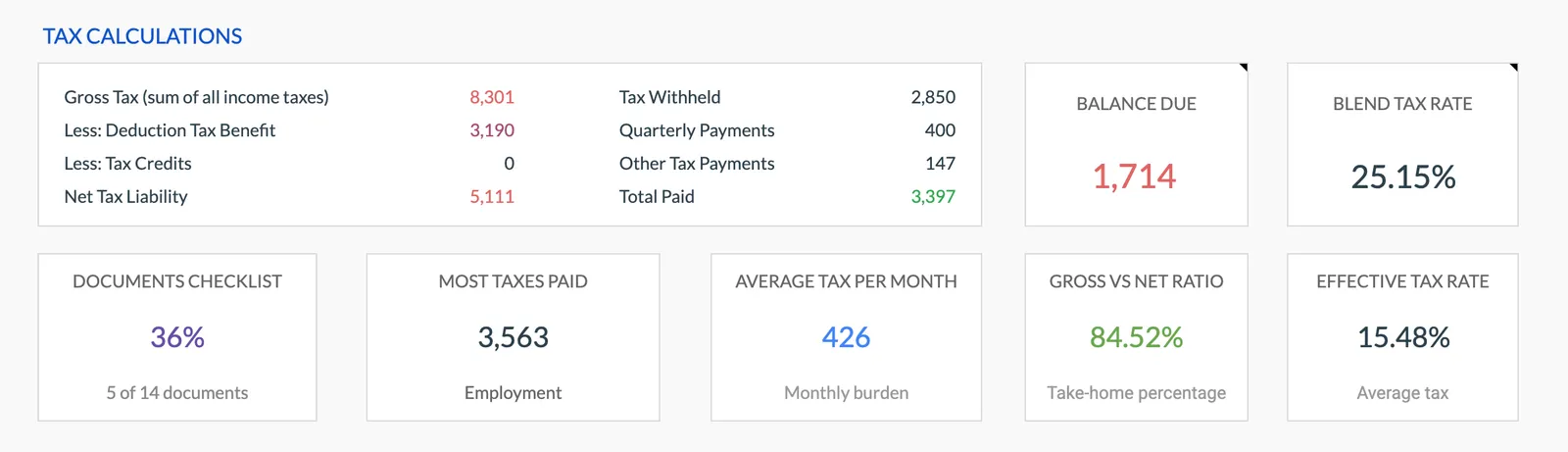
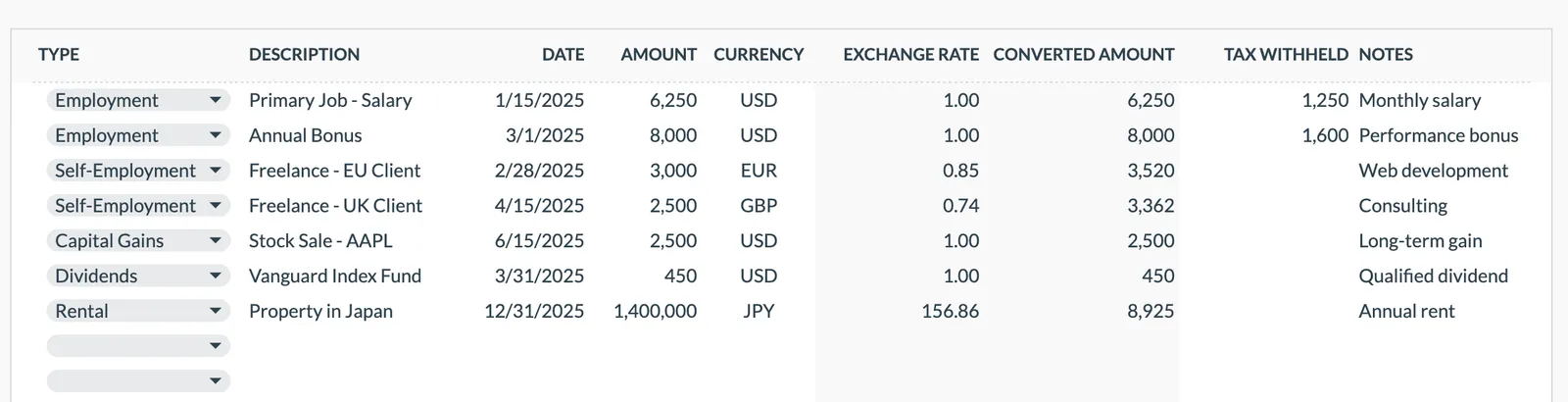
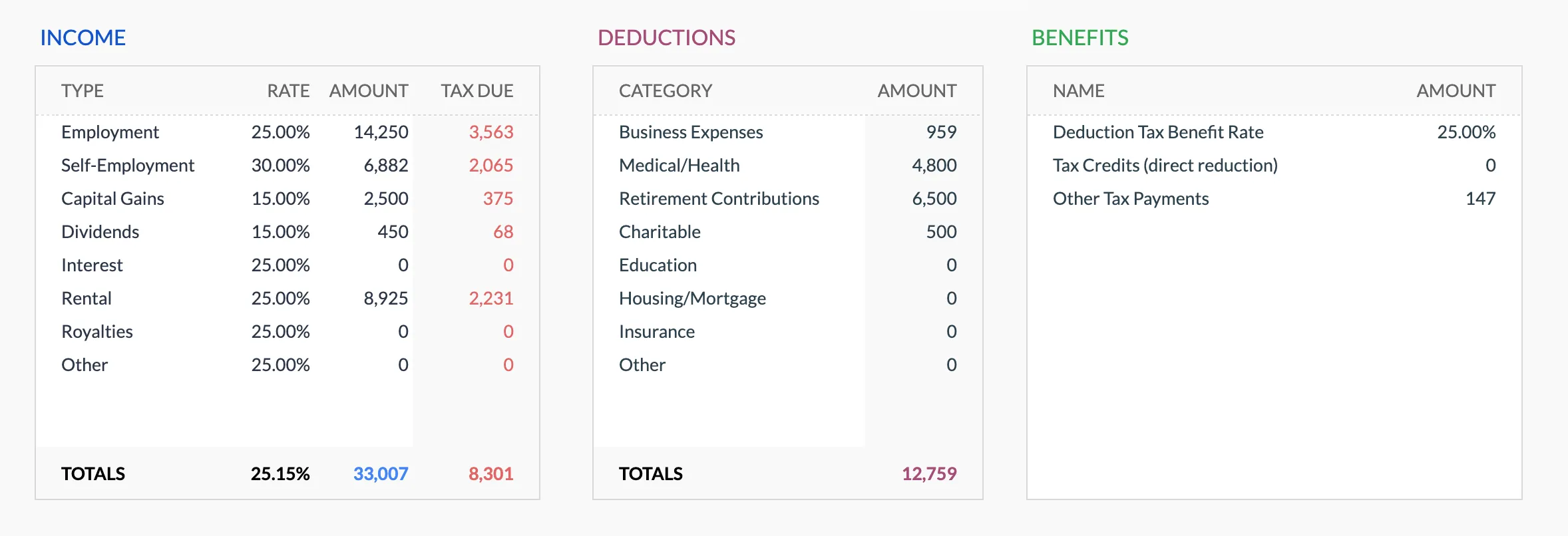
Annual tax overview with key figures
Detailed tax breakdown and projections
Track all income sources for tax purposes
Organize and track tax deductions
Plan and track quarterly estimated tax payments
Getting Started
Start Organizing Your Freelance Taxes
Enter your income as it arrives
Record each client payment with the date and amount. The template calculates running totals.
Log deductions throughout the year
Enter business expenses under the category that fits, with a description and a receipt note, while the details are still fresh.
Calculate quarterly estimates
Before each due date on the Quarterly Payments sheet, fill in your own estimated income and estimated tax for that quarter.
Record payments made
After each estimated payment, log it in the template. Track cumulative payments against obligations.
Review at year end
The summary shows your full tax picture. Use it to prepare for filing or hand it to your tax preparer.
Common Questions
Tax Planner for Freelancers- FAQ
When are quarterly estimated payments due?
Generally April 15, June 15, September 15, and January 15. The Quarterly Payments sheet lists those four periods with their due dates and a column for the amount you paid.
What deductions can freelancers take?
Common categories include home office, equipment, software, travel, professional development, health insurance premiums, and business-related subscriptions. Most are recorded under Business Expenses, health insurance under Medical/Health, with the detail typed into the description field.
Does this calculate my exact tax owed?
The template provides estimates based on income and deductions you enter. For exact calculations, consult a tax professional. The template gives you organized data to share with them.
What if my income varies a lot between quarters?
The annualized income method allows different estimated payments per quarter. Each of the four rows has its own estimated income and estimated tax fields, so the quarters do not have to match.
Does this work for sole proprietors and LLCs?
Yes. Single-member LLCs and sole proprietors have the same tax structure for self-employment purposes. The template works for both.
What about state taxes?
The template focuses on federal tax tracking. You can add a section for state estimated payments using the same income and deduction data.
Can't find the answer you're looking for? Contact our team
Start tax planning as a freelancer
One-time purchase. No subscription. Your financial data stays in your Google Drive.