Mississippi
Tax Planner Template for Mississippi
Organize your federal and Mississippi state tax planning in Google Sheets. Mississippi is stepping its flat income tax rate down year by year.
In Depth
Mississippi's Tax Phase-Down Path
Mississippi finished its move to a flat income tax and immediately set course for something rarer: phasing the tax out. The 2022 reform consolidated the old graduated brackets into a single rate, reaching 4.7% in 2024, and the 2025 Build Up Mississippi Act took over from there with a fixed schedule: 4.4% for 2025, 4.0% for 2026, then 0.25 points a year until the rate reaches 3.0% in 2030. Beyond 2030, further cuts toward full elimination are tied to revenue growth triggers, which as enacted are considerably easier to meet than the drafters originally intended. The first $10,000 of taxable income stays exempt for every filer throughout.
What sets Mississippi apart for retirees is the blanket exemption on qualified retirement income. Social Security benefits, public and private pensions, and qualified 401(k) and IRA distributions are all exempt from Mississippi state income tax, with no age or income cap. This is one of the broadest retirement income exemptions in the country - most states with an income tax still tax at least some of these sources. Early or non-qualified withdrawals are the main exception.
Combined with one of the lowest costs of living in the United States, the overall financial picture in Mississippi differs considerably from higher-cost, higher-tax states. Property taxes are below the national average, and the 2025 law also cut the state sales tax on groceries from 7% to 5%. For working-age residents, the income tax after the exempt threshold is moderate and falling on a published schedule.
Mississippi
Tax Planning in Mississippi
Mississippi has a flat income tax with a rate that steps down every year under a 2025 law: 4.4% in 2025, 4.0% in 2026, and 0.25 points a year until it reaches 3.0% in 2030. The first $10,000 of taxable income is exempt for every filer.
Income Tax Phase-Down
A 2025 law schedules annual rate cuts: 4.4% for 2025, 4.0% for 2026, then 0.25 points a year to 3.0% in 2030. Beyond that, further cuts toward full elimination depend on state revenue growth.
Exempt Threshold
Mississippi exempts the first $10,000 of taxable income from state tax for all filers, and on a combined return each spouse gets the exemption. This effectively acts as a large zero bracket on top of the standard deduction and personal exemption.
Retirement Income
Mississippi does not tax Social Security benefits, pensions, or qualified distributions from retirement plans such as 401(k)s and IRAs. Early or non-qualified withdrawals are taxable.
Low Cost of Living
Mississippi has one of the lowest [2] costs of living in the country. Combined with the retirement income exemptions, the overall tax and cost burden can be notably low.
Get the Annual Tax Planner
Getting Started
How to Use the Template for Mississippi Taxes
Enter income and apply the $10,000 exemption
Add all income sources to the template. For Mississippi's state calculation, the first $10,000 of taxable income is exempt, and only income above that threshold faces the flat rate for the year (4.0% in 2026). This makes the state math simple - but the federal side with graduated brackets is where detailed tracking pays off.
Mark all retirement sources as Mississippi-exempt
Mississippi does not tax Social Security, pensions, or qualified 401(k) and IRA distributions. If you have retirement income, mark it as state-exempt in your notes. This means retirees with no earned income may owe little or no Mississippi tax, even though their federal tax picture may be more involved. Early or non-qualified withdrawals are the exception and remain taxable.
Track federal deductions closely since state is simple
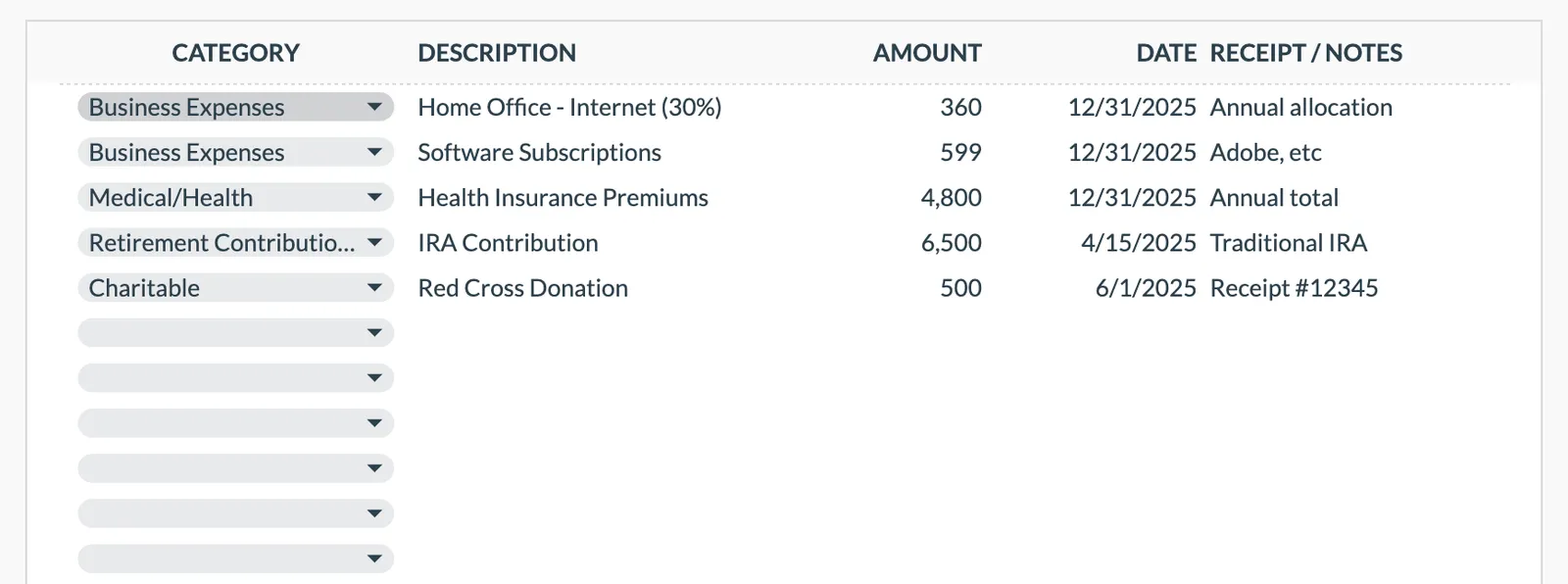
With Mississippi's streamlined structure, most of the planning value comes from the federal side. Focus on tracking deductions, credits, and the standard-vs-itemized decision at the federal level. The template's deduction tracking helps organize items like mortgage interest, charitable contributions, and medical expenses that only matter for the federal return.
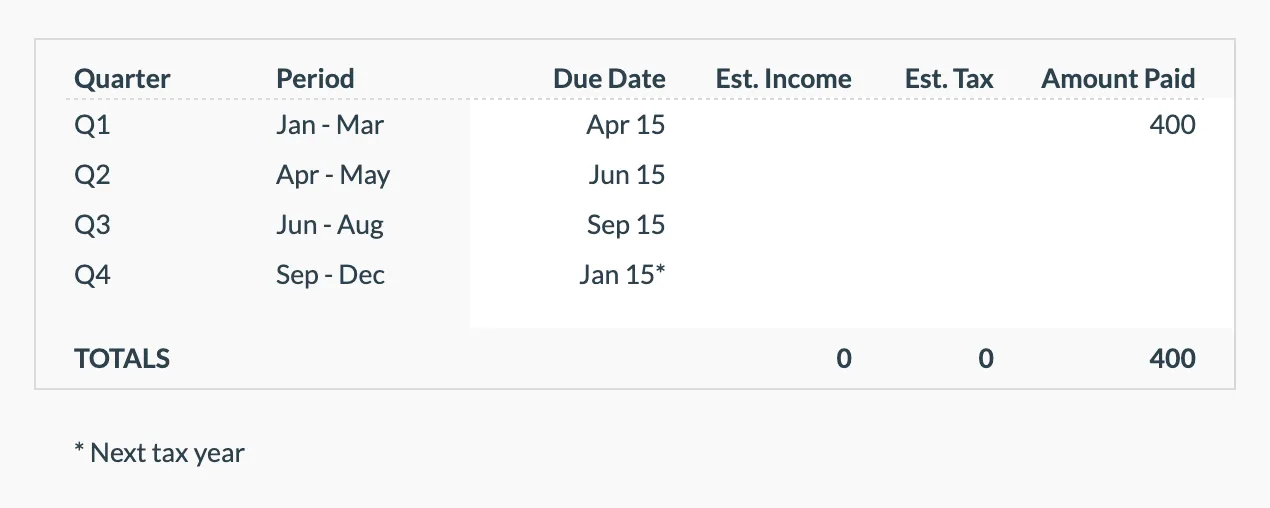
Record estimated payments if you have earned income
For self-employed Mississippi residents, estimated payments cover federal and state obligations. The state portion is straightforward: apply the current year's flat rate [1] to projected income above the exempt threshold and divide by four. Because the rate steps down each year, using the current year's rate rather than last year's keeps the estimate aligned.
Compare your effective rates at each level
The $10,000 exemption means your effective Mississippi rate on total income is lower than the headline flat rate, and the annual step-downs lower it further each year. Track this effective rate in your notes alongside your federal effective rate for a clear picture of your total tax burden across both levels.
See It In Action
What the tax planner looks like
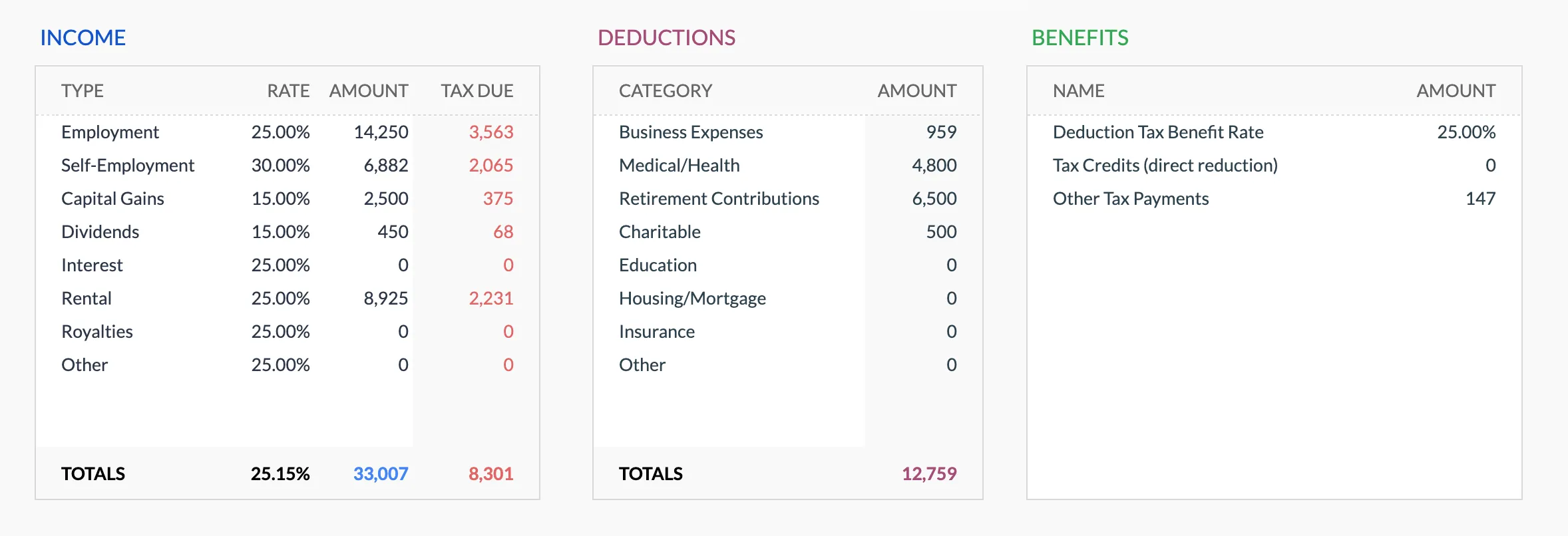
Browse through the template to see how it tracks income, deductions, credits, and estimated quarterly payments.
- Annual tax overview dashboard
- Income tracking by source
- Deductions and credits organizer
- Quarterly payment tracker
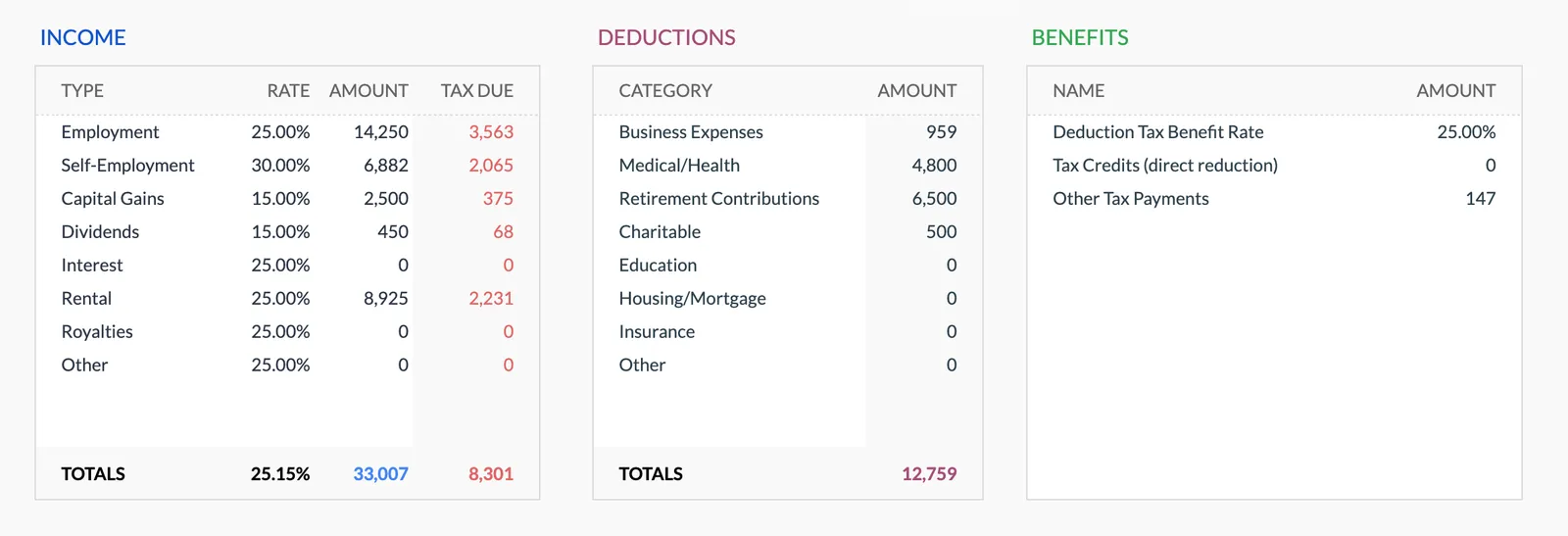
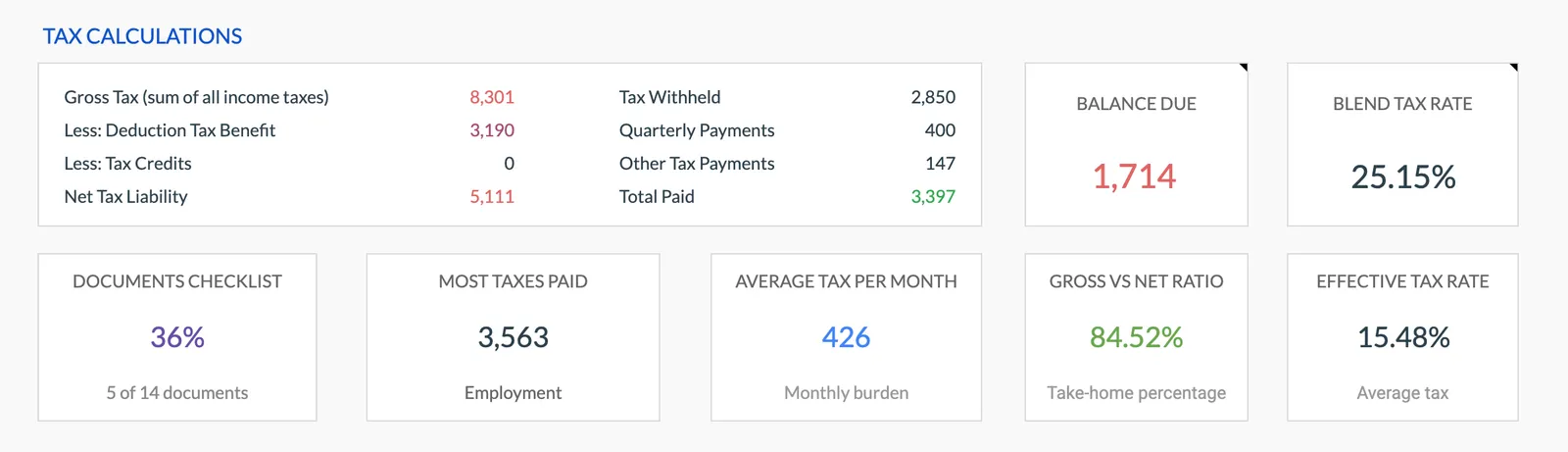
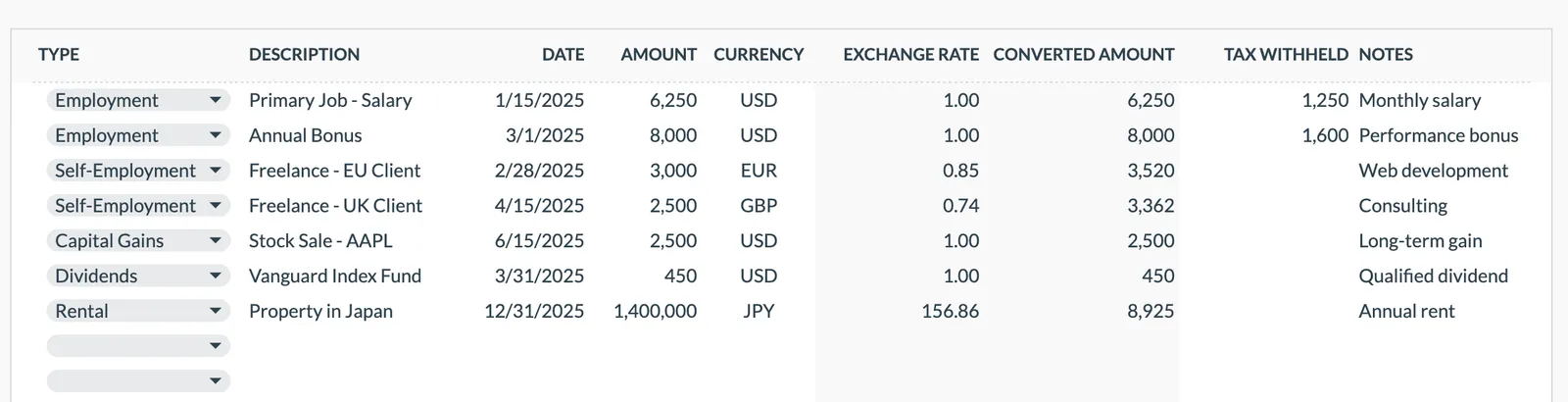
Annual tax overview with key figures
Detailed tax breakdown and projections
Track all income sources for tax purposes
Organize and track tax deductions
Plan and track quarterly estimated tax payments
Common Questions
Tax Planning in Mississippi - FAQ
How does Mississippi's first-$10,000-exempt rule work?
Mississippi exempts the first $10,000 of taxable income from state tax for all filers, and on a combined return each spouse gets their own $10,000 zero bracket. This functions like a large zero-bracket amount on top of the standard deduction and personal exemption. Income above the threshold is taxed at the flat rate for that year: 4.4% in 2025 and 4.0% in 2026. The exempt threshold provides proportionally larger relief for lower-income residents.
What is Mississippi's income tax rate, and where is it heading?
The flat rate is stepping down every year under the 2025 Build Up Mississippi Act: 4.4% for 2025, 4.0% for 2026, then 0.25 points a year until it reaches 3.0% in 2030 [1]. After 2030, further reductions toward eliminating the income tax entirely are tied to state revenue growth triggers, which as enacted are much easier to meet than originally drafted. The rate that applies is always the one set for the tax year in question.
Does Mississippi tax any retirement income?
Mississippi does not tax Social Security benefits, pensions, or qualified distributions from plans like 401(k)s and IRAs, with no age or income cap. Early or non-qualified withdrawals that do not meet the plan's retirement requirements are taxable. This blanket exemption on qualified retirement income is one of the broadest in the country. For Mississippi retirees, state income tax applies primarily to earned income from continued employment.
How does Mississippi's low cost of living factor into tax planning?
Mississippi has one of the lowest costs of living in the United States, which means take-home pay after taxes stretches further than in most states. While cost of living does not directly change tax calculations, it is useful context when comparing Mississippi's falling flat rate to higher rates in states with higher living costs. The 2025 law also cut the state sales tax on groceries from 7% to 5%, effective July 2025. The combination of the exempt threshold, retirement income exemptions, and low costs creates a distinct financial environment.
Can I use this template for Mississippi's simplified structure?
The template focuses on federal tax planning, which is the more complex side for Mississippi residents. The state structure is straightforward: after the standard deduction and personal exemption, the first $10,000 of taxable income is exempt, and the remainder is taxed at that year's flat rate, 4.0% for 2026. Use the notes section to track this calculation and any retirement income exemptions alongside your federal projections.
Can't find the answer you're looking for? Contact our team
Official Tax Resources
For current rates, forms, and filing deadlines specific to Mississippi:
Organize your tax planning for Mississippi
One-time purchase. No subscription. Your financial data stays in your Google Drive.
Tax rules, rates, and contribution limits change, and official publications can themselves lag behind the law in force. We review these figures on a best-effort basis against sources we consider authoritative, but we cannot guarantee they are current, complete, or that better sources do not exist, and nothing here is tax, legal, or financial advice. For decisions, the relevant government authority is the reference. Last reviewed: August 2026.