Iowa
Tax Planner Template for Iowa
Track your federal and Iowa state tax planning in Google Sheets. Iowa has taxed individual income at a single flat rate of 3.8% since 2025.
In Depth
Iowa's Flat-Tax Transformation
Iowa's income tax went through one of the faster transformations of any state. As recently as 2022, Iowa had a graduated system with many brackets and a top rate near 8.5%, among the higher rates in the Midwest. A reform enacted that year collapsed the brackets step by step, and a follow-up law accelerated the finish: since tax year 2025, all taxable income is taxed at a single flat rate of 3.8%, a year earlier and slightly lower than the original schedule.
The same reform changed what the tax applies to. Iowa now starts its calculation from federal taxable income, so the federal standard-or-itemize decision flows straight through to the state return, and Iowa no longer maintains its own standard deduction. The historic deduction for federal income taxes paid, a feature Iowa shared with only a few states, was repealed as part of the move.
Iowa is notably generous with retirement income. Residents aged 55 and older, disabled taxpayers, and qualifying surviving spouses can exclude qualifying retirement income from state tax, including pensions, 401(k) distributions, IRA withdrawals, and annuities from qualified plans. Social Security benefits are exempt for everyone. This combination is a significant factor for anyone planning retirement in Iowa.
Iowa
Tax Planning in Iowa
Iowa completed a multi-year reform in 2025, replacing its graduated brackets with a single flat rate of 3.8%. The state now starts its calculation from federal taxable income, which keeps the two levels closely linked.
Flat Income Tax
Iowa taxes individual income at a flat 3.8% rate, in place since tax year 2025 [1]. The move completed a reform that began in 2022 and arrived a year earlier, and at a slightly lower rate, than the 3.9% originally scheduled for 2026.
Federal Taxable Income Starting Point
Since 2023, the Iowa return starts from federal taxable income, after the federal standard or itemized deduction. Iowa no longer has its own standard deduction, and the old deduction for federal taxes paid was repealed as part of the same reform.
Retirement Income
Iowa excludes qualifying retirement income (pensions, 401(k) distributions, IRA withdrawals, and annuities from qualified plans) for residents 55 and older, disabled taxpayers, and qualifying surviving spouses. Social Security benefits are exempt for everyone, regardless of age or income.
Property Tax
Iowa property tax rates are moderate. A homestead credit is available for primary residences.
Get the Annual Tax Planner
Getting Started
How to Use the Template for Iowa Taxes
Enter income under the flat 3.8% rate
Add all income sources - wages, self-employment, investments, and retirement distributions. Since tax year 2025, Iowa taxes individual income at a single flat rate of 3.8%, so state projections no longer depend on which bracket your income falls into. The template helps you organize income for both the federal graduated brackets and the flat state calculation.
Start from federal taxable income
The Iowa return begins with federal taxable income, after the federal standard or itemized deduction has been applied. Iowa no longer has a separate standard deduction, and the historic deduction for federal taxes paid was repealed in 2023. In practice this means the choices you make on the federal side flow directly into the state calculation, which makes tracking both together especially useful.
Track retirement income exclusions
Iowa excludes qualifying retirement income (pensions, 401(k) distributions, IRA withdrawals, and annuities from qualified plans) for residents aged 55 and older, disabled taxpayers, and qualifying surviving spouses. Social Security benefits are exempt for all residents. If you receive retirement income, entering each source separately helps clarify how much is excluded from Iowa tax and how much remains taxable.
Review deductions on the federal side
Because Iowa starts from federal taxable income, deductions like mortgage interest, charitable contributions, and medical expenses affect your Iowa tax through the federal return rather than a separate state schedule. Enter all deduction items in the template to see how the standard-versus-itemized decision changes both federal and Iowa liability at once.
Plan estimated payments at the settled flat rate
Iowa requires estimated payments on income not subject to withholding. With the rate settled at a flat 3.8%, prior-year liability is a reasonable reference point again, and Iowa allows safe harbor methods similar to the IRS approach. The template's quarterly tracker helps you record each payment and compare the running total against your projected liability.
See It In Action
What the tax planner looks like
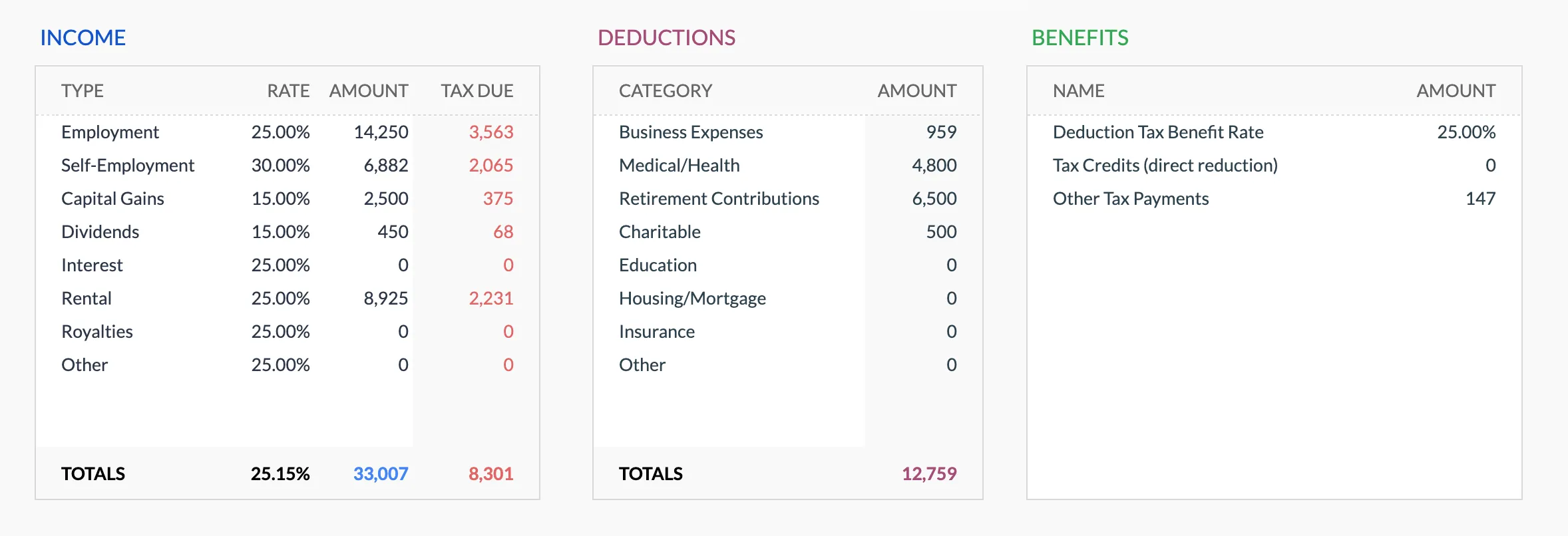
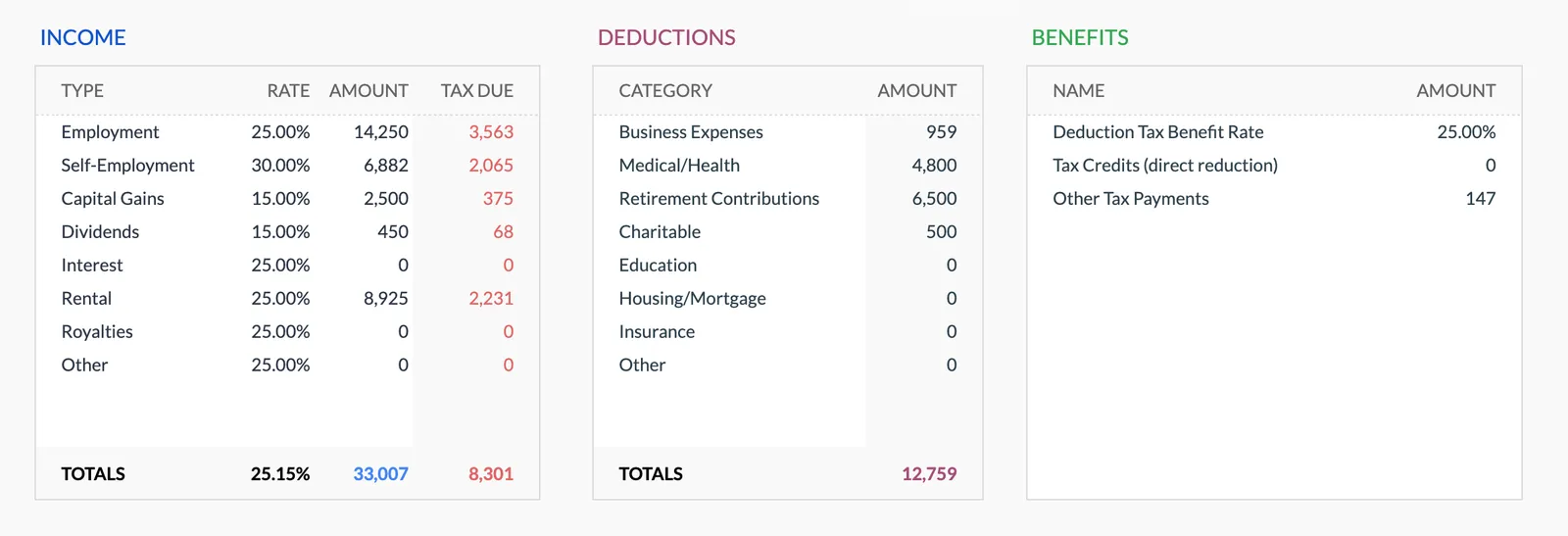
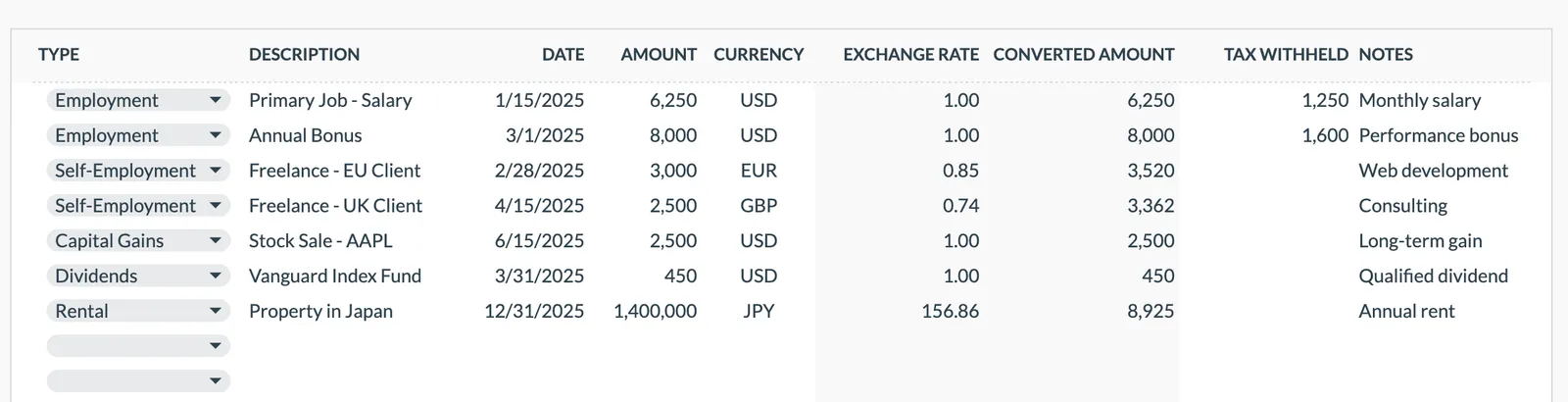
Browse through the template to see how it tracks income, deductions, credits, and estimated quarterly payments.
- Annual tax overview dashboard
- Income tracking by source
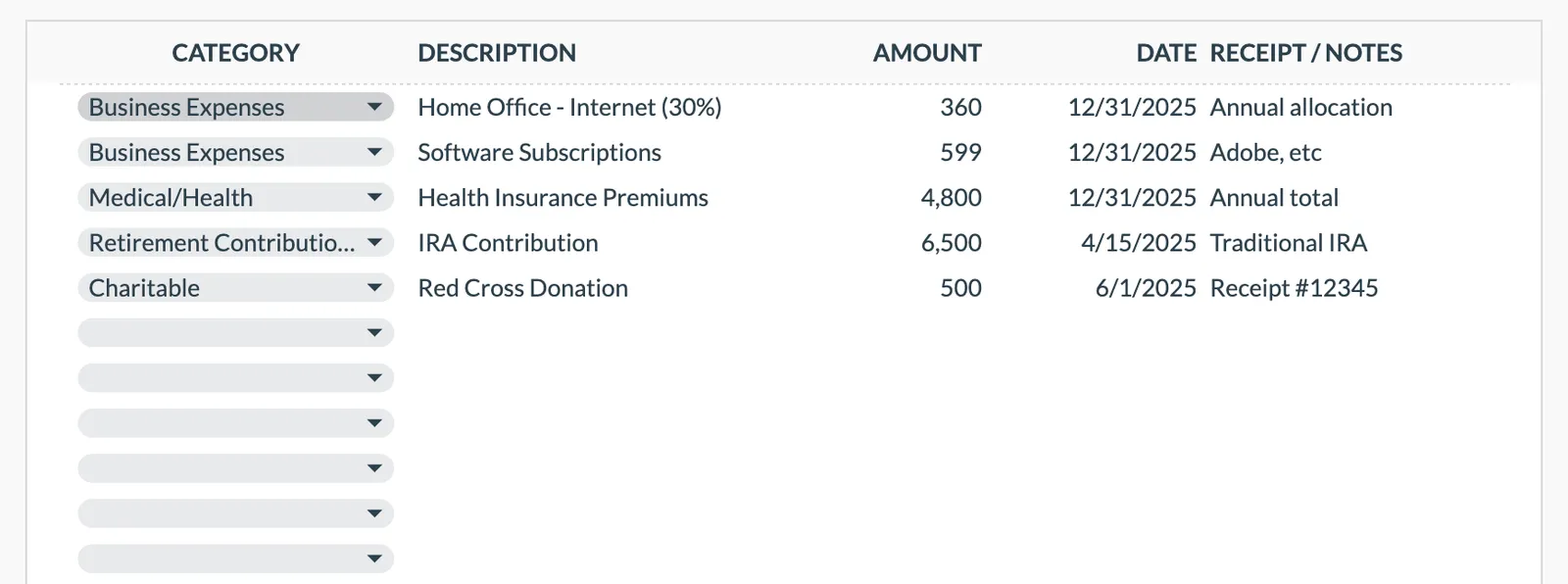
- Deductions and credits organizer
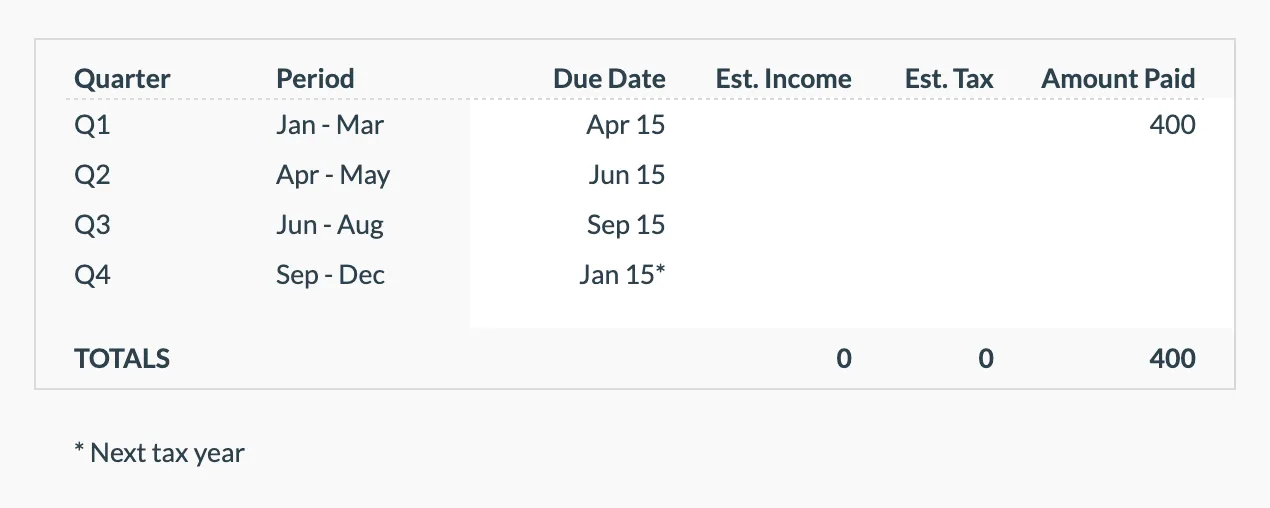
- Quarterly payment tracker
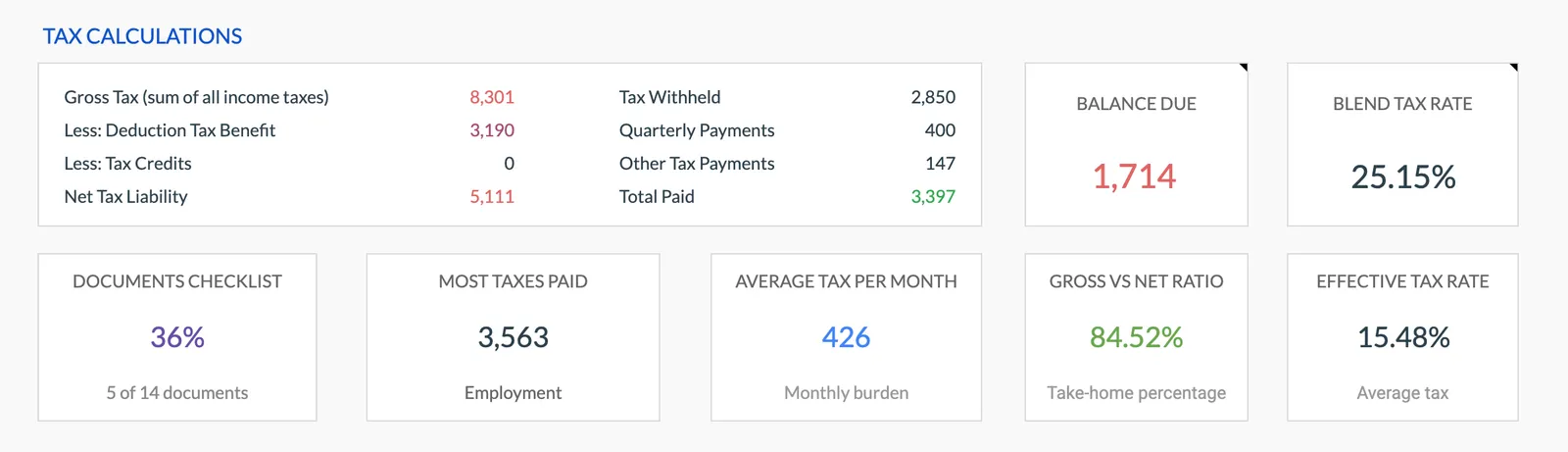
Annual tax overview with key figures
Detailed tax breakdown and projections
Track all income sources for tax purposes
Organize and track tax deductions
Plan and track quarterly estimated tax payments
Common Questions
Tax Planning in Iowa - FAQ
What is Iowa's current income tax rate?
Iowa has taxed individual income at a single flat rate of 3.8% since tax year 2025 [1]. This completed a reform that began in 2022, when Iowa still had a multi-bracket graduated system with a top rate near 8.5%. The flat rate arrived a year earlier, and slightly lower, than the 3.9% originally scheduled for 2026. No further individual rate reductions are currently scheduled.
What happened to Iowa's federal tax deduction?
Iowa was one of a handful of states that allowed residents to deduct federal income taxes paid from their state taxable income. That deduction was repealed effective tax year 2023, when Iowa also moved to federal taxable income as the starting point for the state return. The two changes worked in opposite directions: the lost deduction raised Iowa taxable income, while the falling rates lowered the tax on it. The reform has since settled into the current flat 3.8% structure.
How does Iowa treat retirement income?
Generously. Residents aged 55 and older, disabled taxpayers, and qualifying surviving spouses can exclude qualifying retirement income from Iowa tax, including pensions, 401(k) distributions, IRA withdrawals, and annuities from qualified plans [2]. Social Security benefits are exempt for all residents regardless of age or income. Nonqualified deferred compensation and nonqualified annuities do not qualify for the exclusion.
How does Iowa's flat rate compare to neighboring states?
As of the 2026 tax year, Iowa's 3.8% flat rate sits well below Minnesota's graduated system with its 9.85% top rate and Wisconsin's 7.65% top rate, and below Illinois's 4.95% flat rate. Indiana's flat rate is lower at 2.95%, and Nebraska's top rate has come down to 4.55%. Missouri's top rate is 4.70%, and South Dakota has no income tax at all. For a state that had one of the higher top rates in the Midwest a few years ago, this is a substantial repositioning.
How does the flat rate affect estimated payments?
Estimated payments are more straightforward than during the transition years, when a falling rate made prior-year liability an overestimate. With the rate settled at 3.8%, Iowa's safe harbor methods, which work similarly to the IRS approach based on a percentage of prior-year liability, line up better with current-year reality. The template's projections help you compare a current-year estimate against prior-year figures.
Can't find the answer you're looking for? Contact our team
Official Tax Resources
For current rates, forms, and filing deadlines specific to Iowa:
Sources
Organize your tax planning for Iowa
One-time purchase. No subscription. Your financial data stays in your Google Drive.
Tax rules, rates, and contribution limits change, and official publications can themselves lag behind the law in force. We review these figures on a best-effort basis against sources we consider authoritative, but we cannot guarantee they are current, complete, or that better sources do not exist, and nothing here is tax, legal, or financial advice. For decisions, the relevant government authority is the reference. Last reviewed: August 2026.