United States
FIRE Calculator for the United States
Calculate your path to financial independence in a free Google Sheets calculator, with US context on 401(k), Roth IRA, and HSA contribution limits for 2026.
In Depth
Financial Independence With American Tax Advantages
The US tax code, while complex, offers FIRE-minded savers a powerful toolkit. Maxing out a 401(k) at $24,500 for 2026 reduces taxable income immediately, with catch-up room of $8,000 at 50 and over and $11,250 at ages 60 to 63. Adding a Roth IRA ($7,500 for 2026, or $8,600 at 50 and over) creates a pool of tax-free money accessible in retirement. The HSA, sometimes called the "stealth IRA", provides a triple tax benefit: deductible contributions, tax-free growth, and tax-free withdrawals for medical expenses. Used together, these accounts can take more than $36,000 per year for a single person in 2026, counting an HSA limit of $4,400 for self-only coverage and $8,750 for family coverage (IRS Rev. Proc. 2025-19).
Accessing retirement funds before age 59.5 is the central logistical puzzle of early retirement in America. The Roth conversion ladder, which means converting Traditional IRA funds to Roth and waiting five years before withdrawing, is the most discussed strategy. The Rule of 55 allows penalty-free 401(k) access for those who separate from that employer at 55 or later, one of the IRS exceptions to the 10% early distribution tax. SEPP (72t) distributions offer another path but lock the withdrawals into a fixed series. Most FIRE practitioners plan to live on taxable brokerage accounts and Roth contributions (which can always be withdrawn penalty-free) during the bridge years.
Healthcare before Medicare eligibility at 65 is the largest variable cost in US FIRE planning. ACA marketplace plans are the primary option, and their cost depends heavily on reported income. FIRE practitioners who keep taxable income low, by drawing from Roth accounts or spending down taxable accounts with a low cost basis, may qualify for premium tax credits, though the enhanced credits lapsed after 2025 and 2026 eligibility again stops above 400% of the federal poverty level (HealthCare.gov). This interaction between withdrawal strategy and healthcare costs is one of the most important calculations in American early retirement planning.
United States
FIRE in the United States: What to Know
The FIRE (Financial Independence, Retire Early) movement is particularly active in the US, where tax-advantaged accounts and relatively high salaries in certain industries create opportunities for aggressive saving.
Tax-advantaged accounts accelerate the path to FIRE
Maximizing 401(k), Roth IRA, and HSA contributions reduces current taxes and grows investments tax-efficiently. The "mega backdoor Roth" strategy, available through some 401(k) plans, uses the gap between the employee deferral limit and the overall cap on all 401(k) additions, which the IRS set at $72,000 for 2026 (Notice 2025-67), leaving up to $47,500 before employer contributions. Understanding and using these accounts is central to most US FIRE strategies.
The 4% rule originated from US market data
The widely cited 4% safe withdrawal rate comes from the 1998 Trinity Study by Cooley, Hubbard and Walz in the AAII Journal, based on US stock and bond market history. It suggests that withdrawing 4% of your portfolio in year one (adjusting for inflation thereafter) has historically sustained a 30-year retirement. Some people use 3.5% for longer retirements or 3% for added safety.
Accessing retirement funds before 59.5 requires planning
US early retirees need strategies to access funds before standard retirement age: Roth IRA contribution withdrawals (always penalty-free), Roth conversion ladders (5-year waiting period), SEPP/72(t) distributions, which appear among the IRS exceptions to the 10% additional tax on early distributions, or relying on taxable brokerage accounts. Planning the bridge between early retirement and age 59.5 is a central FIRE consideration.
Healthcare is the biggest pre-65 FIRE challenge
Without employer-sponsored insurance, ACA marketplace plans are the primary option. Premiums depend on income, so FIRE practitioners often watch their taxable income closely. The enhanced premium tax credits from 2021 lapsed after 2025, so for 2026 eligibility follows the earlier rules again, including the cutoff above 400% of the federal poverty level (HealthCare.gov). This interplay between withdrawals, taxes, and healthcare subsidies is a key FIRE planning element.
Get the Template
Getting Started
Running Your US FIRE Numbers
Enter your current financial position
Input your total invested assets across all accounts - 401(k), IRA, Roth, HSA, and taxable brokerage. Include current balances and annual contribution amounts.
Set your target annual spending
Enter your expected annual expenses in early retirement. Include healthcare costs, which will likely be higher without employer coverage. The calculator uses this to determine your FIRE number (typically 25x annual spending).
Adjust assumptions for your situation
Set expected investment returns, inflation rate, and withdrawal rate. Conservative assumptions (lower returns, higher inflation, lower withdrawal rate) give more confidence in the results.
Factor in Social Security as a future offset
Most FIRE retirees still build up Social Security credits along the way. Personalized estimates come from a my Social Security account, and a benefit that starts later reduces what the portfolio has to cover from that point on.
Review your FIRE date and savings rate
The calculator shows your projected FIRE date based on current inputs. Your savings rate (percentage of income invested) is the primary lever - even small increases can move the date significantly.
See It In Action
What the template looks like
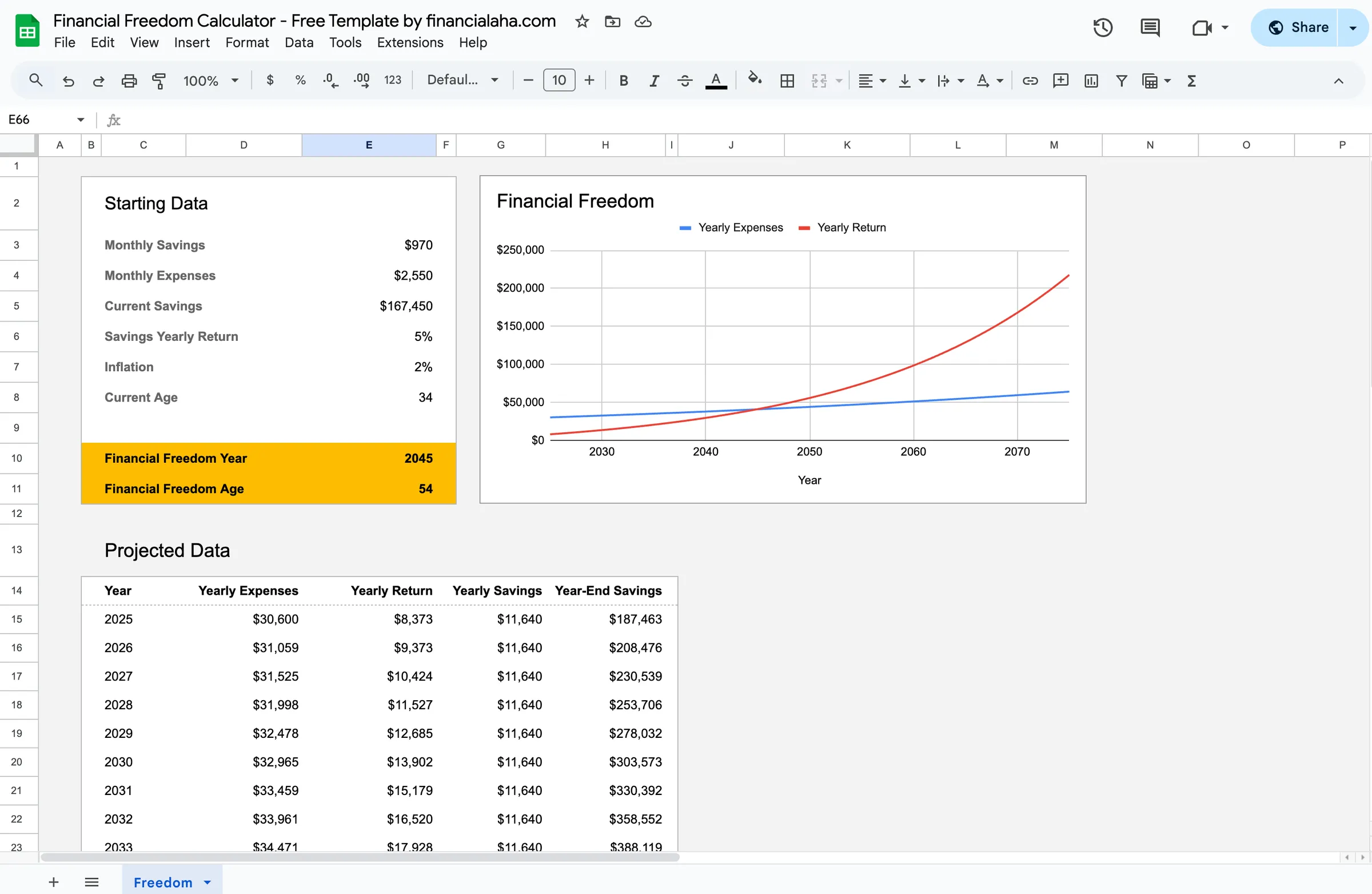
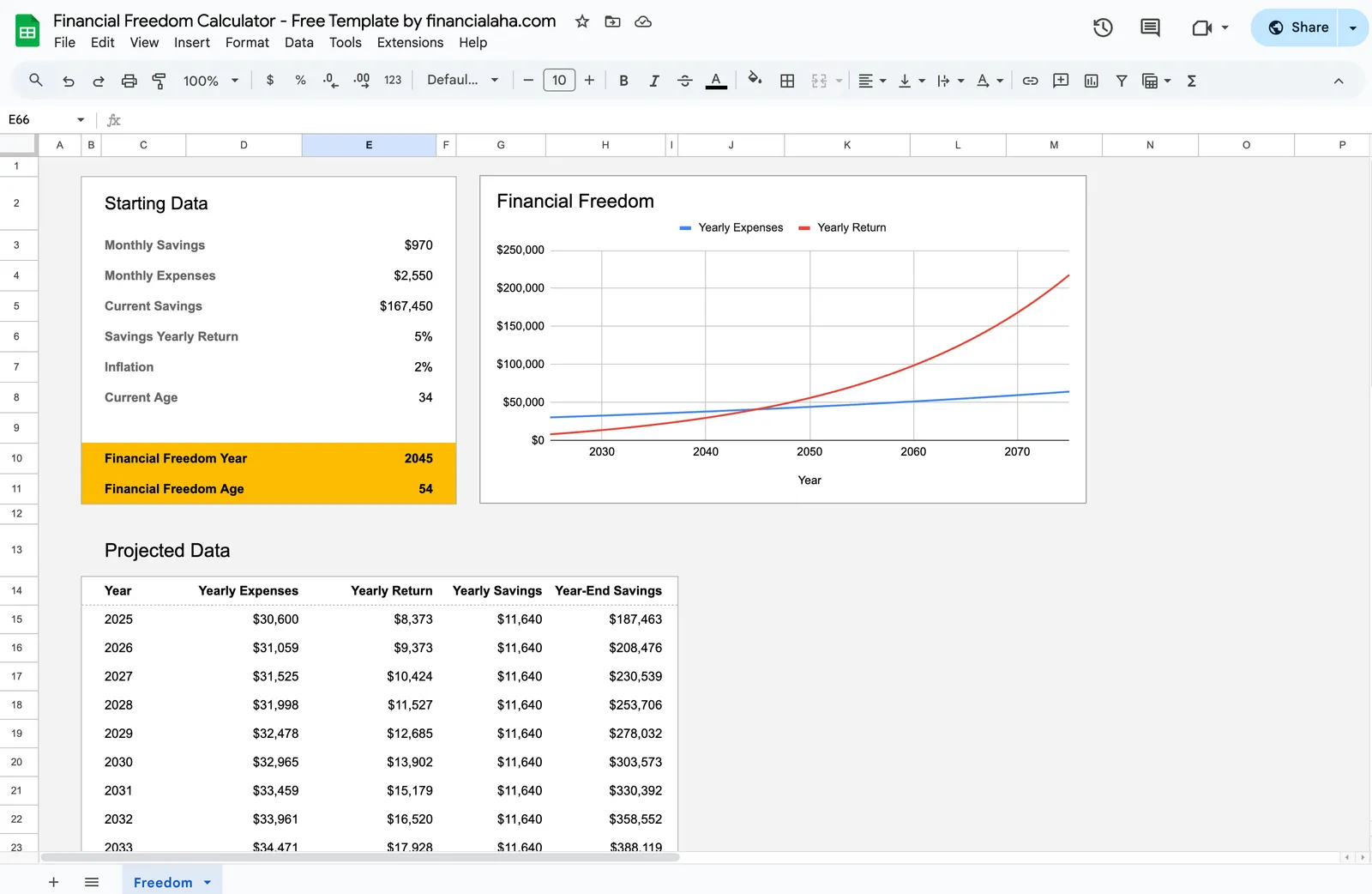
Browse through the template to see the dashboard, the entry sheets, and the summaries it produces, all adaptable to your local financial setup.
- Built-in currency selector
- Calculations update automatically
- Visual summaries of your numbers
- No setup required
Calculate your path to financial independence
Common Questions
FIRE Calculator for the United States - FAQ
Is this FIRE calculator really free?
Yes. The FIRE calculator is completely free - no payment, no email required. It runs in Google Sheets so you own and control your data.
What is a good FIRE number for the US?
It depends entirely on your annual spending. The standard formula is 25x annual expenses (based on a 4% withdrawal rate). If you spend $40,000/year, your FIRE number is $1,000,000. If you spend $80,000/year, it's $2,000,000. Location, healthcare costs, and lifestyle choices are the main variables.
How do I access 401(k) money before 59.5?
Common strategies include: Roth conversion ladder (convert Traditional to Roth, wait 5 years, withdraw penalty-free), Rule of 55 (if you leave that employer at 55 or later), SEPP/72(t) distributions (substantially equal periodic payments), or relying on taxable accounts to bridge the gap. Each has specific rules and tax implications, and the IRS lists the penalty exceptions in Topic no. 558.
Does this account for taxes on withdrawals?
The calculator provides a high-level projection. In practice, your tax situation in early retirement depends on which accounts you withdraw from and in what order. Pre-tax accounts are taxed as income, Roth withdrawals are tax-free, and taxable accounts have capital gains implications.
What savings rate do I need for FIRE?
The math is straightforward: at a 50% savings rate, you can reach FIRE in roughly 17 years; at 65%, roughly 10 years; at 75%, roughly 7 years. These assume starting from zero and reasonable investment returns. The FIRE calculator shows your specific timeline based on your actual numbers.
How do I handle healthcare costs in FIRE planning?
Budget for ACA marketplace premiums, which vary by state, age, and income. Many FIRE practitioners keep taxable income low with premium tax credits in mind, though the enhanced credits lapsed after 2025 and 2026 eligibility again ends above 400% of the federal poverty level. The HealthCare.gov plan preview tool shows 2026 prices for a given ZIP code, age, and household size. Once you reach 65, Medicare takes over, though it still has premiums and supplemental costs.
Can't find the answer you're looking for? Contact our team
Explore More
Free Tools for the United States
Ready to get started?
Download instantly and start managing your finances, or contact us to design a custom template package for your needs.
Tax rules, rates, and contribution limits change, and official publications can themselves lag behind the law in force. We review these figures on a best-effort basis against sources we consider authoritative, but we cannot guarantee they are current, complete, or that better sources do not exist, and nothing here is tax, legal, or financial advice. For decisions, the relevant government authority is the reference. Last reviewed: August 2026.