United States
Monthly Budget Template for the United States
Track your income in USD, manage 401(k) contributions, HSA deposits, tax withholdings, and everyday expenses - all in a Google Sheets template you own.
In Depth
Why American Budgets Need to Account for the Paycheck Gap
The difference between a US salary and what actually lands in a bank account can be striking. Federal income tax, state income tax (in most states), Social Security, Medicare, 401(k) contributions, health insurance premiums, and HSA deposits all come out before the direct deposit hits. For someone earning $85,000 a year, the actual monthly take-home might be closer to $4,800 depending on the state and benefit elections. Starting a budget from that real number, not the headline salary, avoids the common trap of planning around money that was never available to spend.
Health insurance is a budget category that barely exists in many other countries but can dominate a US household's monthly expenses. In the 2025 KFF Employer Health Benefits Survey, the average worker premium contribution was $1,440 a year for single coverage and $6,850 for family coverage, roughly $120 and $571 a month, and that covers only the premium. Deductibles, copays, and out-of-pocket costs pile on top. Families on marketplace plans or COBRA coverage may face even steeper premiums. Giving healthcare its own section in a budget, rather than tucking it into a generic "bills" category, makes the true cost visible.
Debt is another distinctly American budget factor. Federal Reserve G.19 data show about $5.2 trillion of US consumer credit outstanding in June 2026, spanning credit cards, auto loans and student loans, on top of whatever mortgage debt a household carries. These minimum payments collectively consume a significant portion of monthly cash flow. A budget that itemizes each debt payment separately, showing interest versus principal where those numbers are available, reveals how much of each paycheck goes toward past spending versus current needs.
State-level differences add another wrinkle. Someone budgeting in Texas or Florida keeps more of their paycheck (no state income tax) but may face higher property taxes. A New Yorker or Californian deals with substantial state and local income taxes but might have access to different public services. Even sales tax rates vary widely: Oregon levies none, while Louisiana averaged 10.13% combined state and local in the Tax Foundation midyear 2026 figures. The same salary produces meaningfully different budgets depending on the zip code.
United States
Budgeting in the United States: What to Know
The US financial system has unique elements that shape how people budget. Understanding these can help you set up a template that reflects your actual financial picture.
Pre-tax deductions change your take-home pay significantly
Between 401(k) contributions, HSA deposits, health insurance premiums, and federal/state/local taxes, the gap between gross and net pay can be substantial. Some people find it useful to budget from their actual direct deposit amount rather than their salary figure. If you contribute to a 401(k) or HSA, those amounts leave your paycheck before you see it.
Federal and state taxes vary widely
The US has a layered tax system - federal income tax (10-37% marginal rates), plus state income tax in most states (some states like Texas, Florida, and Washington have none). For 2026 the standard deduction is $16,100 for single filers and $32,200 for married filing jointly, under the IRS annual inflation adjustments. Your effective tax rate depends on your specific situation, so using your actual paycheck amount is more reliable than estimating.
Health insurance is a major budget category
Unlike countries with universal healthcare, US health insurance premiums can be a significant monthly expense - whether through an employer plan, the ACA marketplace, or COBRA. Deductibles, copays, and out-of-pocket maximums add another layer. Worth tracking these separately to see the full picture of healthcare spending.
Credit and debt play a large role in US finances
Student loans, auto loans, credit card balances, and mortgages are common in the US. Federal Reserve G.19 data put US consumer credit outstanding, which counts credit cards, auto loans and student loans but not mortgages, at about $5.2 trillion in June 2026. A budget that gives these their own line items, rather than lumping them together, tends to provide clearer visibility into where money goes each month.
Get the Template
Getting Started
Your First Steps With the US Budget Template
Start with your net pay
Enter your actual take-home pay - the amount deposited into your bank account after taxes, 401(k), HSA, and insurance deductions. If you have multiple income sources (W-2 job plus 1099 freelance work), add each as a separate income line.
Set up US-relevant expense categories
Add categories that reflect American financial life: health insurance copays, student loan payments, car insurance, property tax (or rent), gas/electric utilities, and subscriptions. The template is fully customizable - rename any category to match your spending patterns.
Track retirement contributions separately
If you contribute to a 401(k) through your employer, that money leaves your paycheck before you see it. Track Roth IRA contributions or brokerage investments as a budget category since those come from your take-home pay. The IRA contribution limit for 2026 is $7,500, or $8,600 for those 50 and over, per the IRS.
Account for irregular US expenses
Some expenses hit at specific times: property tax bills (often semi-annual), annual insurance renewals, estimated quarterly tax payments for freelancers, and open enrollment health insurance decisions. Building these into the months they occur helps avoid surprises.
Switch the display to USD
There's a currency setting at the top of the dashboard. Choose USD or $ as your display currency. The math applies in any currency, so the formulas work regardless of which symbol is shown.
See It In Action
What the template looks like
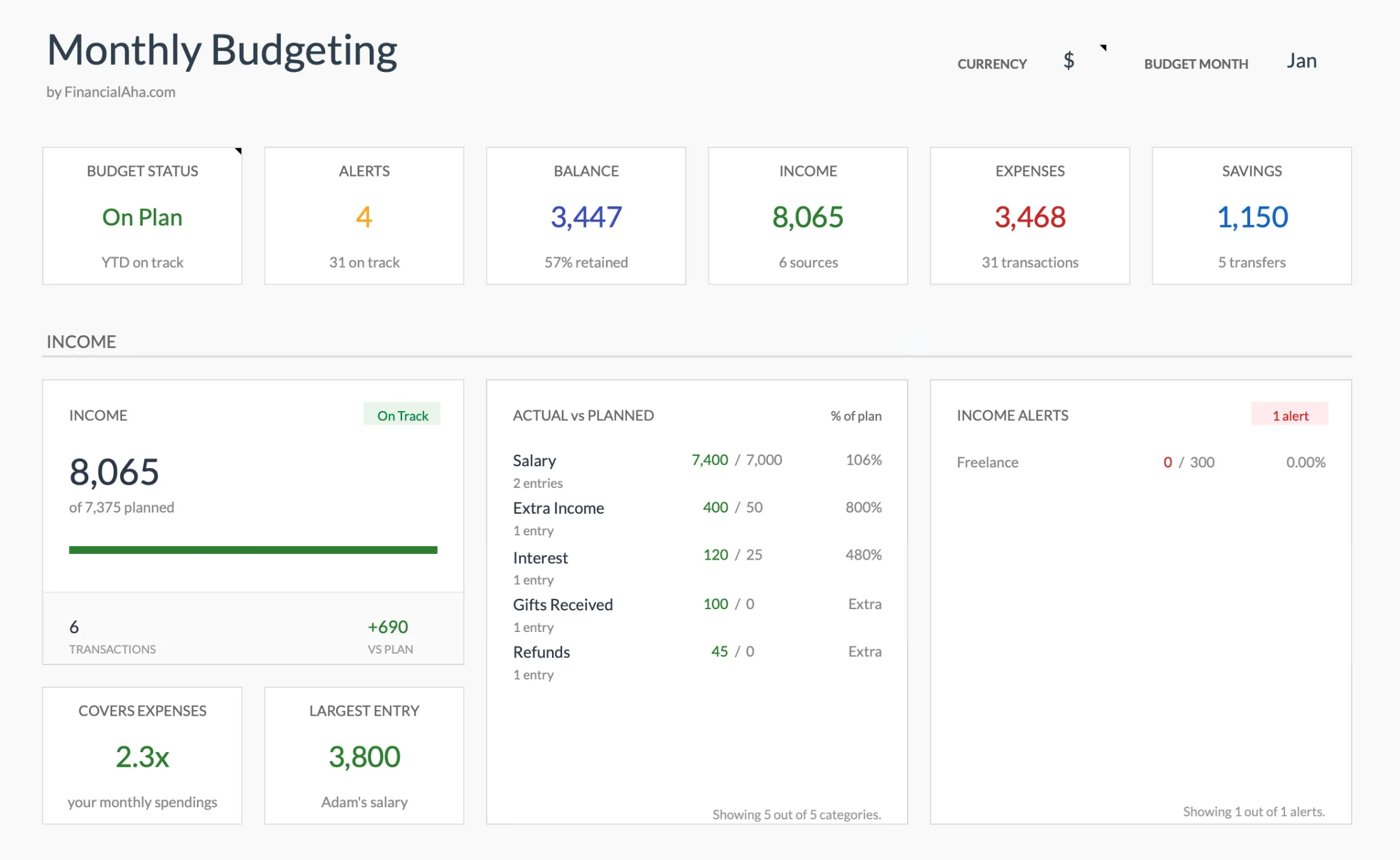
Browse through the template to see the dashboard, the entry sheets, and the summaries it produces, all adaptable to your local financial setup.
- Built-in currency selector
- Calculations update automatically
- Visual summaries of your numbers
- No setup required
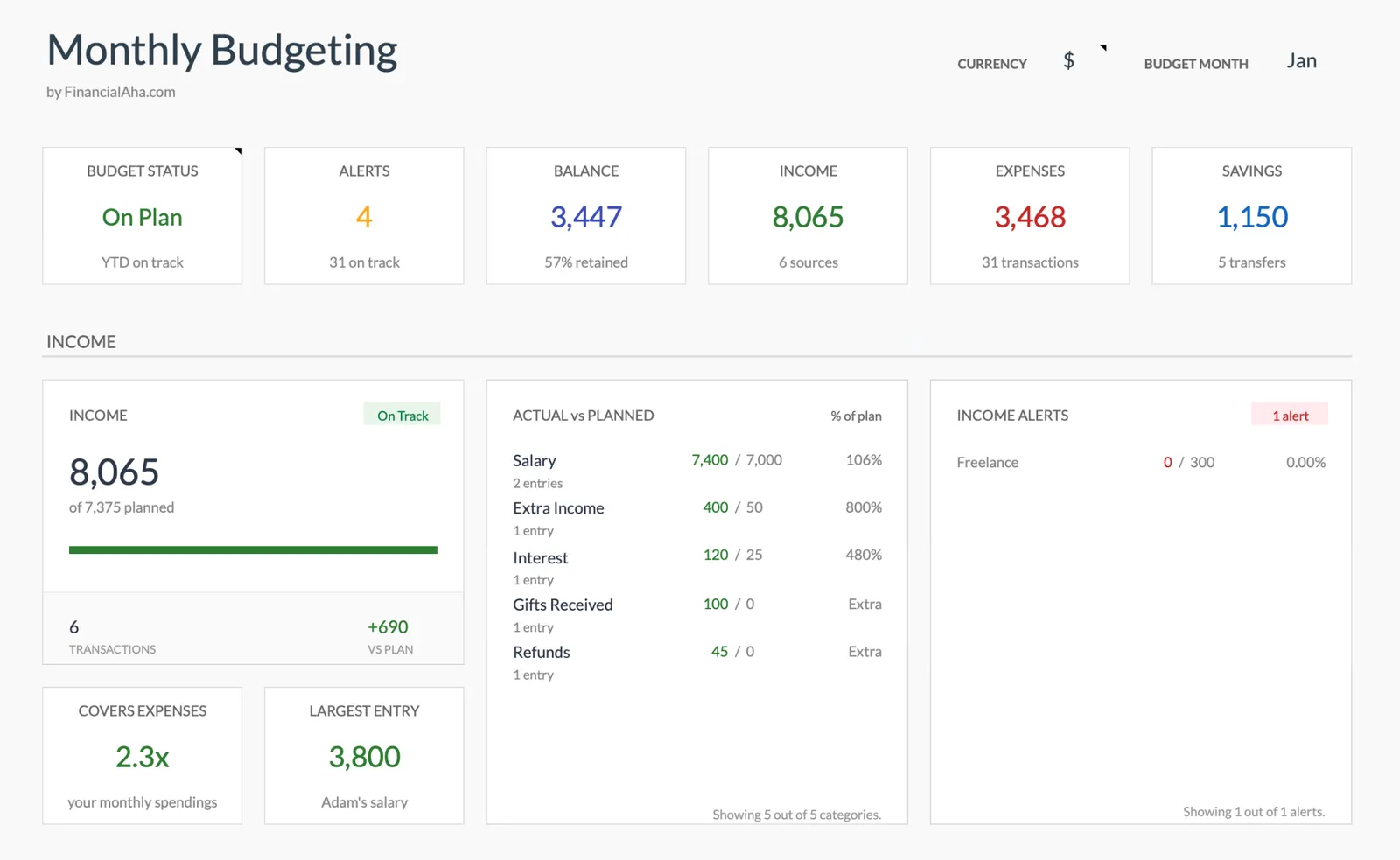
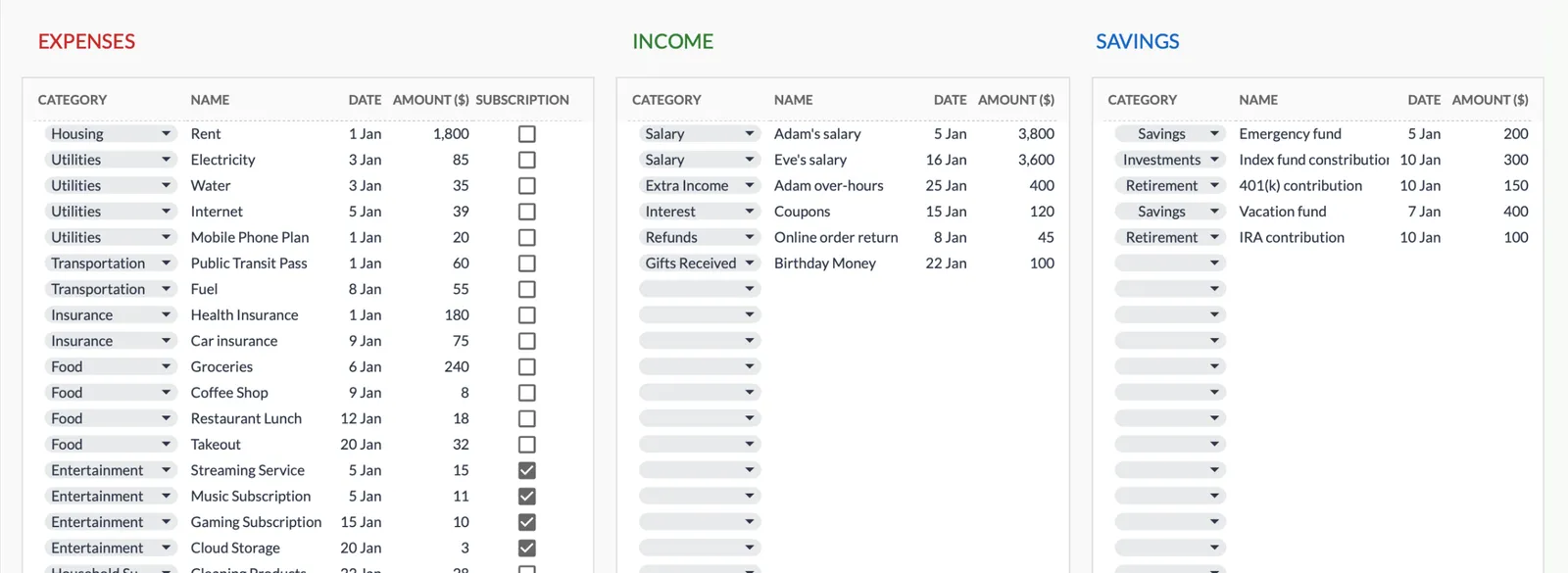
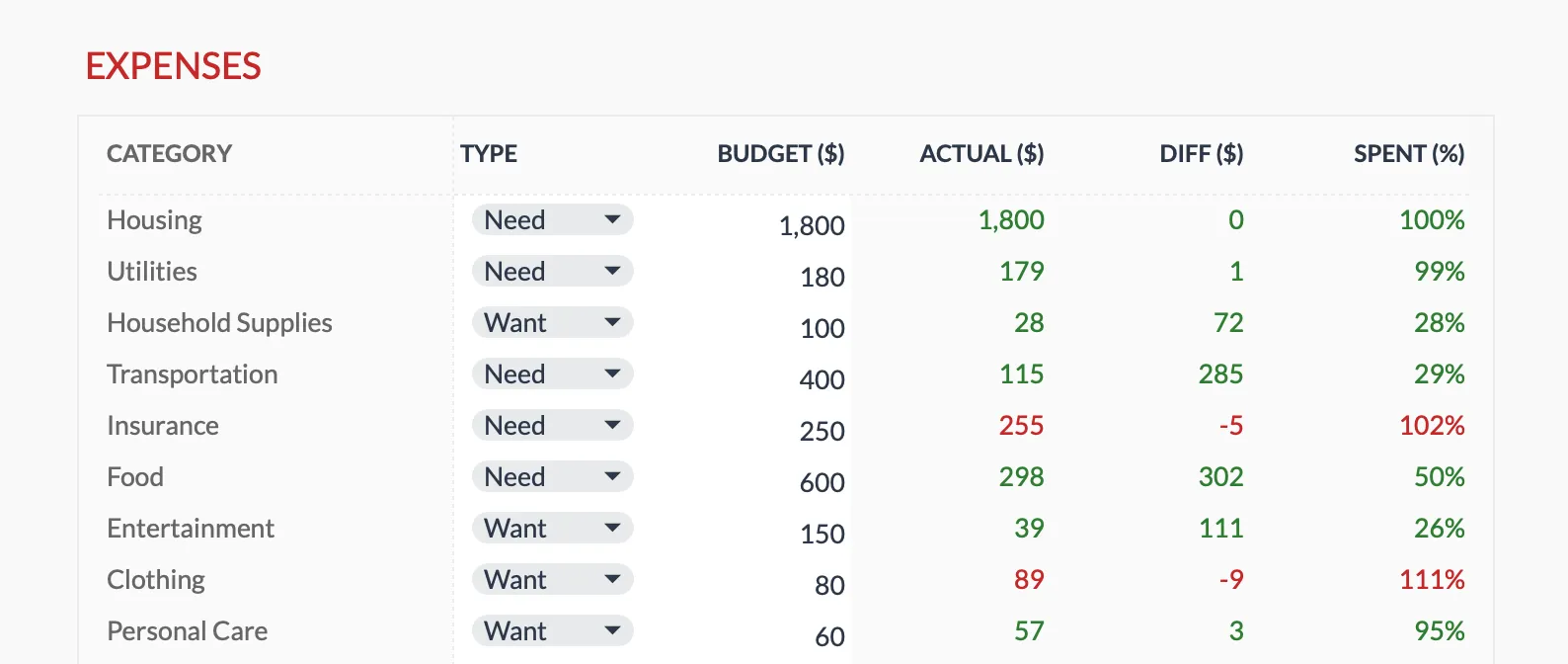
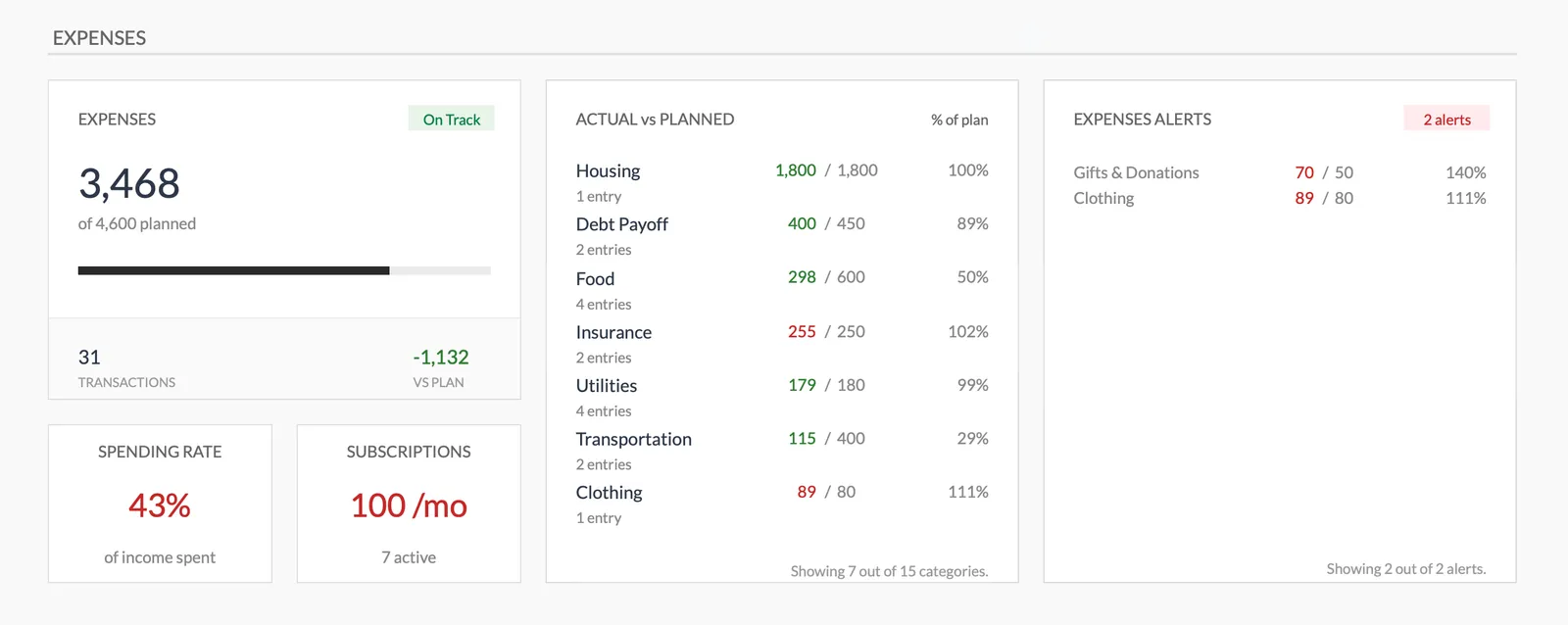
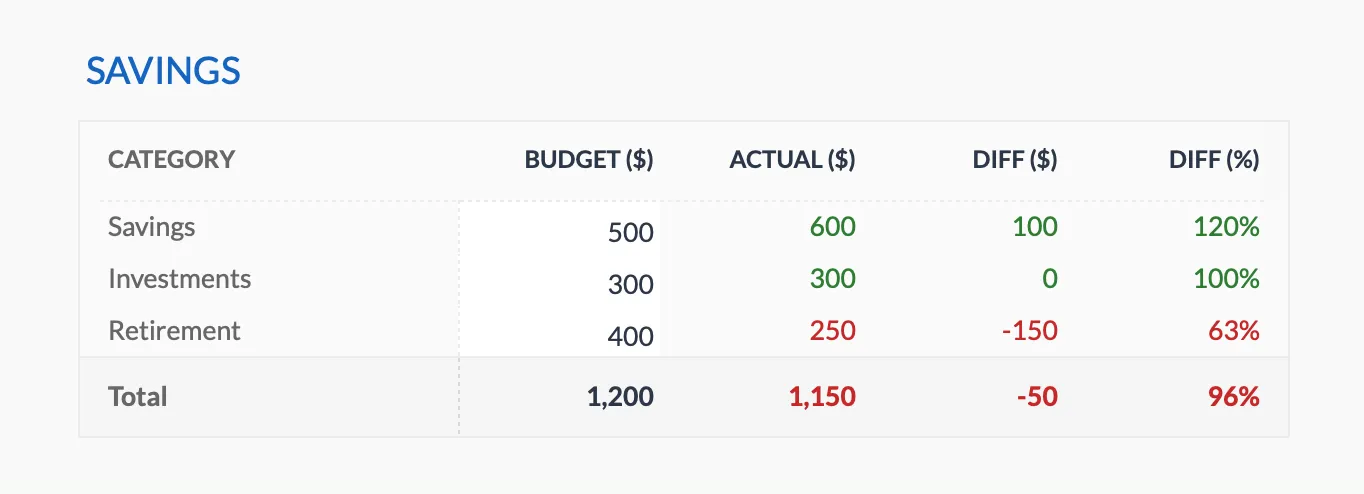
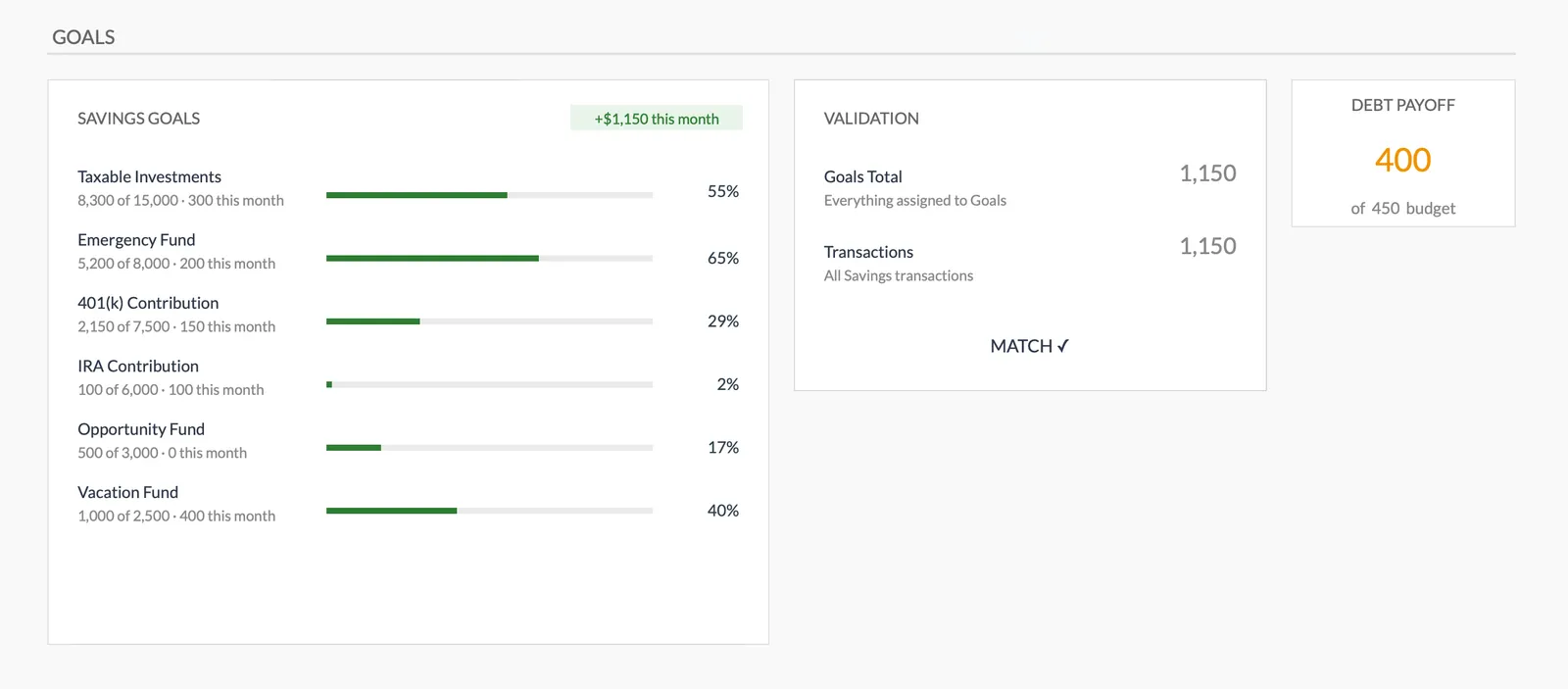
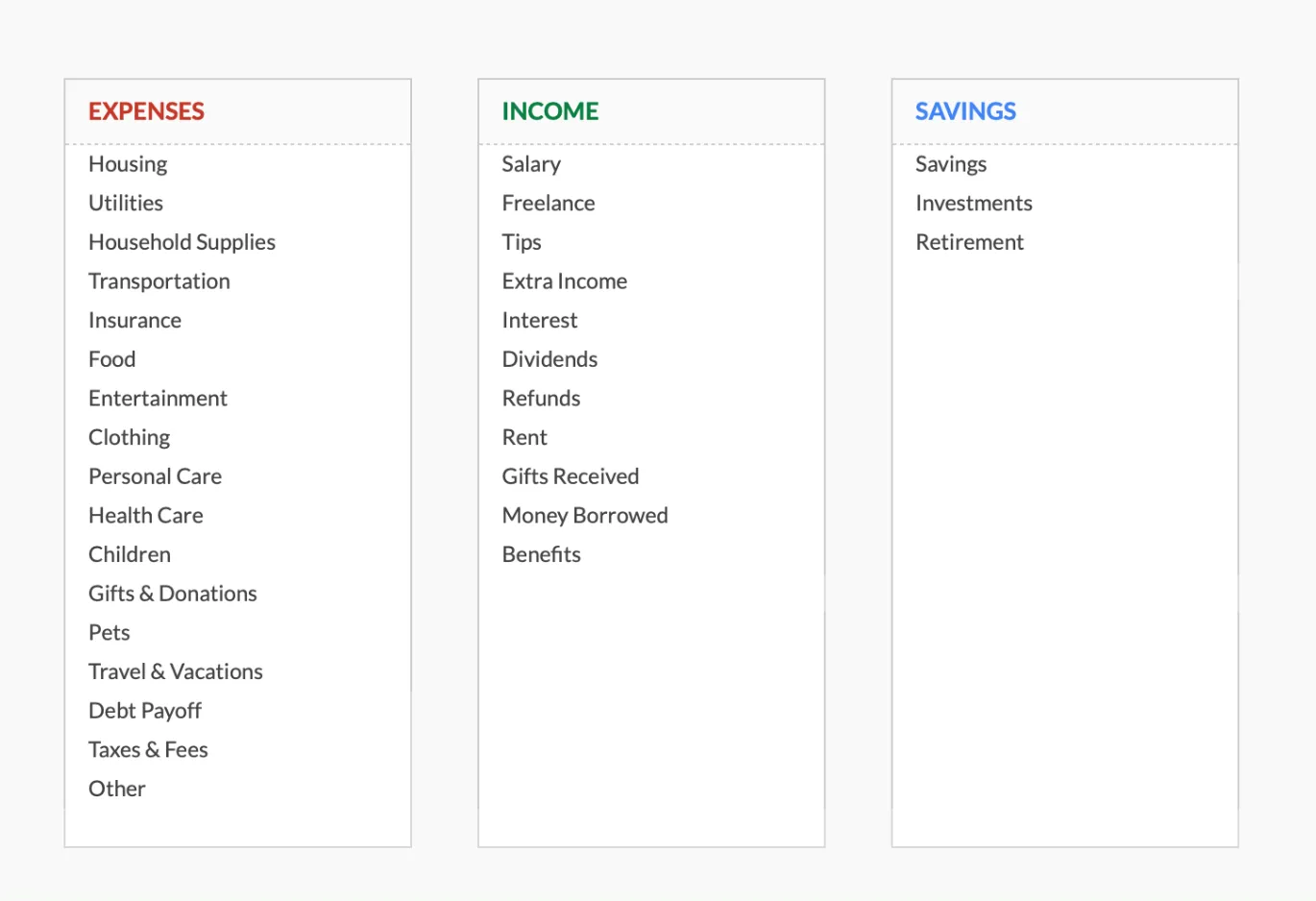
Dashboard with income, expenses, and savings at a glance
Log transactions with automatic categorization
Set targets per category and track actual spending
Visual breakdown of where your money goes
Track savings goals alongside your budget
Monitor progress toward financial goals
Fully customizable expense, income, and savings categories
Common Questions
Monthly Budget Template for the United States - FAQ
Does this template work with US dollars?
Yes. Switch the currency display to USD using the dropdown in the header. The calculations are currency-neutral, so the formulas work the same regardless of what's shown.
Can I track 401(k) and IRA contributions?
Employer 401(k) contributions are deducted before your paycheck, so they don't need a budget line - just use your net pay as income. For Roth IRA or taxable investment contributions you make manually, add those as a budget category to track against contribution limits.
How do I handle variable income from freelance or 1099 work?
Add each income source as a separate line item. For variable income, some people enter their lowest typical month as the baseline and treat anything above that as a bonus. Some people set aside roughly 25-30% of 1099 income for self-employment and income taxes.
Can I budget for multiple bank accounts?
The template tracks total income and total expenses - it doesn't connect to bank accounts. You can enter income and expenses regardless of which account they flow through. Some people find it helpful to add a note in the category name indicating which account a payment comes from.
Is this template updated for current US tax brackets?
This is a budgeting template, not a tax calculator. You enter your actual take-home pay rather than calculating taxes within the sheet. For tax estimation, the free income tax calculator on this site can help approximate your federal and state tax burden.
Can't find the answer you're looking for? Contact our team
Explore More
Free Tools for the United States
Ready to get started?
Download instantly and start managing your finances, or contact us to design a custom template package for your needs.
Tax rules, rates, and contribution limits change, and official publications can themselves lag behind the law in force. We review these figures on a best-effort basis against sources we consider authoritative, but we cannot guarantee they are current, complete, or that better sources do not exist, and nothing here is tax, legal, or financial advice. For decisions, the relevant government authority is the reference. Last reviewed: August 2026.