Ireland
Financial Planning Template for Ireland
Consolidate your pension, credit union savings, State Pension projections, property value, and long-term goals in one planning template you own.
In Depth
Pension Relief, Property, and the Exit Tax on Funds
Irish pension tax relief runs at the marginal rate, so a contribution from a higher-rate taxpayer costs 60 cents on the euro of take-home pay. The age-related percentage limits can feel abstract earlier in a career, and contributions often sit well below them as a result. Tracking contributions against the limit for your own age band turns an obscure tax rule into a number that is easy to watch.
Exit tax on funds is one of Ireland's more unusual features. Irish and EU-domiciled funds are taxed at 38% from 1 January 2026, reduced from 41%, and a deemed disposal every eight years taxes accumulated gains whether or not units are sold. That sits apart from direct shareholdings, where CGT at 33% applies only on an actual disposal. For a long-term plan, the timing difference can matter as much as the headline rate.
Property remains central to most Irish financial plans, whether the question is saving for a first home through Help to Buy or managing an existing mortgage. With the HTB refund covering up to EUR 30,000 of a deposit on a new build, and the scheme running to the end of 2029, it can shift a purchase timeline by a noticeable margin. Setting it alongside pension targets and a PRSI record check gives a more complete planning picture.
Ireland
Financial Planning in Ireland: Key Considerations
Ireland's financial planning landscape combines tax-efficient pension saving, a contributory State Pension, and a property-focused culture. A template helps organize these elements.
Pension tax relief runs at the marginal rate
Pension contributions receive tax relief at your marginal rate, 40% for higher-rate taxpayers and 20% at the standard rate. Age-related limits apply, from 15% of earnings up to age 29 rising in steps to 40% from age 60, and relief applies to earnings up to a cap of EUR 115,000. Employer contributions do not count against the personal limit. Contributions tracked against those limits give a plan one of its clearer numbers to work with.
The State Pension (Contributory) requires PRSI contributions
The maximum State Pension (Contributory) is EUR 299.30 a week from January 2026. Qualification depends on your PRSI contribution record, which needs a minimum number of paid contributions. The Total Contributions Approach considers the total PRSI record from age 16 to State Pension age of 66. The record can be checked at mywelfare.ie, which is where gaps show up.
The Help to Buy scheme supports first-time buyers
The Help to Buy (HTB) incentive refunds first-time buyers the income tax and DIRT paid over the previous four years, up to EUR 30,000 or 10% of the purchase price, on a new-build or self-build home. The scheme runs to the end of 2029. For anyone buying a first home it changes the deposit arithmetic, so it tends to earn its own line in the plan.
Ireland's tax treatment of investments is distinctive
Ireland taxes investment gains and income differently depending on the vehicle. Irish and EU-domiciled funds and ETFs fall under the exit tax regime, reduced from 41% to 38% with effect from 1 January 2026, and a deemed disposal still applies every eight years whether or not units are sold. Direct shares are taxed under CGT at 33% on disposal, with an annual personal exemption of EUR 1,270. Deposit interest is subject to DIRT at 33%. These differences shape which vehicles suit which goals.
Get the Template
Getting Started
Configuring the Financial Planner for Irish Finances
List all accounts and current values
Enter bank accounts, pension fund value, An Post State Savings, credit union savings, investment accounts, property value where it applies, and all debts including mortgage, car loan, and credit cards. Current values provide your starting point.
Track pension contributions against the limits
Record contributions against the age-related percentage limit for your age band. For a higher-rate taxpayer, EUR 1,000 into a pension reduces take-home pay by EUR 600 once relief is applied. The template can track progress against the annual allowable limit.
Check your PRSI record
Review your PRSI contribution history at mywelfare.ie. Note any gaps that could affect your State Pension entitlement. Some gaps can be filled with voluntary contributions. Enter your projected State Pension as future income.
Set clear goals with timelines
Home purchase including HTB eligibility, a pension fund target, an emergency fund, children's education, or anything else: each needs a target amount and a date. Track progress in the template.
Review annually around January
The Irish tax year follows the calendar year from January to December. January is a natural point to review the prior year and set up the new one. Update balances, contribution amounts, and goals.
See It In Action
What the template looks like
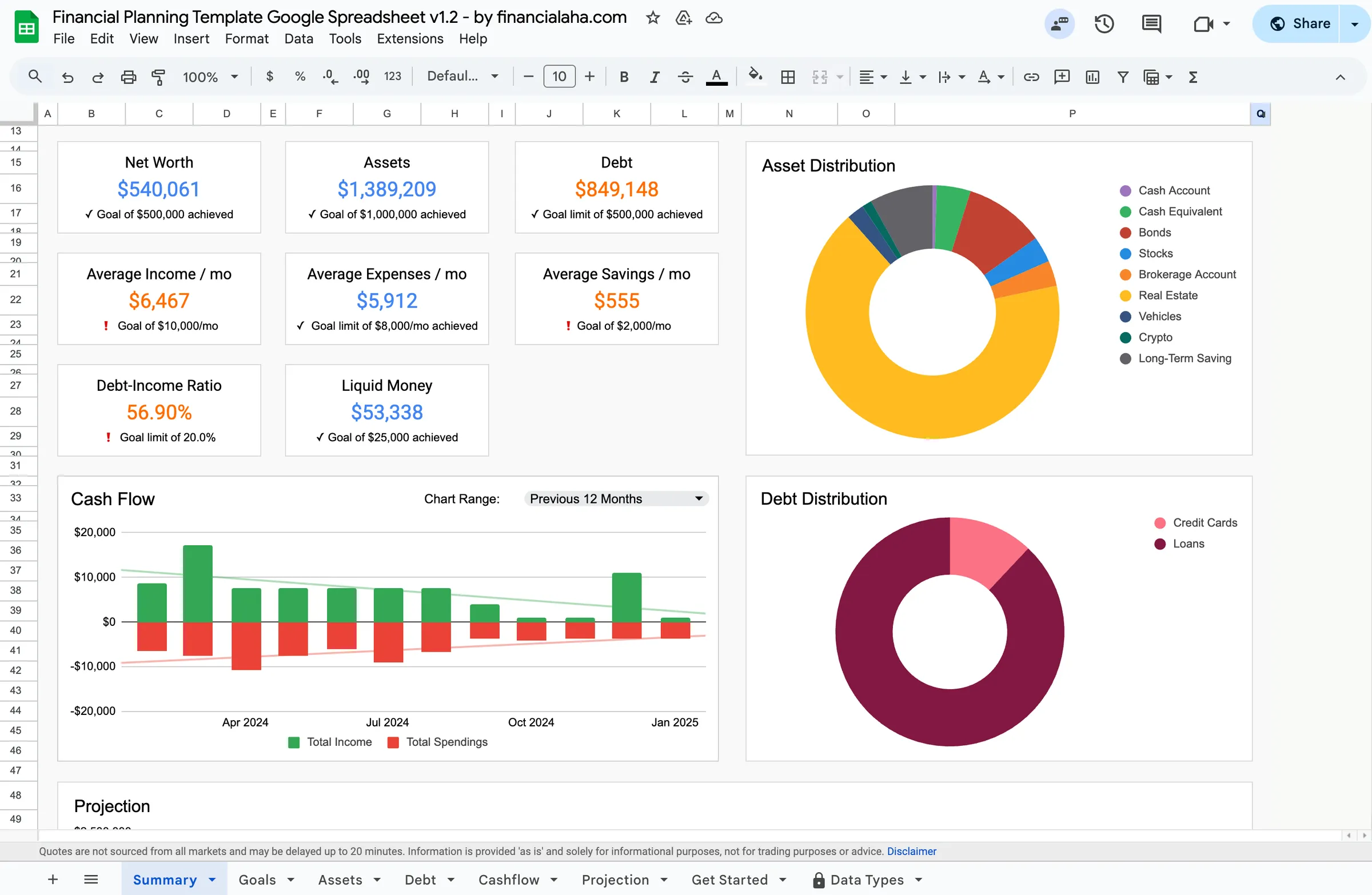
Browse through the template to see the dashboard, the entry sheets, and the summaries it produces, all adaptable to your local financial setup.
- Built-in currency selector
- Calculations update automatically
- Visual summaries of your numbers
- No setup required
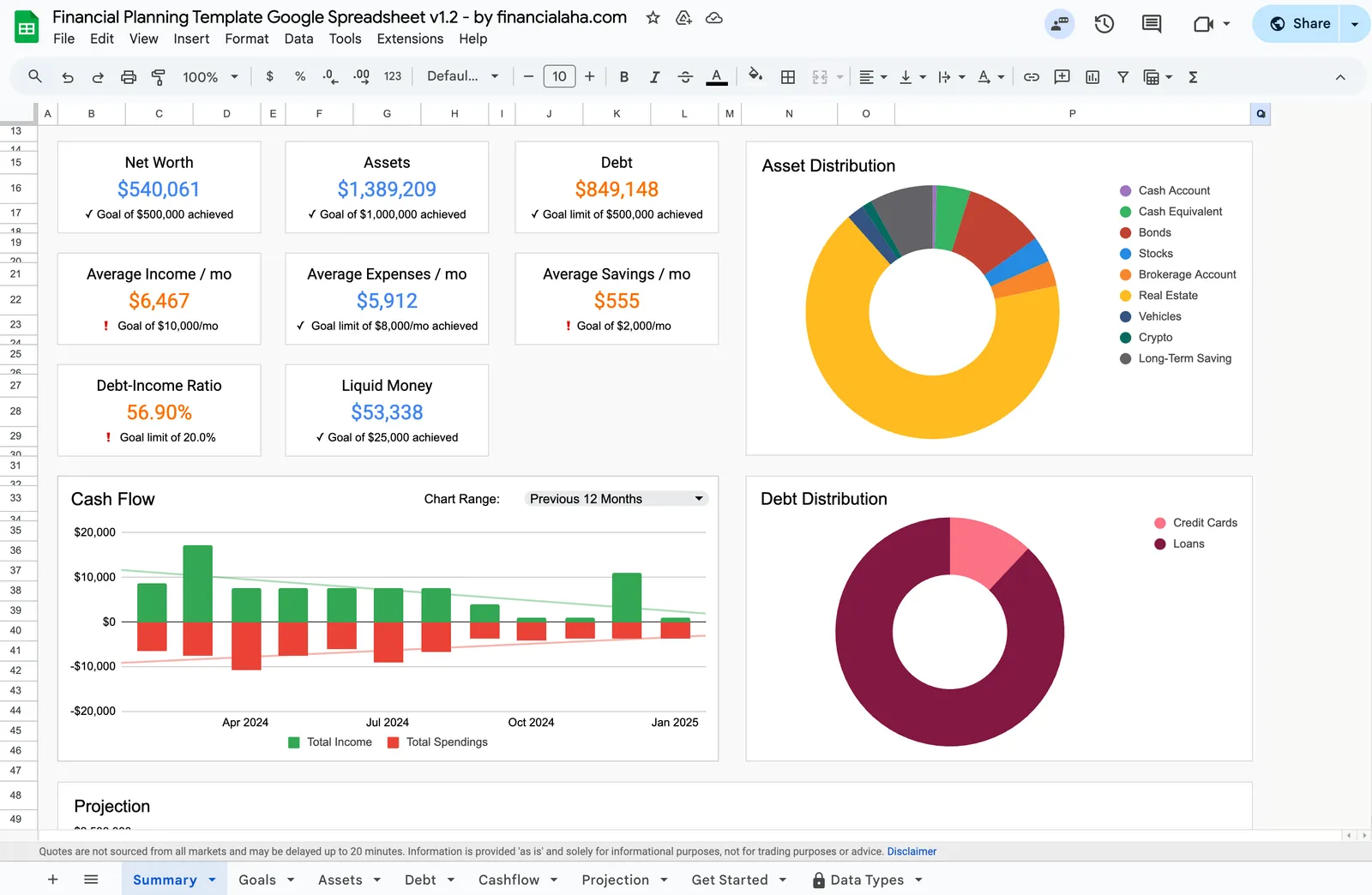
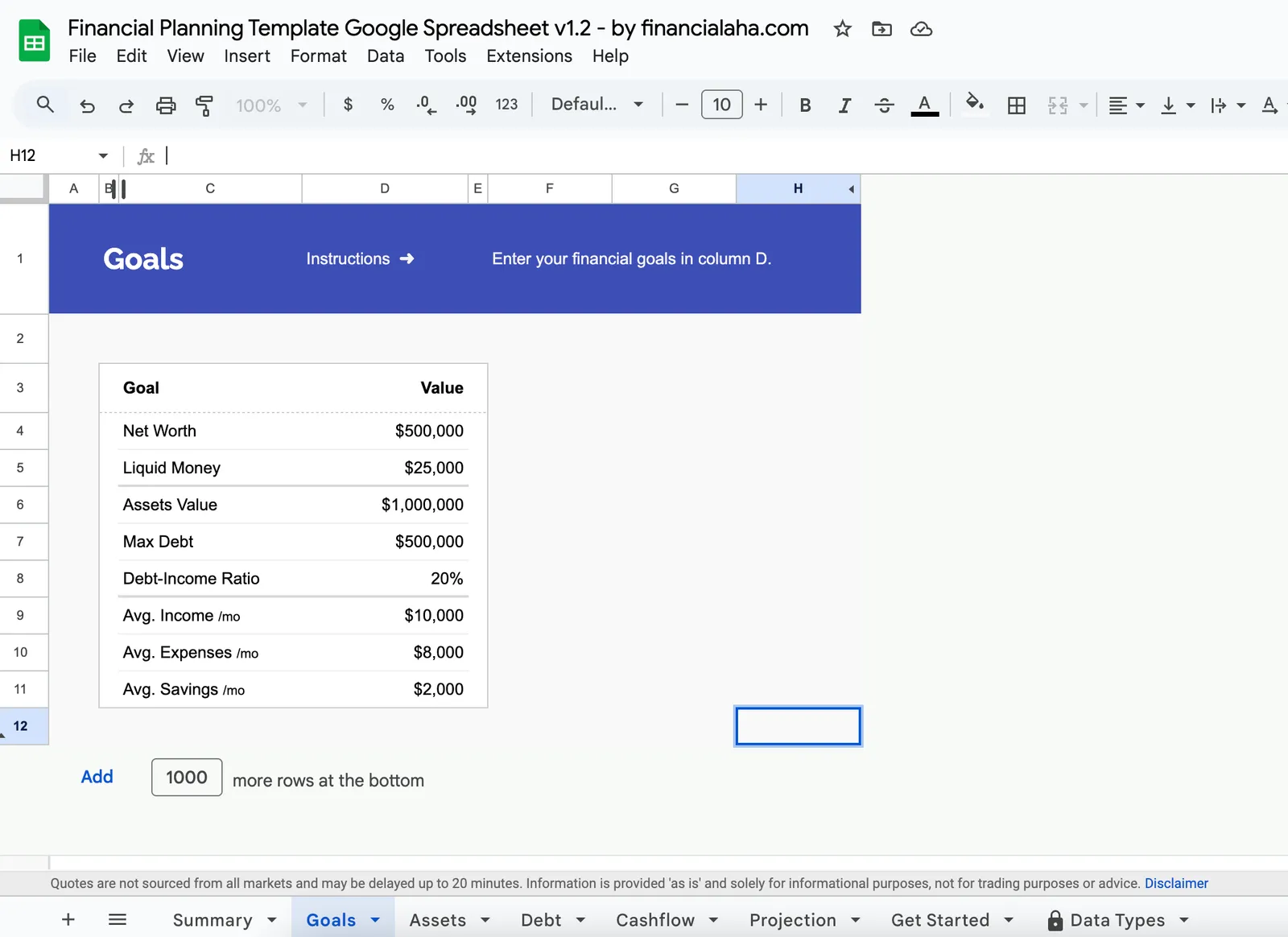
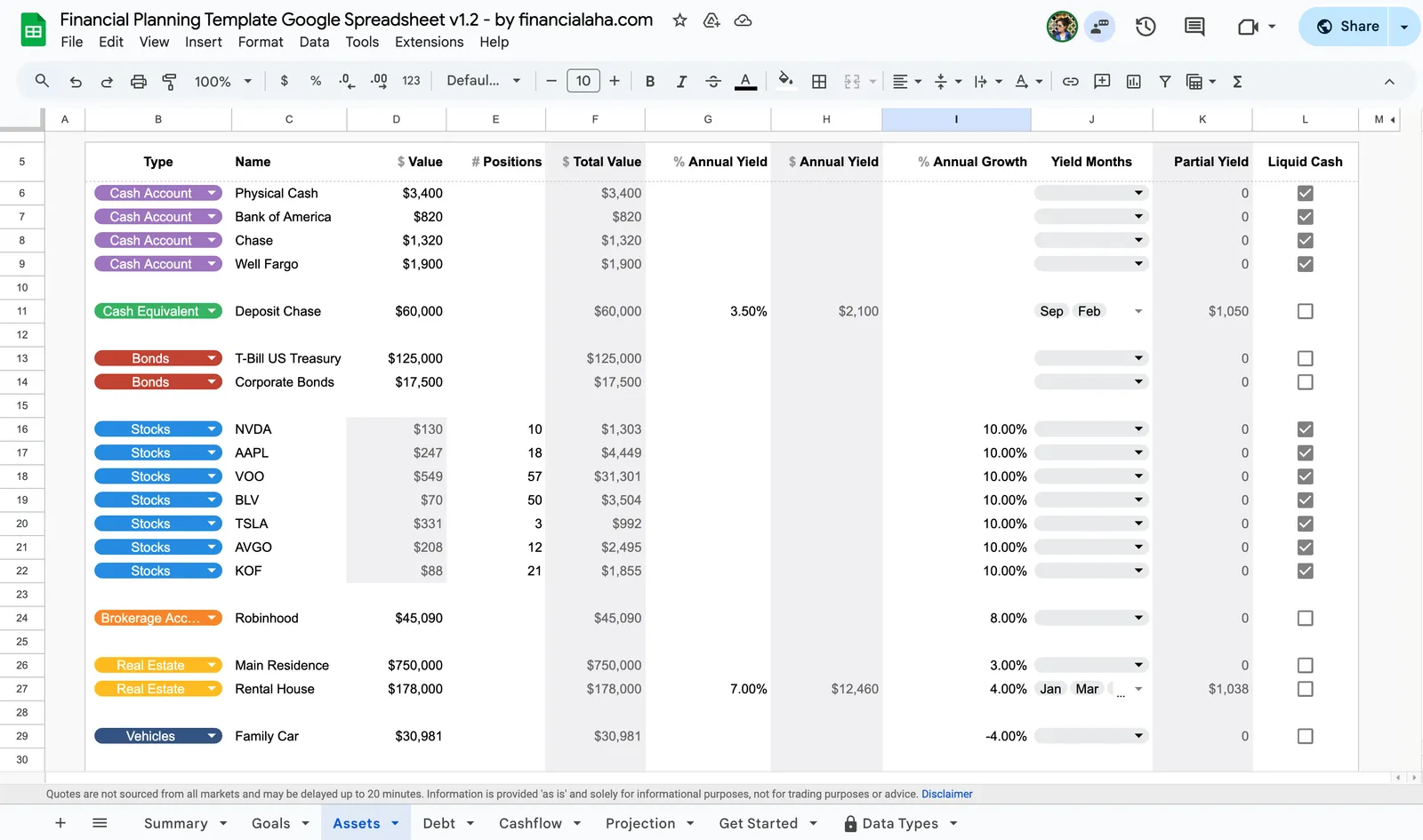
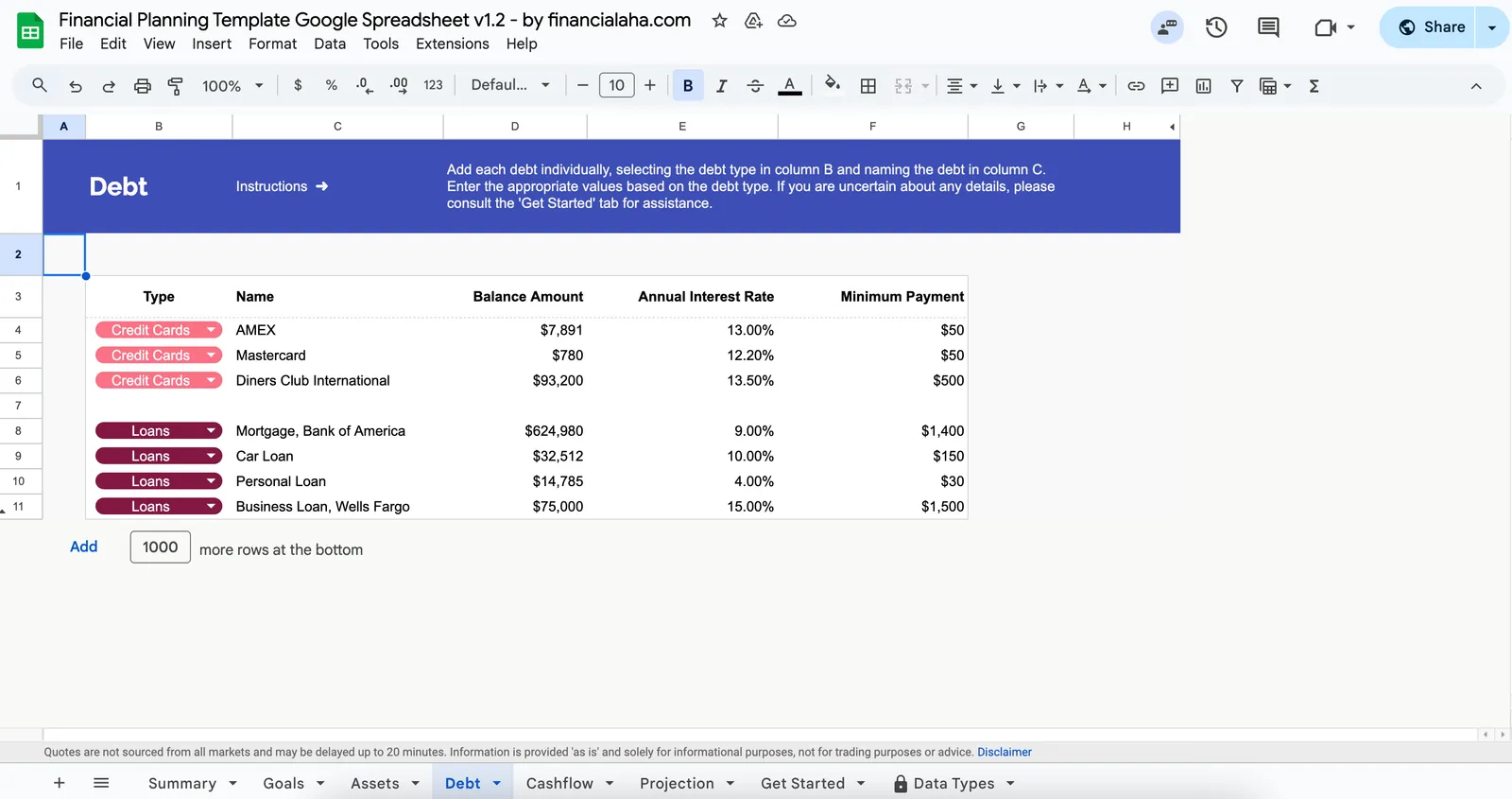
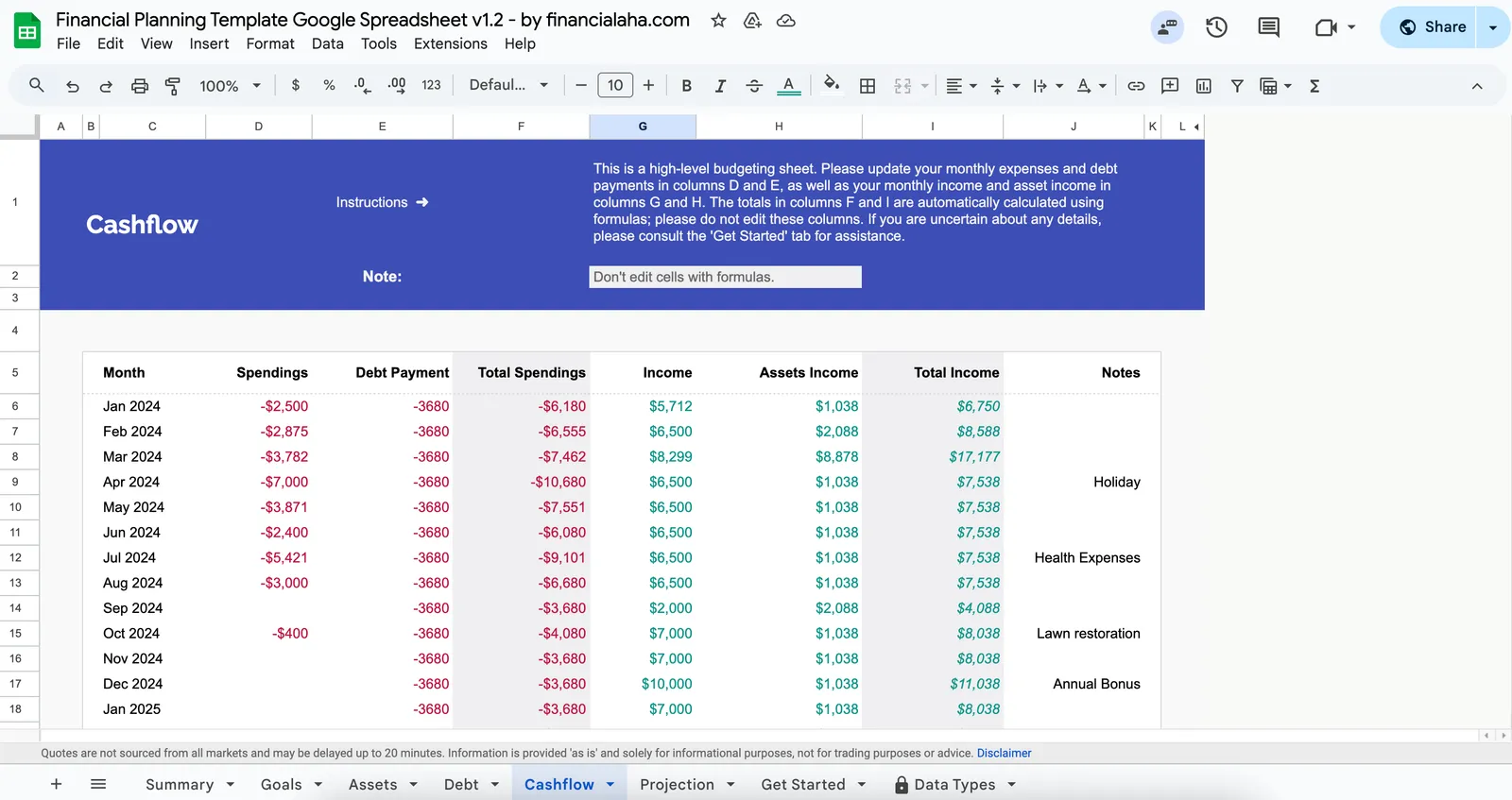
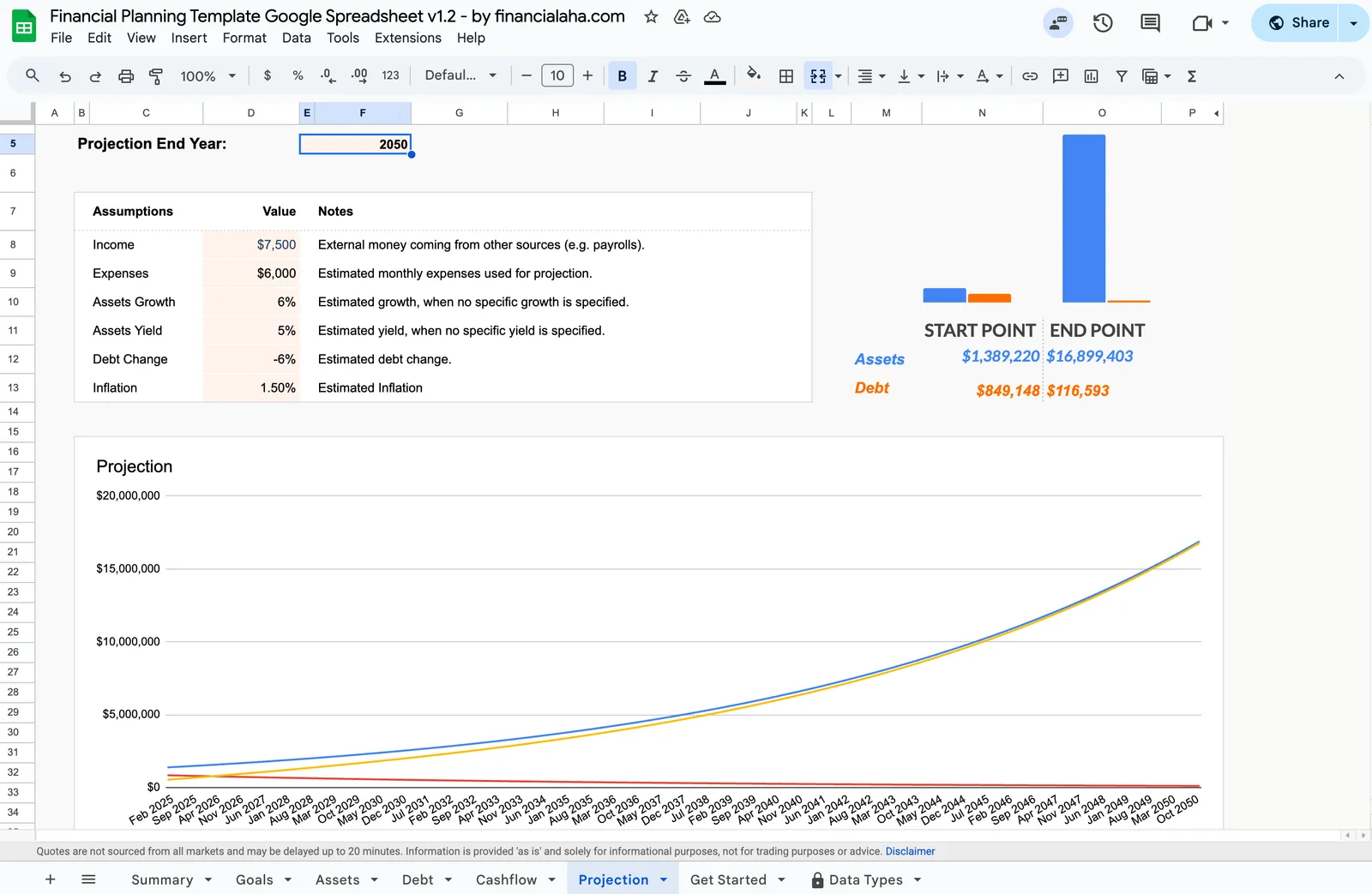
Complete financial overview with net worth and goals
Set and track progress toward financial milestones
Track all your assets in one place
Monitor and plan debt repayment
Visualize your income vs spending over time
Project your financial future
Common Questions
Financial Planning Template for Ireland - FAQ
Can this replace a financial adviser?
This template organizes your financial information; it does not provide advice. For complex situations such as pension planning, tax, or insurance needs, a Qualified Financial Adviser (QFA) in Ireland can provide personalized guidance. The template helps you arrive at those conversations well-prepared.
How do I include my pension?
Add your pension with its current fund value, available from your pension provider or employer's HR department, along with the annual contribution amount and the employer contribution. For defined benefit schemes, note the projected annual pension income rather than a fund value.
How are ETFs and direct shares taxed differently in Ireland?
The template can track either, and the tax treatment differs. EU-domiciled ETFs fall under the exit tax regime at 38% from 1 January 2026, down from 41%, with a deemed disposal every eight years that taxes gains even where nothing has been sold. Direct shares are taxed at 33% CGT only on disposal, with a EUR 1,270 annual exemption. The difference matters most over long holding periods.
How do I plan for the Help to Buy scheme?
For a first-time buyer purchasing or building a new home, the relevant figures are the income tax and DIRT paid over the last four years. The HTB refund can reach EUR 30,000 or 10% of the purchase price, and the scheme runs to the end of 2029. Add the expected refund as a line item in your home deposit savings plan.
Does this work for self-employed people in Ireland?
Yes. Self-employed individuals can add their own PRSI (Class S at 4.2%, rising to 4.3% from 1 October 2026), USC, and income tax obligations. Personal pension contributions through a Personal Retirement Savings Account (PRSA) follow the same age-related limits. Track preliminary tax payments alongside regular expenses.
Can't find the answer you're looking for? Contact our team
Explore More
Free Tools for Ireland
Ready to get started?
Download instantly and start managing your finances, or contact us to design a custom template package for your needs.
Tax rules, rates, and contribution limits change, and official publications can themselves lag behind the law in force. We review these figures on a best-effort basis against sources we consider authoritative, but we cannot guarantee they are current, complete, or that better sources do not exist, and nothing here is tax, legal, or financial advice. For decisions, the relevant government authority is the reference.