Life Event Guide
Financial Planning When Retiring Early
Early retirement - whether at 40, 50, or 55 - requires a different financial playbook than retiring at 65. The math is more demanding, but the principles are straightforward.
Financial Impact
The Financial Impact of Retiring Early
Retiring before traditional retirement age means your savings need to last longer, you face a gap before Medicare and Social Security, and the math around safe withdrawal rates changes. Understanding these factors is essential for anyone considering an early exit from the workforce.
Your savings need to last much longer
Retiring at 65 with a 30-year time horizon requires different planning than retiring at 50 with a potential 45-year horizon. The traditional "4% rule" (withdraw 4% of your portfolio annually, adjusted for inflation) was designed for 30-year retirements. For 40-50 year retirements, many FIRE community members use 3-3.5%, which means needing a larger portfolio. To support $50,000/year in spending: the 4% rule requires $1.25 million, while 3.5% requires $1.43 million.
The healthcare gap is a major cost factor
Medicare begins at 65. If you retire at 50, that is 15 years of self-funded health insurance. ACA marketplace plans for a couple run $1,000-$2,500/month depending on age and location (with subsidies potentially reducing this based on income). Over 15 years, healthcare alone could cost $180,000-$450,000. This is often the most underestimated cost in early retirement planning.
Accessing retirement funds before 59.5 requires strategy
Traditional 401(k) and IRA withdrawals before age 59.5 trigger a 10% early withdrawal penalty plus income tax. Strategies to bridge this gap include: Roth conversion ladders (convert traditional IRA funds, wait 5 years, withdraw contributions tax-free), Rule of 55 (penalty-free 401(k) withdrawals if you leave your job at 55+), and SEPP/72(t) distributions (substantially equal periodic payments at any age). Each has specific rules and limitations.
Social Security benefits are reduced with early retirement
Social Security benefits are based on your highest 35 years of earnings. Retiring at 50 after 25 years of work means 10 years of $0 earnings in the calculation, reducing benefits. Additionally, claiming at 62 (earliest age) yields 30% less than waiting until 67 (full retirement age). For someone with a $2,500/month benefit at 67, claiming at 62 reduces it to $1,750/month - a $750/month difference for life.
Getting Ready
How to Plan Your Budget for Early Retirement
Calculate your FIRE number
Your FIRE (Financial Independence, Retire Early) number is your annual spending divided by your safe withdrawal rate. At $50,000/year spending and a 3.5% withdrawal rate, you need roughly $1.43 million. At $70,000/year, it is $2 million. This number is the target - every financial decision during the accumulation phase either moves you closer to or further from it.
Track your actual spending meticulously
Your FIRE number depends entirely on accurate spending data. Many people underestimate their actual spending by 10-20%. Tracking every expense for 6-12 months reveals the real number. Include everything: regular bills, irregular expenses (car repairs, medical, home maintenance), annual costs (insurance, subscriptions), and discretionary spending. This real number - not a guess - drives the entire plan.
Build a bridge account strategy
Create a plan for accessing funds between retirement and age 59.5: taxable brokerage accounts (no age restrictions), Roth IRA contributions (always accessible penalty-free), Roth conversion ladder (requires 5-year planning), and cash reserves for the first 1-2 years. Having 2-3 years of expenses in accessible accounts provides flexibility during market downturns.
Plan for healthcare costs explicitly
Model healthcare costs year by year from retirement to age 65 when Medicare begins. ACA marketplace premiums, dental and vision (often separate), out-of-pocket maximums, and potential premium changes all factor in. Some early retirees budget $15,000-$25,000/year per couple for comprehensive healthcare coverage.
Stress-test your plan against bad scenarios
Model what happens if: the market drops 40% in your first year of retirement, inflation runs at 5% for a decade, healthcare costs increase faster than expected, or you need to support a family member financially. A plan that works only in average conditions is not robust enough for a 40-50 year retirement. Building in margin - a larger portfolio, lower withdrawal rate, or part-time income options - adds resilience.
See The Templates
Tools for this stage of life
Browse the templates that help with financial planning during major life transitions.
- Financial planning dashboard
- Monthly budget tracking
- Net worth over time
- Goal setting and tracking
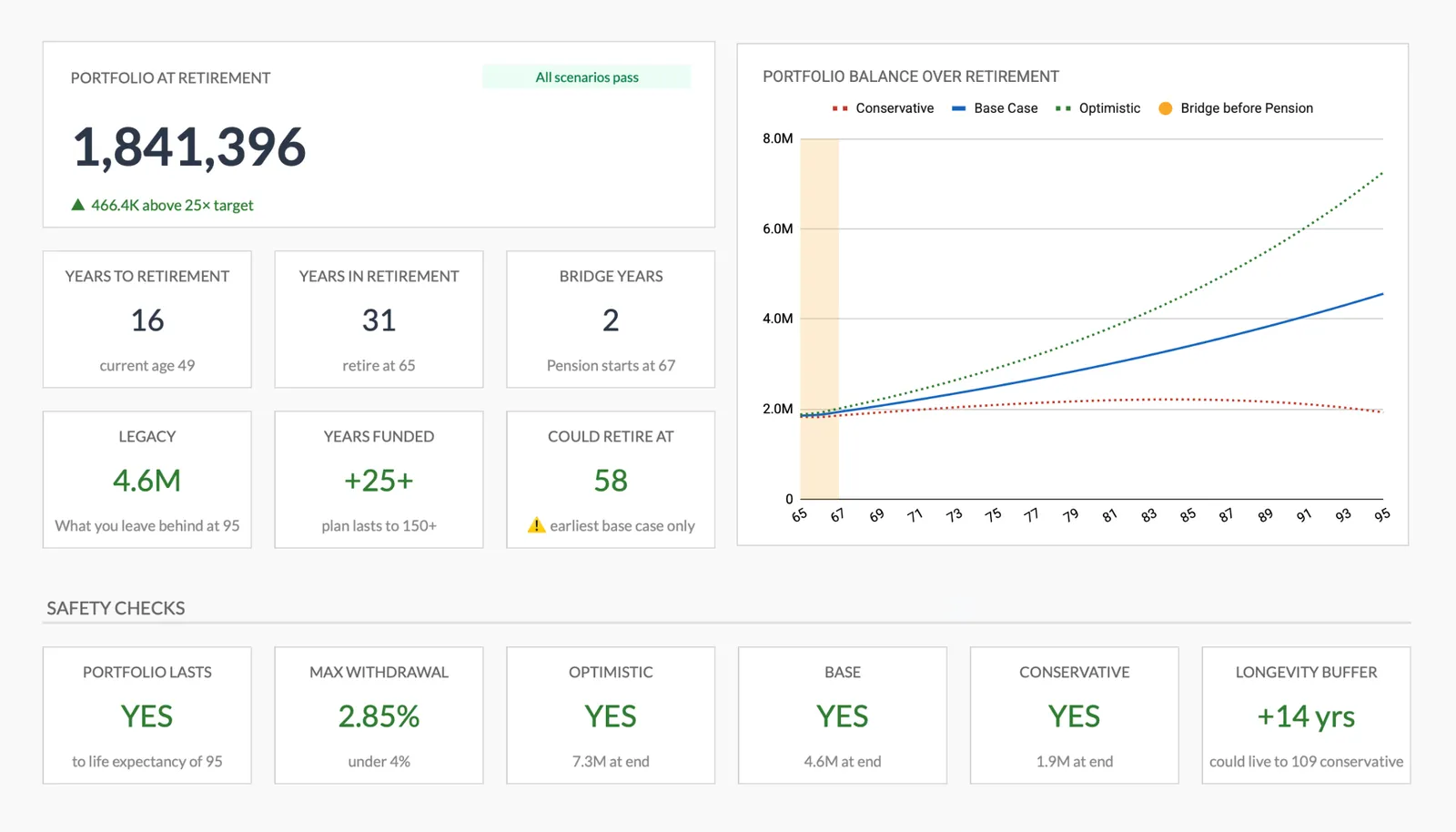
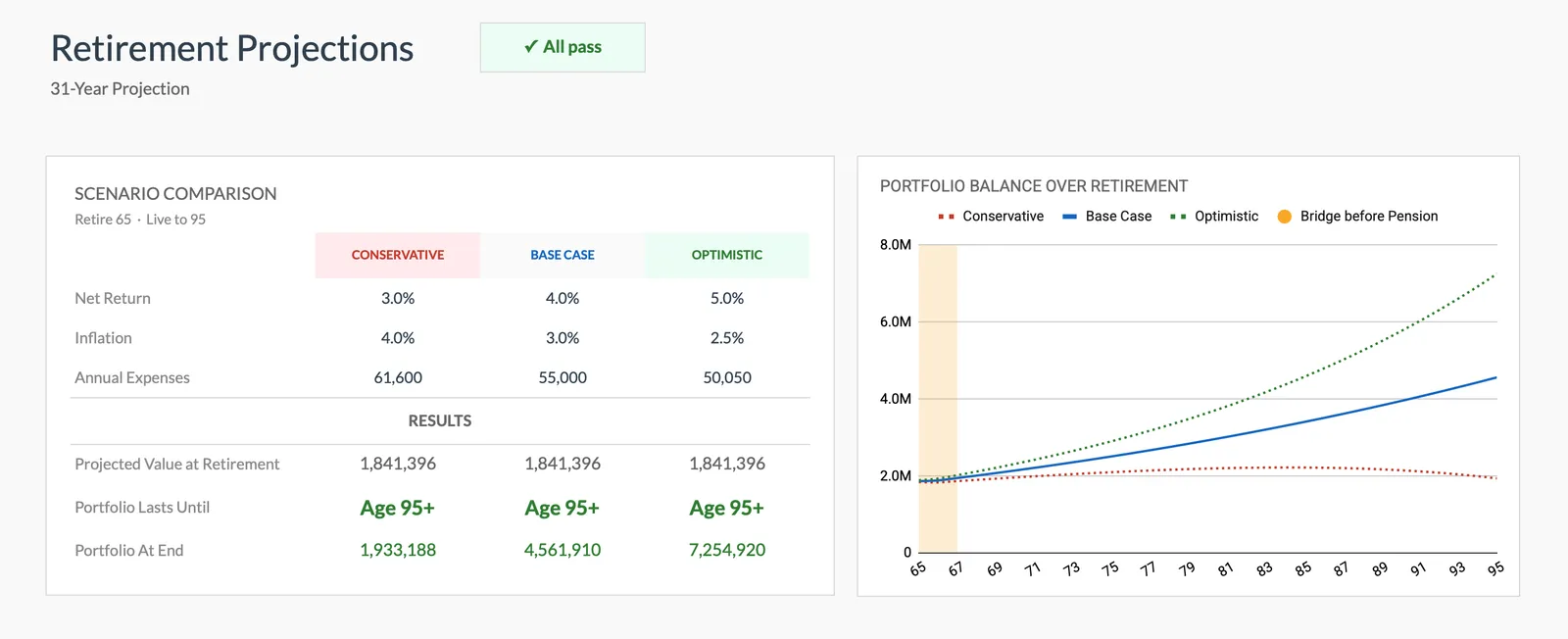
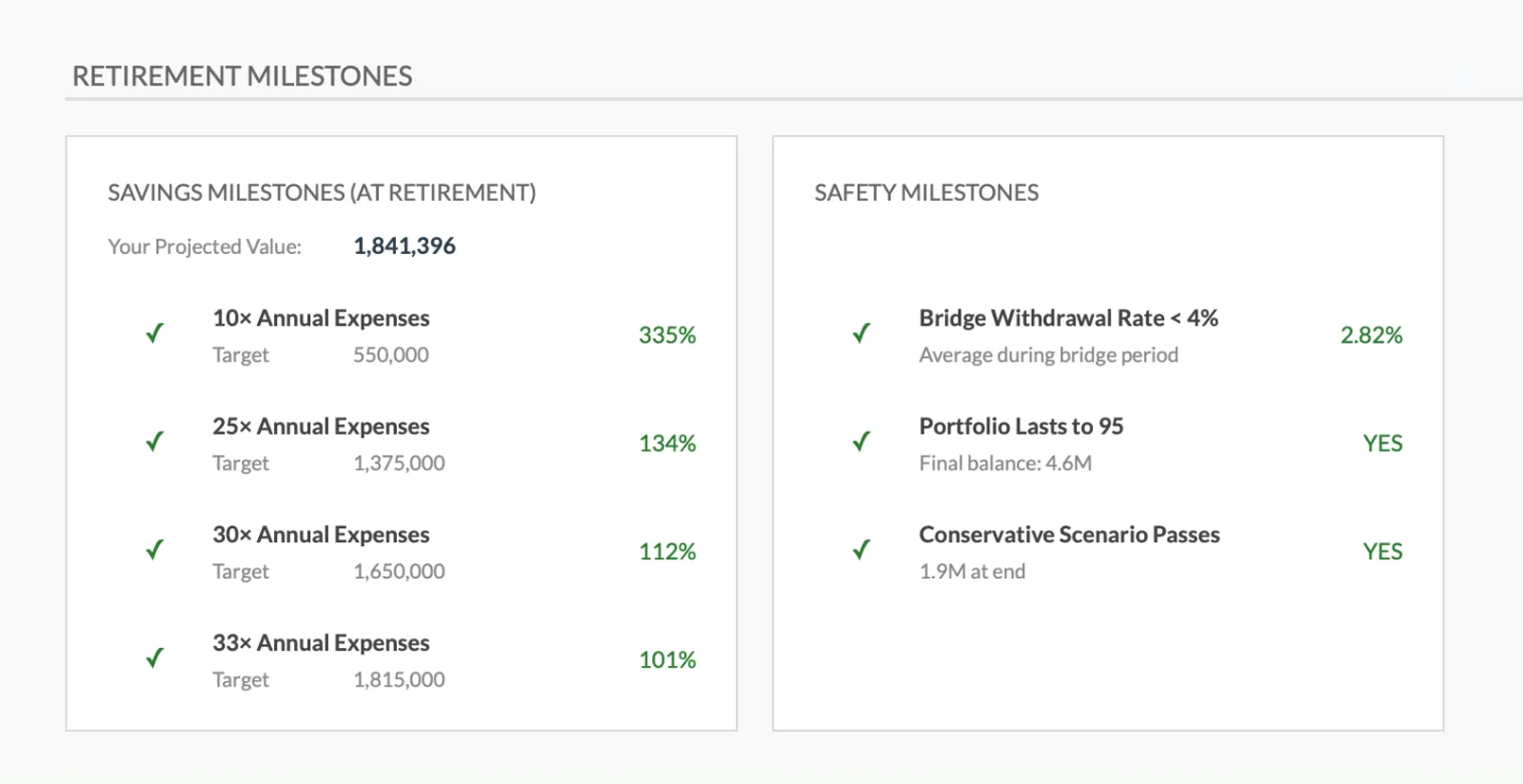
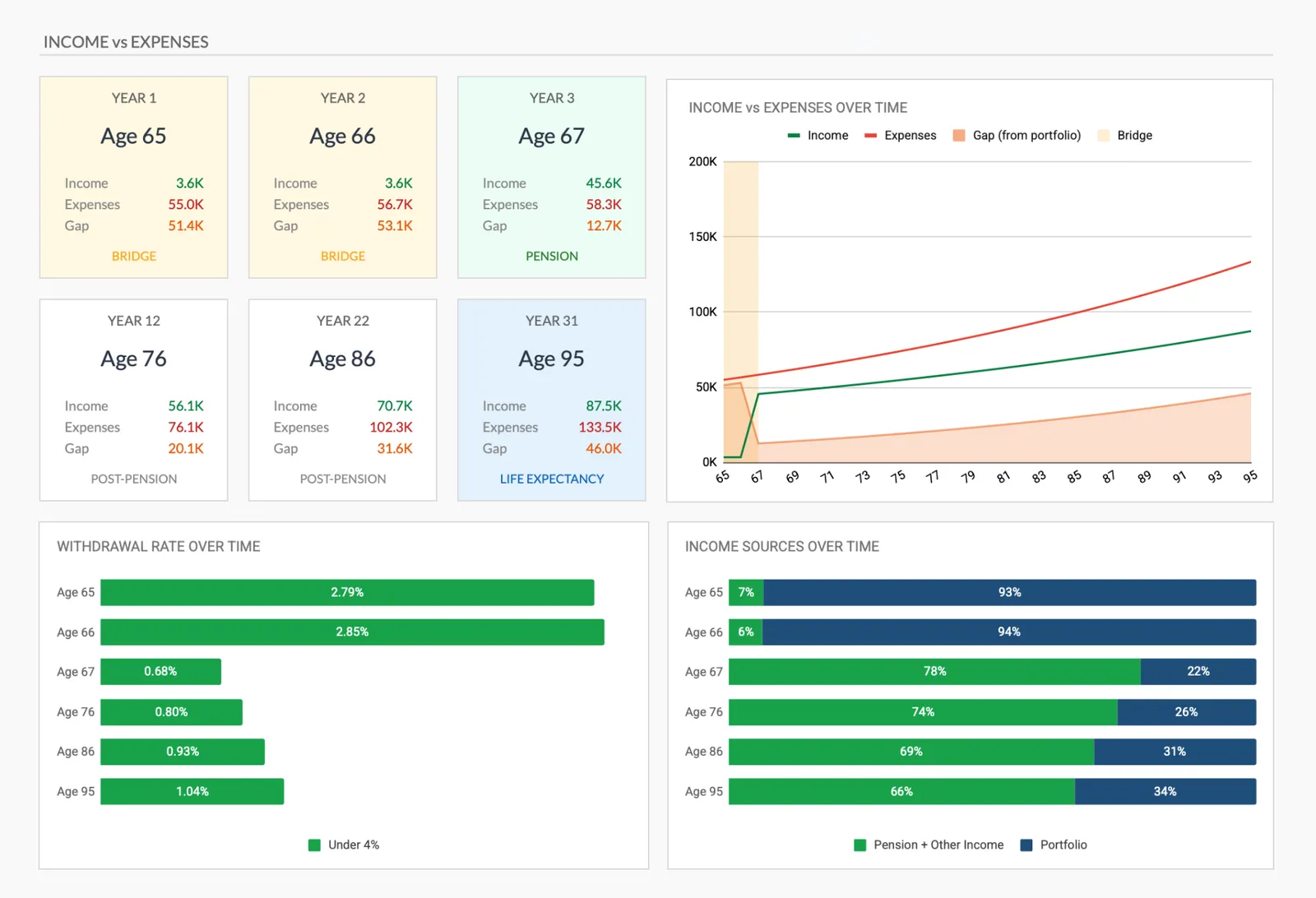
Complete retirement overview with projections
Project your retirement savings growth
Track progress toward retirement goals
Plan your retirement income against expenses
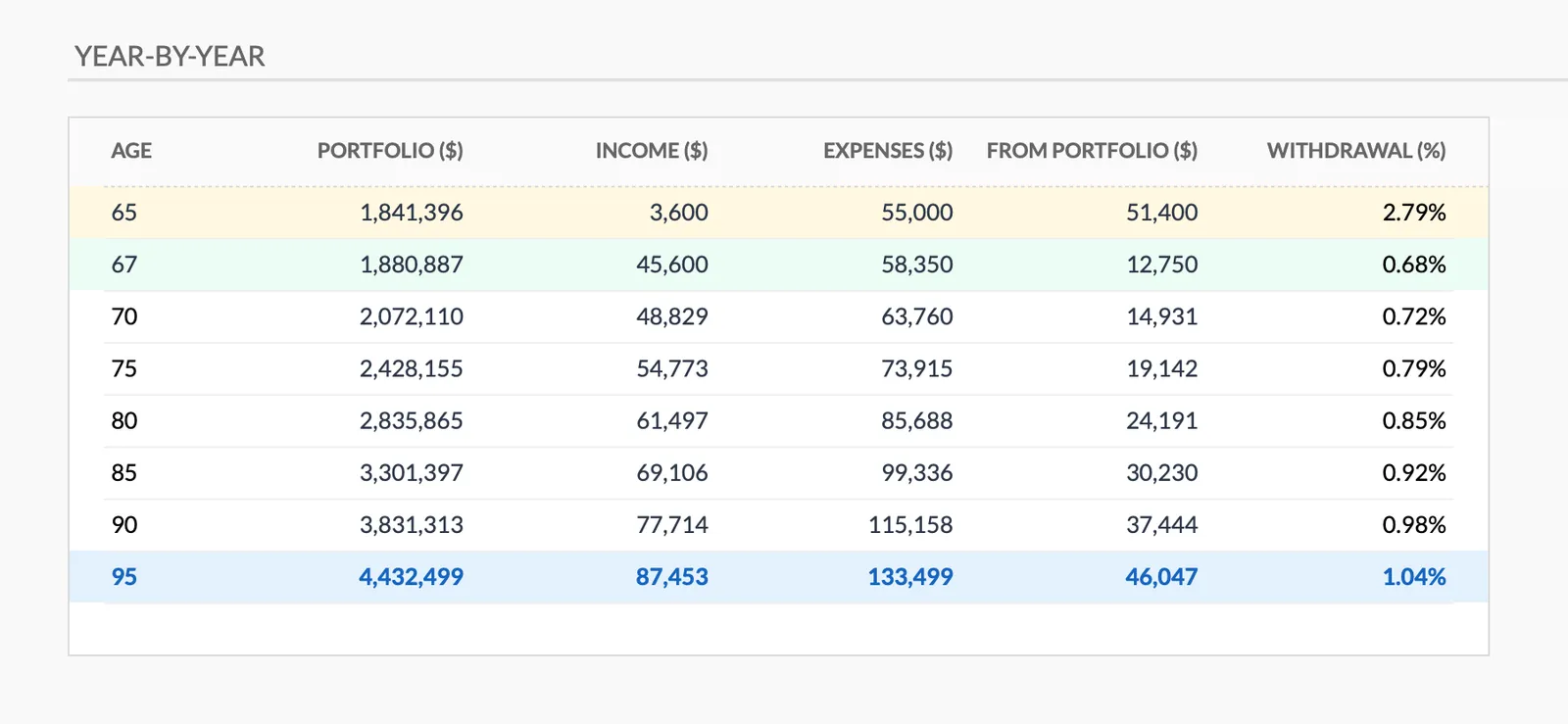
Detailed year-by-year retirement projection
Recommended Templates
The Right Templates for This Stage
Early retirement planning requires detailed projections and ongoing tracking. These templates cover the full journey:
Project retirement income, spending, and portfolio longevity over a 40-50 year horizon. Model different withdrawal rates, account types, and Social Security claiming strategies to find a sustainable plan.
View templateTrack progress toward your FIRE number month by month. Seeing your net worth approaching the target (and eventually sustaining in retirement) provides both motivation and early warning if things drift off course.
View templateMap out the full financial picture including the bridge strategy between early retirement and traditional retirement account access. Useful for modeling Roth conversion ladders and other multi-year tax strategies.
View templateFree Tools
Calculators to Help You Plan
Common Questions
Retiring Early - Financial FAQ
How much do I need to retire early?
The formula: annual spending divided by your safe withdrawal rate. At $50,000/year with a 3.5% withdrawal rate, the target is about $1.43 million. At $80,000/year, it is about $2.29 million. The two variables you control are spending (lower spending = lower target) and savings rate (higher savings = reaching the target sooner). A 50% savings rate on a $100,000 income could reach FIRE in 15-17 years.
What is the 4% rule and does it work for early retirement?
The 4% rule says you can withdraw 4% of your portfolio in year one of retirement, then adjust for inflation each year, and have a high probability of not running out of money over 30 years. For longer retirements (40-50 years), the success rate drops. Many early retirees use 3-3.5% to add safety margin, or they build in flexibility - reducing withdrawals during market downturns.
How do I access retirement accounts before 59.5?
Several options exist: Roth IRA contributions (not earnings) can be withdrawn anytime. A Roth conversion ladder lets you access converted amounts after a 5-year waiting period. Rule of 55 allows penalty-free 401(k) access if you leave your employer at 55+. SEPP/72(t) distributions allow penalty-free IRA access at any age through substantially equal periodic payments. Each has specific requirements and tradeoffs.
What about healthcare before Medicare at 65?
ACA marketplace plans are the most common solution. With early retirement income often below $50,000-$70,000 (from controlled withdrawals), subsidies may significantly reduce premiums. Health sharing ministries and short-term plans are other options with different tradeoffs. Budgeting $10,000-$25,000/year per couple for healthcare between early retirement and Medicare is a common range.
Can't find the answer you're looking for? Contact our team
Ready to get started?
Download instantly and start managing your finances, or contact us to design a custom template package for your needs.