South Carolina
Tax Planner Template for South Carolina
Organize your federal and South Carolina state tax planning in Google Sheets. Track income, deductions, and the state's retirement income benefits.
In Depth
South Carolina's Appeal for Retirees
South Carolina has a graduated income tax whose top rate fell to 5.21% for the 2026 tax year, but the state's real distinction is in how it treats retirement income. Social Security benefits are fully exempt. Beyond that, a retirement income deduction allows each taxpayer to shield a meaningful amount of pension, 401(k), and IRA income from state tax, with a larger deduction for those 65 and older. These provisions stack together to create a notably low effective rate for retirees.
Military retirees get an even more favorable deal - all military retirement pay is exempt from South Carolina state income tax, regardless of amount. This full exemption, combined with the general retirement deduction for other income, the presence of multiple military installations, and the relatively low cost of living, has made South Carolina one of the more popular retirement destinations for veterans.
South Carolina's property tax system uses different assessment ratios for different property types. Owner-occupied primary residences are assessed at a much lower ratio than commercial or rental properties, which results in effective property tax rates for homeowners that are well below the national average. The homestead exemption provides additional relief for residents 65 and older, disabled residents, and legally blind residents. This favorable property tax treatment adds to the retirement-friendly tax picture.
South Carolina
Tax Planning in South Carolina
South Carolina has a graduated income tax with a favorable treatment of retirement income. For the 2026 tax year the state replaced its old graduated schedule with a two-bracket structure and a lower top rate.
Graduated Income Tax
South Carolina has a graduated income tax that, for the 2026 tax year, uses two brackets: 1.99% on the first $30,000 of taxable income and 5.21% above that. Further top-rate reductions are tied to state revenue growth triggers.
Generous Retirement Deduction
South Carolina allows a retirement income deduction of $3,000 that rises to $10,000 from age 65, plus a separate deduction of up to $15,000 for residents 65 and older that is reduced by any retirement deduction claimed. Social Security benefits are fully exempt from state tax.
Military-Friendly
South Carolina exempts all military retirement pay from state income tax. This, combined with the general retirement deduction, makes the state particularly favorable for military retirees.
Property Tax
South Carolina uses a lower assessment ratio for owner-occupied homes compared to other property types, resulting in relatively low effective property tax rates for homeowners.
Get the Annual Tax Planner
Getting Started
How to Use the Template for South Carolina Taxes
Enter income with declining state rates in mind
Add all income sources - wages, self-employment, investments, and retirement income. South Carolina's top rate is being reduced over time, so current-year rates matter for accuracy. The template helps you see where your income falls in both South Carolina's brackets (1.99% and 5.21% for the 2026 tax year) and federal brackets.
Track retirement income deductions carefully
If you are 65 or older, note the $10,000 retirement income deduction and the separate age 65 and older deduction of up to $15,000 available in South Carolina. Social Security is fully exempt. Enter each retirement income source separately - pension, 401(k), IRA - to see which portions qualify for the deduction and which face state tax at graduated rates.
Note military retirement exemption
Military retirement pay is fully exempt from South Carolina state tax. If you receive military retirement, enter it as a separate income category and note in the custom fields that it is exempt at the state level. This keeps your federal and state projections accurate.
Factor in low property tax for homeowners
South Carolina's low assessment ratio for owner-occupied homes means property taxes are below average [2]. Enter your property tax for the federal SALT deduction - with low property taxes, most South Carolina homeowners have room under the SALT cap to also deduct state income tax paid.
Review the retirement-friendly tax picture
The dashboard shows projected liability at both levels. For retirees in South Carolina, the combination of Social Security exemption, the retirement and age 65 deductions, low property taxes, and the lower 2026 rates often produces a state tax picture that is notably favorable. Review it to see how these provisions interact with your specific income mix.
See It In Action
What the tax planner looks like
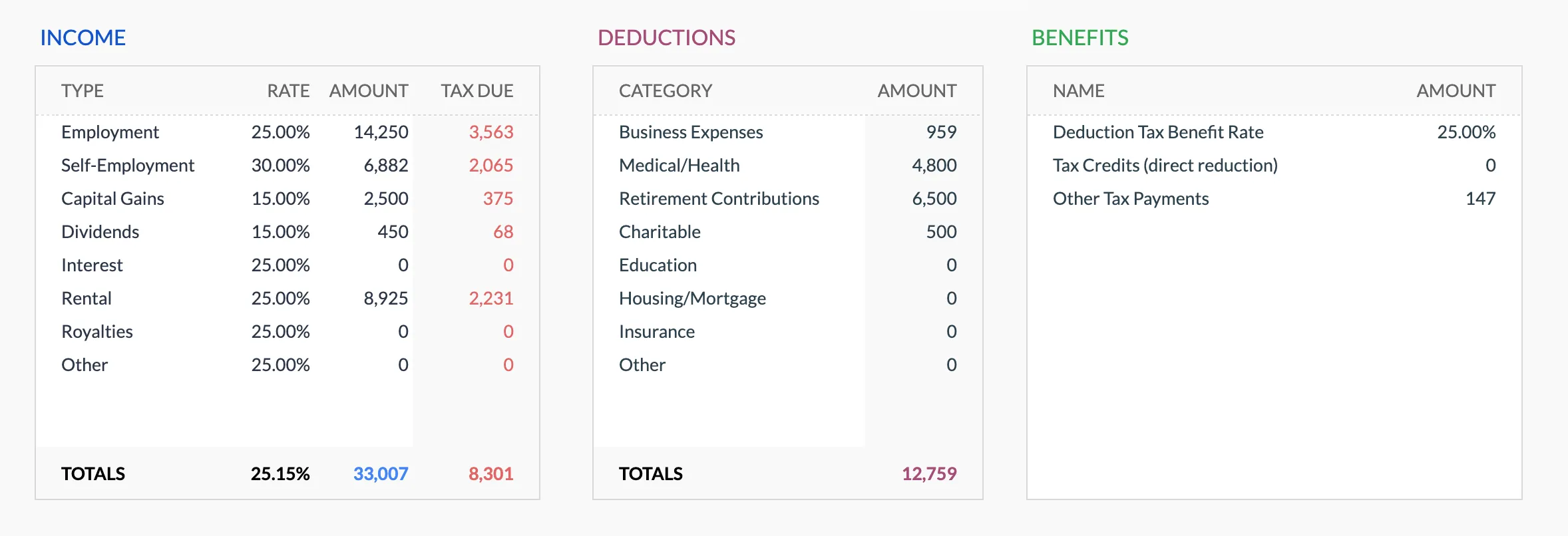
Browse through the template to see how it tracks income, deductions, credits, and estimated quarterly payments.
- Annual tax overview dashboard
- Income tracking by source
- Deductions and credits organizer
- Quarterly payment tracker
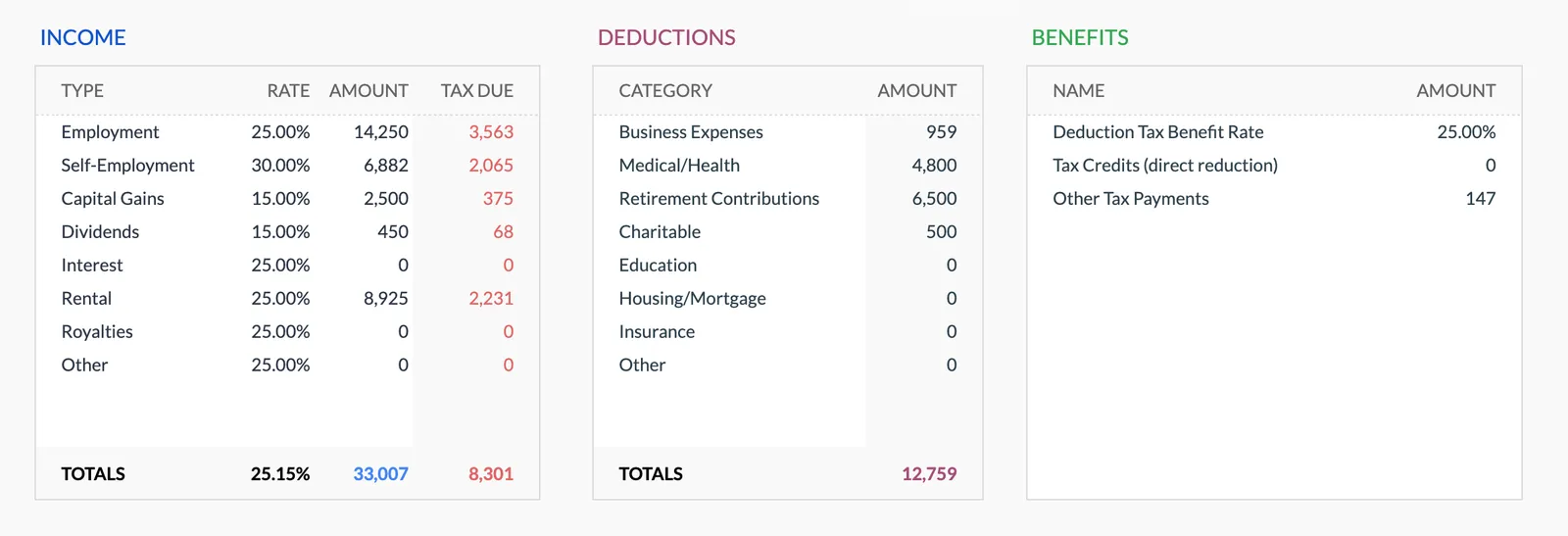
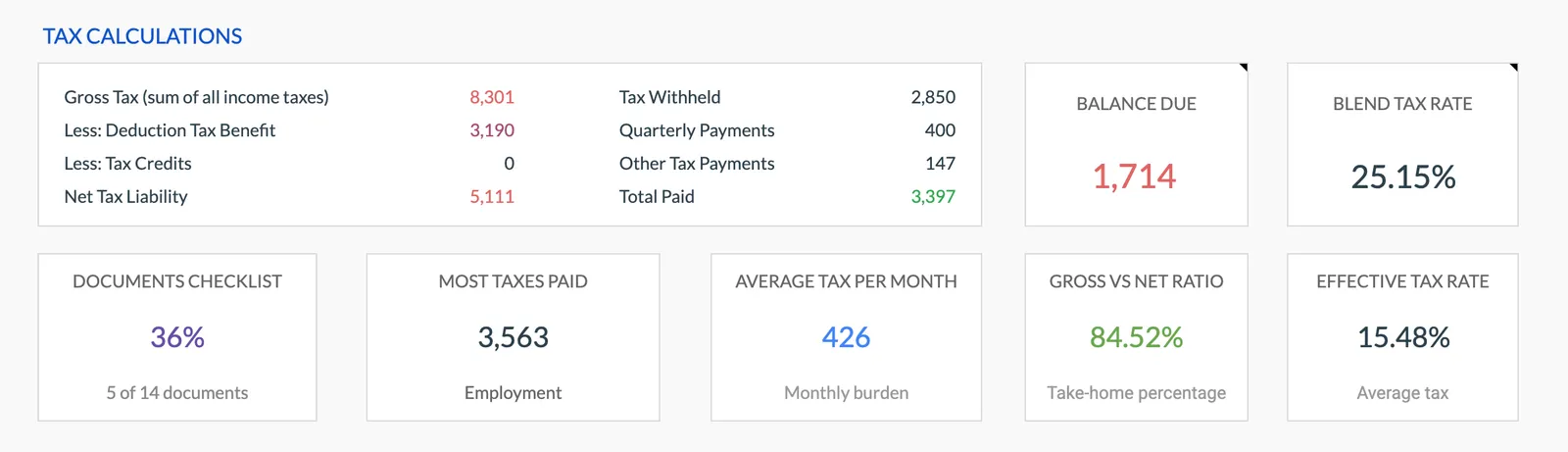
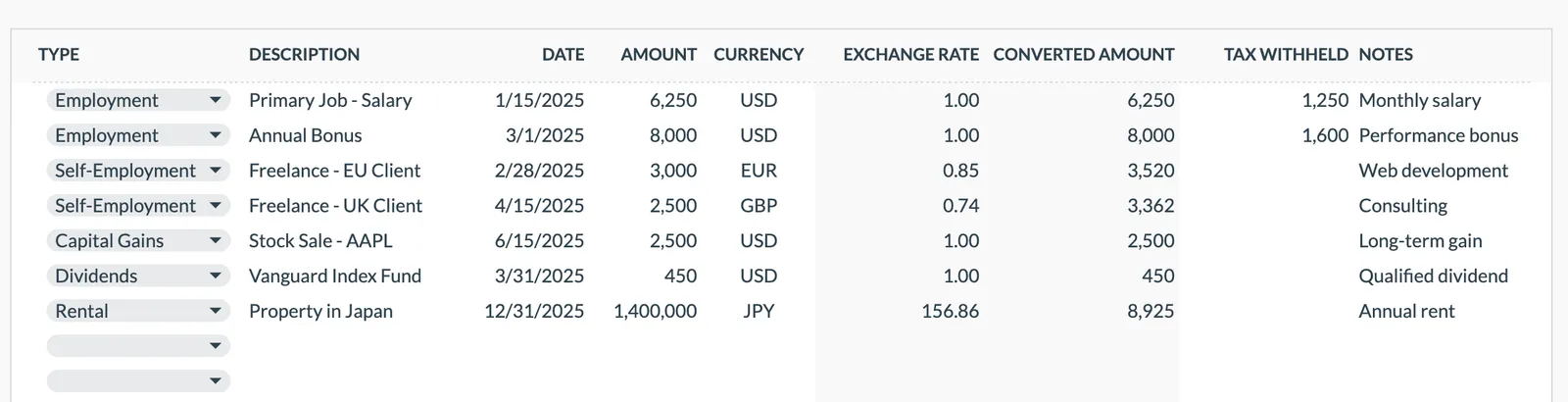
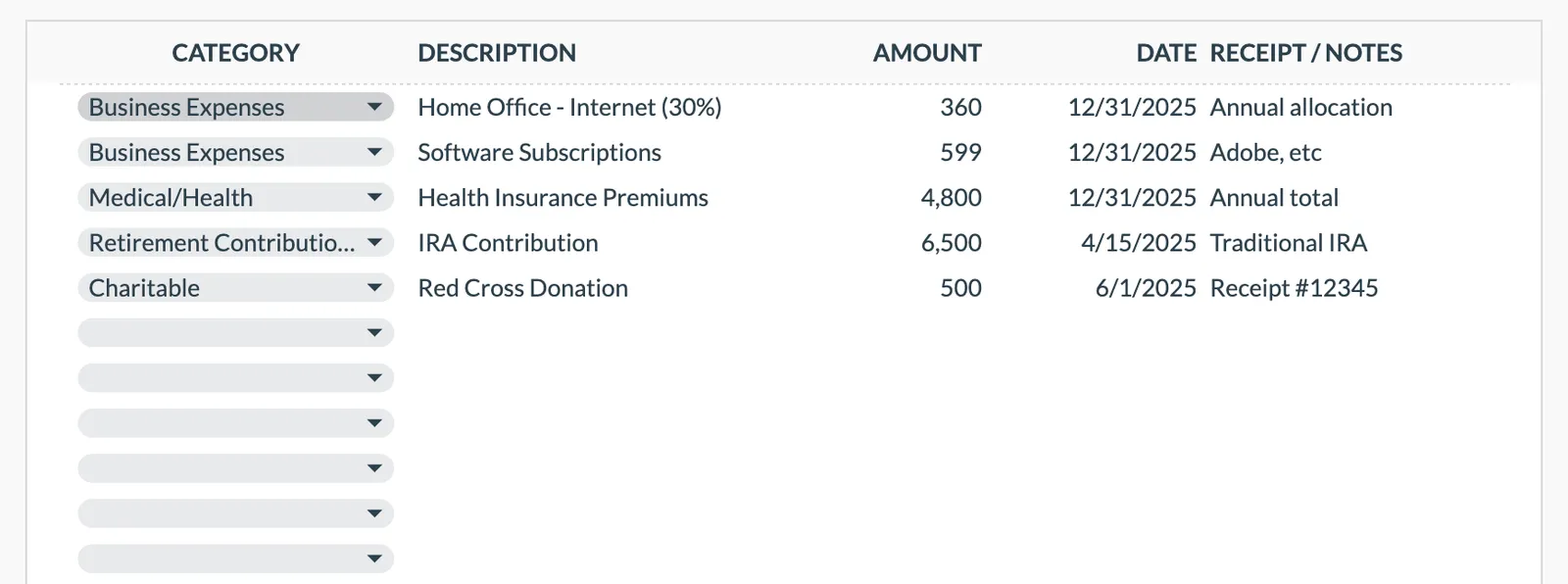
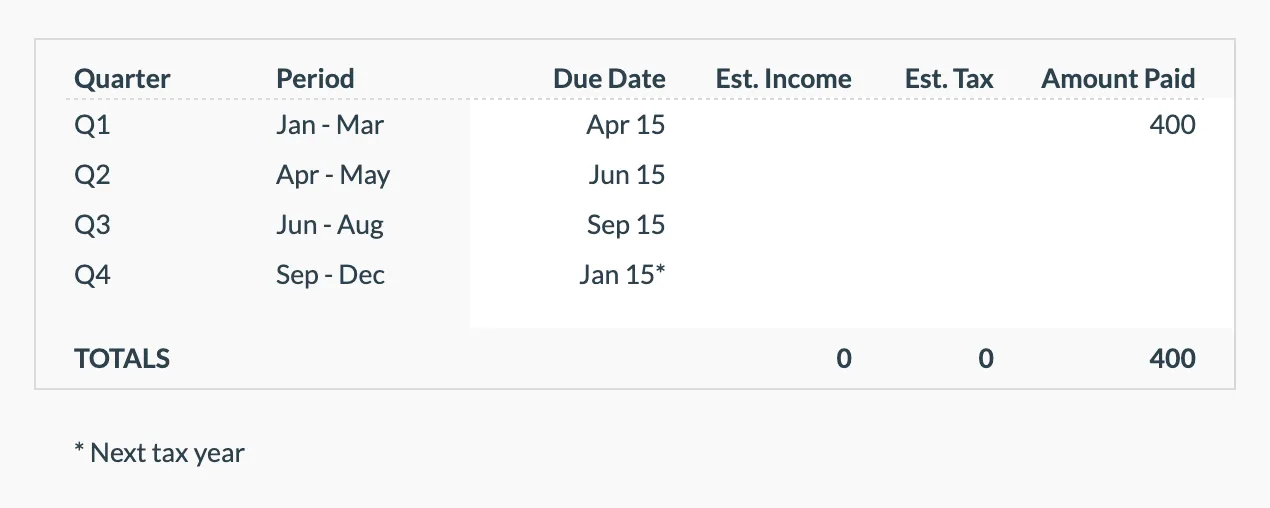
Annual tax overview with key figures
Detailed tax breakdown and projections
Track all income sources for tax purposes
Organize and track tax deductions
Plan and track quarterly estimated tax payments
Common Questions
Tax Planning in South Carolina - FAQ
What are South Carolina's income tax rates?
South Carolina has a graduated income tax with two brackets for the 2026 tax year, 1.99% on the first $30,000 of taxable income and 5.21% above that [1], down from a 6% top rate in 2025. Further top-rate cuts are tied to state revenue growth triggers. Two brackets mean the effective rate depends on total taxable income.
How does South Carolina's retirement income deduction work?
South Carolina offers a retirement income deduction that allows taxpayers to exclude a meaningful amount of qualifying retirement income from state tax. The retirement income deduction is $3,000 for taxpayers under 65 and $10,000 from age 65, and residents 65 and older can also claim a separate deduction of up to $15,000 against any income, reduced by any retirement deduction taken. Social Security benefits are fully exempt regardless of income level. These provisions stack together to create a low effective rate for many retirees.
Is military retirement pay taxed in South Carolina?
All military retirement pay is fully exempt from South Carolina state income tax, regardless of amount. This full exemption, combined with the general retirement deduction, the presence of military installations like Fort Jackson and Joint Base Charleston, and a relatively low cost of living, has made South Carolina popular among military retirees.
How does South Carolina's property tax system work for homeowners?
South Carolina uses different assessment ratios for different property types. Owner-occupied primary residences are assessed at a much lower ratio (4%) than commercial or rental properties (6%), resulting in effective property tax rates for homeowners that are well below the national average. A homestead exemption provides additional relief for residents 65 and older, disabled, and legally blind residents.
Is the top income tax rate in South Carolina decreasing?
Yes. The 2026 tax year brought the largest step so far, replacing the old graduated schedule with 1.99% and 5.21% brackets, and further top-rate cuts are triggered when projected state revenue growth meets a set threshold. This means the rate for one tax year may differ from the next. Using current-year rates in the template ensures accurate projections, and year-over-year comparisons can show how the reductions affect your state tax liability.
Can't find the answer you're looking for? Contact our team
Official Tax Resources
For current rates, forms, and filing deadlines specific to South Carolina:
Sources
Organize your tax planning for South Carolina
One-time purchase. No subscription. Your financial data stays in your Google Drive.
Tax rules, rates, and contribution limits change, and official publications can themselves lag behind the law in force. We review these figures on a best-effort basis against sources we consider authoritative, but we cannot guarantee they are current, complete, or that better sources do not exist, and nothing here is tax, legal, or financial advice. For decisions, the relevant government authority is the reference. Last reviewed: August 2026.