Maine
Tax Planner Template for Maine
Plan your federal and Maine state taxes in Google Sheets. Track income, deductions, and credits for a state with graduated income tax rates.
In Depth
Maine's Tax Credits and the Pension Deduction
Maine's three-bracket income tax structure has a top rate that is moderately high by national standards, and since tax year 2026 a 2% surtax on income above $1 million pushes the top marginal rate to 9.15%. The 7.15% bracket kicks in at a threshold that many dual-income households reach, so the effective rate for middle-class families is often close to that rate. Maine sets its own standard deduction rather than matching the federal amount, and phases it out at higher incomes.
The pension income deduction in Maine has an important wrinkle - it is reduced dollar-for-dollar by Social Security benefits received. This means residents who receive substantial Social Security payments may see little or no benefit from the pension deduction. For someone with a large pension but modest Social Security, the deduction is more valuable. Understanding this interaction is useful when projecting retirement income taxes.
Maine's Property Tax Fairness Credit is a refundable credit available to residents whose property tax (or a portion of rent, treated as indirect property tax) exceeds a set percentage of income. Because it is refundable, it can result in a payment even if you owe no state income tax. This credit is particularly relevant for residents on fixed incomes in areas where property assessments have been rising.
Maine
Tax Planning in Maine
Maine has a graduated income tax with rates that are moderate but can add up. The state offers several credits and adjustments that are worth tracking throughout the year.
Graduated Income Tax
Maine has three income tax brackets with a moderately high top rate, and since tax year 2026 a 2% surtax applies to income above $1 million. The top bracket applies at moderate income thresholds.
Pension Income Deduction
Maine offers a pension income deduction for eligible retirement income. This deduction is reduced dollar-for-dollar by Social Security benefits received.
Property Tax Fairness Credit
Maine has a refundable Property Tax Fairness Credit for eligible residents whose property tax or rent exceeds a certain percentage of income. Worth tracking for potential tax savings.
Standard Deduction
Maine sets its own standard deduction, close to the federal amount but not identical, and phases it out for higher-income filers.
Get the Annual Tax Planner
Getting Started
Getting Started with Maine Tax Planning
Enter income across all categories
Add wages, self-employment, investment income, and retirement distributions. Maine has three graduated income tax brackets with rates from 5.8% to 7.15%, and since tax year 2026 a 2% surtax lifts the top marginal rate to 9.15% on income above $1 million for single filers. The 7.15% rate applies at moderate income levels, so accurately tracking all income sources helps project which bracket your top dollars fall into.
Track pension income against the deduction cap
Maine offers an indexed pension income deduction, up to $48,216 per taxpayer for the 2025 tax year, for eligible retirement income. This deduction is reduced dollar-for-dollar by Social Security benefits received, and since tax year 2025 it also phases out at higher federal AGI levels. Enter pension income and Social Security separately so you can see the net benefit of the deduction based on your specific combination of retirement income sources.
Check eligibility for the Property Tax Fairness Credit
Maine's Property Tax Fairness Credit is a refundable credit for residents whose property tax (or rent, treated as indirect property tax) exceeds a certain percentage of income. Having accurate income figures in the template makes it easier to estimate whether you qualify and the potential credit amount. This credit can result in a refund even if no state tax is owed.
Review deductions with federal conformity in mind
Maine largely conforms to the federal Internal Revenue Code, but it sets its own standard deduction, $15,300 for single filers in the 2026 tax year, and phases that deduction out at higher incomes. Maine also allows a personal exemption that has no federal counterpart. Enter all deduction items to see whether itemizing at the state level produces a different result than the standard deduction.
Plan estimated payments at both levels
Maine's top rate of 7.15%, rising to 9.15% above the surtax threshold since tax year 2026, means underpayment penalties can add up. Use the quarterly tracker for both federal and state estimated payments. If your income varies from self-employment, seasonal work, or investment gains, staying current with Maine estimated payments avoids penalties and surprises at filing time.
See It In Action
What the tax planner looks like
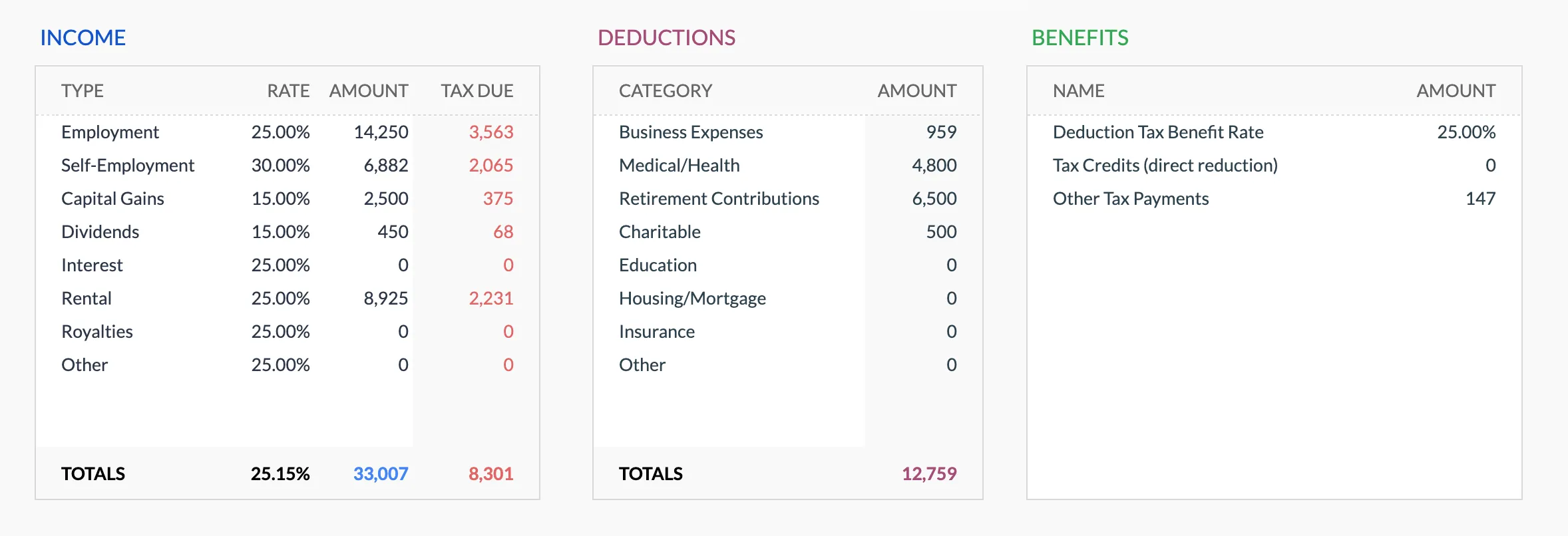
Browse through the template to see how it tracks income, deductions, credits, and estimated quarterly payments.
- Annual tax overview dashboard
- Income tracking by source
- Deductions and credits organizer
- Quarterly payment tracker
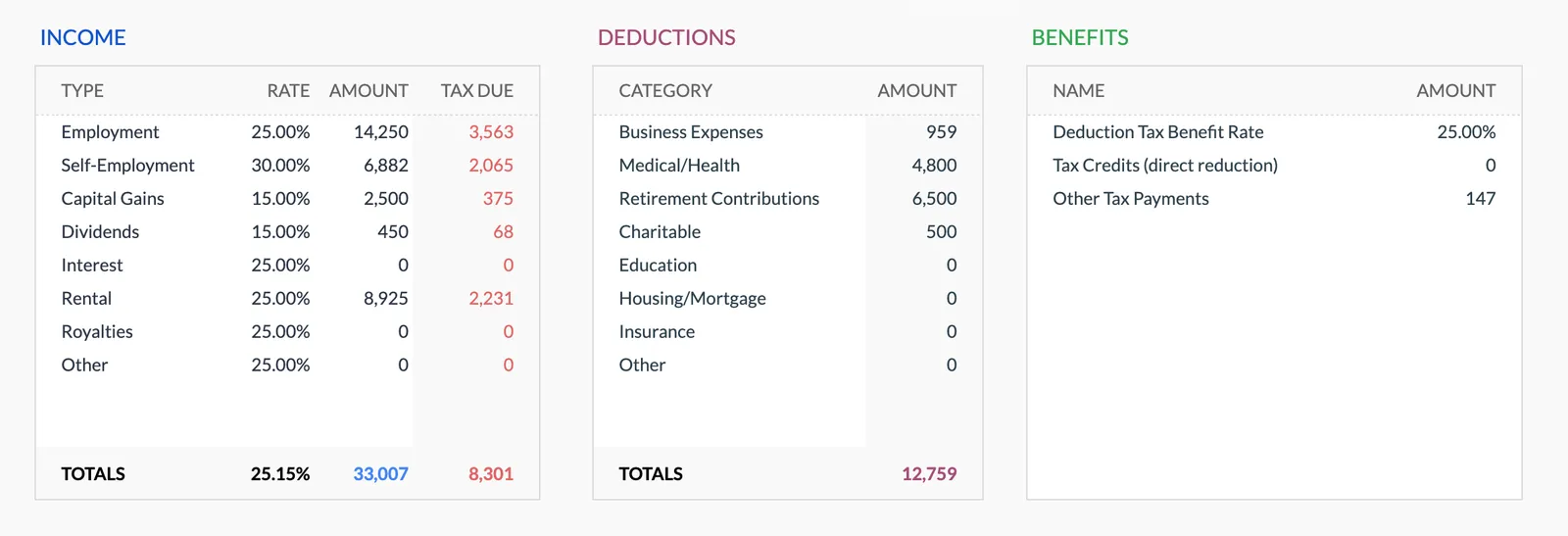
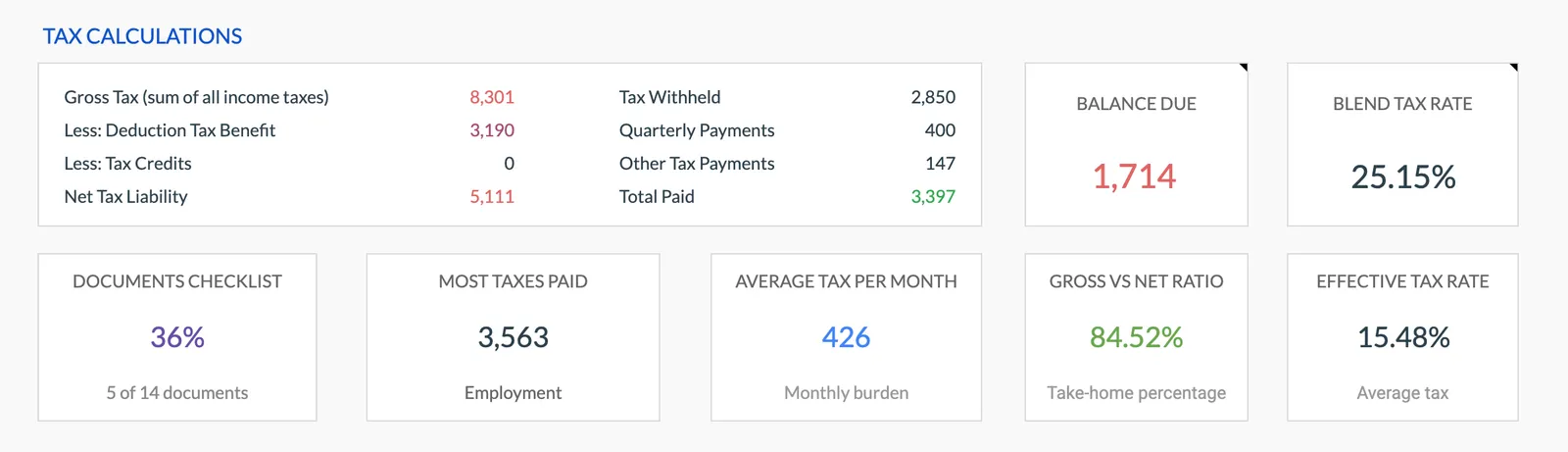
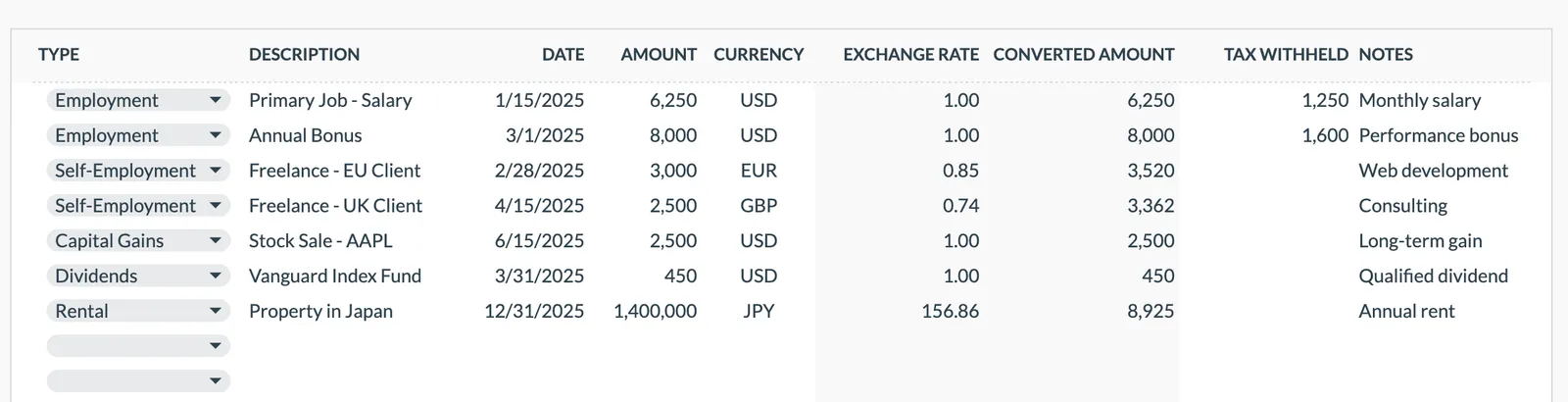

Annual tax overview with key figures
Detailed tax breakdown and projections
Track all income sources for tax purposes
Organize and track tax deductions
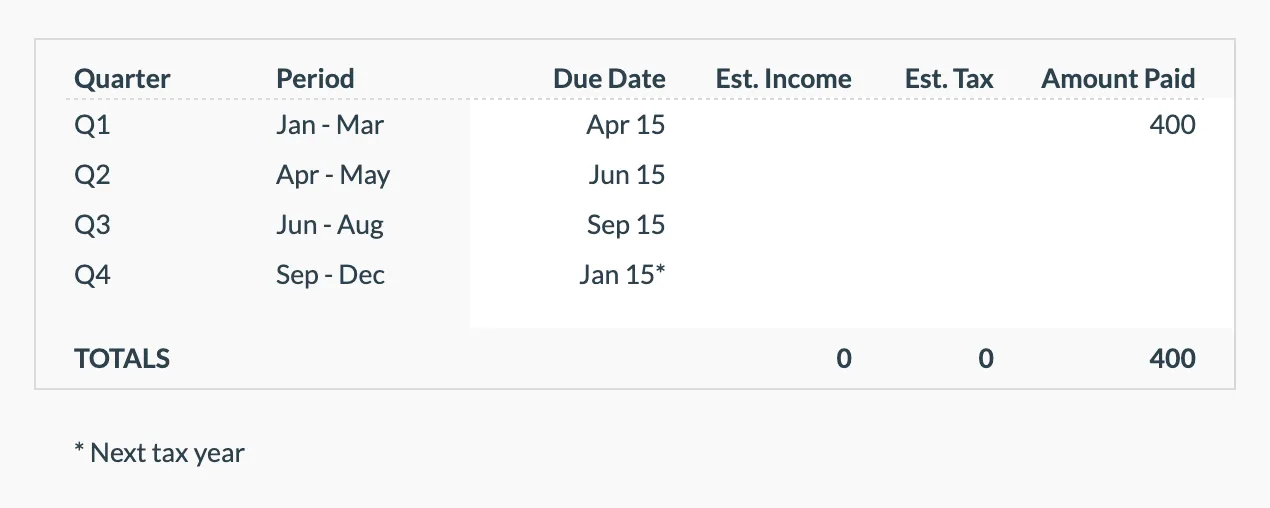
Plan and track quarterly estimated tax payments
Common Questions
Tax Planning in Maine - FAQ
What are Maine's income tax rates?
Maine has three graduated income tax brackets with rates of 5.8% [1], 6.75%, and 7.15%. Since tax year 2026 a 2% surtax on income above $1 million for single filers and $1.5 million for joint filers raises the top marginal rate to 9.15%. The 7.15% rate applies at moderate income thresholds, meaning many full-time workers with above-average incomes reach the top bracket. Even the lowest bracket rate of 5.8% is higher than many states' flat rates or top graduated rates [2].
How does Maine's pension income deduction work?
Maine allows an indexed deduction for eligible pension and retirement income, up to $48,216 per taxpayer for the 2025 tax year. The key detail is that this deduction is reduced dollar-for-dollar by any Social Security benefits received. Someone with $30,000 in Social Security and $40,000 in pension income would get an $18,216 pension deduction ($48,216 minus $30,000 Social Security), capped at the pension actually received. Since tax year 2025 the deduction also phases out once federal AGI passes $125,000 for single filers, $187,500 for heads of household, and $250,000 for joint filers. For residents with substantial Social Security, the pension deduction may provide little or no benefit.
What is Maine's Property Tax Fairness Credit?
The Property Tax Fairness Credit is a refundable credit available to Maine residents whose property tax or rent (a portion of rent is treated as property tax) exceeds a set percentage of household income. Because it is refundable, it can generate a payment even if you owe no state income tax. This credit is particularly relevant for residents on fixed incomes or in areas where property assessments have been rising.
Does Maine conform to federal tax rules?
Maine closely conforms to the federal Internal Revenue Code as a starting point, though it sets its own standard deduction and has decoupled from several recent federal changes. Most federal adjustments still flow through to the Maine calculation, which simplifies the state return for many filers. However, Maine has its own credits and deductions - like the pension deduction and Property Tax Fairness Credit - that are specific to the state.
Is Social Security taxed in Maine?
Maine does not tax Social Security benefits. Any portion taxable on your federal return is subtracted on the Maine return, so it does not end up in Maine taxable income. However, the pension income deduction can interact with Social Security - the deduction is reduced by Social Security benefits received, which effectively means the state gives relief for one or the other but not both.
Can't find the answer you're looking for? Contact our team
Official Tax Resources
For current rates, forms, and filing deadlines specific to Maine:
Organize your tax planning for Maine
One-time purchase. No subscription. Your financial data stays in your Google Drive.
Tax rules, rates, and contribution limits change, and official publications can themselves lag behind the law in force. We review these figures on a best-effort basis against sources we consider authoritative, but we cannot guarantee they are current, complete, or that better sources do not exist, and nothing here is tax, legal, or financial advice. For decisions, the relevant government authority is the reference. Last reviewed: August 2026.