District of Columbia
Tax Planner Template for District of Columbia
Organize your federal and D.C. tax planning in Google Sheets. The District has a graduated income tax with a high top rate and unique considerations for residents of the nation's capital.
In Depth
D.C.'s High Rates and Unique Federal District Status
The District of Columbia has a graduated income tax with a top rate of 10.75%, placing it among the highest in the country alongside California and New York City. The rate structure progresses steeply - even the lowest bracket starts at 4%, which is higher than many states' top rates. For high-income professionals working in the nation's capital, the combined federal and D.C. tax rate is notable.
As a federal district rather than a state, D.C. has unique characteristics. There are no separate local or county income taxes layered on top - the district rate is the only local income tax. This is simpler than neighboring Maryland, where county income taxes add a layer, but D.C.'s higher base rates can more than offset that simplicity at higher income levels. Virginia's flat-like structure with a 5.75% top rate offers a different comparison point for metro-area residents choosing where to live.
D.C. stands out for its generous earned income tax credit, which is one of the largest in the country as a percentage of the federal EITC. For qualifying lower-income workers, this credit can provide substantial relief and even generate a refund. The district does not tax Social Security benefits, but other retirement income faces the full graduated rate structure. Property taxes in D.C. are moderate, and itemizers can deduct them on the district income tax return, though state and local income taxes cannot be.
District of Columbia
Tax Planning in District of Columbia
The District of Columbia has a graduated income tax with rates that reach 10.75% at the top - one of the highest top rates in the country. As a federal district rather than a state, D.C. has unique tax characteristics worth understanding.
High Graduated Rates
D.C. has a graduated income tax with rates ranging from 4% to 10.75%. The top rate is among the highest [2] in the nation and applies to high earners. Multiple brackets create a progressive structure with significant rate increases at upper income thresholds.
Standard Deduction
D.C. offers a standard deduction for residents based on filing status. Residents can also itemize if their deductions exceed the standard amount. The standard deduction amounts follow the federal figures, since D.C. conforms to the federal standard deduction.
Itemized Deduction Rules on the D.C. Return
D.C. allows itemizers to deduct real property taxes on the district return, though state and local income taxes are not deductible there. Property taxes in D.C. are moderate, and the income tax carve-out is a distinction from many states.
Generous EITC
D.C. offers one of the most generous earned income tax credits in the country, reaching 100% of the federal EITC for the 2026 tax year. This can provide substantial relief for qualifying lower-income workers.
Get the Annual Tax Planner
Getting Started
Using the Tax Planner as a D.C. Resident
Enter income across D.C.'s wide bracket range
Add all income sources - wages, self-employment, investments, and other earnings. D.C.'s rates range from 4% to 10.75%, with the top rate among the highest in the nation. The template shows where your income falls in both D.C.'s brackets and federal brackets, which is especially useful given the steep progression at higher income levels.
Note how property tax is treated on the D.C. return
D.C. allows itemizers to deduct real property taxes on the district return, though state and local income taxes are not deductible there. Enter your property tax for federal SALT deduction purposes and, if you itemize, for the district return as well. D.C. property taxes are moderate, and the split treatment of taxes is worth keeping visible in the template.
Track the D.C. earned income credit if eligible
D.C. offers one of the most generous earned income tax credits in the country. If you qualify for the federal EITC, D.C.'s credit is calculated as a large percentage of that amount and can result in a refund beyond D.C. tax owed. Note this in the custom fields to see the full picture of credits at both levels.
Compare your D.C. tax to Virginia and Maryland alternatives
If you work in D.C. and are considering where to live in the metro area, the template can help compare. D.C.'s higher top rate affects high earners most, while Virginia's lack of local taxes and Maryland's county tax layer create different outcomes at different income levels. Track your D.C. projection to see how it stacks up.
Review the high-rate projection regularly
The dashboard shows your federal and D.C. projections. With D.C.'s top rate at 10.75%, high earners face a combined federal and local rate that is among the steepest in the country. Review quarterly to ensure withholdings and estimated payments keep pace, especially if your income varies.
See It In Action
What the tax planner looks like
Browse through the template to see how it tracks income, deductions, credits, and estimated quarterly payments.
- Annual tax overview dashboard
- Income tracking by source
- Deductions and credits organizer
- Quarterly payment tracker
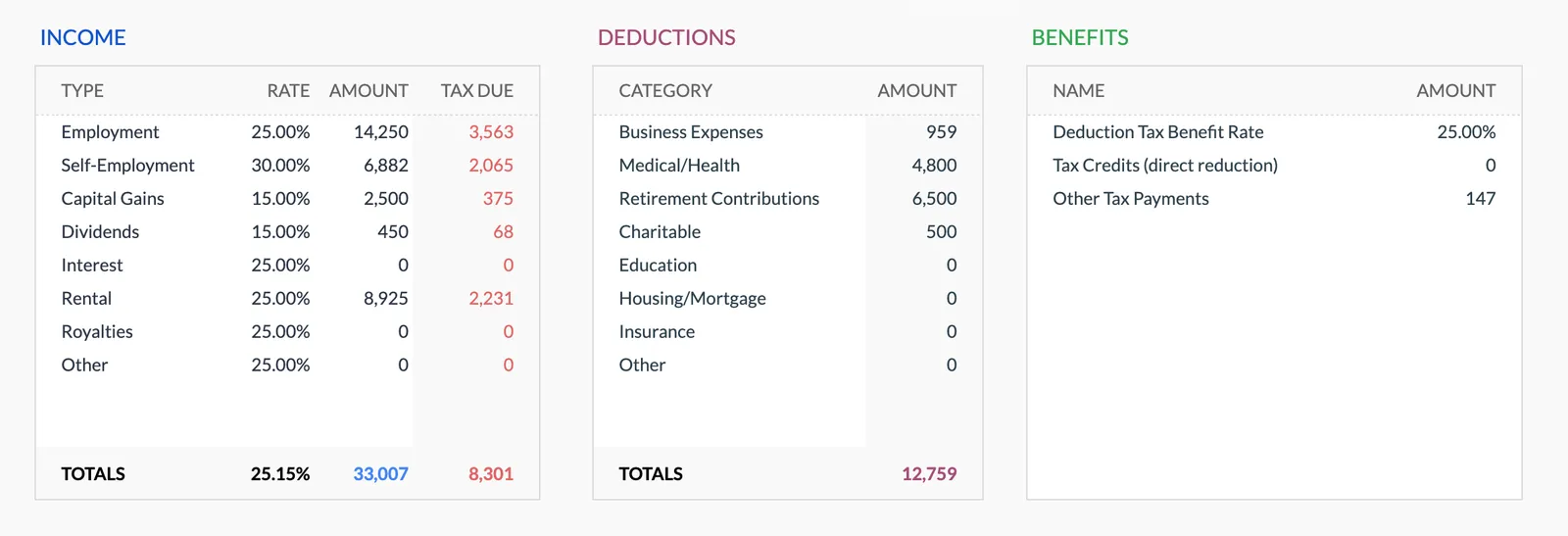
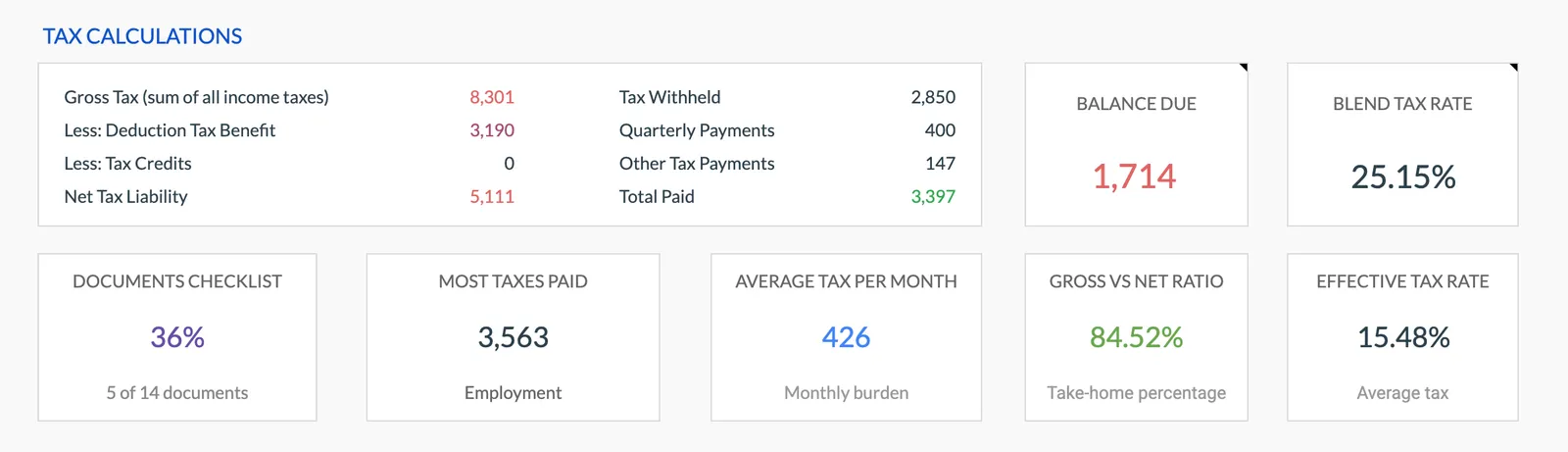
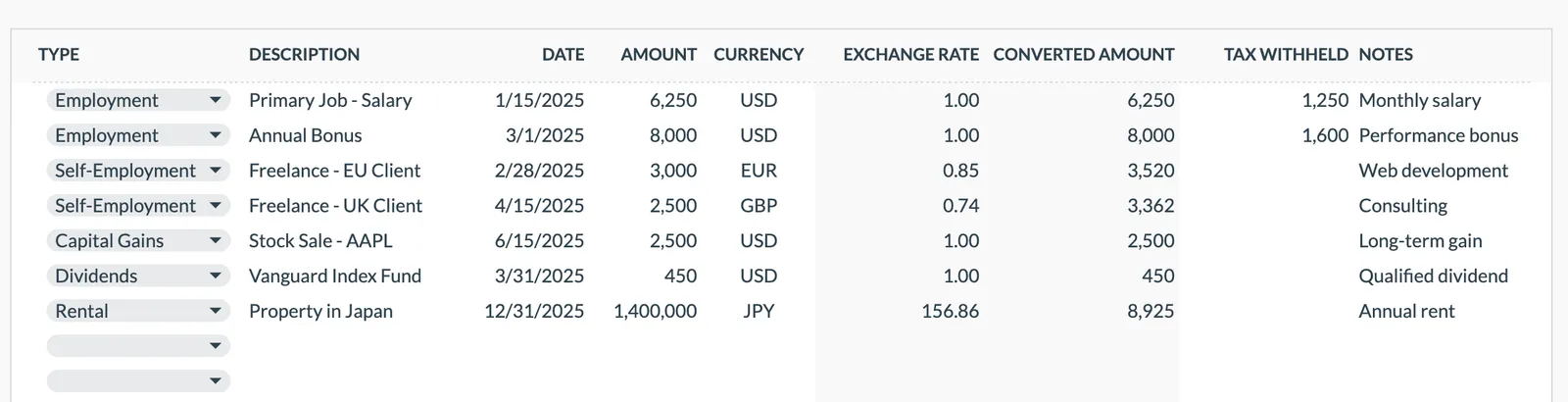
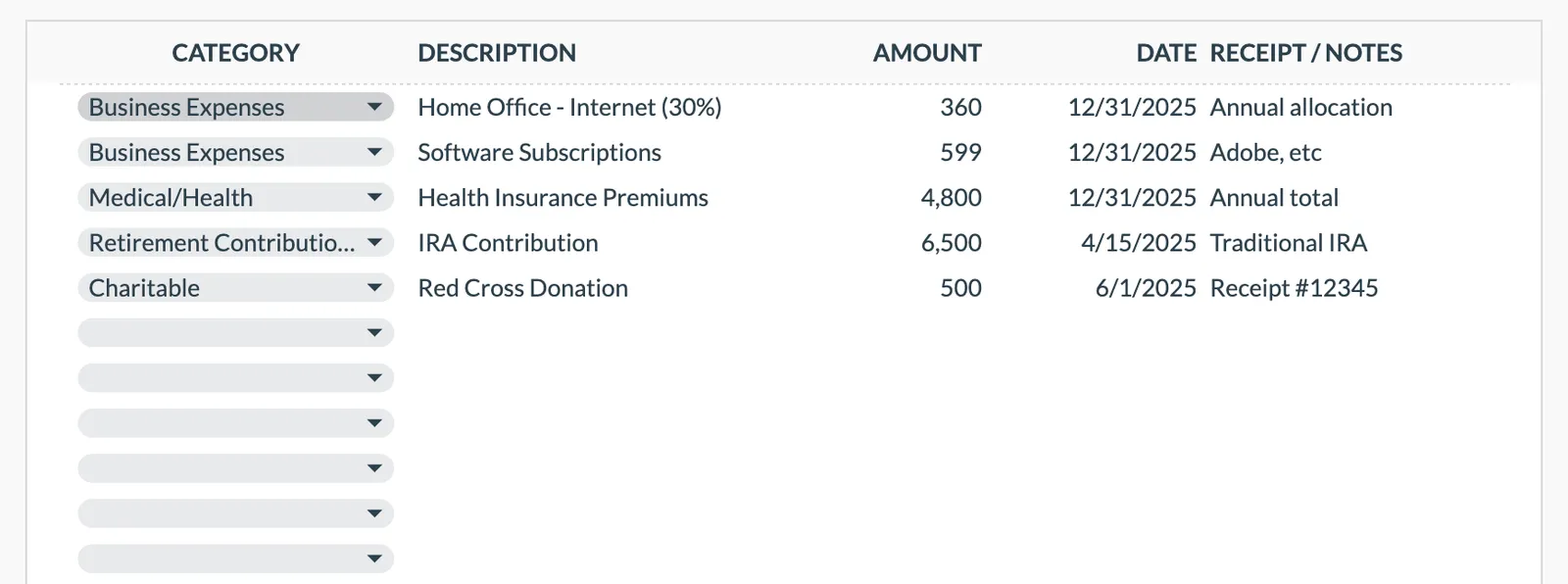
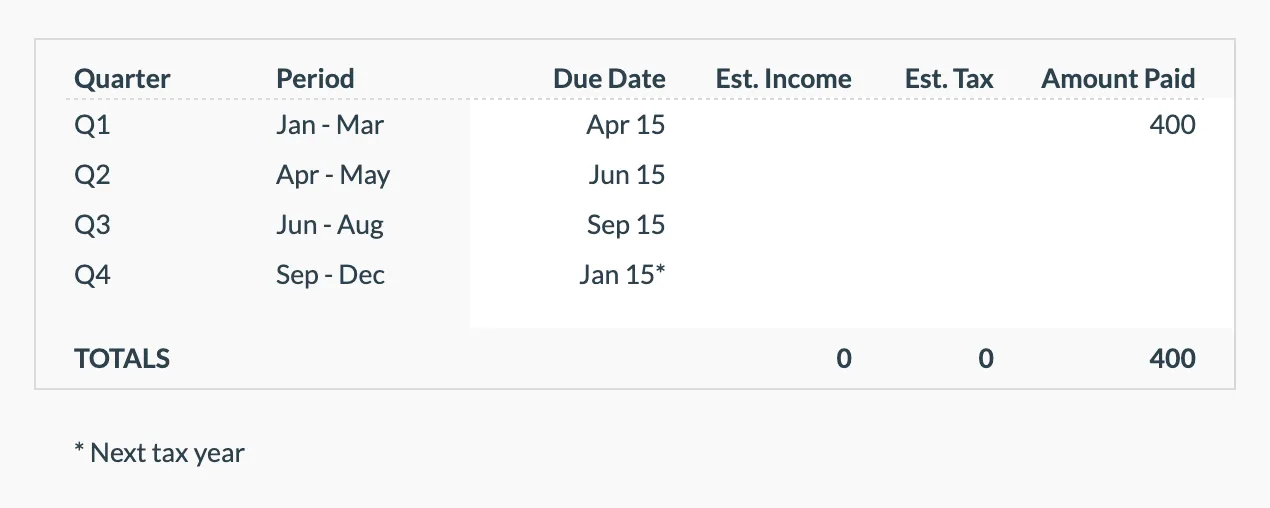
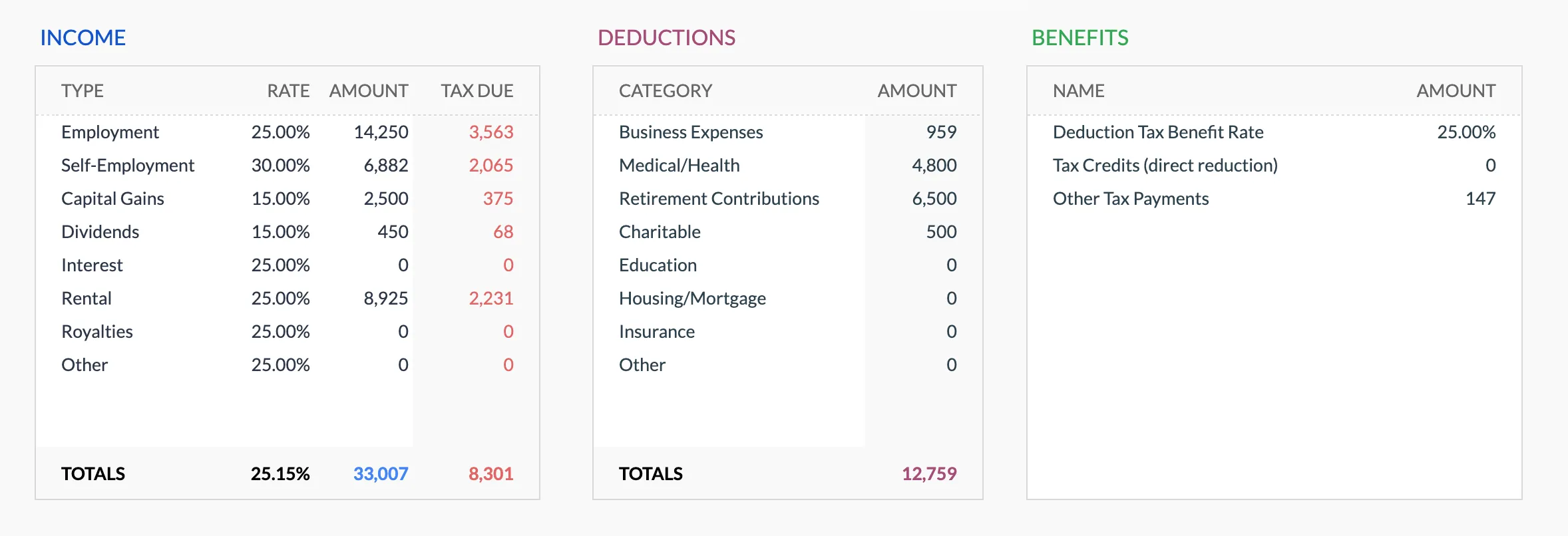
Annual tax overview with key figures
Detailed tax breakdown and projections
Track all income sources for tax purposes
Organize and track tax deductions
Plan and track quarterly estimated tax payments
Common Questions
Tax Planning in District of Columbia - FAQ
What are the District of Columbia's income tax rates?
D.C. has a graduated income tax with rates from 4% to 10.75% [1]. The 10.75% top rate is one of the highest in the country and applies to income above a high threshold. The lower brackets start at 4%, making even the entry-level rate higher than many states' top rates. The graduated structure means your effective rate depends on total taxable income.
How does D.C.'s tax situation compare to neighboring Virginia and Maryland?
D.C. residents face higher top income tax rates than both Virginia (5.75% top rate) and Maryland (a 6.5% state top rate since tax year 2025, plus county taxes). However, D.C. has no local income tax layer on top of its rates, while Maryland adds county income taxes. The comparison depends on income level - D.C.'s higher top rate primarily affects high earners, while lower-income residents may pay similar effective rates across the three jurisdictions.
Does D.C. tax retirement income and Social Security?
D.C. does not tax Social Security benefits. Other retirement income - pensions, 401(k) distributions, IRA withdrawals - is generally taxed at the regular graduated rates. There is no broad retirement income exclusion comparable to what some states offer, so the full graduated rate structure applies to most non-Social-Security retirement income.
What is D.C.'s earned income tax credit?
D.C. offers one of the most generous state-level earned income tax credits (EITC) in the country, reaching 100% of the federal EITC for the 2026 tax year after a multi-year phase-up. For qualifying lower-income workers, this can result in a significant refund even beyond any D.C. tax owed. The credit is worth tracking alongside the federal EITC to see the combined benefit, which can be meaningful.
Can I deduct property taxes on my D.C. return?
Yes, if you itemize. D.C. allows a deduction for real property taxes on the district income tax return, though state and local income taxes are not deductible there. Property taxes in D.C. are moderate compared to nearby Maryland and Northern Virginia suburbs. Property taxes are also deductible on your federal return, subject to the SALT cap.
Can't find the answer you're looking for? Contact our team
Official Tax Resources
For current rates, forms, and filing deadlines specific to District of Columbia:
Sources
Organize your tax planning for District of Columbia
One-time purchase. No subscription. Your financial data stays in your Google Drive.
Tax rules, rates, and contribution limits change, and official publications can themselves lag behind the law in force. We review these figures on a best-effort basis against sources we consider authoritative, but we cannot guarantee they are current, complete, or that better sources do not exist, and nothing here is tax, legal, or financial advice. For decisions, the relevant government authority is the reference. Last reviewed: August 2026.