United Kingdom
FIRE Calculator for the United Kingdom
Calculate your path to financial independence in a free Google Sheets calculator that lets you factor in ISAs, SIPPs, State Pension, and UK tax rules.
In Depth
Why the UK Is Quietly One of the Better Places for FIRE
The UK has several structural features that shape financial independence planning. NHS care free at the point of use keeps healthcare largely out of the early retirement budget, in contrast to the US, where it is often the single largest FIRE variable. ISAs allow £20,000 a year of tax-free saving and investing for the 2026-27 tax year, with no age restriction on withdrawals. The State Pension, at roughly £12,550 a year in full, is not enough to live on by itself, but it acts as an inflation-linked income floor from State Pension age that a portfolio no longer has to cover.
The typical UK FIRE structure has two phases. Before the normal minimum pension age, currently 55 and rising to 57 on 6 April 2028, spending comes from ISAs and general investment accounts, both reachable at any age without a penalty. After that point SIPP withdrawals become available, with up to 25% able to be taken tax free. Funding the bridge period is the central planning problem, which is why ISA balances tend to dominate UK FIRE plans. A decade of using the full Stocks and Shares ISA allowance builds a sizeable tax-free bridge fund.
Cost of living plays a huge role in UK FIRE numbers. Someone targeting financial independence in London faces a fundamentally different calculation than someone in Wales, northern England, or Scotland. Housing costs alone can differ by a factor of three or more. Many UK FIRE practitioners treat geographic flexibility, meaning the option of moving to a lower-cost area, as a lever that can pull the target number down noticeably. A FIRE calculator that lets you model different spending levels makes this comparison concrete rather than speculative.
United Kingdom
FIRE in the United Kingdom: What to Know
The FIRE movement has a growing UK community, with some advantages over other countries - notably the NHS, ISA allowances, and generous pension tax relief.
The NHS removes healthcare from the equation
Unlike the US, where healthcare costs are a major FIRE variable, the NHS provides care free at the point of use regardless of employment status. That removes the largest unknown from many early retirement budgets, though dentistry, optical care, and prescriptions in England still carry charges. Private health insurance is a choice rather than a requirement.
ISAs and SIPPs provide a powerful tax-efficient combination
ISAs carry a £20,000 annual allowance for the 2026-27 tax year and withdrawals are free of UK tax at any age, which is why they show up in plans covering the years before pension access. SIPPs give tax relief on contributions and tax-free growth inside the wrapper, but nothing can be drawn before the normal minimum pension age of 55, rising to 57 on 6 April 2028. A common UK FIRE pattern fills ISAs for the bridge period and SIPPs for later retirement. Worth noting that from April 2027 the cash ISA share of the allowance is set to fall to £12,000 a year for savers under 65.
The State Pension reduces the required portfolio size
The full new State Pension is £241.30 a week for the 2026-27 tax year, roughly £12,550 annually, and it starts at State Pension age, which is phasing up from 66 to 67 and reaches 67 for anyone born from 6 March 1961 onwards. Because it arrives as a guaranteed income later on, a portfolio only has to cover the full spending figure until that point. That is why a UK FIRE number can come out below what a flat 25x calculation implies.
UK FIRE numbers tend to be lower than US equivalents
Between the NHS, State Pension, and generally lower cost of living outside London, many UK FIRE practitioners find their target numbers are lower than American equivalents. A couple targeting a moderate lifestyle outside London might aim for £500,000-800,000 in invested assets, plus eventual State Pension.
Get the Template
Getting Started
Running Your UK FIRE Numbers With ISAs and Pensions
Enter your current invested assets
Input total values across ISAs (Cash and Stocks & Shares), SIPPs, workplace pensions, GIAs, and any other investments. Include everything you're counting toward financial independence.
Set your target annual spending
Enter your expected annual expenses in early retirement. With the NHS covering most healthcare, the figure is mainly housing, food, utilities, transport, leisure, and insurance. Twelve months of actual tracked spending tends to produce a steadier number than an estimate made from memory.
Add your annual savings amount
Enter how much you invest each year. Include ISA contributions, pension contributions (including employer match and tax relief), and any GIA investments. Your savings rate is the primary driver of your FIRE timeline.
Factor in future State Pension income
Enter your projected State Pension amount and the age you'll receive it. This reduces the long-term portfolio requirement since the State Pension provides a baseline income you don't need to fund from investments.
Review your projected FIRE date
The calculator shows when your investments can sustain your target spending. Experiment with different savings rates and spending levels to see how sensitive the date is to changes.
See It In Action
What the template looks like
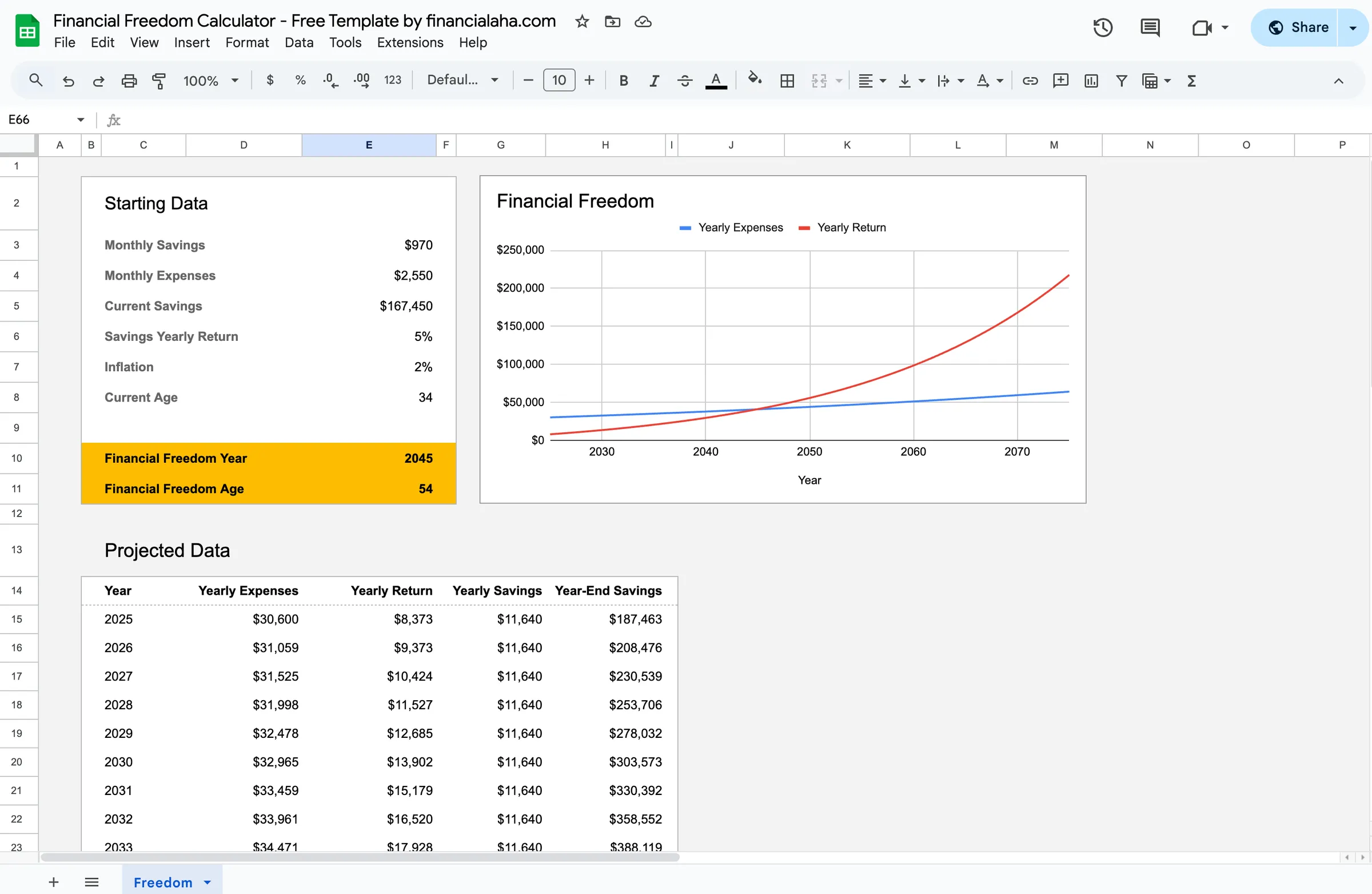
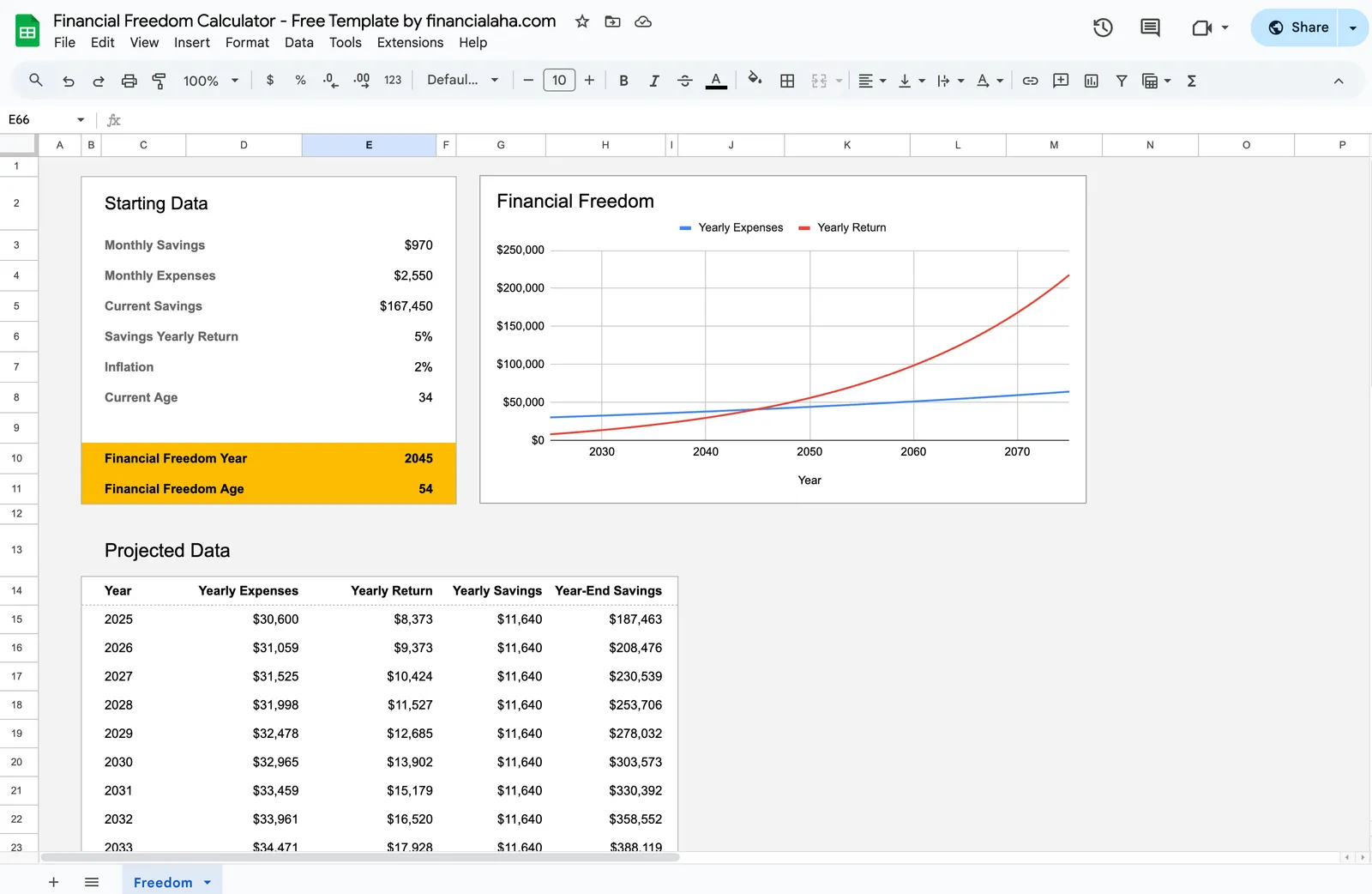
Browse through the template to see the dashboard, the entry sheets, and the summaries it produces, all adaptable to your local financial setup.
- Built-in currency selector
- Calculations update automatically
- Visual summaries of your numbers
- No setup required
Calculate your path to financial independence
Common Questions
FIRE Calculator for the United Kingdom - FAQ
Is this FIRE calculator really free?
Yes. The FIRE calculator is completely free - no payment, no email required. It runs in Google Sheets so you own and control your data.
How do I access pension money before 55?
A SIPP or workplace pension cannot normally be accessed before the normal minimum pension age of 55, rising to 57 on 6 April 2028, outside narrow exceptions such as serious ill health. UK FIRE plans generally use ISAs and general investment accounts to cover the bridge period between stopping work and reaching pension access age, which is why ISA balances feature so heavily in them.
What is a typical UK FIRE number?
It depends entirely on annual spending and whether you account for the State Pension. Someone spending £30,000 a year might use £750,000 as a 25x figure. With a full State Pension of roughly £12,550 a year for 2026-27 arriving later, the portfolio only has to cover about £17,450 a year from State Pension age onwards, so the long-run requirement can be lower than the flat multiple suggests.
Does the 4% rule work in the UK?
The 4% rule was based on US market data, but similar analyses of global markets suggest 3.5-4% is a reasonable range. Some UK FIRE planners use 3.5% for added safety, especially for very long retirements (40+ years). The State Pension also provides a floor that reduces reliance on the portfolio alone.
How important is the ISA allowance for FIRE?
It carries a lot of weight in most UK plans. The £20,000 annual allowance for 2026-27 gives tax-free growth and tax-free withdrawals, with no capital gains tax and no income tax on interest or dividends inside the wrapper. Because the money is reachable at any age, ISAs are the usual vehicle for the pre-pension bridge period, and the allowance does not carry over to the next tax year if it goes unused.
Can't find the answer you're looking for? Contact our team
Explore More
Free Tools for the United Kingdom
Ready to get started?
Download instantly and start managing your finances, or contact us to design a custom template package for your needs.
Tax rules, rates, and contribution limits change, and official publications can themselves lag behind the law in force. We review these figures on a best-effort basis against sources we consider authoritative, but we cannot guarantee they are current, complete, or that better sources do not exist, and nothing here is tax, legal, or financial advice. For decisions, the relevant government authority is the reference.