Cash Flow Forecast
Cash Flow Forecast Template for Salons / Barbershops
Forecast appointment revenue, track product sales, manage stylist compensation, and plan for seasonal demand patterns - all in a Google Sheets template built for cash flow management.
In Depth
The Financial Rhythm of Salon and Barbershop Life
Salons and barbershops have a financial characteristic that many other businesses envy - they collect payment at the time of service. There is no invoicing, no net-30 terms, no accounts receivable to chase. When a client sits in the chair, the revenue is realized the moment they pay at checkout. This immediate cash collection simplifies the incoming side of cash flow, but it also means revenue is tightly coupled to daily foot traffic and appointment volume.
The compensation model a salon chooses shapes its entire financial structure. Commission-based salons pay stylists 40-60% of service revenue, meaning labor costs move in lockstep with income. Booth rental models flip this - the salon collects fixed rent from each stylist regardless of how busy they are, creating predictable income but less control over the client experience. Each model has trade-offs, and many salon owners find that their choice of compensation structure has more impact on cash flow than almost any other decision.
Stylist retention is a financial issue as much as a management one. An experienced stylist with a full book of clients might represent $8,000-$15,000 in monthly revenue. When that stylist leaves - whether for a competitor, to go independent, or for personal reasons - a significant portion of their clients leave too. Rebuilding that revenue with a new stylist typically takes three to six months, creating a measurable dip in the salon's cash flow that no amount of marketing can immediately fix.
Retail product sales represent an often-underutilized cash flow opportunity. Products carry 40-50% margins and do not require additional labor to sell. A salon generating $30,000/month in services that adds $4,000/month in retail sales at 45% margin creates $1,800 in additional monthly profit with minimal extra cost. Some salon owners find that simply displaying products more prominently and training stylists to discuss home care routines meaningfully changes the retail contribution over time.
The Challenge
Cash Flow Challenges for Salons and Barbershops
Salons operate on a service-based model where revenue depends on booked chairs and stylists showing up. The business model creates specific cash flow dynamics around staffing, retail, and seasonal demand.
Revenue is limited by chair capacity and operating hours
A salon with 6 chairs operating 10 hours a day has a theoretical maximum of 60 service hours daily. At an average ticket of $75, the daily ceiling is $4,500 - but actual utilization typically runs 60-80%. Walk-in no-shows, gaps between appointments, and stylist schedules all reduce actual revenue below capacity. Growth requires either raising prices, adding chairs, extending hours, or improving booking efficiency.
Stylist compensation models complicate cash flow
Salons use three main compensation models: commission (40-60% of service revenue), booth rental ($200-$600/week), or hourly plus tips. Commission-based models mean labor costs scale with revenue but eat a large percentage. Booth rental provides predictable income but less control over the client experience. Each model has different cash flow implications - commission creates variable costs while booth rental creates fixed income.
Seasonal demand creates revenue peaks and valleys
Salons typically see peaks before major holidays (Christmas, Valentine's Day, prom season) and dips in January and late summer. Wedding season (May-September) drives updo and color services. Back-to-school creates another mini-surge. The difference between peak and slow months can be 20-30% of revenue. Fixed costs (rent, insurance, utilities) stay constant through these fluctuations.
Product inventory ties up cash with uncertain returns
Retail product sales can add 10-20% to salon revenue with 40-50% margins. But inventory requires upfront investment and products can expire or become obsolete. A salon might invest $3,000-$8,000 in product inventory, tying up cash that sits on shelves for weeks or months. Overbuying locks up cash; underbuying means missed sales. Tracking product turnover rate helps optimize inventory investment.
Start forecasting your cash flow
Forecasting Guide
How to Forecast Cash Flow for Your Salon or Barbershop
Salon cash flow forecasting starts with appointment volume and average ticket price. Here is how to structure it using the Cash Flow Forecast template.
Revenue Categories
- Service revenue (cuts, color, styling)
- Product retail sales
- Booth rental income (if applicable)
- Bridal and event styling
- Gift card sales
- Add-on services (treatments, extensions)
Expense Categories
- Stylist compensation (commission or wages)
- Payroll taxes and benefits
- Rent and utilities
- Product inventory (professional and retail)
- Equipment and tool replacement
- Insurance (general liability, professional)
- Booking and POS software
- Marketing (social media, local advertising)
- Cleaning and laundry
- Continuing education and training
- Credit card processing fees
Cash Flow Timing
Salon cash flow is relatively predictable on a daily and weekly basis since most payments are collected at time of service. The main timing considerations are seasonal demand patterns and product inventory purchases. Stock up on retail products before holiday gift-buying season (October-November) and plan for the January revenue dip when clients space out appointments. Booth rental income arrives weekly or monthly regardless of business volume.
See It In Action
What the template looks like
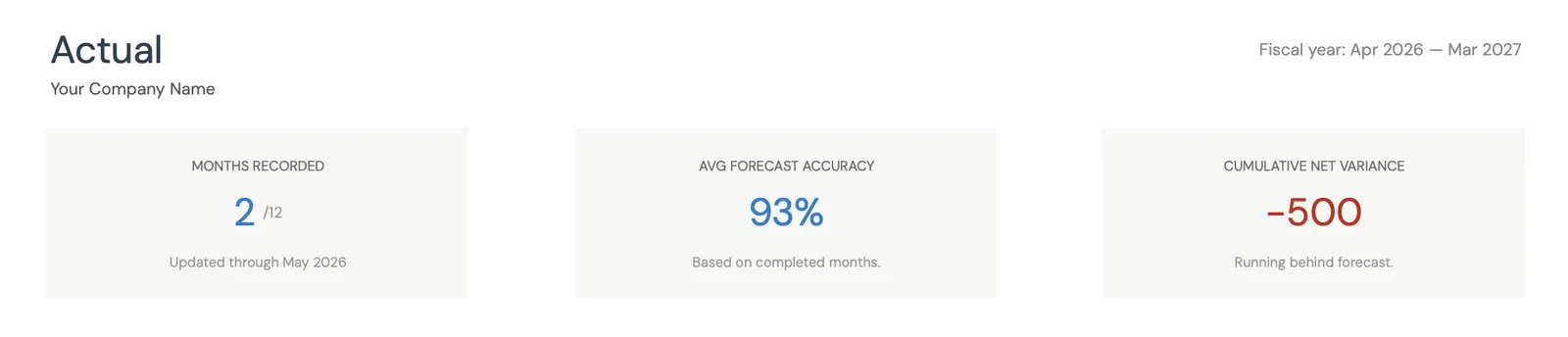
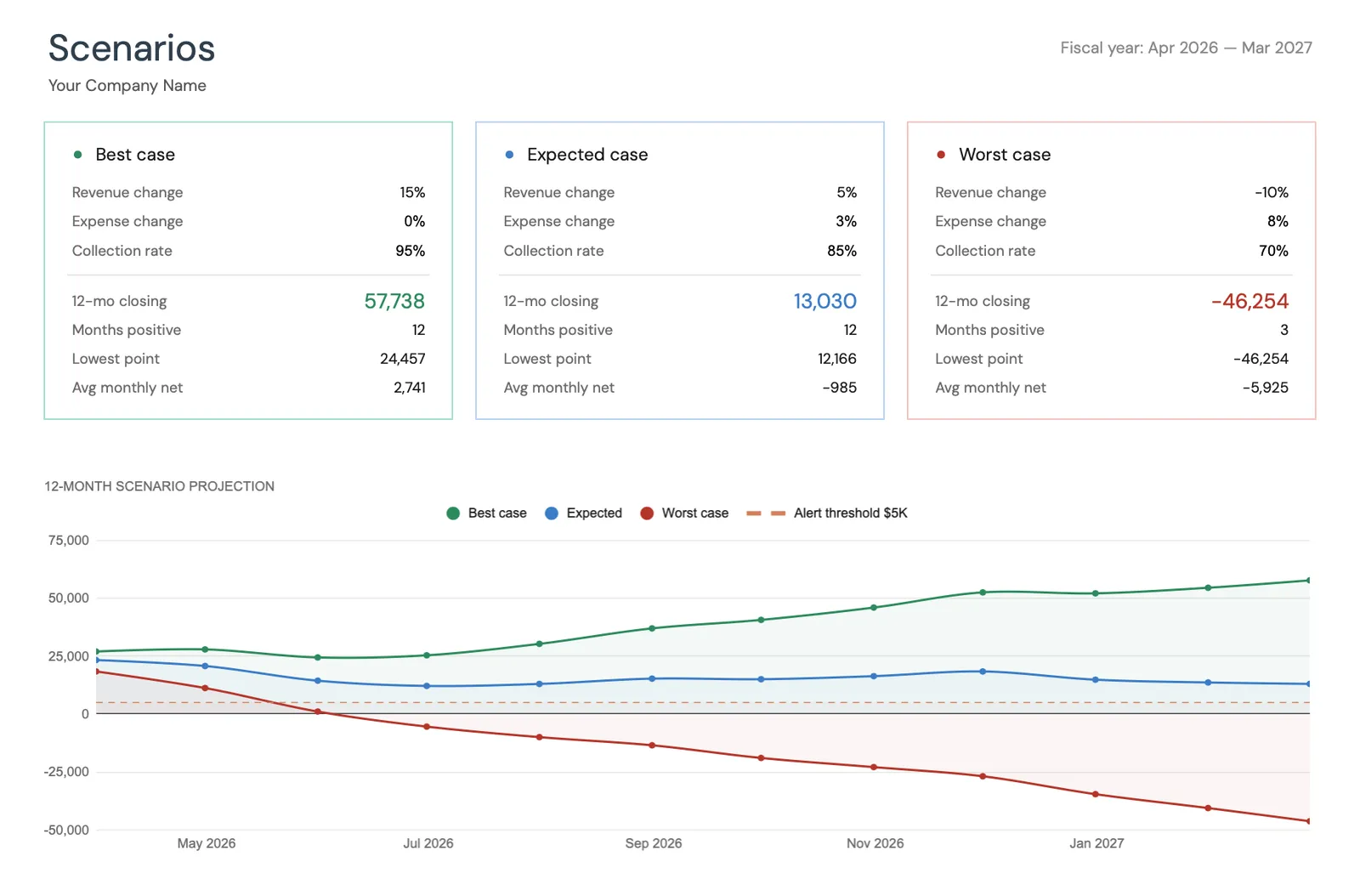
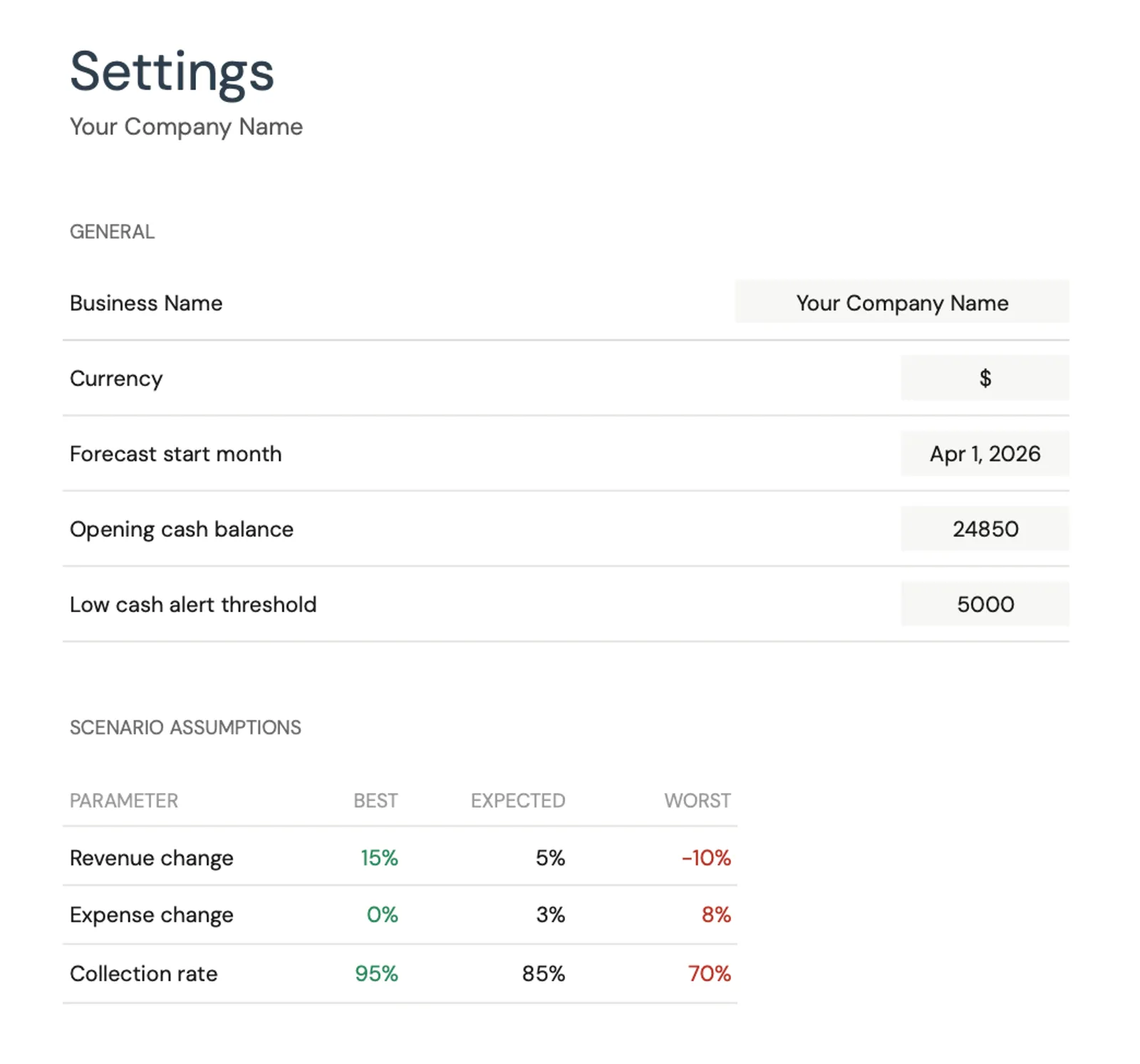
Browse through the template to see dashboards, forecasting, actuals tracking, and scenario planning.
- Visual cash flow dashboard
- Forecast vs actuals comparison
- Scenario planning tools
- Customizable categories
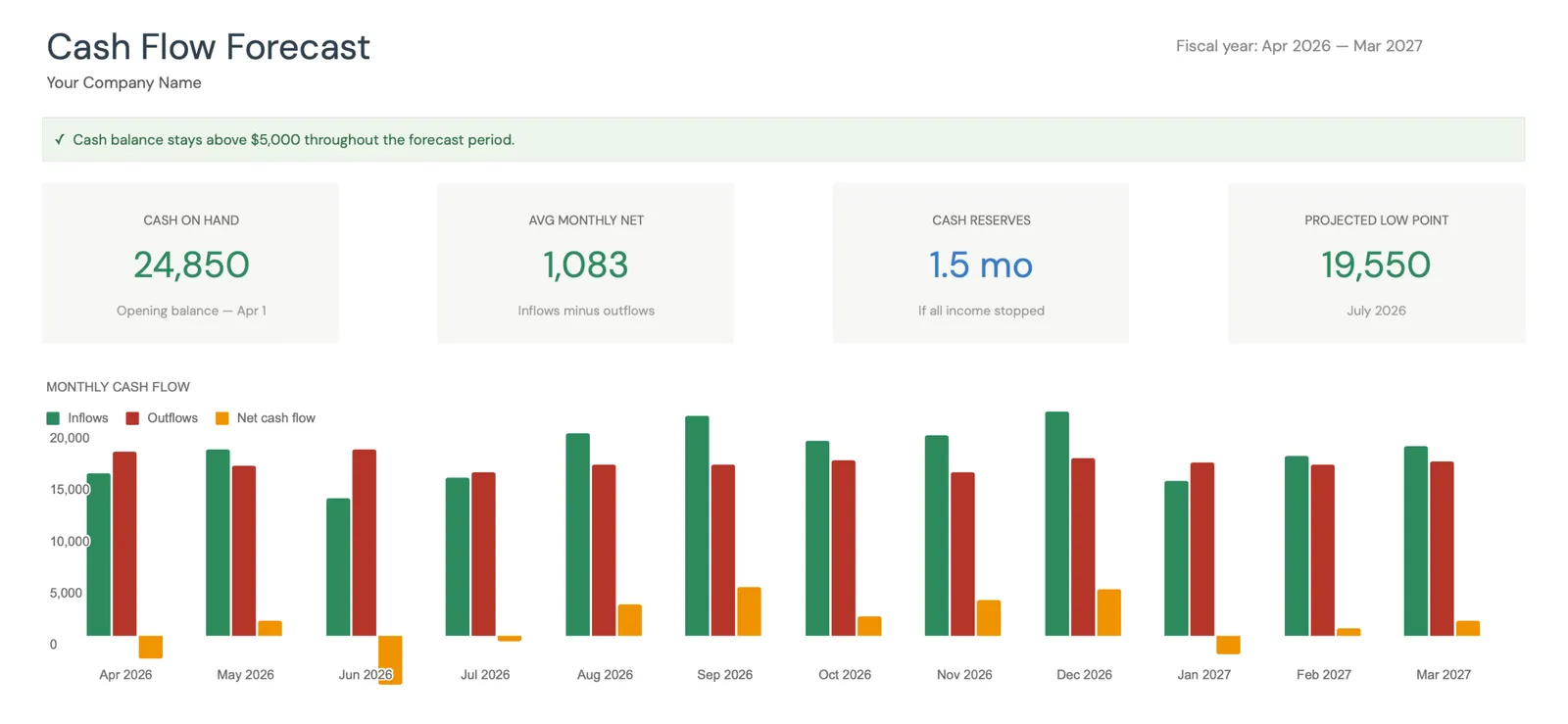
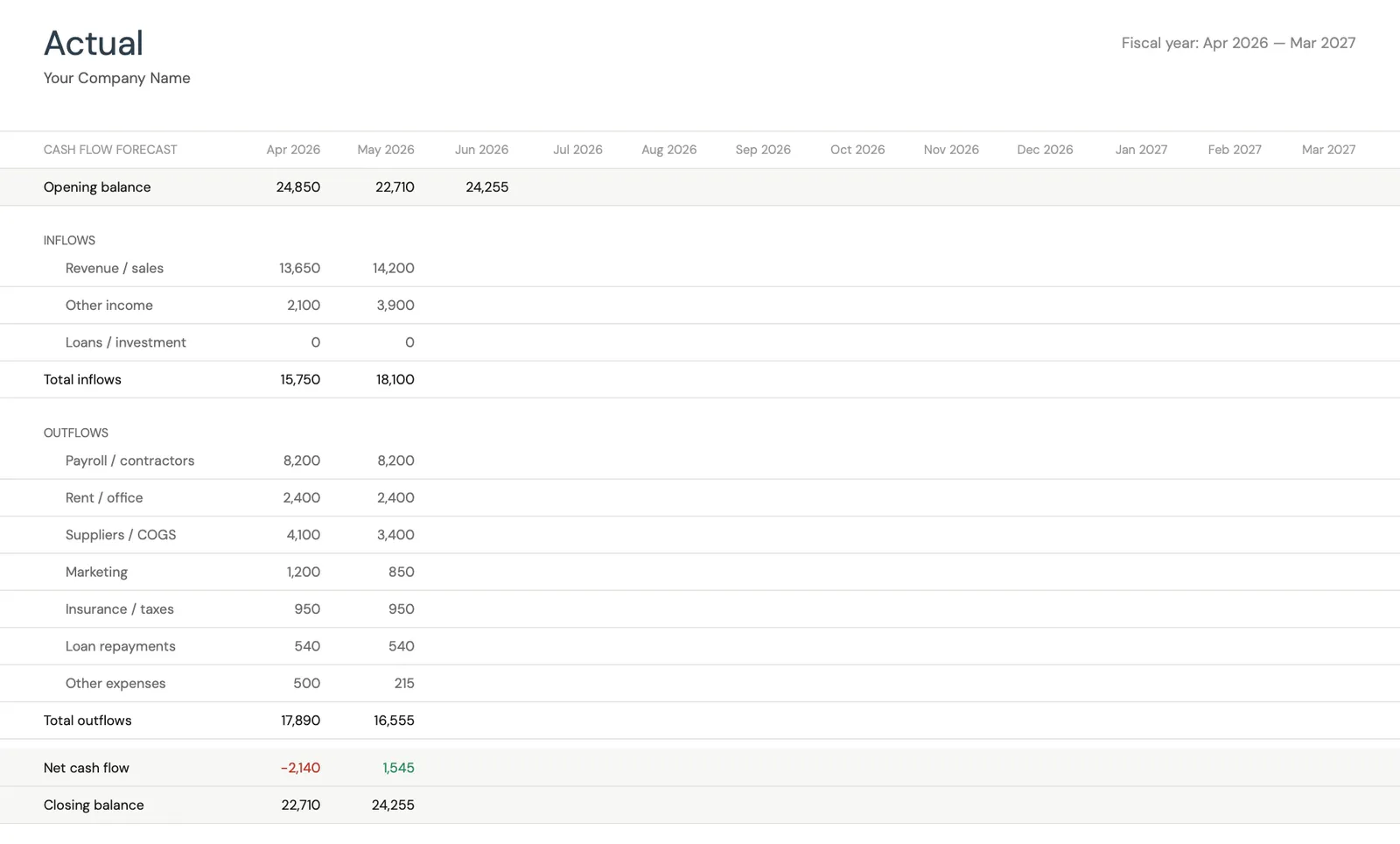
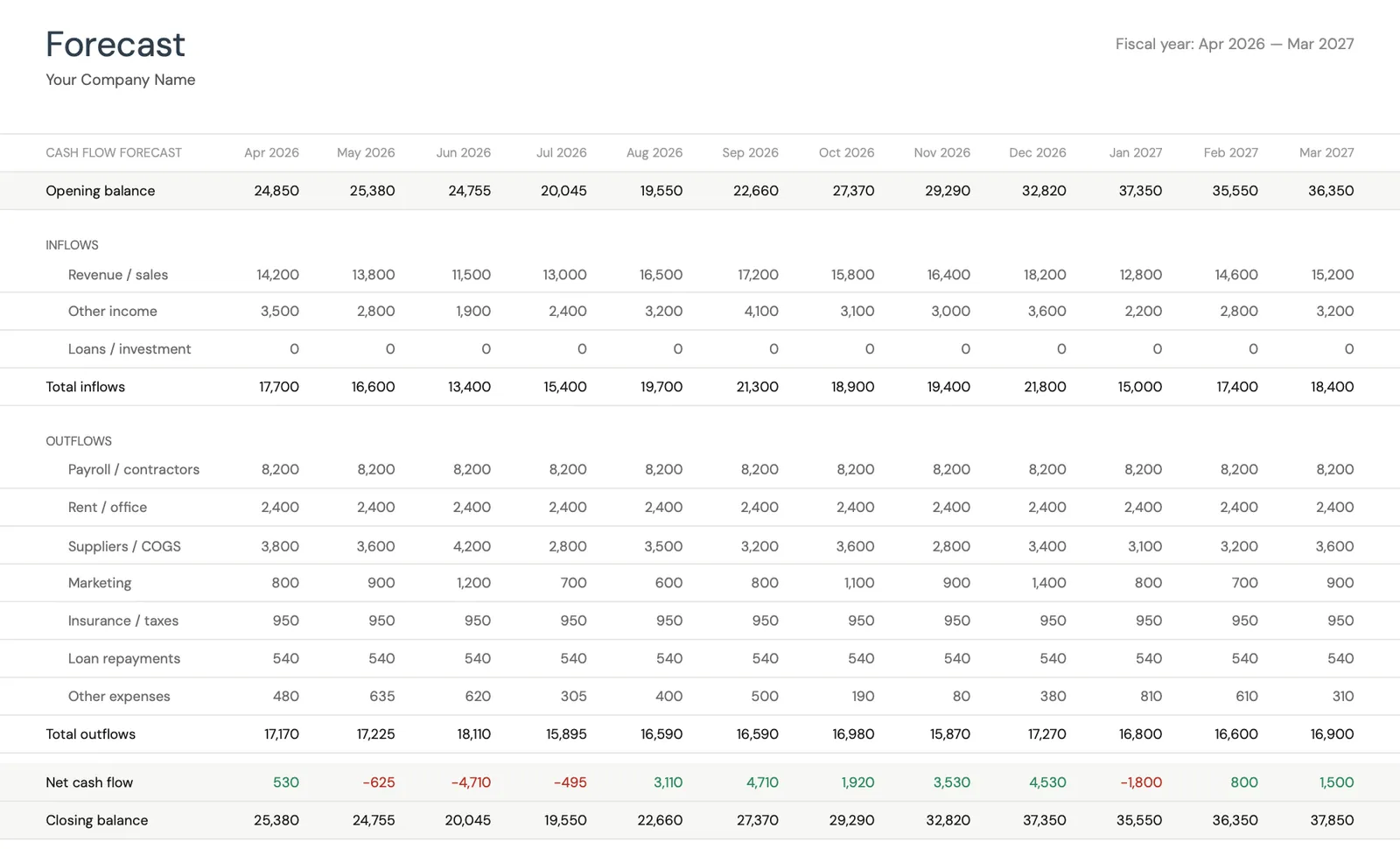
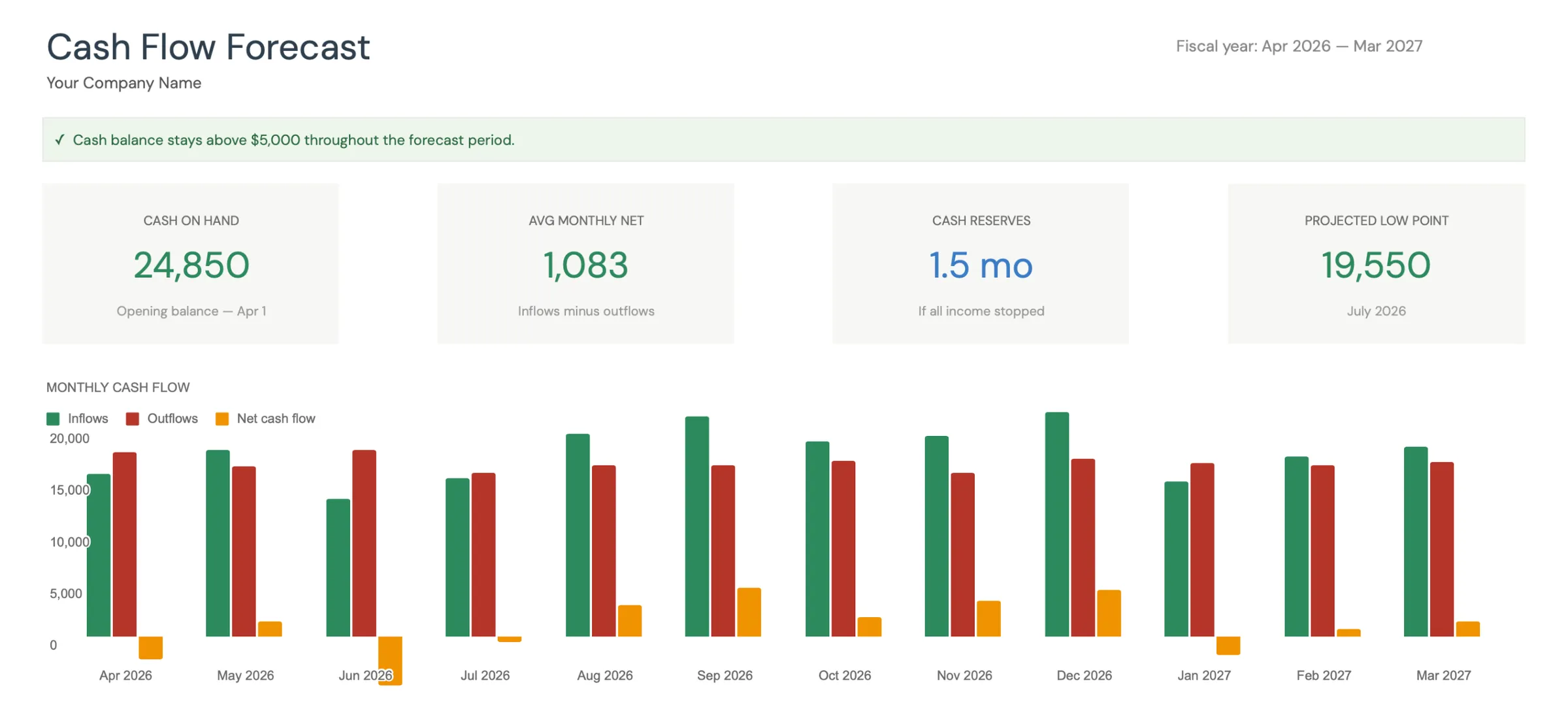
Monthly cash flow overview with KPIs and charts
Track actual cash flow against your forecast
Project cash flow 12 months ahead
Key performance indicators for your cash flow
Model different scenarios for your business
Customize categories for your business type
What You Get
How This Template Works for Salons and Barbershops
Service and retail revenue tracking
Track service revenue and product sales separately. Most salon profit comes from services, but retail sales carry higher margins per transaction. Understanding the mix helps optimize both revenue streams.
Seasonal demand planning
Build seasonal patterns into the 12-month forecast based on your historical data. Plan marketing pushes during slow months and staffing adjustments during peak periods.
Appointment volume vs what you expected
Compare projected appointment volume and revenue against actuals. Track average ticket value and appointments per day to identify trends before they impact cash flow significantly.
Full-year salon cash position forecast
See your projected cash position across seasonal cycles. Plan equipment purchases, renovations, and marketing investments during months with projected cash surpluses.
Common Questions
Cash Flow for Salons / Barbershops - FAQ
What profit margin is typical for salons?
Net margins for salons typically range from 8-15% for commission-based models and can be higher for booth-rental models (since rental income is more predictable). Average revenue per service ranges from $35 for a basic haircut to $150+ for color services. Profitability depends heavily on the compensation model and retail sales contribution.
How do I forecast around stylist turnover?
Stylist turnover is a significant cash flow risk because each stylist has a client following. If a stylist leaves and takes 60% of their clients, that revenue disappears immediately. Build a conservative assumption about retention (assume losing 1-2 stylists per year) and the time needed to replace their revenue (typically 3-6 months for a new stylist to build a full book).
Is booth rental or commission better for cash flow?
Booth rental provides more predictable monthly cash flow because rental income is fixed regardless of how busy the renter is. Commission-based models tie labor costs directly to revenue, which is safer during slow periods but more expensive during busy ones. Many salons use a hybrid approach. The forecast helps model the cash flow impact of each structure.
How much should I invest in retail inventory?
A general benchmark is keeping inventory value at 1-2 months of retail sales. If you sell $2,000/month in products, maintaining $2,000-$4,000 in inventory provides adequate stock without excessive capital tied up. Track product turnover rates and focus investment on proven sellers rather than a wide variety of slow-moving items.
How do gift card sales affect cash flow?
Gift cards create a cash flow timing mismatch: you receive cash immediately when the card is purchased but deliver the service (at cost) when it is redeemed, often months later. Holiday gift card sales in November-December create a cash influx, but the corresponding service costs hit in January-March. The forecast should track gift card liability and expected redemption timing.
Can't find the answer you're looking for? Contact our team
Forecast cash flow for your salons / barbershop
One-time purchase. No subscription. Your financial data stays in your Google Drive.