Cash Flow Forecast
Cash Flow Forecast Template for SaaS Startups
Forecast recurring revenue, model churn scenarios, track customer acquisition costs, and calculate runway - all in a Google Sheets template built for cash flow management.
In Depth
Cash Flow Patterns in Subscription Software
SaaS businesses live in a financial world where success and cash problems can coexist for years. The subscription model - widely regarded as one of the most valuable business structures - requires spending heavily today to acquire customers who pay back that investment over months or years. A company growing 10% month over month might be burning cash faster than ever, and that can be entirely healthy. The distinction between healthy burn and unsustainable burn is one of the most consequential questions a SaaS founder faces.
Churn is the number that quietly shapes everything. At 3% monthly churn, a SaaS company loses about 30% of its customers each year. At 5%, it loses roughly 46%. That 2-point difference might seem small, but over 12 months it dramatically changes the revenue trajectory and cash position. Some SaaS operators describe churn as a leaky bucket - pouring more water in (new customers) matters, but the size of the holes matters just as much.
The annual versus monthly billing decision has real cash flow consequences. A customer paying $1,200 upfront for an annual plan gives you twelve months of cash on day one. That same customer on a monthly plan provides $100 each month - same total revenue, but very different cash flow. Companies with a higher percentage of annual plans tend to have stronger cash positions, though they also face concentrated renewal risk when those annual contracts come due.
For venture-funded SaaS companies, the cash flow forecast doubles as a runway calculator. Every month, the forecast answers a straightforward question - at the current burn rate and growth trajectory, how many months of cash remain? That number drives decisions about hiring, marketing spend, and the timing of the next fundraise. For bootstrapped SaaS businesses, the same forecast answers a different version of the same question - when does the business sustain itself without the founder subsidizing it?
The Challenge
Cash Flow Challenges for SaaS Startups
SaaS businesses have a counterintuitive cash flow problem: the subscription model that makes them valuable also creates significant upfront losses. You spend to acquire customers today but collect revenue over months or years. Understanding this dynamic is essential for survival.
Customer acquisition costs are paid upfront
Acquiring a SaaS customer might cost $200-$2,000+ depending on your market and price point. That entire cost hits your cash flow in month one, while the customer pays $50-$500 per month over their lifetime. If your CAC payback period is 12 months, every new customer makes your cash flow worse for an entire year before turning positive. The faster you grow, the deeper the cash hole - which is why fast-growing SaaS companies burn cash even when unit economics are healthy.
Churn compounds and erodes your revenue base
Even "good" monthly churn of 3-5% means you lose 30-45% of customers annually. Every churned customer represents sunk acquisition costs and lost future revenue. The math is unforgiving: at 5% monthly churn, you need to add new customers equal to 5% of your base just to stay flat. Forecasting must model churn realistically - not optimistically - because the difference between 3% and 5% monthly churn dramatically changes your cash trajectory over 12 months.
Annual vs monthly billing affects cash timing
Annual billing collects 12 months of revenue upfront - a significant cash flow advantage. A customer paying $1,200 annually gives you all that cash on day one versus $100 per month. But annual billing also creates revenue recognition complexity and a concentration of renewal risk. If a large annual cohort churns at renewal time, the cash impact is sudden and severe. Most SaaS companies see 20-40% of customers on annual plans.
Development costs are constant regardless of revenue
Engineering salaries, cloud infrastructure, and tools represent substantial fixed costs that continue whether you have 10 or 10,000 customers. A small SaaS startup might spend 60-80% of total costs on product development. These costs do not flex with revenue in the short term - you cannot hire half an engineer. This fixed cost structure means cash flow is highly sensitive to revenue growth rates and churn.
Start forecasting your cash flow
Forecasting Guide
How to Forecast Cash Flow for Your SaaS Startup
SaaS cash flow forecasting is fundamentally about modeling the gap between customer acquisition spending and subscription revenue collection. Here is how to structure it using the Cash Flow Forecast template.
Revenue Categories
- Monthly recurring revenue (MRR) from existing customers
- New customer MRR (net new subscriptions)
- Expansion revenue (upgrades and add-ons)
- Annual subscription payments (collected upfront)
- Professional services or onboarding fees
- Usage-based overage charges
Expense Categories
- Engineering salaries and contractors
- Cloud infrastructure (AWS, GCP, Azure)
- Sales team compensation (base + commissions)
- Marketing and advertising spend
- Customer success and support staff
- Software tools and subscriptions
- Office rent and remote work stipends
- Payroll taxes and benefits
- Legal and accounting
- Insurance (E&O, cyber liability)
Cash Flow Timing
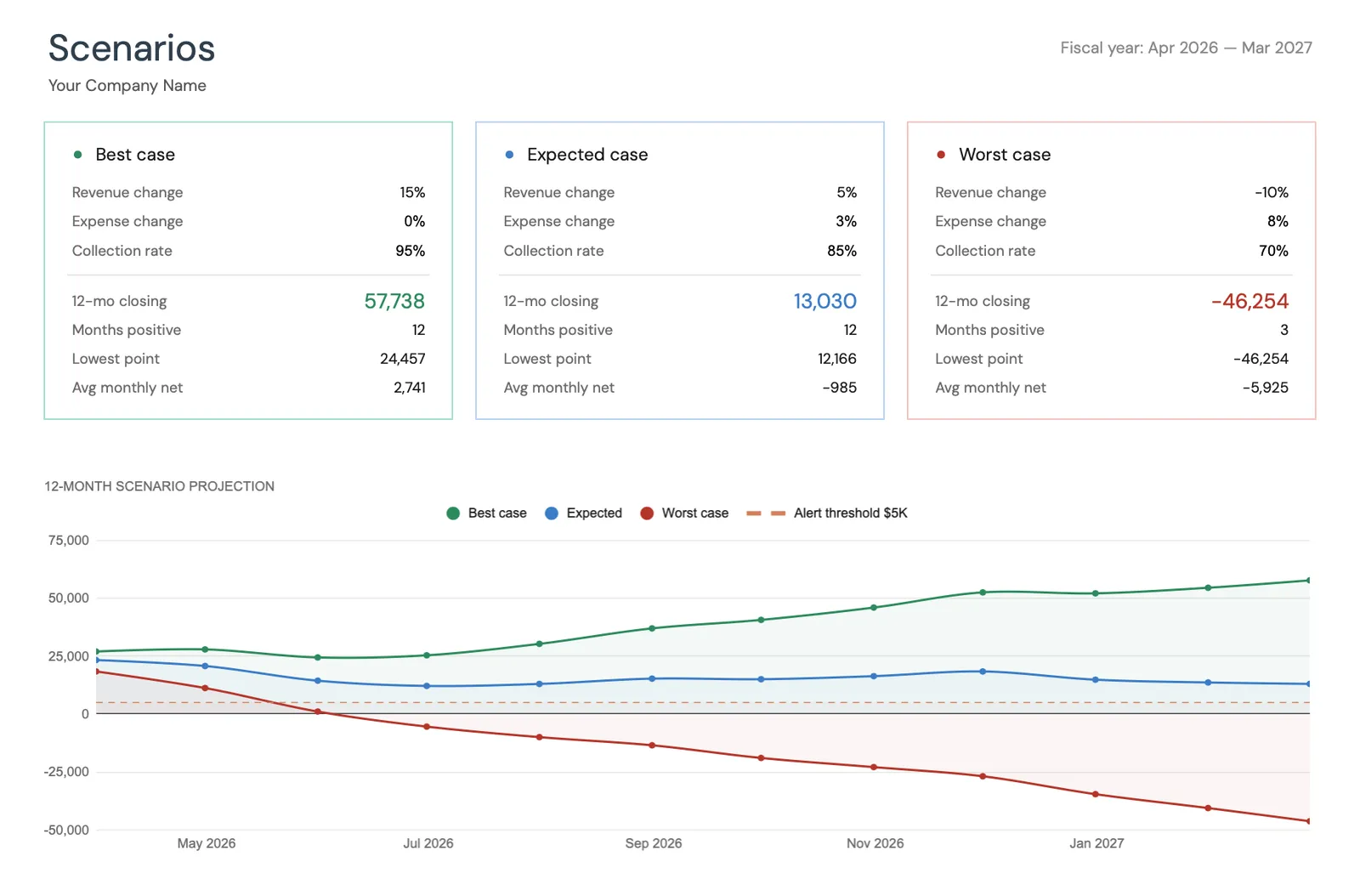
SaaS cash flow is primarily driven by the ratio of customer acquisition spending to MRR growth. Model three scenarios: optimistic, expected, and conservative churn rates. The difference in cash position between 3% and 6% monthly churn over 12 months is dramatic. For startups with runway concerns, the forecast should clearly show months of runway remaining under each scenario.
See It In Action
What the template looks like
Browse through the template to see dashboards, forecasting, actuals tracking, and scenario planning.
- Visual cash flow dashboard
- Forecast vs actuals comparison
- Scenario planning tools
- Customizable categories
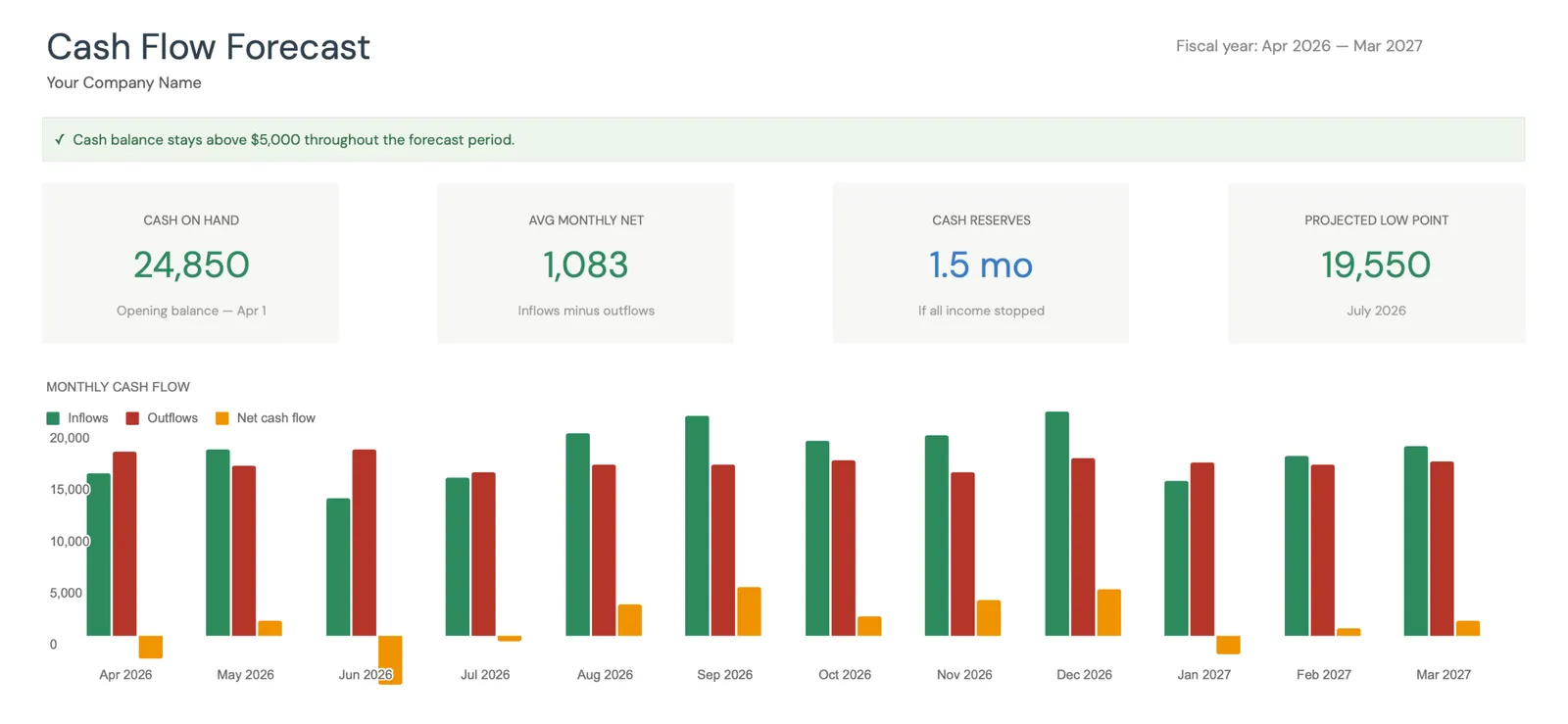
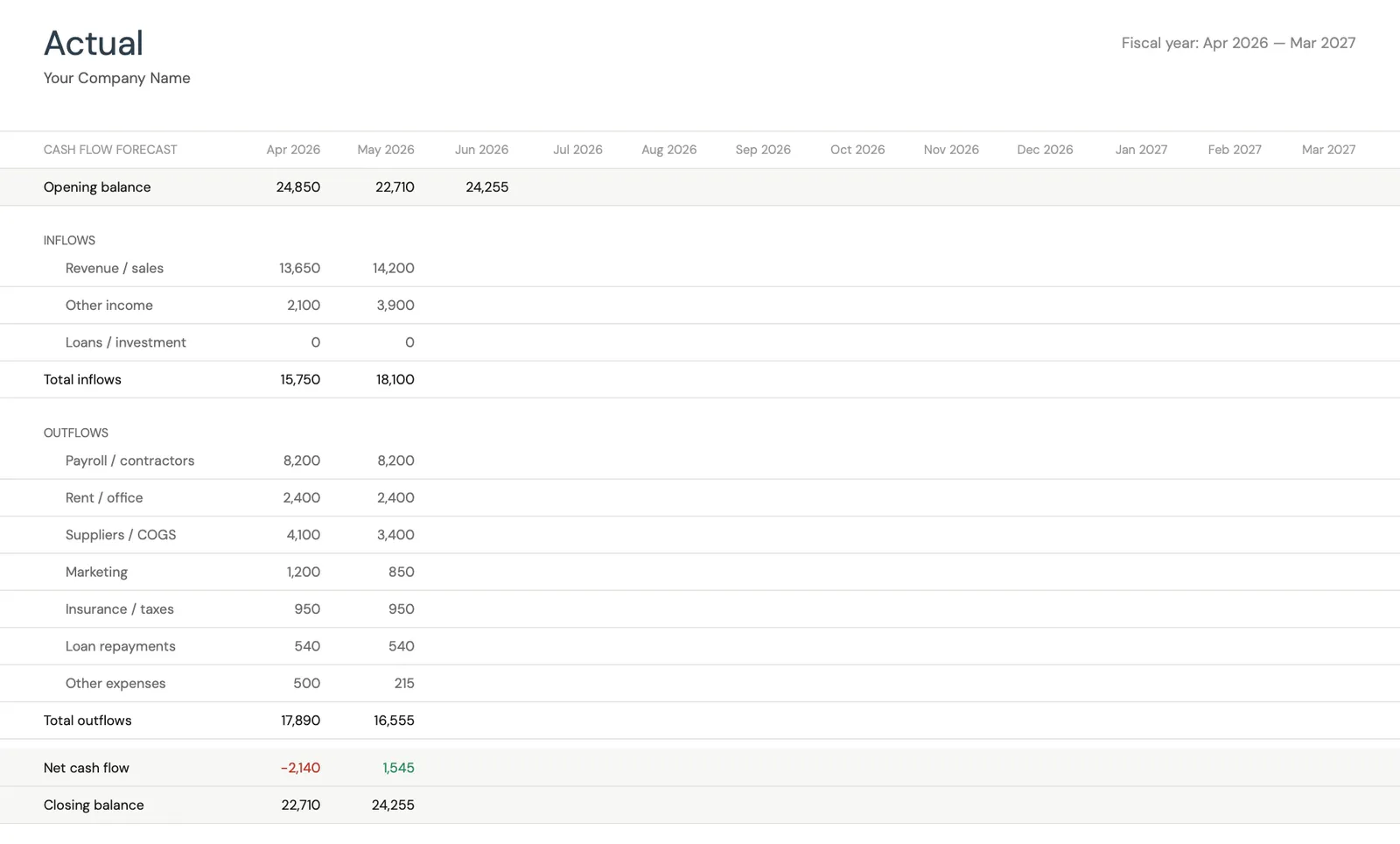
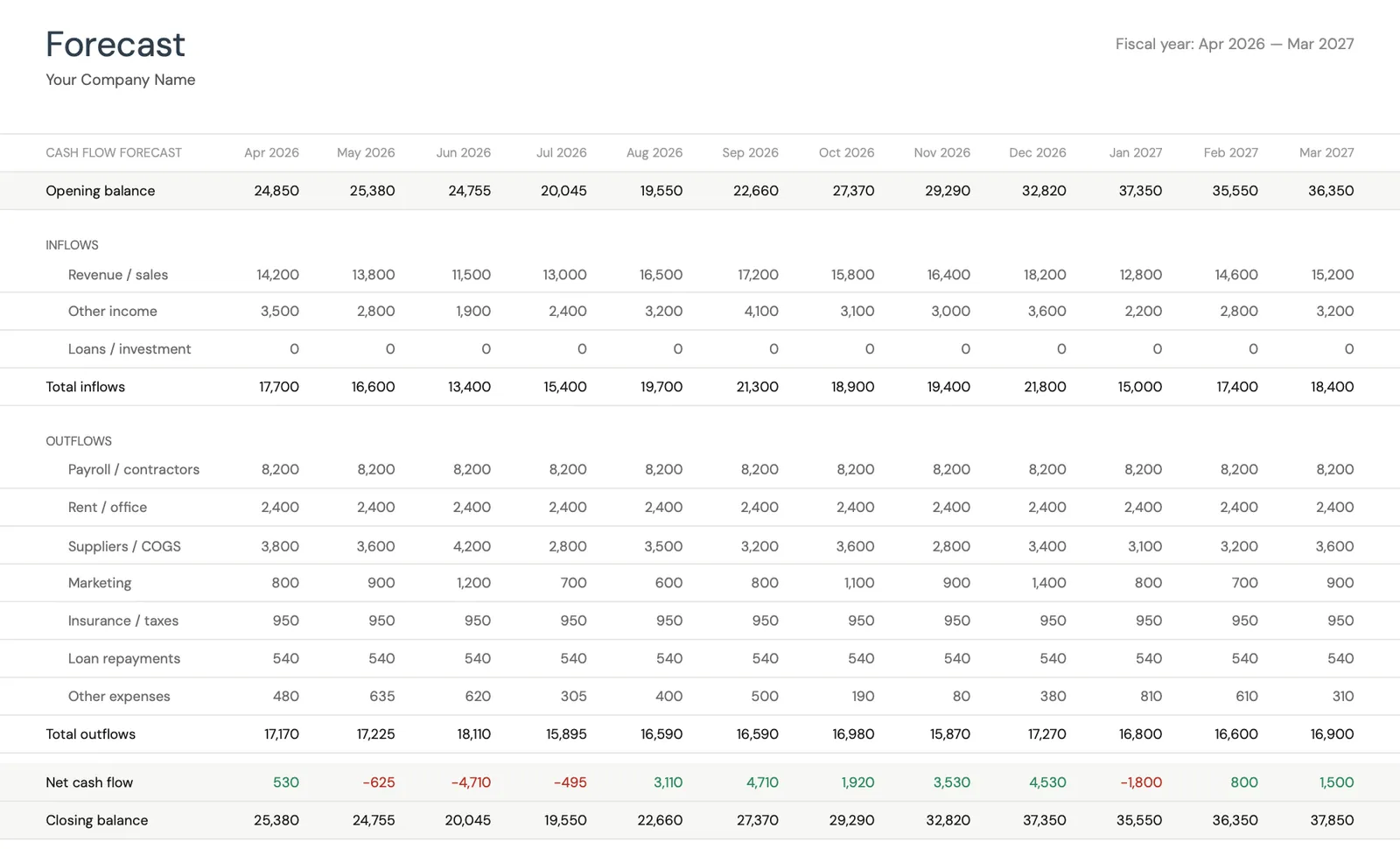
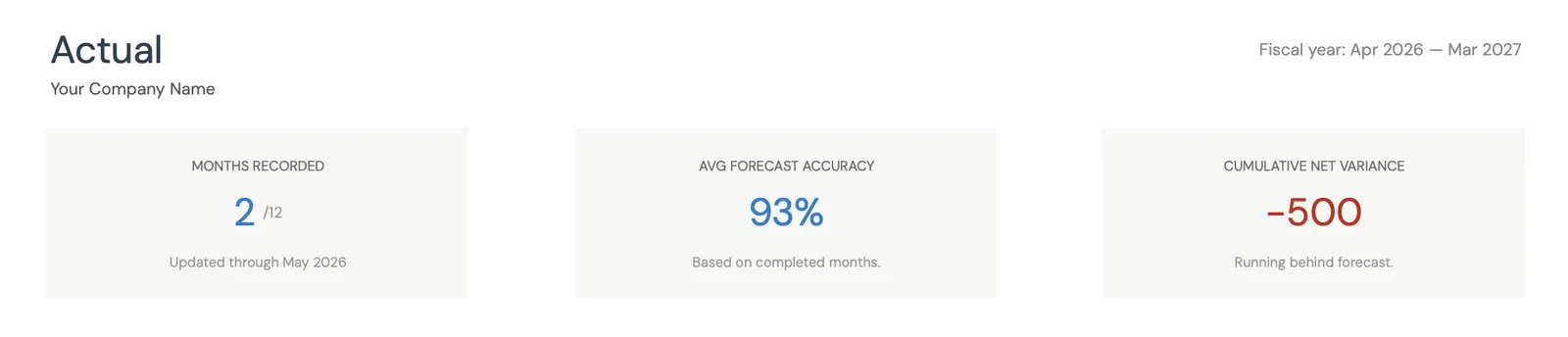
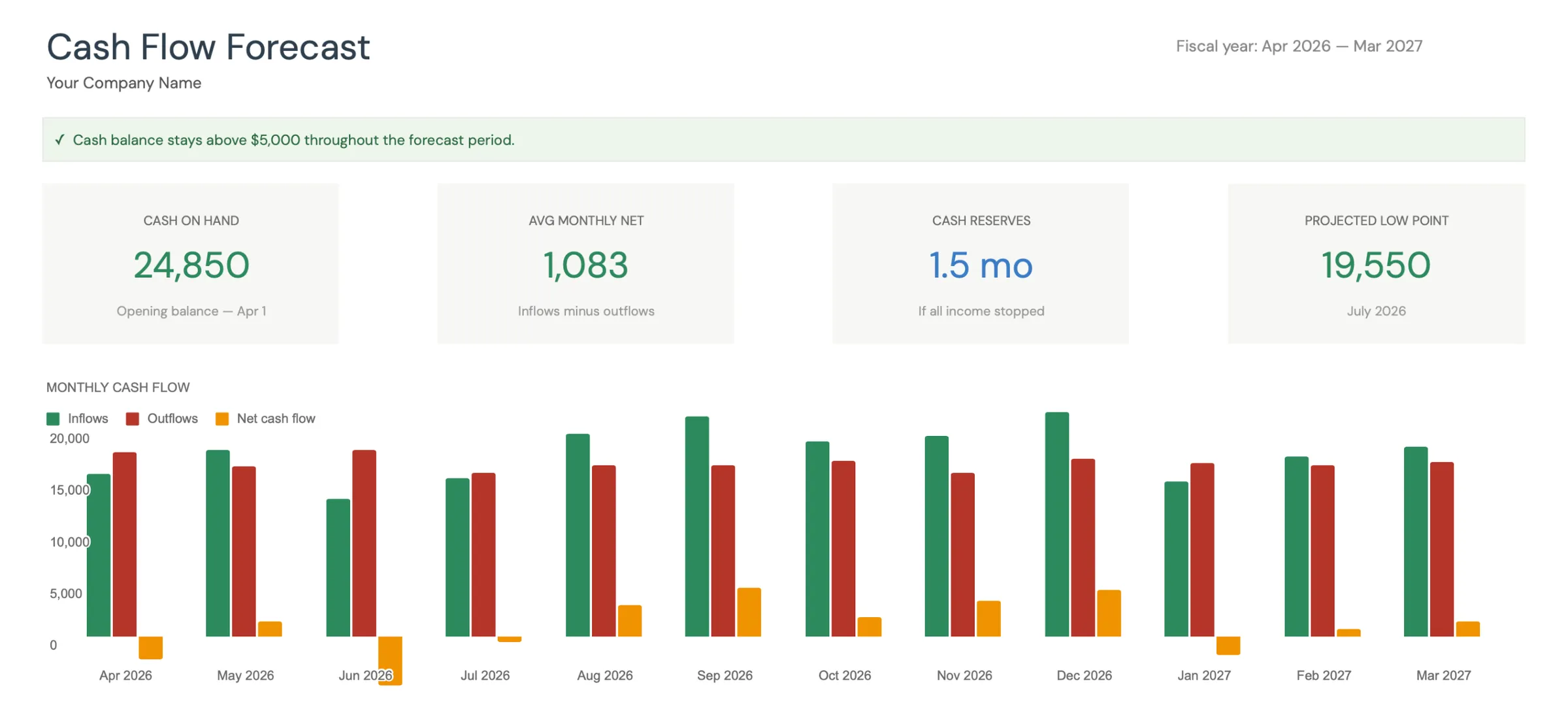
Monthly cash flow overview with KPIs and charts
Track actual cash flow against your forecast
Project cash flow 12 months ahead
Key performance indicators for your cash flow
Model different scenarios for your business
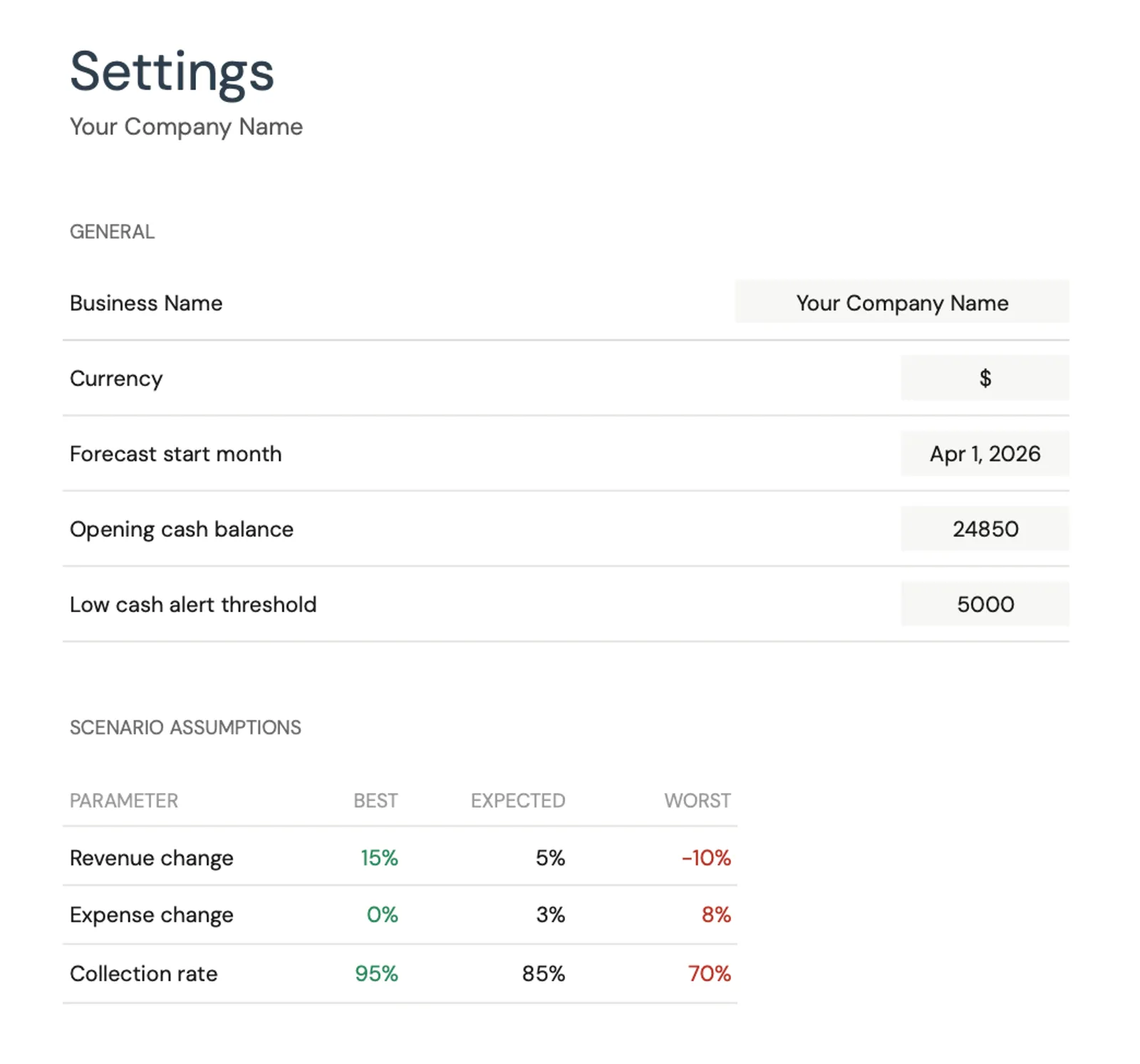
Customize categories for your business type
What You Get
What SaaS Founders Get With This Template
MRR and churn modeling
Track monthly recurring revenue, new customer additions, churn, and expansion revenue. The template helps visualize how these components interact to drive your net revenue growth - or decline.
Runway calculation
With your current burn rate and cash balance, the template shows how many months of runway remain. Update monthly to see how actual results affect your runway projection - this is the number that determines when you need to fundraise or reach profitability.
MRR reality check against projections
Compare projected MRR growth, churn, and expenses against actuals. SaaS metrics are highly trackable - use this data to refine your forecast assumptions and catch negative trends early.
Forward-looking financial runway
See your projected cash position and MRR trajectory over the next year. Essential for fundraising conversations, hiring plans, and deciding when to accelerate or conserve spend.
Common Questions
Cash Flow for SaaS Startups - FAQ
What is a healthy CAC payback period for SaaS?
Industry benchmarks suggest 12-18 months for B2B SaaS and under 6 months for self-serve products. CAC payback directly drives cash flow: a 6-month payback means each new customer becomes cash-flow positive twice as fast as an 18-month payback. The cash flow template helps you track actual payback against these targets.
How do I model different growth scenarios?
Create three versions of your forecast: conservative (lower growth, higher churn), expected, and optimistic. The key variables to adjust are new customer acquisition rate, monthly churn rate, and expansion revenue. Even small changes in churn dramatically affect the 12-month cash outlook.
How do I handle annual vs monthly billing in the forecast?
Enter annual payments as lump-sum revenue in the month collected. For cash flow purposes, this is when the cash arrives. Track the percentage of annual vs monthly subscribers to forecast the mix. Some SaaS companies see a spike in annual renewals in Q1 or Q4, creating predictable cash inflow patterns.
What burn rate is sustainable for a SaaS startup?
It depends entirely on your funding, growth rate, and path to profitability. As a general reference, having 12-18 months of runway provides a reasonable buffer. The forecast helps answer the real question: at your current burn rate and growth trajectory, when do you reach cash flow breakeven?
Can this template replace SaaS financial modeling tools?
The template covers cash flow forecasting, which is one component of SaaS financial modeling. For detailed cohort analysis, LTV calculations, and investor-ready models, specialized tools can go deeper. But for tracking monthly cash in vs cash out and maintaining a clear runway picture, a well-maintained spreadsheet is often more practical than complex software.
Can't find the answer you're looking for? Contact our team
Forecast cash flow for your saas startup
One-time purchase. No subscription. Your financial data stays in your Google Drive.