Cash Flow Forecast
Cash Flow Forecast Template for Pet Grooming / Boarding
Forecast grooming and boarding revenue, manage staffing and supply costs, track seasonal demand patterns, and plan for facility expenses - all in a Google Sheets template built for cash flow management.
In Depth
How Pet Care Businesses Manage Their Finances
Pet grooming and boarding businesses benefit from something many industries lack - a customer base with strong emotional attachment to the service. Pet owners who find a groomer they trust tend to return consistently, creating a recurring revenue pattern that resembles subscription income. A dog that needs grooming every six to eight weeks represents $500-$800 in annual revenue, and that cycle continues for the pet's lifetime. This loyalty creates a stable revenue base, though it also means losing a popular groomer can disrupt dozens of these recurring relationships at once.
Holiday boarding represents both the biggest revenue opportunity and the most significant operational challenge for pet care facilities. Thanksgiving, Christmas, and summer vacation periods can fill every kennel space and generate 50-100% more revenue than a typical week. But staffing these peak periods means paying premium wages for holiday shifts while maintaining the same care standards that clients expect during normal weeks. The financial reward from holiday peaks often funds quieter periods in January and February when boarding demand drops significantly.
The capacity constraint in pet grooming is fundamentally physical - a groomer can only handle so many dogs per day, and each grooming session takes 1.5 to 3 hours depending on the breed and service. This means revenue growth eventually requires adding groomers, which introduces labor costs before the new groomer builds a full appointment book. The transition period - typically two to four months for a new groomer to reach full capacity - represents a cash investment that requires advance planning.
Water usage is a cost that surprises many new pet care business owners. Between bathing, cleaning kennels, and laundry, a grooming and boarding facility can use three to five times more water than a typical retail space of the same size. Combined with specialized drainage requirements, ventilation systems, and noise management, the facility costs of a pet care operation tend to run higher than standard commercial space. These elevated fixed costs mean the breakeven point - the number of daily appointments or occupied kennels needed to cover overhead - is higher than it might first appear.
The Challenge
Cash Flow Challenges for Pet Grooming and Boarding Businesses
Pet care businesses benefit from strong customer loyalty but face capacity constraints, seasonal demand spikes, and the challenge of scaling a hands-on service. Cash flow management determines whether growth is profitable or just busy.
Revenue is constrained by appointment capacity
A groomer can typically handle 5-8 dogs per day depending on breed size and service complexity. At $60-$100 per groom, a single groomer generates $300-$800/day or $6,000-$16,000/month. Revenue growth requires hiring additional groomers, which means adding labor costs before the new groomer's schedule fills. Boarding revenue is similarly constrained by kennel capacity - once full, revenue cannot increase without facility expansion.
Boarding revenue spikes during holidays create capacity and staffing challenges
Holiday periods (Thanksgiving, Christmas, summer vacation) can see boarding demand surge 50-100% above normal. This is excellent for revenue but requires additional staff to maintain care standards. Staff expect premium pay for working holidays. The spike is temporary - revenue drops sharply after the holiday rush. Pricing premium rates during peak periods helps, but the revenue swing still creates uneven monthly cash flow.
Groomer retention directly impacts revenue
Experienced groomers build client followings. When a groomer leaves, their clients often follow or stop coming until they find another preferred groomer. Losing a groomer who handles 6 dogs/day at $80 average means losing $2,400/week in revenue - potentially $10,000+/month - while paying to recruit and train a replacement. Competitive wages help retention but squeeze margins. Commission-based pay (40-55% of service revenue) is industry standard.
Facility and insurance costs are significant
Pet care facilities require specialized buildout (drains, ventilation, noise management, kennel runs), and commercial rent for suitable spaces runs higher than standard retail. Insurance requirements are substantial - general liability, animal bailee coverage, and workers' comp for staff working with animals. Monthly facility costs of $3,000-$8,000 are common for mid-size operations, creating a high breakeven point.
Start forecasting your cash flow
Forecasting Guide
How to Forecast Cash Flow for Your Pet Grooming or Boarding Business
Pet care cash flow forecasting starts with daily appointment capacity and boarding utilization. Here is how to structure it using the Cash Flow Forecast template.
Revenue Categories
- Grooming services (bath, haircut, full groom)
- Boarding - overnight stays
- Daycare services
- Add-on services (nail trim, teeth brushing, flea treatment)
- Retail product sales (shampoo, treats, toys)
- Tips and gratuities
Expense Categories
- Groomer compensation (wages or commission)
- Support staff wages (kennel attendants, front desk)
- Payroll taxes and benefits
- Rent and facility costs
- Grooming supplies (shampoo, blades, tools)
- Boarding supplies (food, bedding, cleaning)
- Utilities (water usage is significant)
- Insurance (liability, animal bailee, workers' comp)
- Equipment maintenance and replacement
- Marketing and online presence
- Software (scheduling, POS)
- Waste disposal and laundry
Cash Flow Timing
Grooming and daycare revenue is collected at time of service, making daily cash flow straightforward. Boarding is typically paid at pickup, creating a short lag between service start and payment. Holiday boarding periods generate large revenue spikes - plan to build cash reserves during these peaks. January through March is typically the slowest grooming period. Use the forecast to ensure holiday revenue covers the Q1 slow season.
See It In Action
What the template looks like
Browse through the template to see dashboards, forecasting, actuals tracking, and scenario planning.
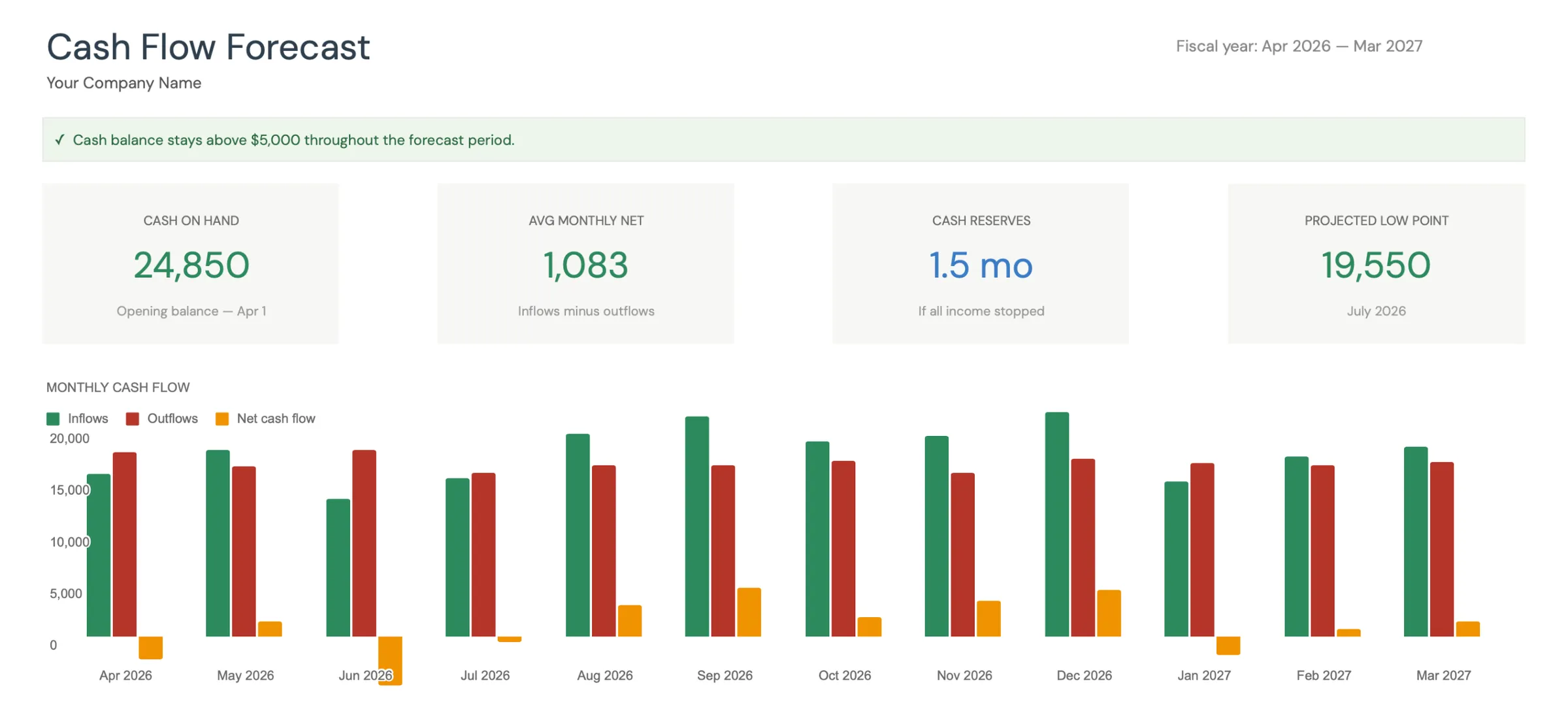
- Visual cash flow dashboard
- Forecast vs actuals comparison
- Scenario planning tools
- Customizable categories
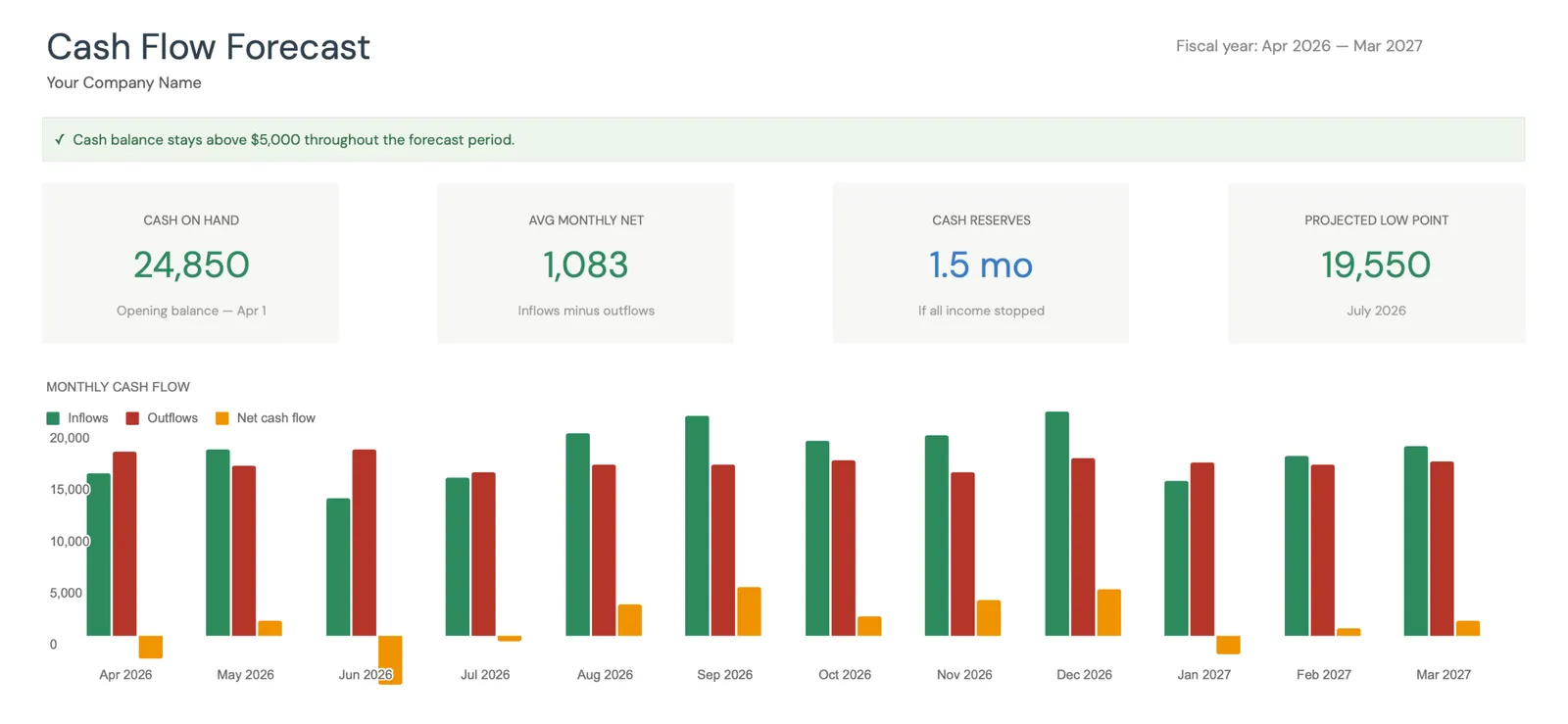
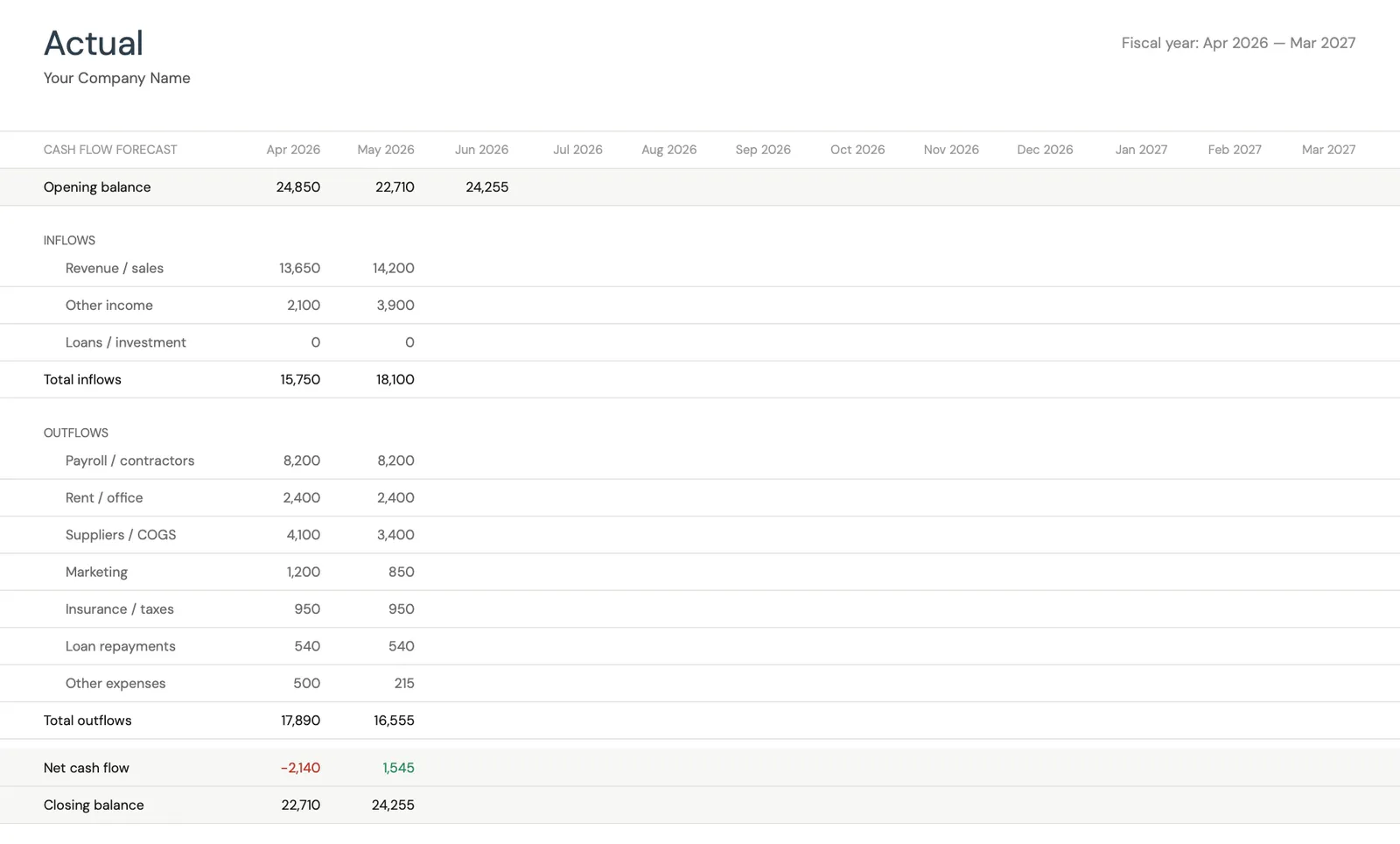
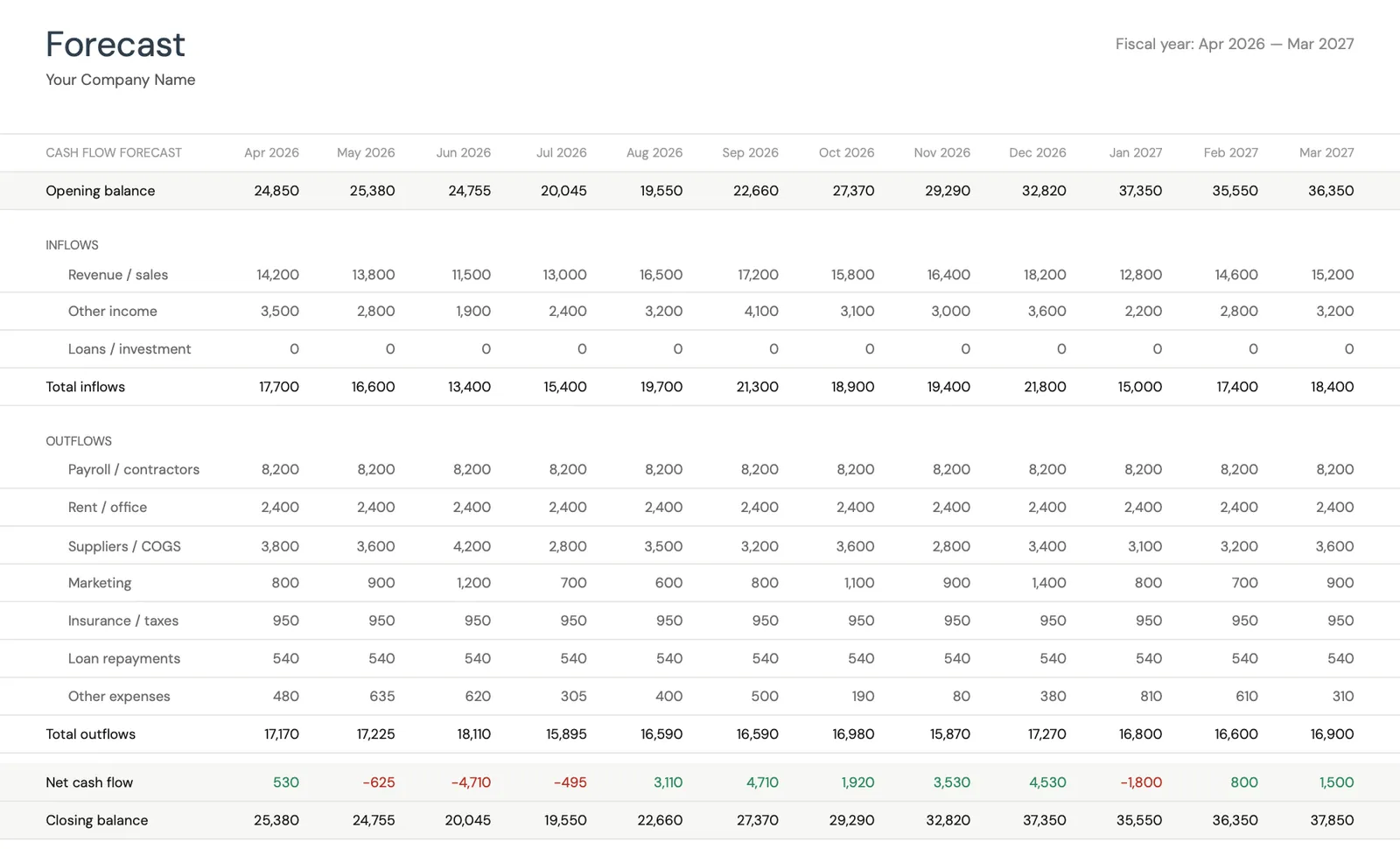
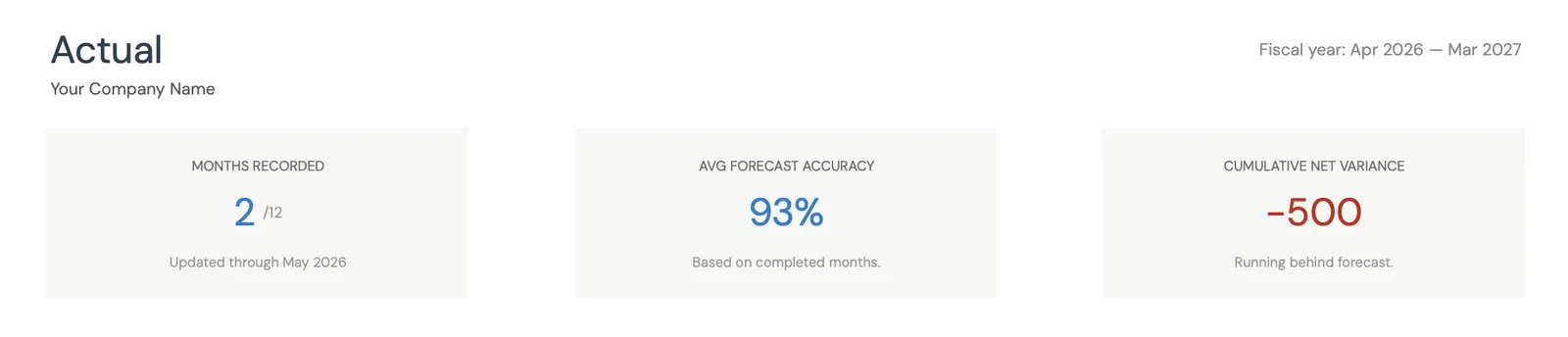
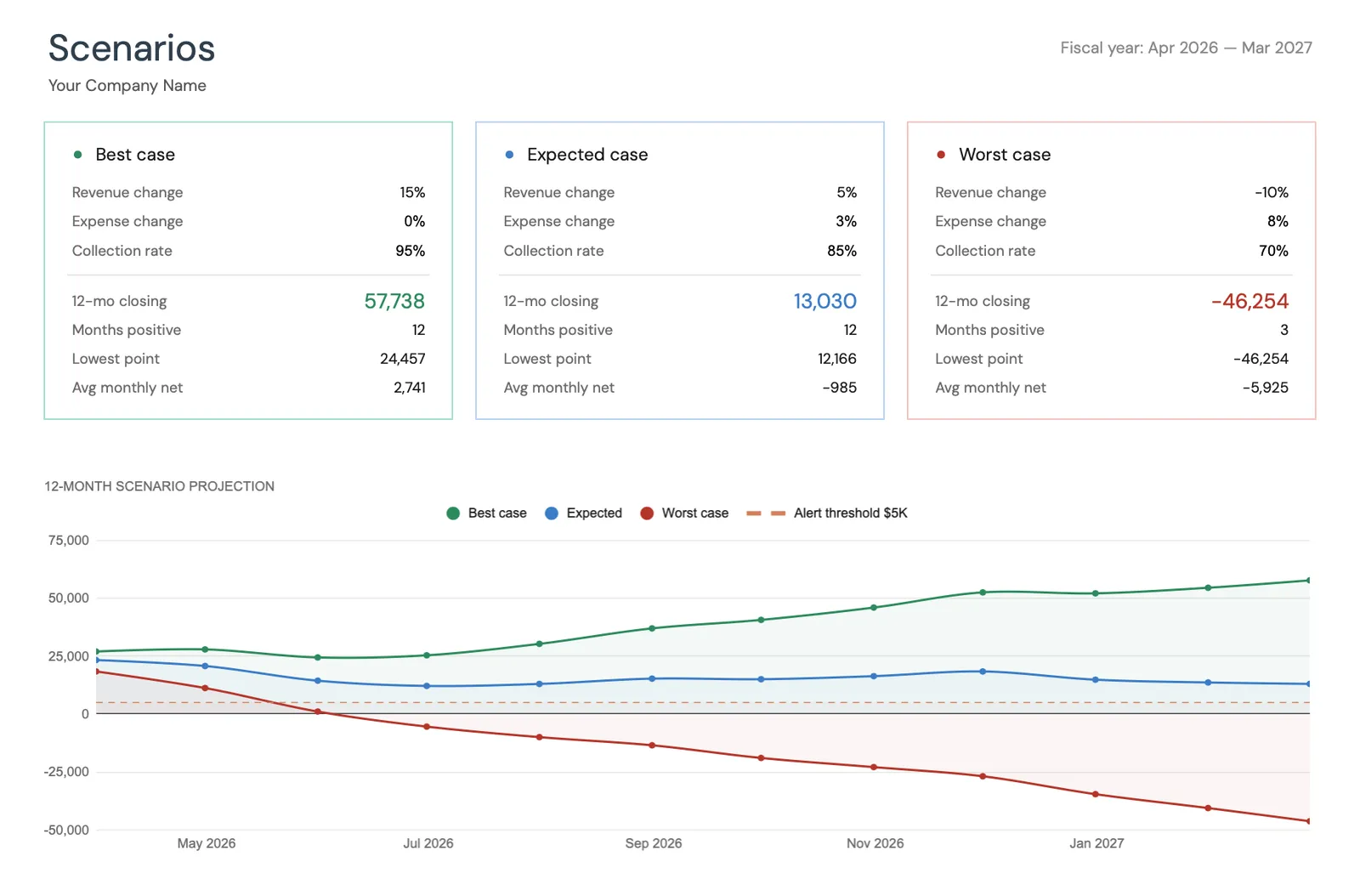
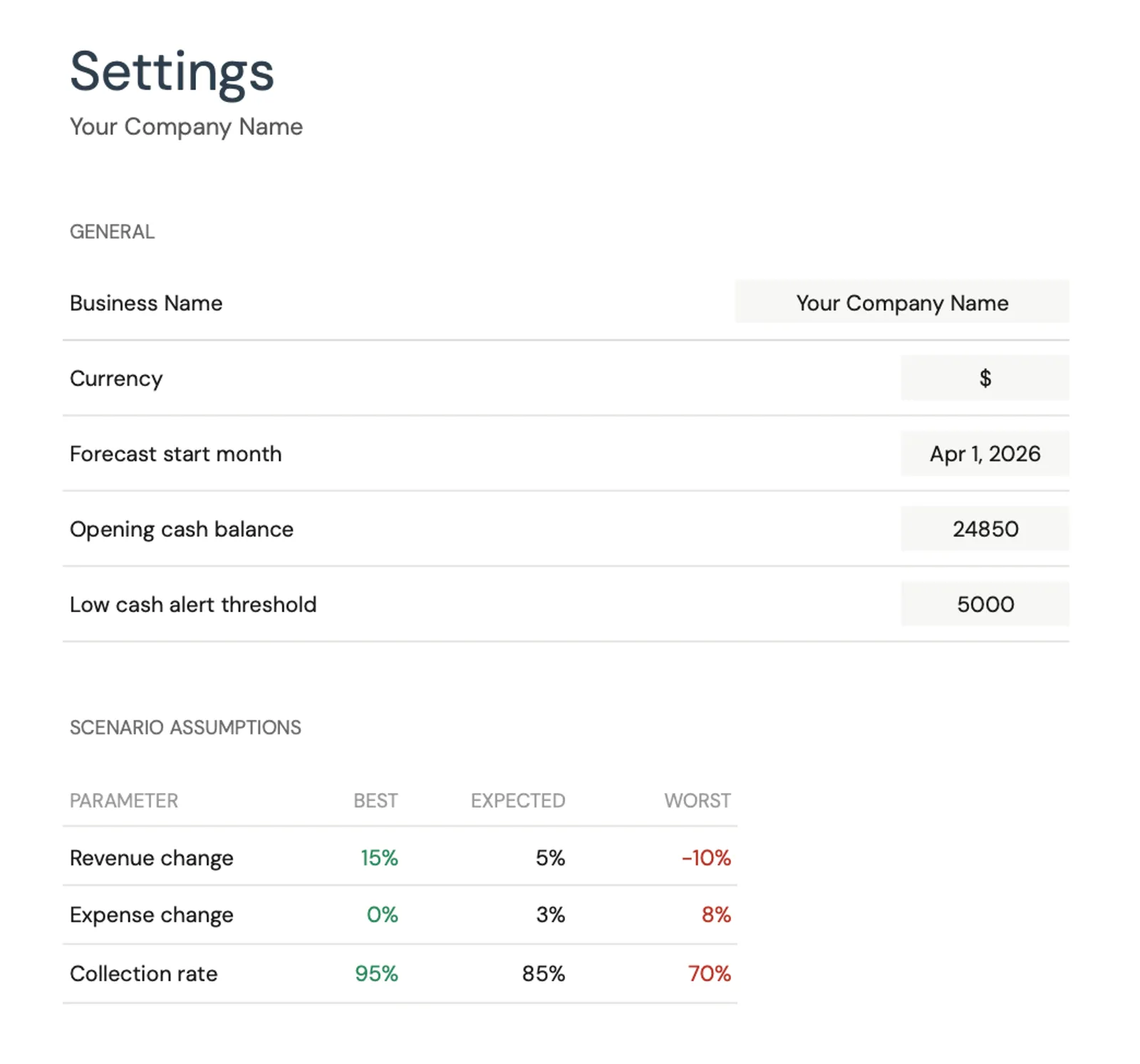
Monthly cash flow overview with KPIs and charts
Track actual cash flow against your forecast
Project cash flow 12 months ahead
Key performance indicators for your cash flow
Model different scenarios for your business
Customize categories for your business type
What You Get
How This Template Works for Pet Grooming and Boarding
Service revenue breakdown
Track grooming, boarding, daycare, and retail revenue separately. Each has different margins, seasonality, and growth potential. Understanding the mix helps prioritize where to invest for growth.
Capacity utilization tracking
Monitor grooming appointments and boarding occupancy rates against capacity. When utilization exceeds 85%, it signals the need to plan expansion or staffing increases before revenue opportunities are lost.
Booking trends vs your financial model
Compare projected appointment volume and revenue against actuals. Pet care businesses with good booking data can forecast within 10% accuracy, making variance analysis useful for early trend identification.
Holiday-to-holiday cash flow projection
See your projected cash position through seasonal peaks and valleys. Plan equipment purchases and facility improvements during cash-strong months following holiday boarding peaks.
Common Questions
Cash Flow for Pet Grooming / Boarding - FAQ
What profit margin is typical for pet grooming businesses?
Net margins for pet grooming shops typically range from 10-20%. Boarding facilities often achieve higher margins (15-30%) when at high occupancy. The key metric is revenue per groomer per day and groomer compensation as a percentage of grooming revenue (typically 40-55%). Retail sales add high-margin incremental revenue. Solo groomers working from dedicated spaces often achieve the highest margins.
How do I forecast holiday boarding demand?
Use historical booking data from previous holidays. Most pet boarding businesses see Thanksgiving, Christmas, and summer vacation as their three biggest periods. Start accepting holiday bookings 2-3 months early to gauge demand. If you filled to 95% capacity last Christmas, forecast similar demand this year. The forecast should also capture the additional staffing costs required during these peak periods.
When should I consider expanding my facility?
The forecast helps model expansion timing. If you are consistently at 85%+ capacity and turning away clients, the forecast can project the revenue from additional capacity against expansion costs. Key factors: facility buildout cost, time to fill new capacity (typically 3-6 months), additional staff needed, and the cash reserves required to fund the gap between investment and breakeven.
How do I handle groomer commission structures in the forecast?
Enter grooming revenue and groomer commission (40-55% of service revenue) as linked line items. When grooming revenue increases, commission costs increase proportionally. This variable cost structure means margins stay relatively stable as volume grows - unlike fixed-cost businesses where margins improve with scale.
Should I add boarding to my grooming business?
The forecast helps model this decision. Boarding requires significant facility investment ($20,000-$100,000+ depending on capacity) but generates revenue during hours when grooming is closed (evenings, nights, weekends). Model the additional revenue, staffing costs, and facility expenses against your current cash flow to determine payback period and cash flow impact during the ramp-up phase.
Can't find the answer you're looking for? Contact our team
Forecast cash flow for your pet grooming / boarding
One-time purchase. No subscription. Your financial data stays in your Google Drive.