Cash Flow Forecast
Cash Flow Forecast Template for Landscaping Companies
Forecast seasonal revenue patterns, manage crew labor costs, track equipment investments, and plan for the off-season - all in a Google Sheets template built for cash flow management.
In Depth
Seasonal Swings and the Landscaping Business Calendar
Landscaping is perhaps the most seasonally concentrated business type there is. In most US markets, the core revenue window runs from April through October - roughly seven months to generate the cash that must sustain the business for twelve. A company earning $400,000 annually might bring in $55,000-$60,000 per month during peak season and $5,000-$10,000 in winter. That arithmetic shapes every financial decision, from equipment purchases to hiring to how much the owner takes home.
The spring startup is a particularly cash-intensive period. Crews need to be hired and trained, equipment serviced and repaired, and supply accounts restocked - all before the first mowing invoice goes out. Some companies find themselves spending $15,000-$30,000 in March and early April on preparation before meaningful revenue begins flowing. This annual startup cost makes winter reserves not just helpful but essential for a smooth seasonal transition.
The mix between maintenance and project work creates different cash flow textures. Recurring maintenance contracts - weekly mowing, monthly trimming - provide a steady, predictable revenue stream billed monthly. Installation projects like patios, retaining walls, and landscape design bring larger payments but with more variable timing. A company that relies primarily on project work tends to see lumpier cash flow than one anchored by a strong maintenance base. Many operators try to build the maintenance side specifically because of its stabilizing effect on finances.
Snow removal, for companies that offer it, transforms the off-season financial picture. A landscaping company that adds $10,000-$20,000 in monthly winter revenue from plowing and salting reduces the seasonal cash flow gap dramatically. However, snow revenue is itself unpredictable - a mild winter might bring half the expected income. Some companies sell seasonal snow contracts at a fixed monthly rate, trading potential upside from heavy snow years for the certainty of predictable winter income.
The Challenge
Cash Flow Challenges for Landscaping Companies
Landscaping is among the most seasonal businesses in existence. Revenue compresses into 6-8 months while many costs persist year-round. Managing this imbalance is the central cash flow challenge.
Revenue compresses into 6-8 months of the year
In most US markets, landscaping generates 75-90% of annual revenue between April and October. A company earning $400,000 annually might generate $50,000-$60,000/month during peak season and $5,000-$10,000/month in winter. Fixed costs (equipment loans, insurance, owner salary) continue through the slow months. Without disciplined cash reserves, the spring startup period becomes a financial scramble.
Equipment is expensive and essential
Mowers, trucks, trailers, and specialized equipment represent significant capital investment. A mid-size landscaping operation might have $100,000-$300,000 in equipment. Commercial mowers alone cost $8,000-$15,000 each with 3-5 year useful lives. Breakdowns during peak season are urgent and expensive - a downed mower during a busy week can cost $500-$1,000 in emergency repairs plus lost revenue from missed appointments.
Crew labor costs are the largest expense
Labor (including payroll taxes, workers' comp, and overtime) typically represents 35-50% of landscaping revenue. The seasonal workforce creates a unique challenge: you hire and train crew in spring, work them hard through fall, and lay off most in winter. Training costs, ramp-up productivity losses, and the risk of losing good crew members to year-round employers make workforce management a constant cash flow factor.
Project work and maintenance have different cash patterns
Recurring maintenance contracts (mowing, trimming) provide predictable weekly revenue, typically billed monthly. Installation projects (patios, retaining walls, plantings) bring larger but less predictable payments. A $15,000 hardscape project requires $5,000-$8,000 in materials upfront with payment on completion. Balancing steady maintenance income with lumpy project revenue creates cash flow complexity.
Start forecasting your cash flow
Forecasting Guide
How to Forecast Cash Flow for Your Landscaping Company
Landscaping cash flow forecasting must account for extreme seasonality. Here is how to structure it using the Cash Flow Forecast template.
Revenue Categories
- Recurring maintenance contracts (mowing, trimming)
- Landscape installation projects
- Hardscape projects (patios, walls, walkways)
- Spring and fall cleanup services
- Snow removal (if applicable)
- Irrigation installation and maintenance
Expense Categories
- Crew wages and overtime
- Payroll taxes and workers' compensation
- Equipment fuel and maintenance
- Equipment loan payments
- Truck and trailer costs
- Materials (plants, mulch, stone, pavers)
- Insurance (general liability, vehicle, equipment)
- Marketing and lead generation
- Dump fees and disposal
- Office and administrative costs
- Subcontractor payments
- Winter operating costs (when revenue is minimal)
Cash Flow Timing
The most important number in landscaping cash flow is your off-season monthly burn rate. Calculate all fixed costs that continue through winter (equipment payments, insurance, owner salary, office) and multiply by the number of slow months (typically 4-5). That total is the cash reserve you need to build during the peak season. If winter costs are $8,000/month and you have 5 slow months, you need $40,000 in reserves by November.
See It In Action
What the template looks like
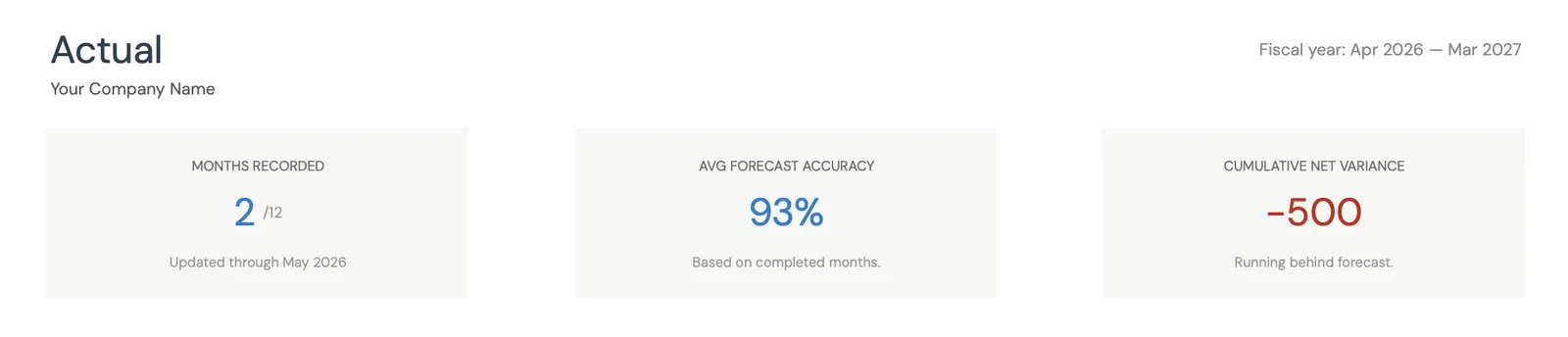
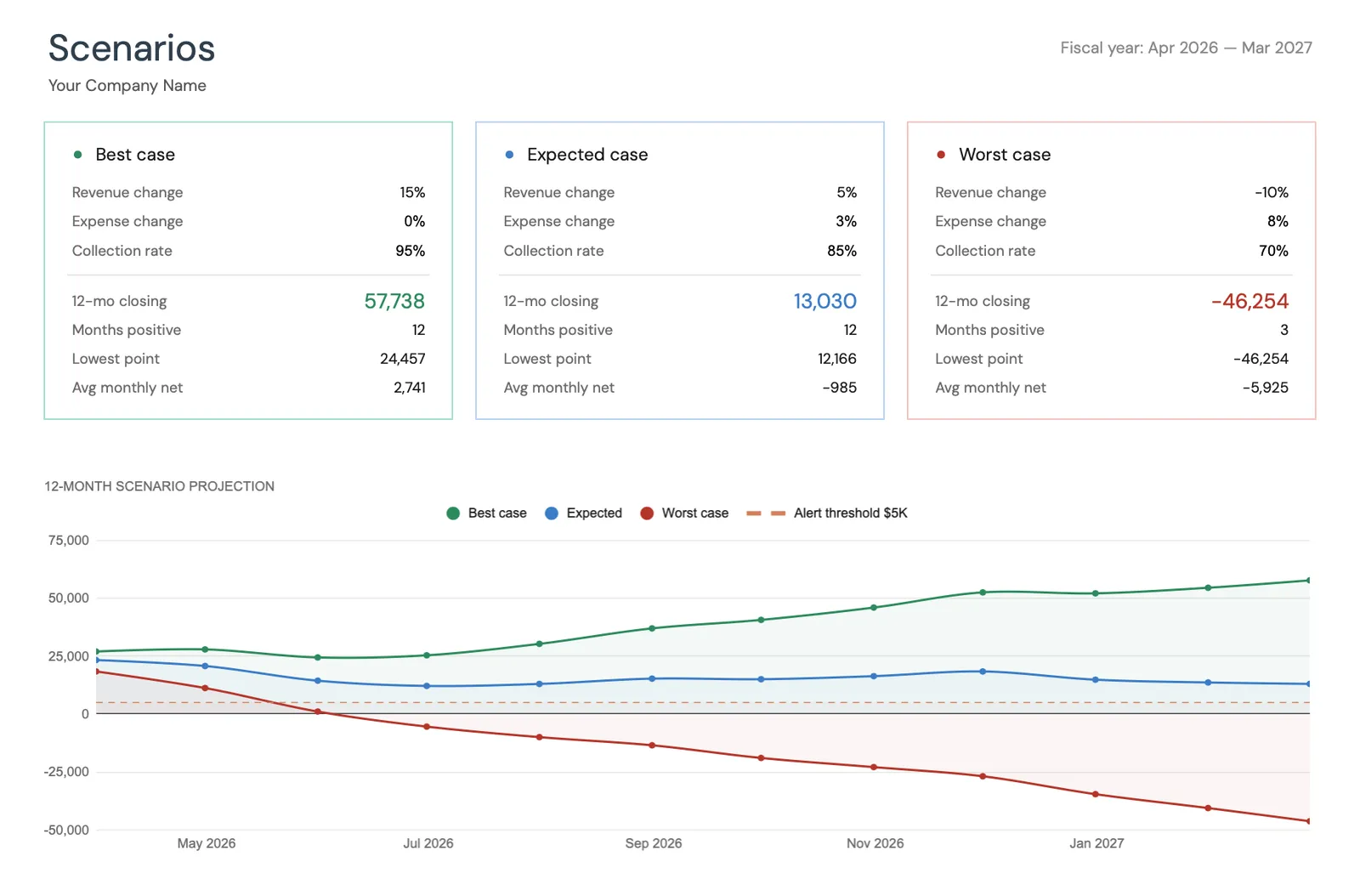
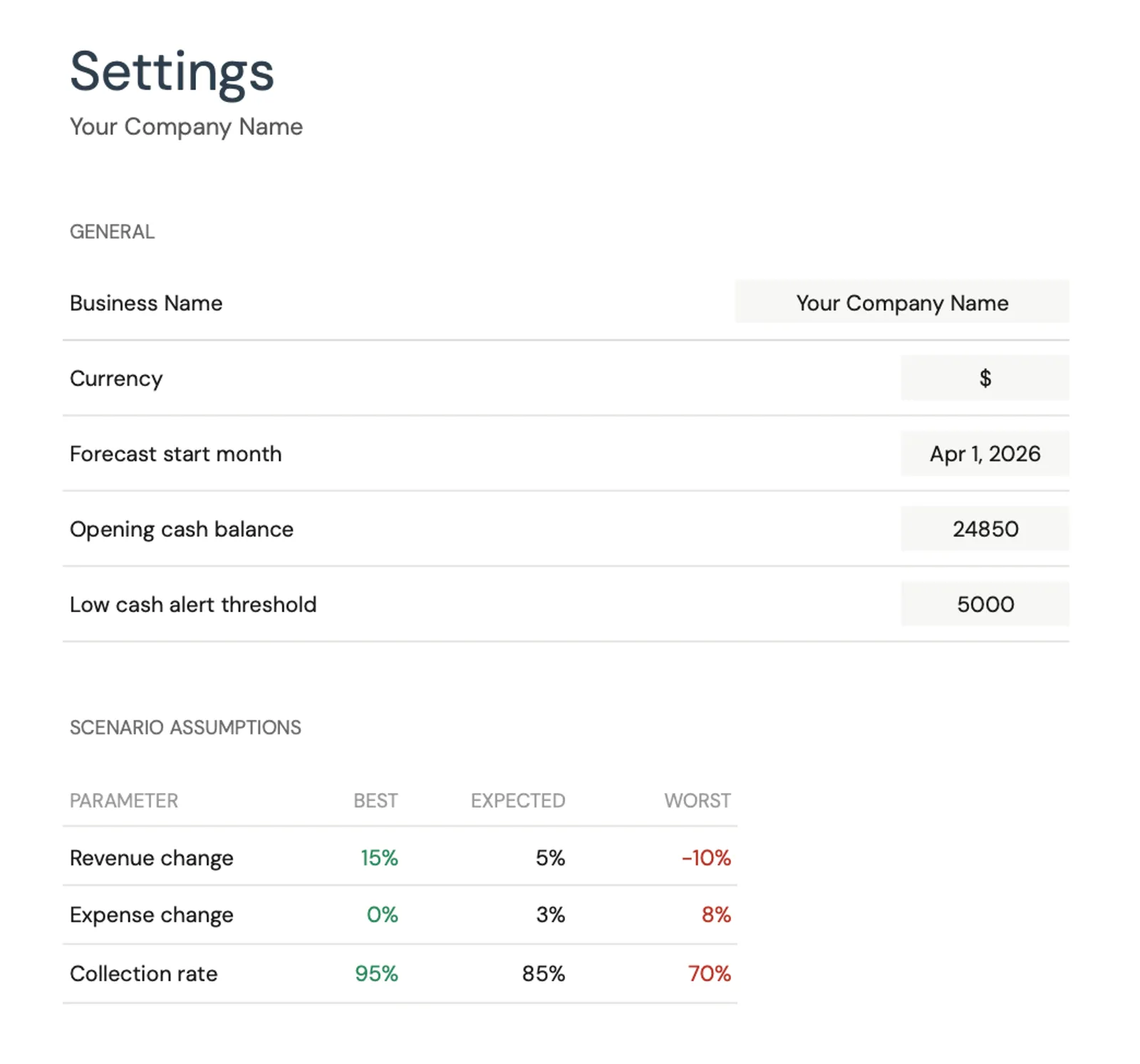
Browse through the template to see dashboards, forecasting, actuals tracking, and scenario planning.
- Visual cash flow dashboard
- Forecast vs actuals comparison
- Scenario planning tools
- Customizable categories
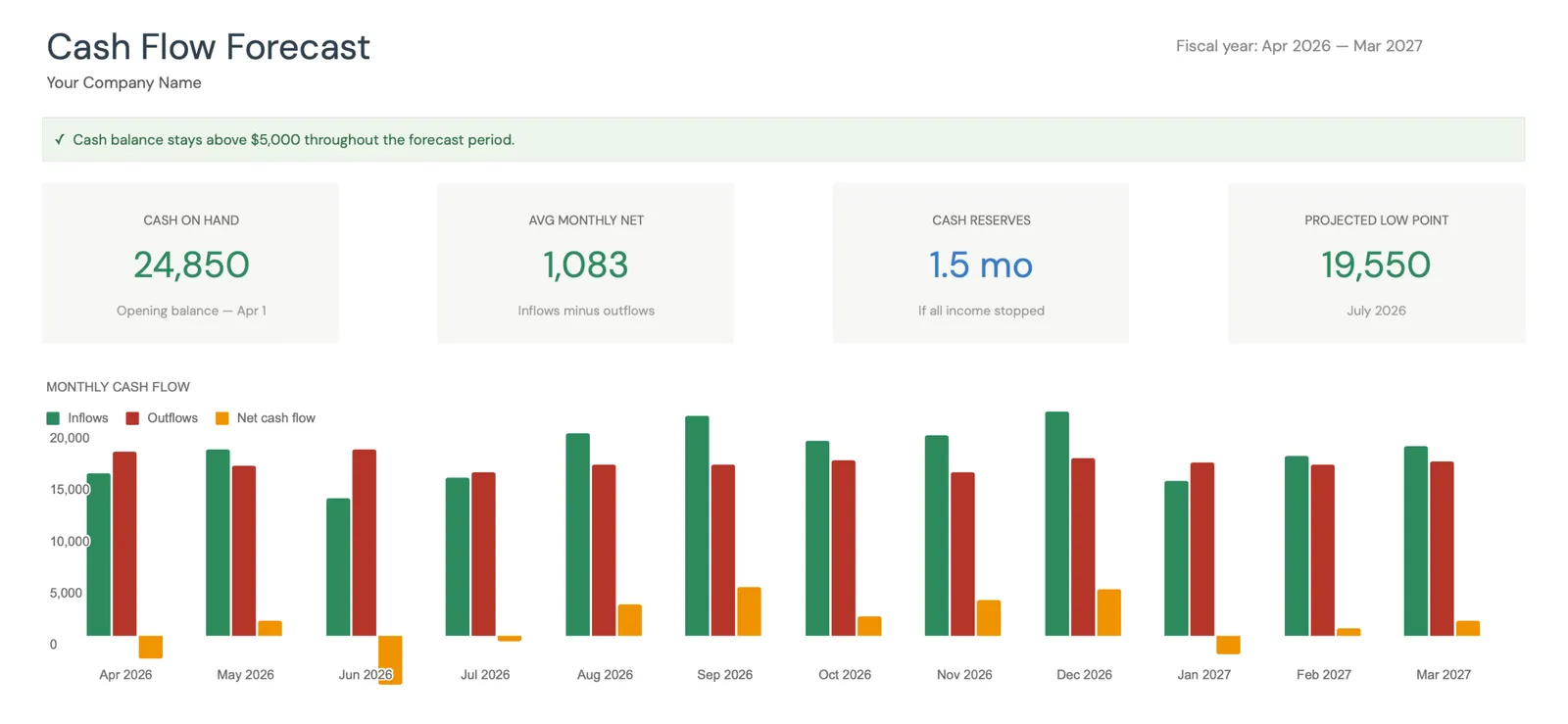
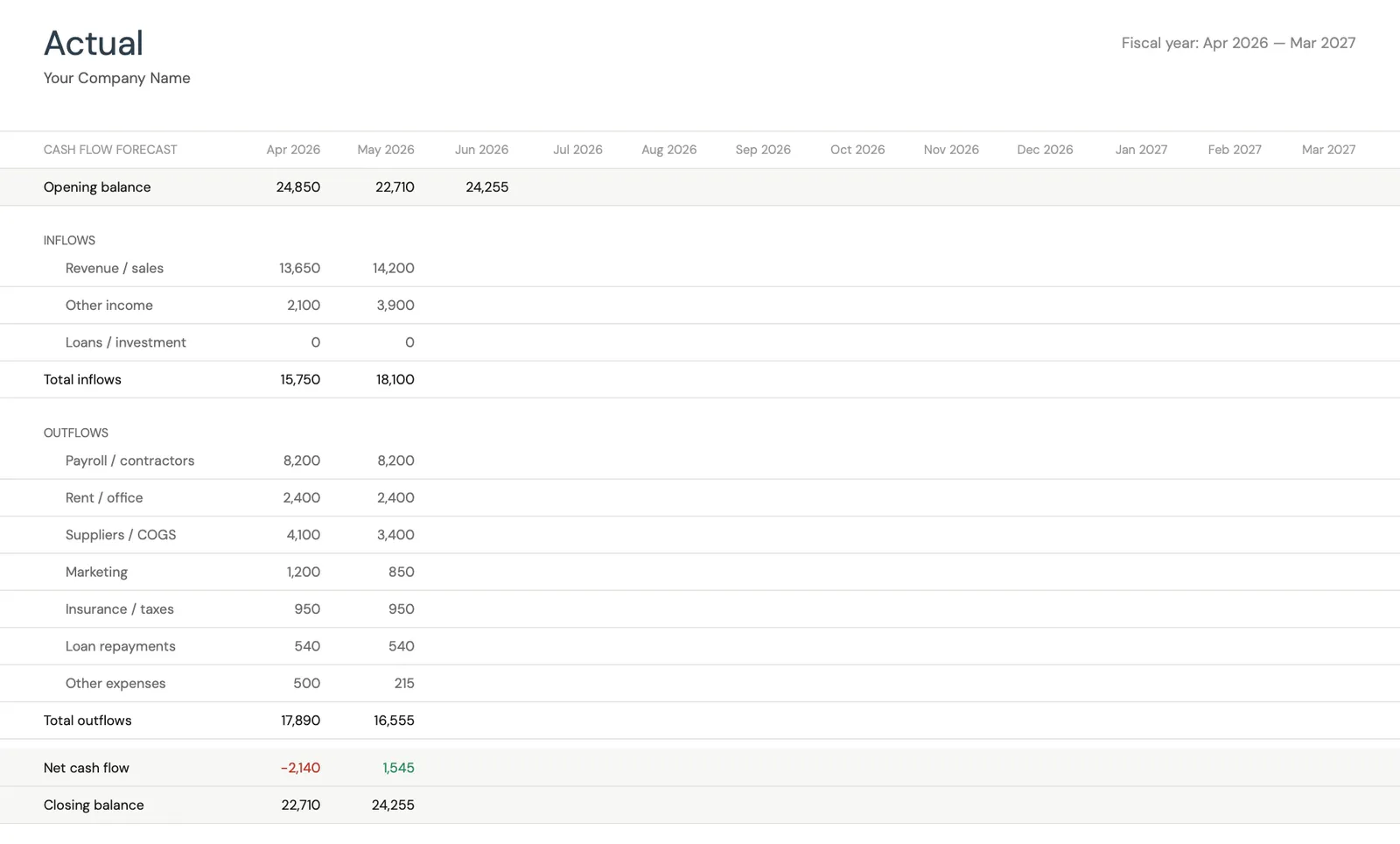
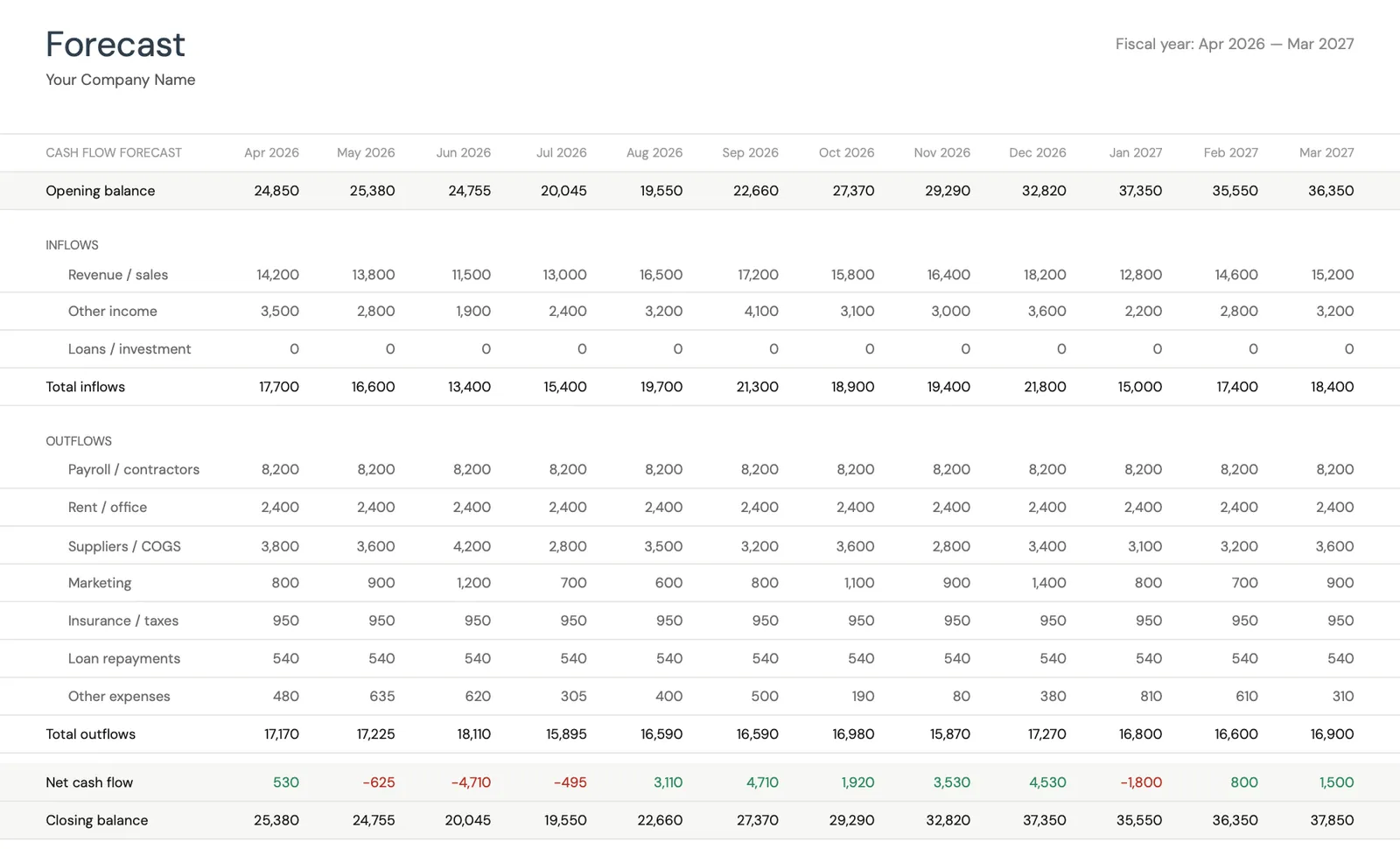
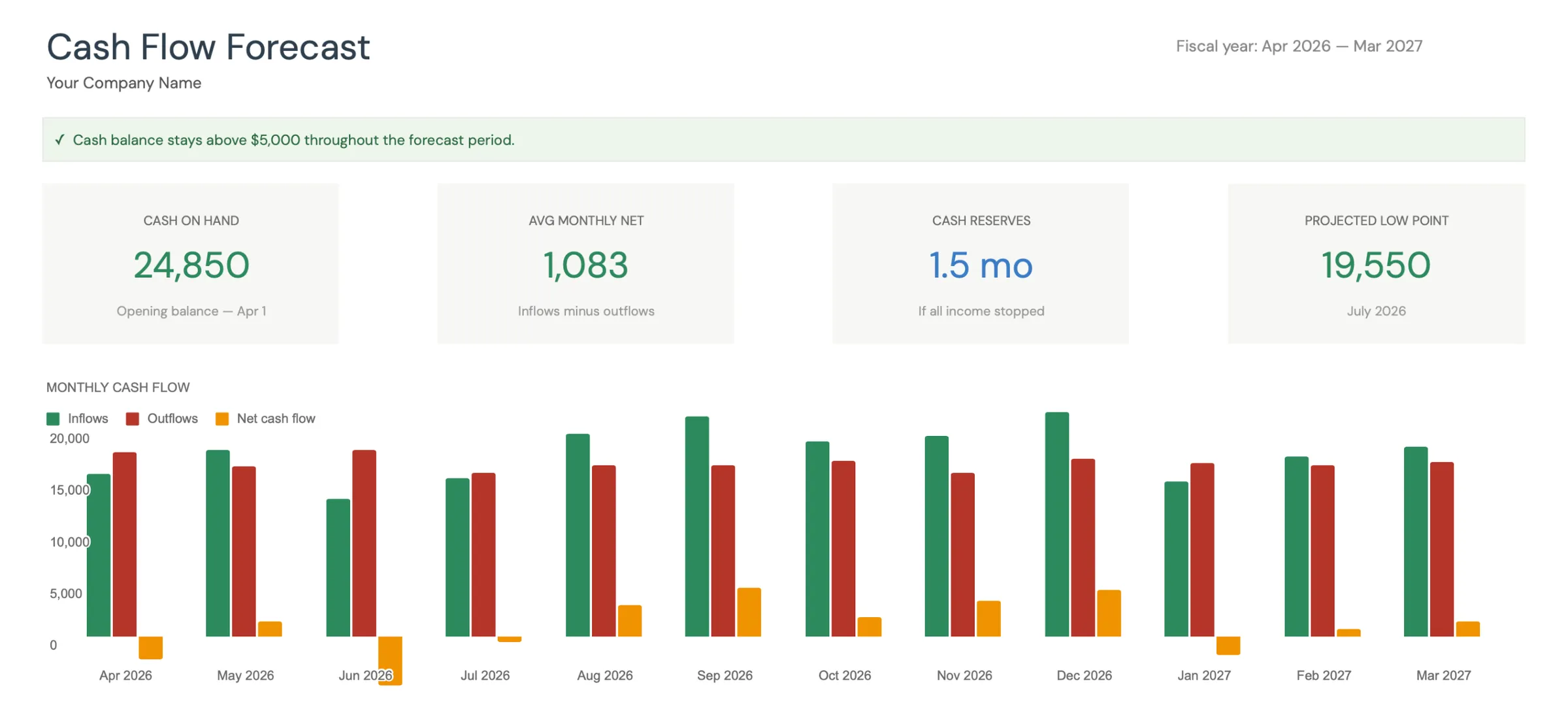
Monthly cash flow overview with KPIs and charts
Track actual cash flow against your forecast
Project cash flow 12 months ahead
Key performance indicators for your cash flow
Model different scenarios for your business
Customize categories for your business type
What You Get
How This Template Handles Landscaping Cash Flow
Seasonal revenue modeling
Build your annual revenue curve by month, reflecting the dramatic seasonal swing. See clearly how peak-season revenue must fund off-season costs, and calculate the required monthly reserve contribution.
Maintenance vs project revenue split
Track recurring maintenance income separately from project-based revenue. Maintenance provides the predictable base; projects provide growth but with less predictable timing.
Seasonal actuals against your projections
Compare projected seasonal patterns against actuals. A wet spring that delays spring cleanup by two weeks shifts revenue timing. Tracking these variations improves future seasonal forecasting.
Full seasonal arc cash flow view
See the full seasonal arc of your business. Plan equipment purchases for cash-rich months, time major project starts to align with labor availability, and verify your winter reserve target.
Common Questions
Cash Flow for Landscaping Companies - FAQ
What profit margin is typical for landscaping companies?
Net margins for landscaping companies typically range from 5-15% for maintenance-focused operations and 10-20% for design-build firms. Maintenance work has lower margins but more predictable volume, while installation projects carry higher margins but are weather-dependent and seasonal. The overall margin depends heavily on crew utilization and equipment costs.
How do I survive the off-season financially?
The forecast is essential for off-season planning. Calculate your total winter expenses and divide by the number of peak-season months to determine the required monthly reserve contribution. Some companies add snow removal to generate winter revenue. Others negotiate annual maintenance contracts billed evenly across 12 months, smoothing revenue even though work is seasonal.
How much should I reserve for equipment replacement?
A common approach is depreciating your equipment fleet over its expected life and setting aside that amount monthly. If you have $150,000 in equipment with an average 5-year life, that is $30,000/year or $2,500/month in replacement reserves. Without this reserve, equipment failures during peak season force emergency purchases or loans at the worst possible time.
How do I handle material costs for large projects?
For installation projects, collect a deposit (typically 30-50%) to cover material costs before purchasing. This aligns cash inflows with outflows. If the project requires $6,000 in materials, a 50% deposit of $7,500 on a $15,000 project covers materials with room for labor startup costs. The forecast should map material purchases to deposit collection timing.
Should I offer annual maintenance contracts?
Annual contracts billed monthly (total annual fee divided by 12) smooth cash flow significantly. A client paying $300/month year-round is more valuable to cash flow than one paying $450/month for 8 months, even though the total is the same. The forecast helps model the cash flow benefit of converting seasonal clients to annual billing.
Can't find the answer you're looking for? Contact our team
Forecast cash flow for your landscaping companie
One-time purchase. No subscription. Your financial data stays in your Google Drive.