Cash Flow Forecast
Cash Flow Forecast Template for Gyms / Fitness Studios
Forecast membership revenue, track class and personal training income, manage equipment costs, and plan for seasonal membership patterns - all in a Google Sheets template built for cash flow management.
In Depth
Membership Economics and the Fitness Business Cycle
The gym business runs on a financial cycle that is remarkably predictable in shape, if not in exact numbers. January brings a wave of new members driven by New Year motivation. By March, cancellations begin to rise. Summer sees attendance and membership both dip as people shift to outdoor activities. Fall brings a modest uptick, and December sees a pre-resolution dip before the January surge starts again. This annual pattern repeats with surprising consistency year after year.
The breakeven membership number is one of the most important figures a gym owner can know. With high fixed costs - rent, equipment leases, utilities, insurance - the gap between profitable and unprofitable can come down to 30-50 members. A boutique studio paying $6,000 in monthly rent with $4,000 in other fixed costs needs roughly 200 members at $50/month just to cover overhead before paying any staff. Every member above that threshold contributes directly to profit; every one below it deepens the loss.
Revenue diversification has become a defining strategy for financially healthy fitness businesses. Membership dues provide the predictable base, but personal training, group classes, retail sales, and specialized programs can add 30-40% to total revenue at higher margins. Some studio owners find that personal training revenue actually exceeds membership dues in total contribution, even though the membership base is what brings clients through the door in the first place.
Payment failure is a persistent, low-level cash flow drain that adds up over time. Credit card expirations, bank account changes, and declined charges affect 3-8% of membership billings each month. Automated retry systems recover some of these, but not all. The gap between billed and collected revenue is worth tracking closely because it tends to grow quietly. A 5% collection gap on $40,000 in monthly billings means $2,000 in expected revenue that never arrives.
The Challenge
Cash Flow Challenges for Gyms and Fitness Studios
Gyms and fitness studios benefit from recurring membership revenue but face high fixed costs and strong seasonal patterns. The January surge and summer slump create predictable cash flow challenges that require planning.
Membership revenue follows predictable seasonal patterns
January brings a surge of new memberships - often 2-3x normal sign-up rates. By March, cancellations begin climbing. Summer months typically see higher churn as people vacation and exercise outdoors. This seasonal pattern means membership revenue peaks in Q1 and often reaches its lowest point in late summer. A gym with 500 members in February might have 420 by August - a 16% revenue drop while costs remain largely fixed.
High fixed costs create a steep breakeven point
Rent, equipment leases, insurance, and utilities represent 50-70% of a gym's total costs - and none of them flex with membership levels. A fitness studio paying $8,000/month in rent needs that revenue whether it has 100 or 300 members. This high fixed-cost structure means the difference between breakeven and profitability might be just 30-50 additional members. Losing 30 members during a slow period can flip cash flow from positive to negative.
Equipment purchases require significant capital
Outfitting a gym costs $50,000-$200,000+ depending on size and equipment quality. Equipment has a 5-10 year lifespan and needs regular maintenance. Replacing worn equipment is not optional - broken or outdated equipment drives member cancellations. These large, periodic capital expenses need to be planned and funded through reserves or financing, creating lumpy cash outflows that monthly membership revenue must cover.
Member payment failures and cancellations erode revenue
Credit card declines, expired cards, and involuntary churn typically affect 3-8% of membership payments each month. Not all failed payments are recovered. Combined with voluntary cancellations, total monthly member loss of 5-10% is common for gyms without long-term contracts. Each lost member's revenue takes 3-6 months to replace through new sales - creating a revenue lag that affects cash flow.
Start forecasting your cash flow
Forecasting Guide
How to Forecast Cash Flow for Your Gym or Fitness Studio
Gym cash flow forecasting centers on membership count projections and the fixed-cost breakeven point. Here is how to structure it using the Cash Flow Forecast template.
Revenue Categories
- Monthly membership dues
- Annual membership payments
- Personal training sessions
- Group class packages and drop-ins
- Retail sales (supplements, apparel, gear)
- Initiation and enrollment fees
Expense Categories
- Rent and CAM charges
- Equipment leases and maintenance
- Staff wages (front desk, trainers, cleaners)
- Payroll taxes and benefits
- Utilities (electricity for a gym runs 3-5x typical retail)
- Insurance (general liability, professional)
- Software (membership management, billing)
- Marketing and promotions
- Cleaning supplies and janitorial
- Music licensing (ASCAP, BMI)
- Loan payments
- Continuing education for trainers
Cash Flow Timing
Membership billing typically processes on the 1st or 15th, creating one or two major cash inflow days per month. Most expenses are monthly recurring. The key timing consideration is seasonal: use the January-March revenue surplus to build reserves for the summer dip. If your breakeven is 250 members, forecast your membership count monthly and identify which months you may dip below that threshold.
See It In Action
What the template looks like
Browse through the template to see dashboards, forecasting, actuals tracking, and scenario planning.
- Visual cash flow dashboard
- Forecast vs actuals comparison
- Scenario planning tools
- Customizable categories
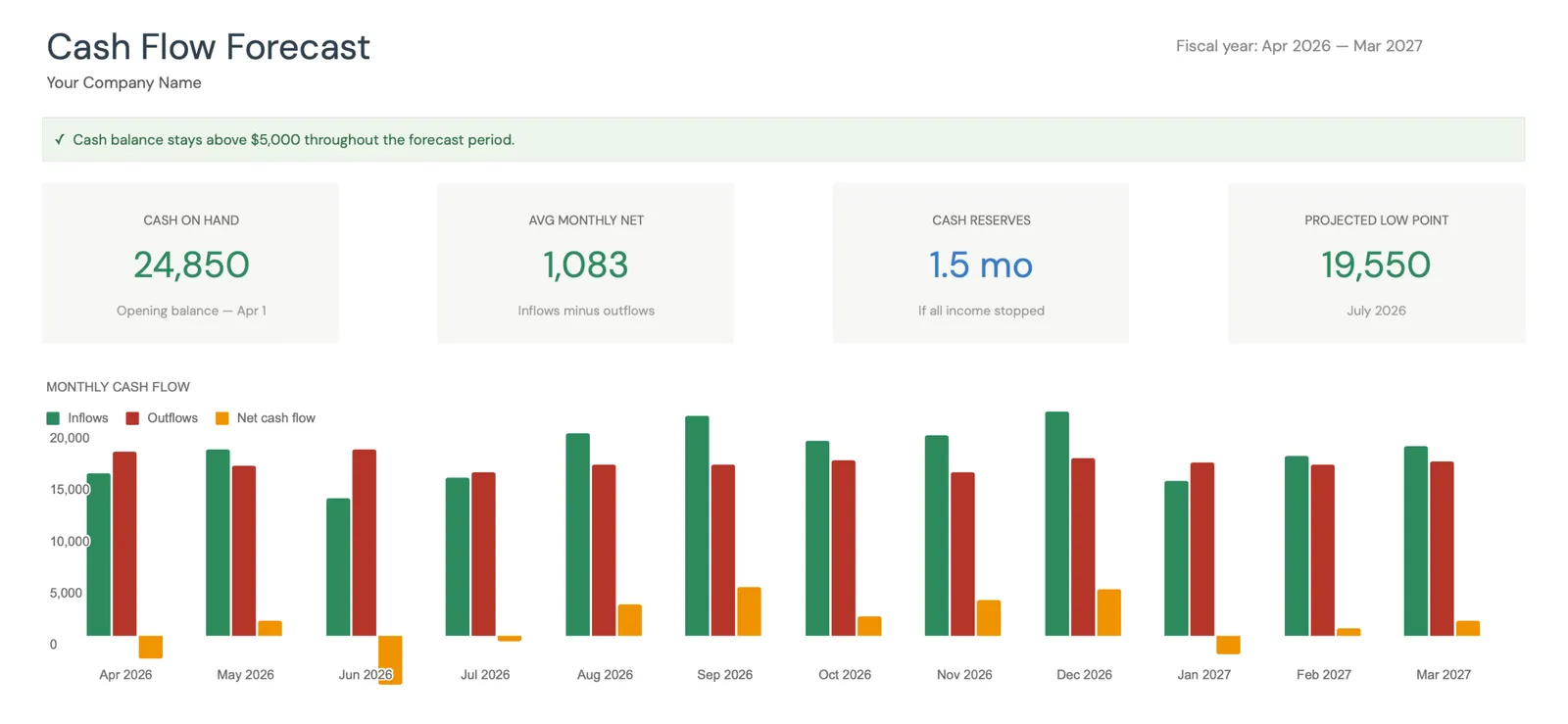
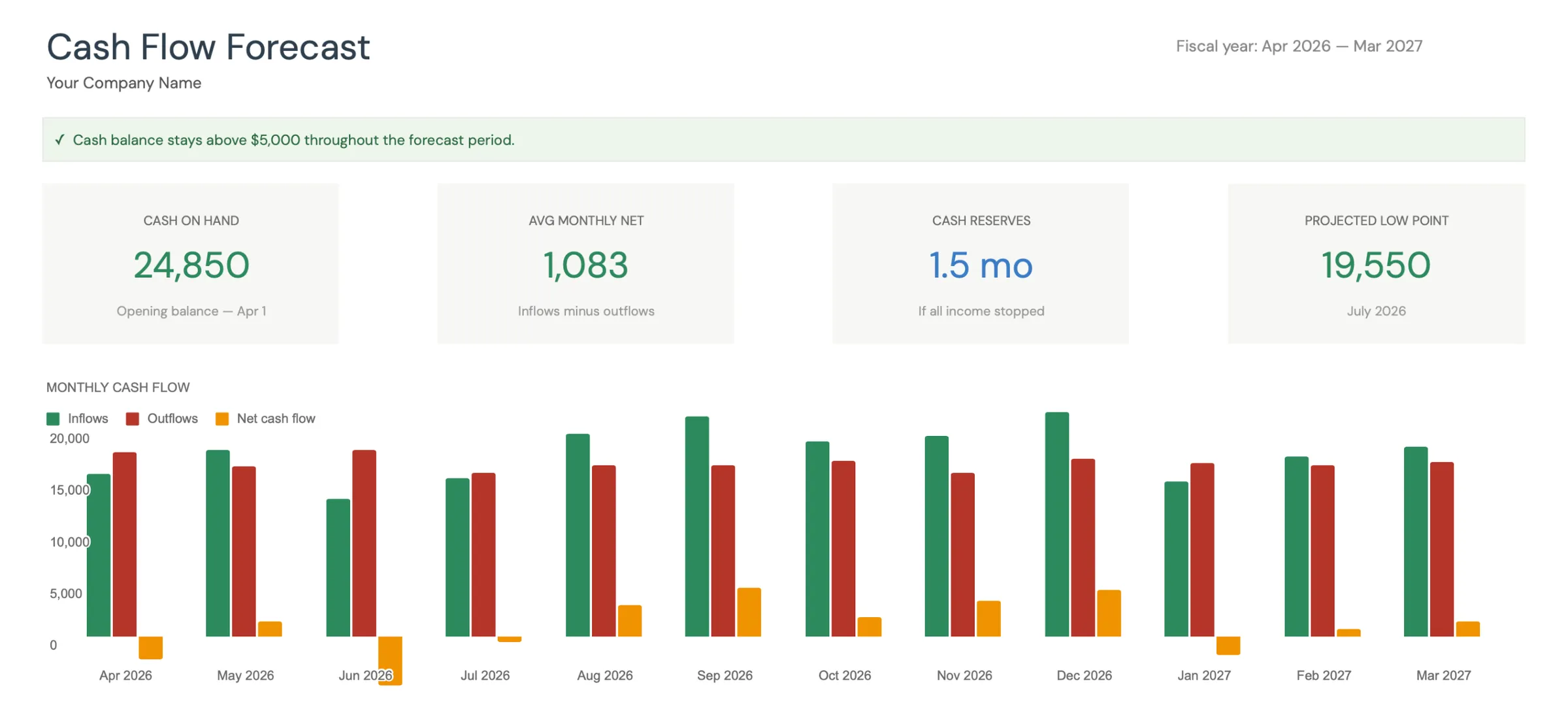
Monthly cash flow overview with KPIs and charts
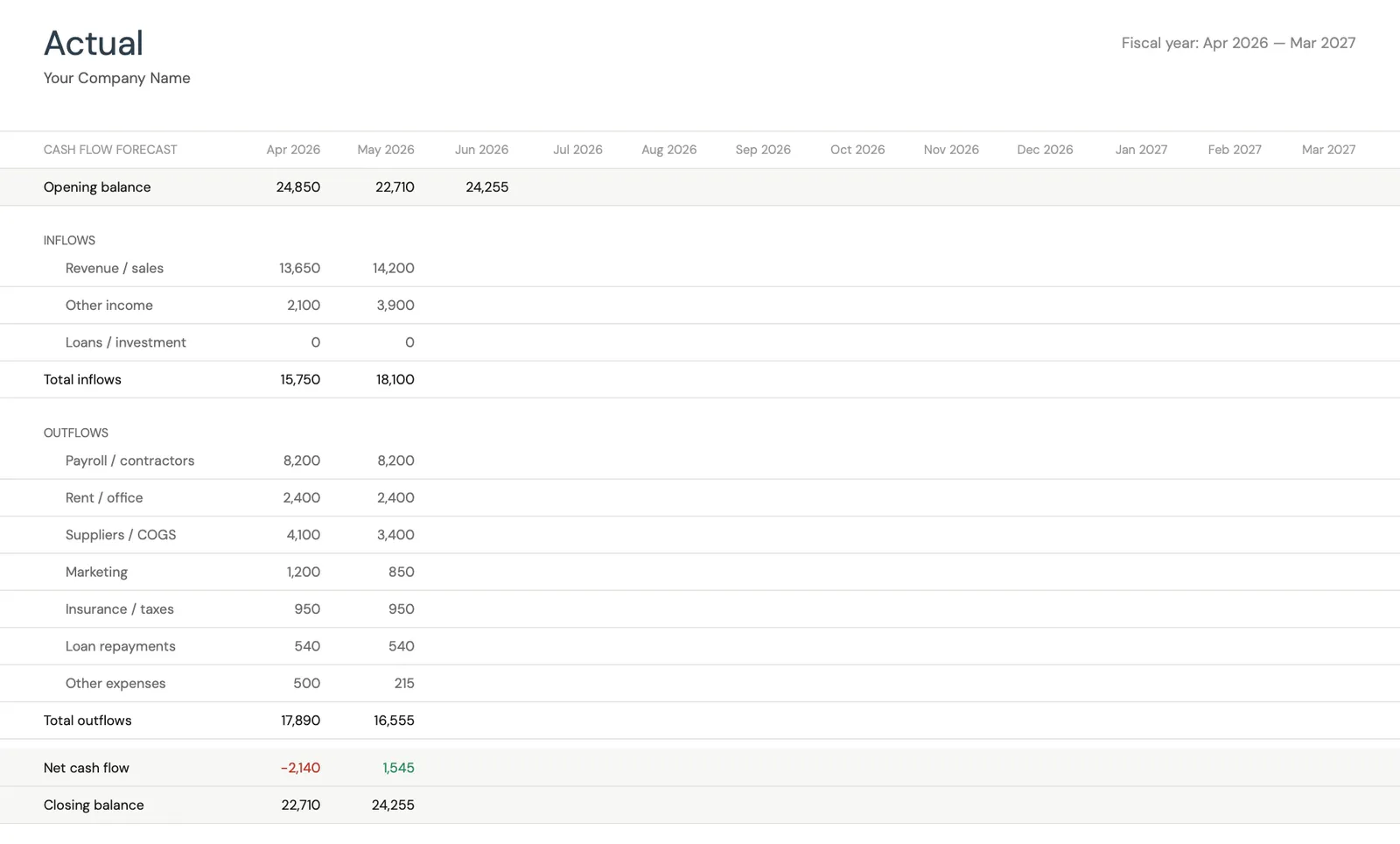
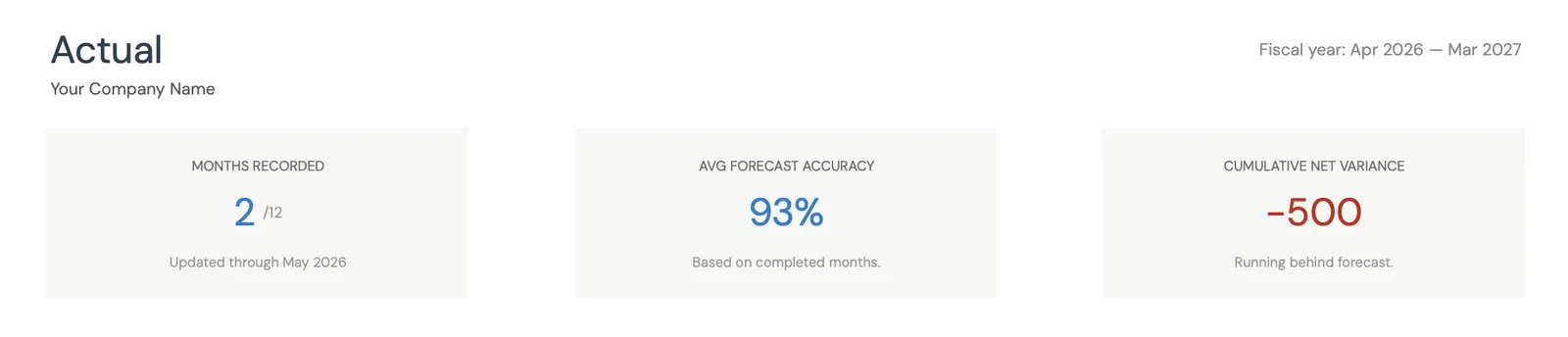
Track actual cash flow against your forecast
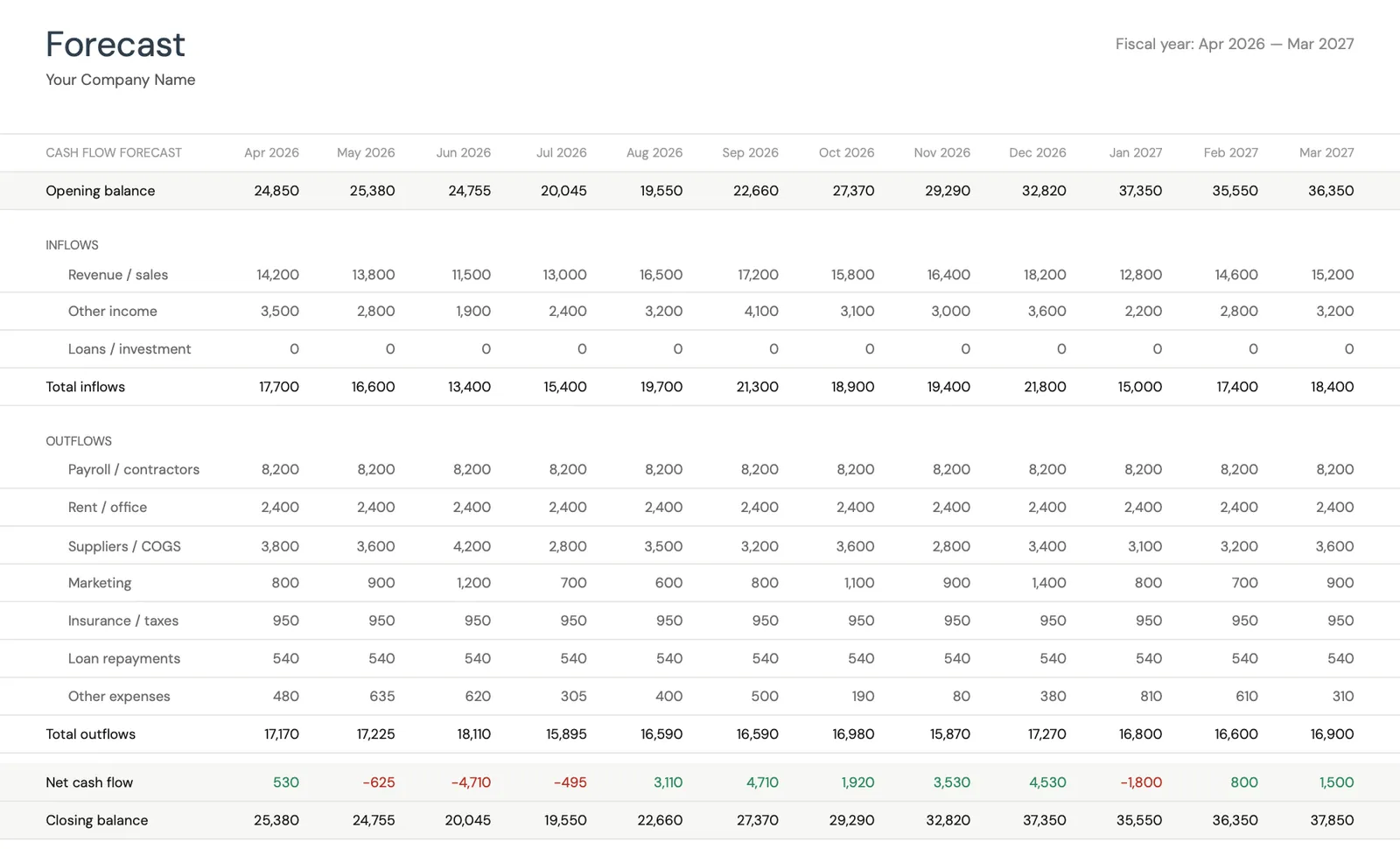
Project cash flow 12 months ahead
Key performance indicators for your cash flow
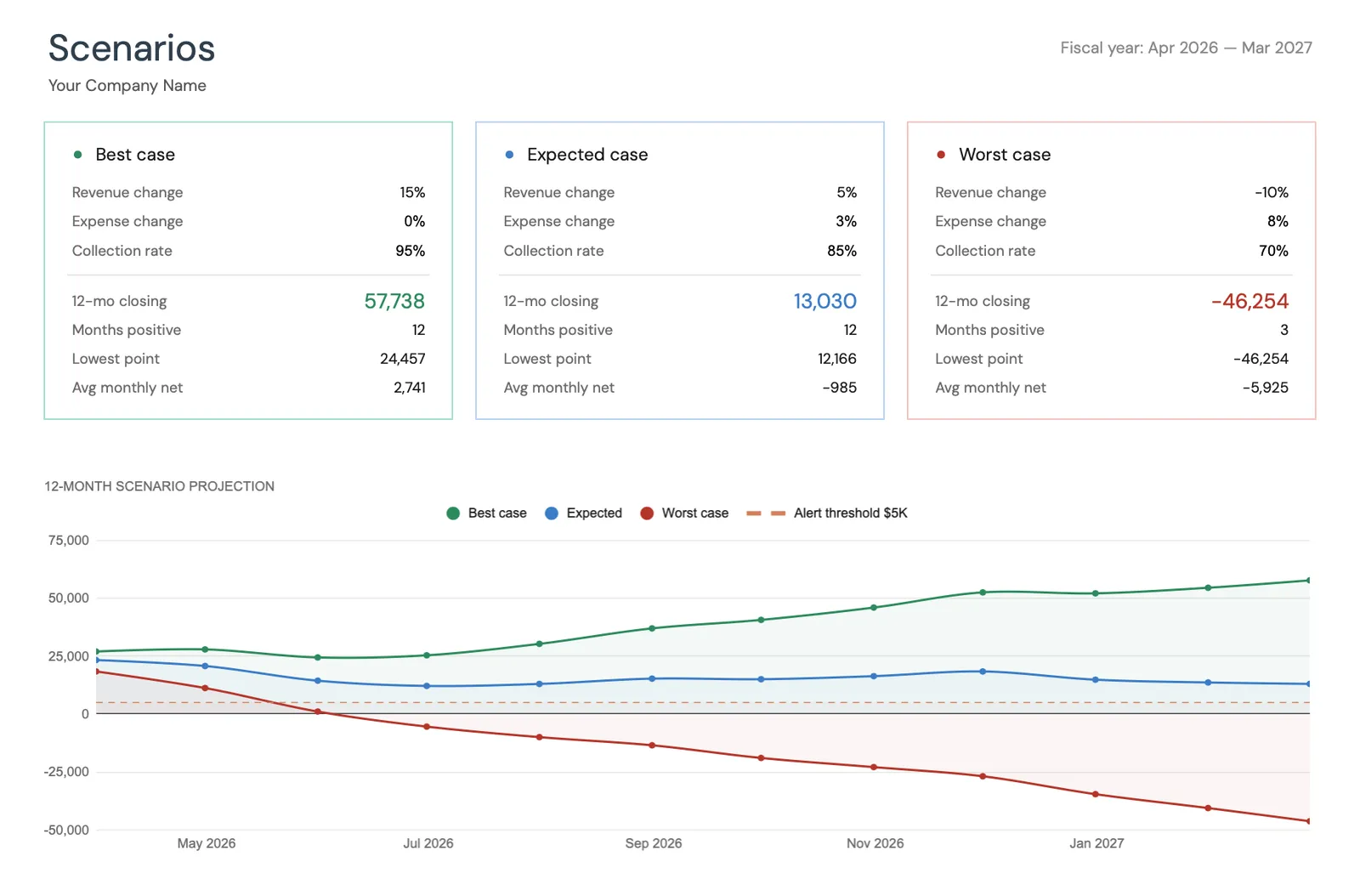
Model different scenarios for your business
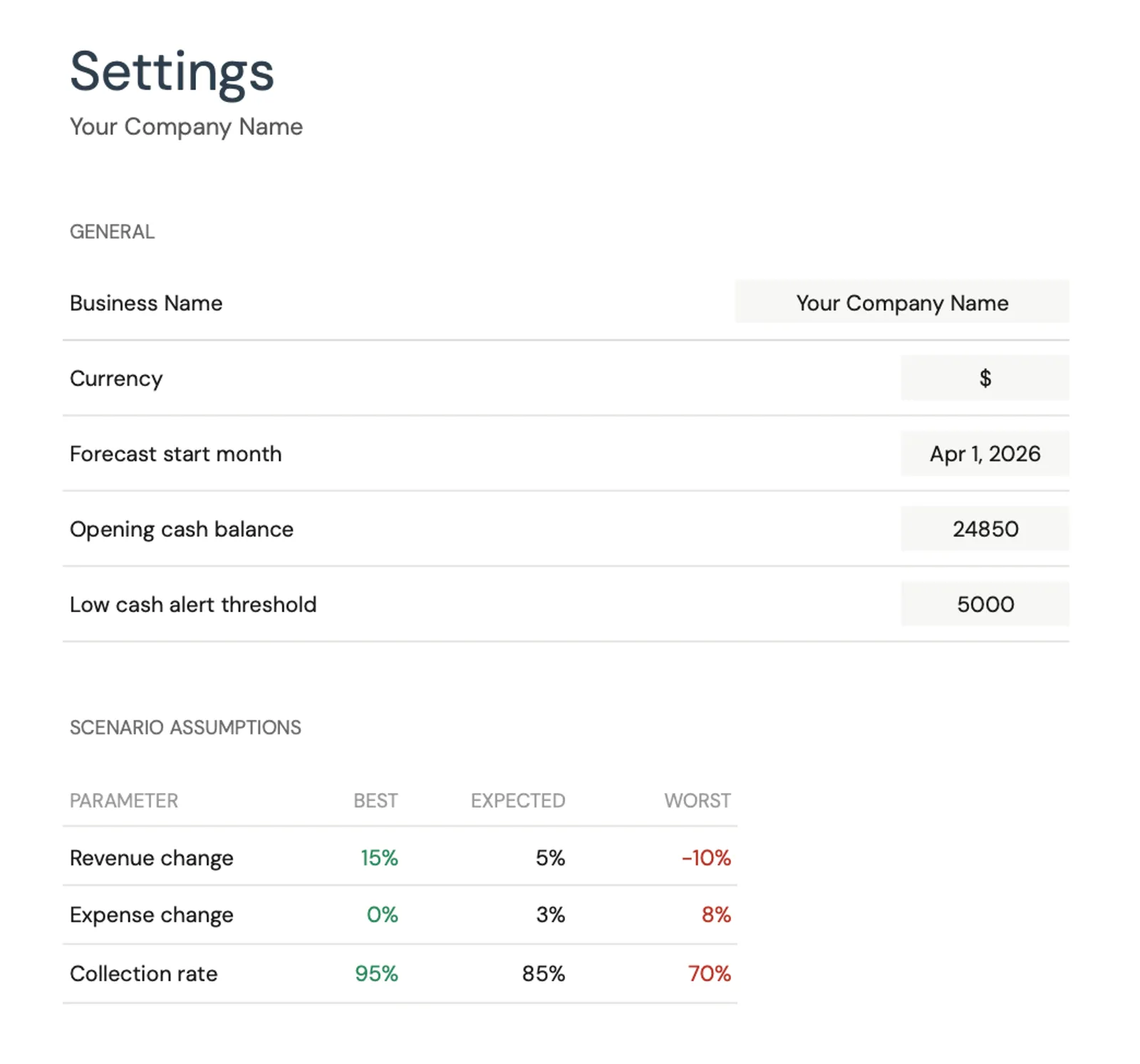
Customize categories for your business type
What You Get
Gym and Fitness Studio Tools Inside the Template
Membership count tracking
Track active members, new sign-ups, and cancellations monthly. Membership count is the primary driver of gym revenue, and even small changes compound quickly. Seeing the trend helps you react before cash flow turns negative.
Revenue stream breakdown
Separate membership dues from personal training, classes, and retail to see which revenue streams are growing or declining. Many successful studios generate 30-40% of revenue from non-membership sources.
Membership churn reality vs your model
Compare projected membership levels, revenue, and expenses against actuals. The biggest forecasting variable is usually membership churn rate - tracking actual churn monthly keeps projections honest.
12-month membership and cash projection
See your projected cash position through full seasonal cycles. Plan January marketing spend based on anticipated sign-ups, and identify summer months where cash reserves will be needed to cover the membership dip.
Common Questions
Cash Flow for Gyms / Fitness Studios - FAQ
What profit margin is typical for gyms and fitness studios?
Net margins for gyms typically range from 10-20% for well-run facilities. Boutique fitness studios can achieve 15-30% margins due to higher per-member pricing. The critical metric is revenue per square foot - which should cover rent, utilities, and equipment costs with enough left over for staff, marketing, and profit. Many gyms operate near breakeven for 12-18 months before reaching profitable membership levels.
How do I forecast the January membership surge?
Historical data is the most reliable guide. If you gained 60 new members in January last year, use that as a baseline adjusted for marketing spend changes and market conditions. First-year gyms can look at industry benchmarks: a 20-40% increase in new sign-ups during January versus average months. Also forecast the corresponding increase in February-March cancellations, which typically follow 60-90 days after New Year sign-ups.
How much should I reserve for equipment replacement?
Set aside 3-5% of monthly revenue into an equipment reserve fund. Most commercial gym equipment has a 7-10 year useful life, so annual replacement costs typically run $5,000-$15,000 for a mid-size facility. Cardio equipment generally wears faster than strength equipment. The reserve fund prevents a needed equipment purchase from creating a cash crisis.
How do I handle the impact of failed payments?
Forecast 3-8% of monthly membership billings as failed payments. Most billing systems retry failed cards, recovering 40-60% of initial failures. Model net collection rate (actual cash received divided by total billed) rather than assuming 100% collection. If you bill $30,000 and consistently collect $28,000, forecast at the $28,000 level.
Can this template handle both a gym and personal training business?
Yes. Set up separate revenue categories for membership dues, personal training sessions, group classes, and retail. Each revenue stream has different margins and growth dynamics. Personal training typically carries 40-60% margins while membership revenue is the stable base. The combined view shows total cash flow while letting you analyze each revenue stream independently.
Can't find the answer you're looking for? Contact our team
Forecast cash flow for your gyms / fitness studio
One-time purchase. No subscription. Your financial data stays in your Google Drive.