Cash Flow Forecast
Cash Flow Forecast Template for Freelance Agencies
Forecast client revenue, manage contractor payments, track project profitability, and smooth out irregular income patterns - all in a Google Sheets template built for cash flow management.
In Depth
Money Flow in the Freelance Agency Model
The freelance agency sits in an interesting middle ground - larger than a solo freelancer, smaller than a traditional agency, and facing cash flow dynamics borrowed from both. Revenue comes from a relatively small number of client relationships, which makes each one financially significant. Losing a single client that represents 25% of revenue is not just a business development problem - it is an immediate cash flow event that affects the ability to pay contractors and cover overhead.
Contractor management creates a financial juggling act that defines the agency model. The agency invoices clients at one rate and pays contractors at another, with the spread covering overhead and profit. But the timing rarely aligns neatly. Contractors expect payment within two to four weeks of completing work, while clients might take six weeks or longer to pay. Across several active projects, this timing gap can require $10,000-$30,000 in working capital that the agency must fund from reserves or a credit line.
Project pricing is where many freelance agencies discover their true margins - often after the fact. A website project quoted at $12,000 that takes 30% more hours than estimated does not just reduce the profit on that project. It also consumes time that could have been spent on another billable engagement. Some agency owners find that tracking actual hours against estimates on every project eventually transforms how they price new work.
The feast-or-famine cycle is perhaps the most discussed aspect of agency life, and it shows up clearly in cash flow data. Three new projects closing in the same month creates a resource scramble and a cash surplus. Three months later, if no new projects have replaced the completed ones, the surplus evaporates. Building retainer relationships - even small ones - tends to reduce the amplitude of these swings over time.
The Challenge
Cash Flow Challenges for Freelance Agencies
Freelance agencies bridge the gap between solo freelancing and traditional agencies. Revenue comes from a smaller number of clients, contractor costs must be paid regardless of client payment timing, and income irregularity is a constant reality.
Income arrives irregularly and in chunks
Unlike a salaried position with predictable bi-weekly deposits, agency income arrives when clients pay - which is often unpredictable. One month might bring $25,000 from three project completions, while the next might see $5,000 from a single retainer. Project-based billing means revenue clusters around completion milestones, not calendar dates. This irregularity makes it difficult to know whether a slow month is a temporary gap or the start of a real problem.
Contractor payments create a timing mismatch
Most freelance agencies rely on subcontractors for 30-60% of project delivery. Contractors typically expect payment within 15-30 days of invoicing, but clients might pay the agency on net-30 or net-45 terms. The agency absorbs this gap. On a $10,000 project with $4,000 in contractor costs, you might pay the contractor $4,000 in week 3 while the client payment arrives in week 6. Across multiple projects, these gaps require working capital.
Client concentration creates risk
Many freelance agencies depend on 3-5 major clients for 70-80% of revenue. If one client pauses work or switches to a competitor, the cash impact is immediate and severe. A forecast that shows revenue by client quickly reveals concentration risk - and the importance of diversifying the client base before a shock hits.
Scope creep erodes project profitability
Fixed-price projects are common for freelance agencies, but scope creep is equally common. A $15,000 website project that requires 50% more hours than estimated does not generate 50% more revenue. The extra hours consume time that could have been billed to other projects - a double hit to cash flow. Tracking actual project costs against estimates reveals patterns that inform better future pricing.
Start forecasting your cash flow
Forecasting Guide
How to Forecast Cash Flow for Your Freelance Agency
Freelance agency cash flow forecasting requires client-level visibility and honest assessment of payment timing. Here is how to structure it using the Cash Flow Forecast template.
Revenue Categories
- Retainer clients (monthly recurring)
- Project-based revenue (by client)
- Milestone payments on active projects
- Rush fees and overage charges
- Passive income (templates, courses, licensing)
Expense Categories
- Contractor and freelancer payments
- Owner salary or draw
- Payroll taxes (self-employment tax)
- Software and tools (design, project management, accounting)
- Coworking space or office rent
- Marketing and lead generation
- Professional development
- Insurance (general liability, E&O)
- Legal and accounting fees
- Equipment and hardware
Cash Flow Timing
Freelance agency cash flow is driven by the gap between paying contractors and collecting from clients. Map each active project's payment milestones and contractor payment obligations onto a monthly timeline. Build a cash buffer equal to 2-3 months of operating expenses to absorb timing gaps. Pay attention to year-end patterns - many clients slow down in December and Q1 can start sluggishly.
See It In Action
What the template looks like
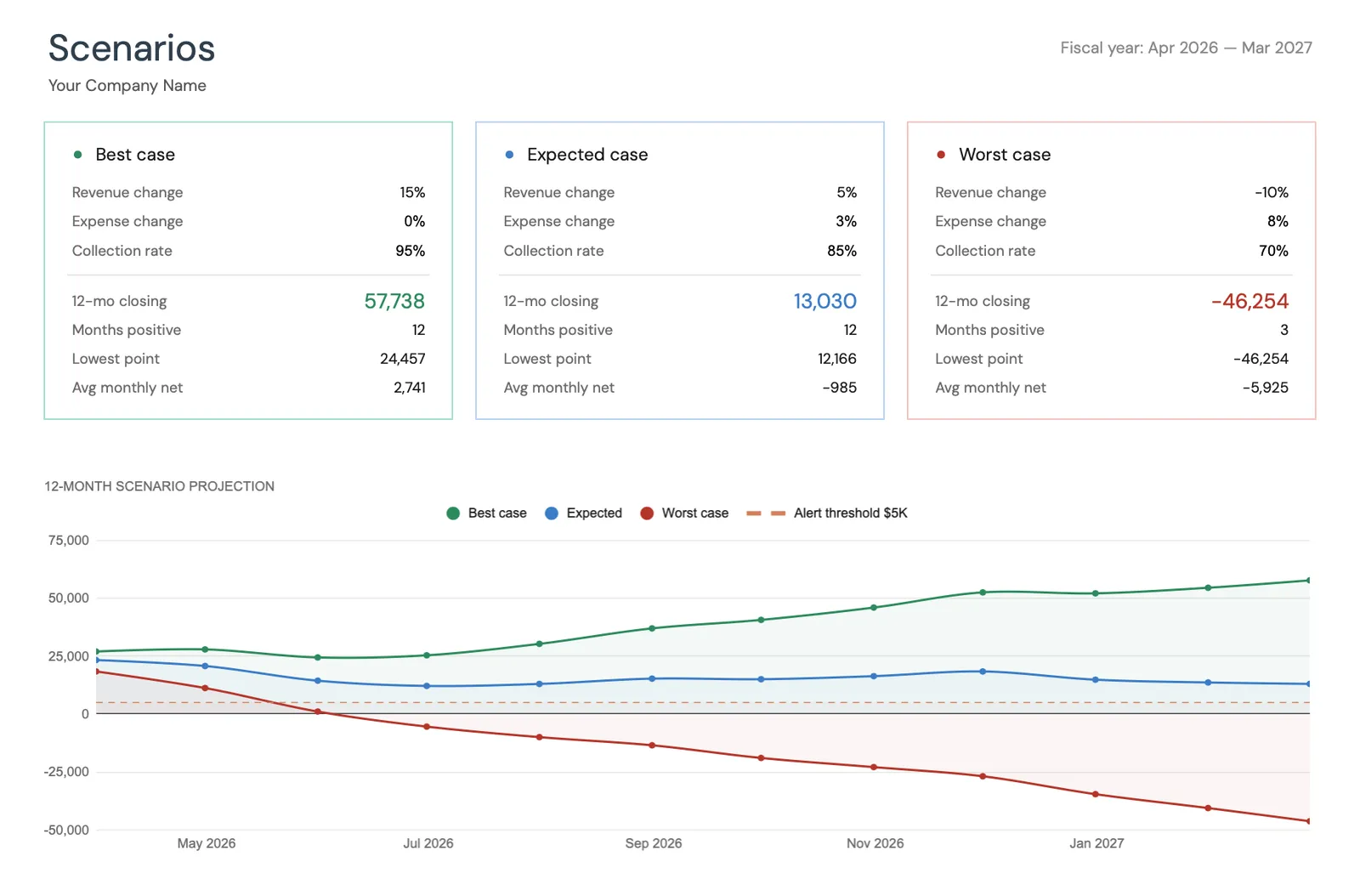
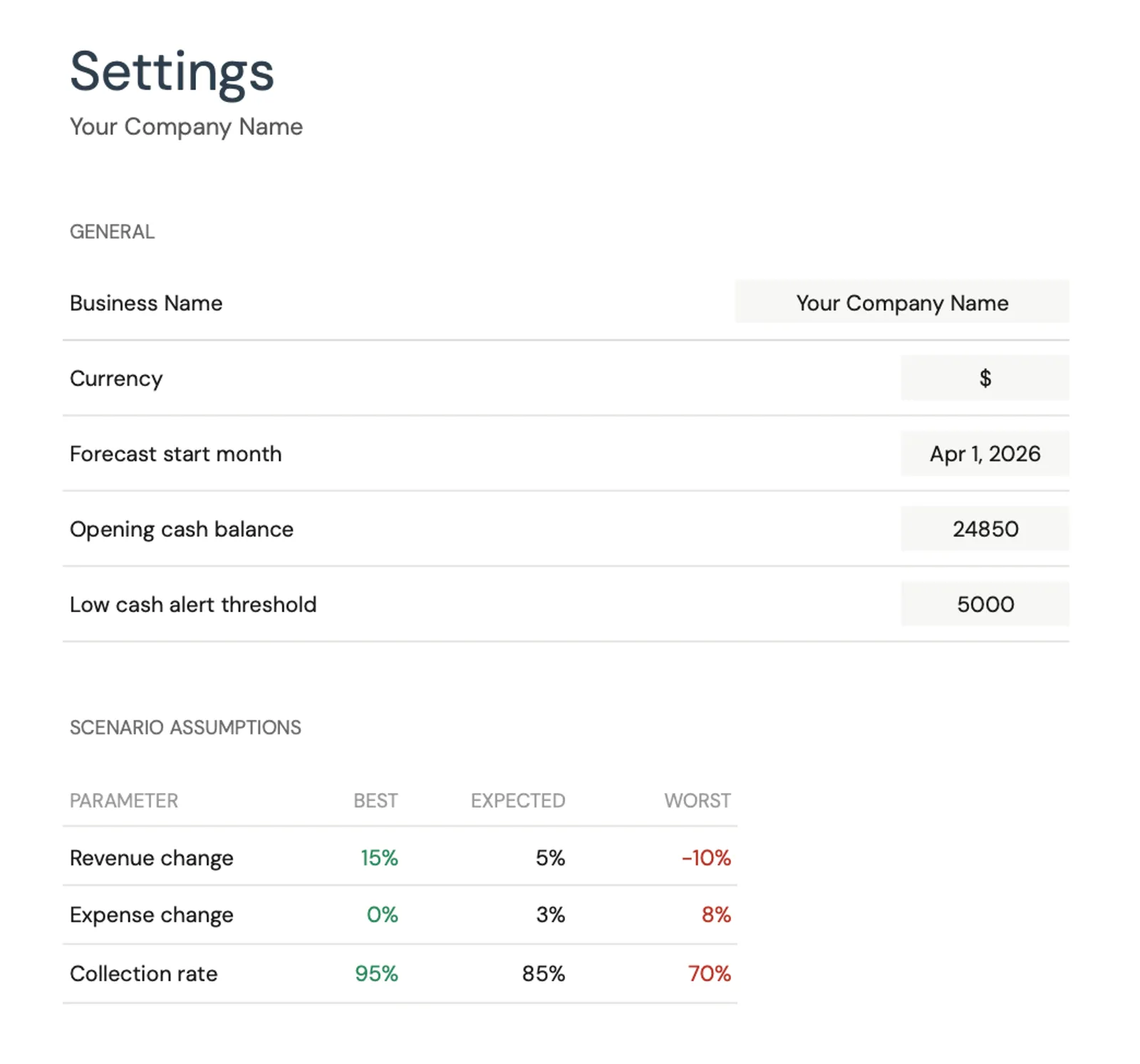
Browse through the template to see dashboards, forecasting, actuals tracking, and scenario planning.
- Visual cash flow dashboard
- Forecast vs actuals comparison
- Scenario planning tools
- Customizable categories
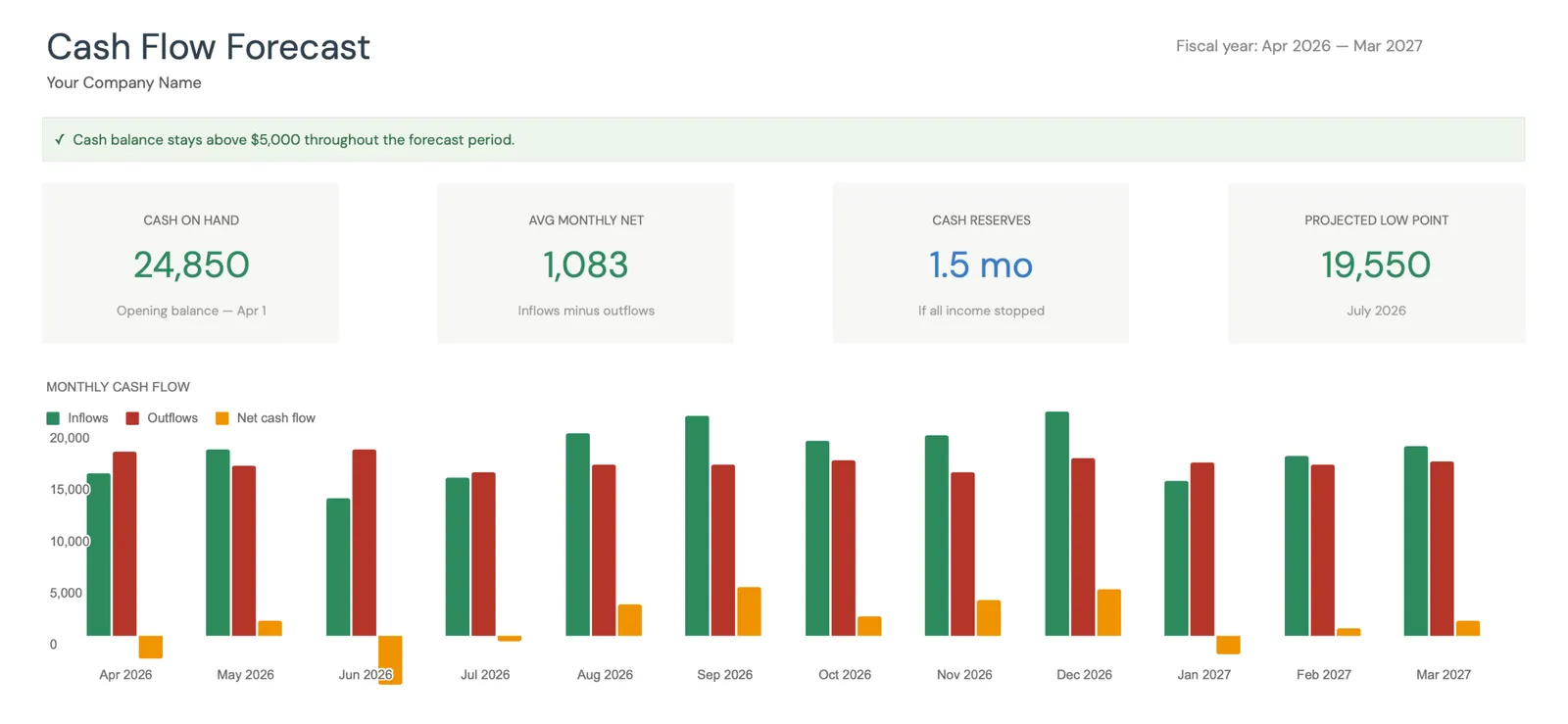
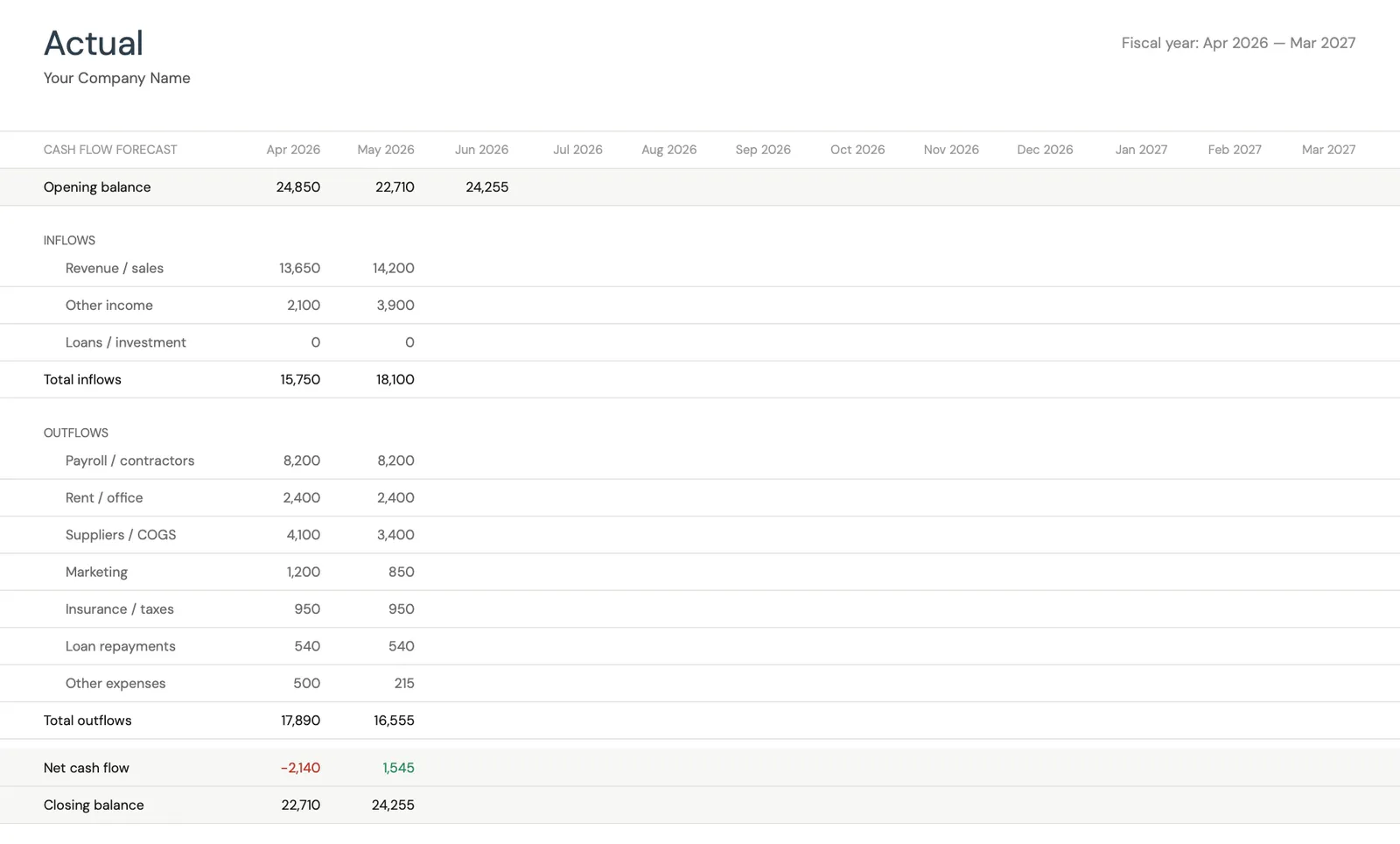
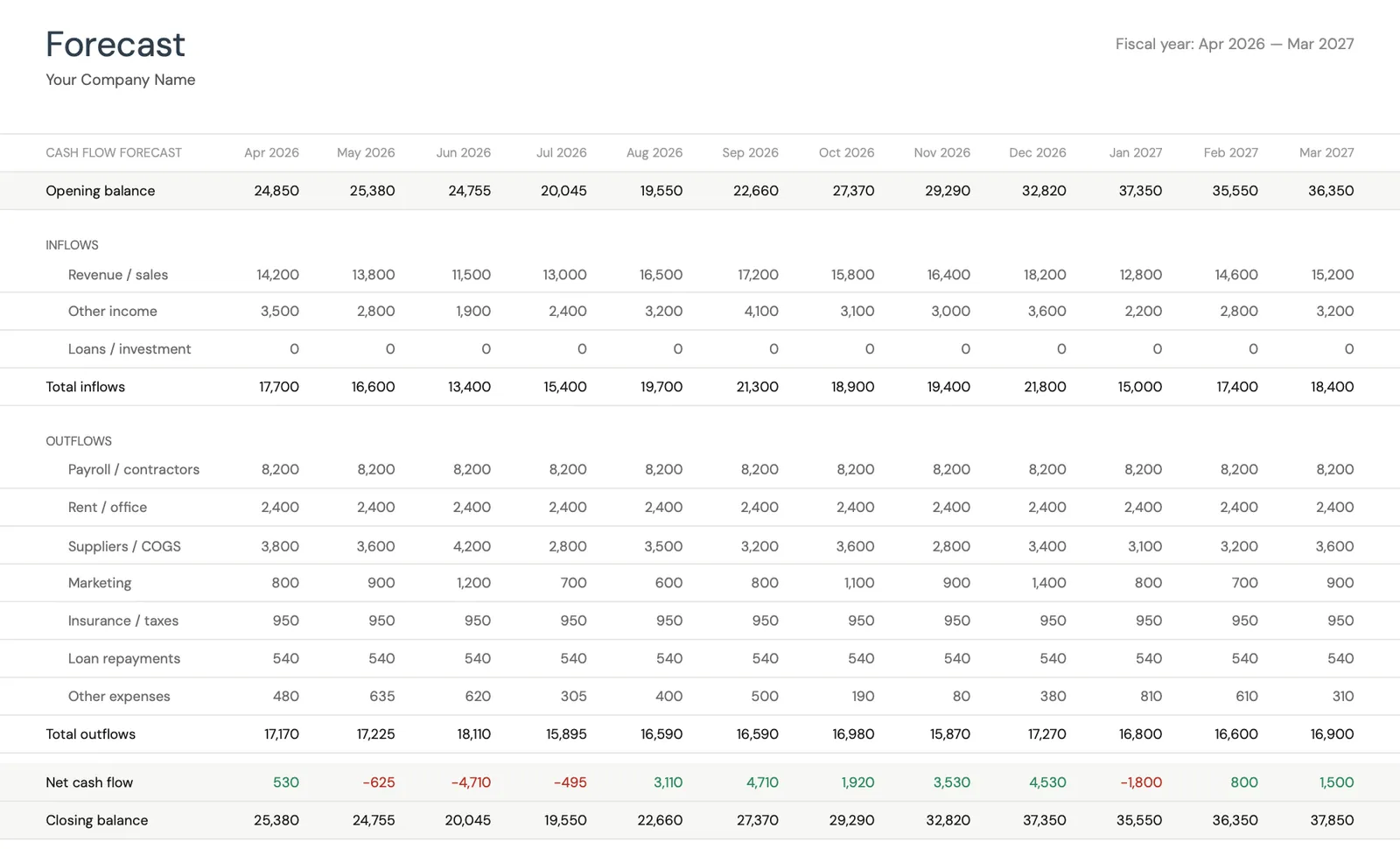
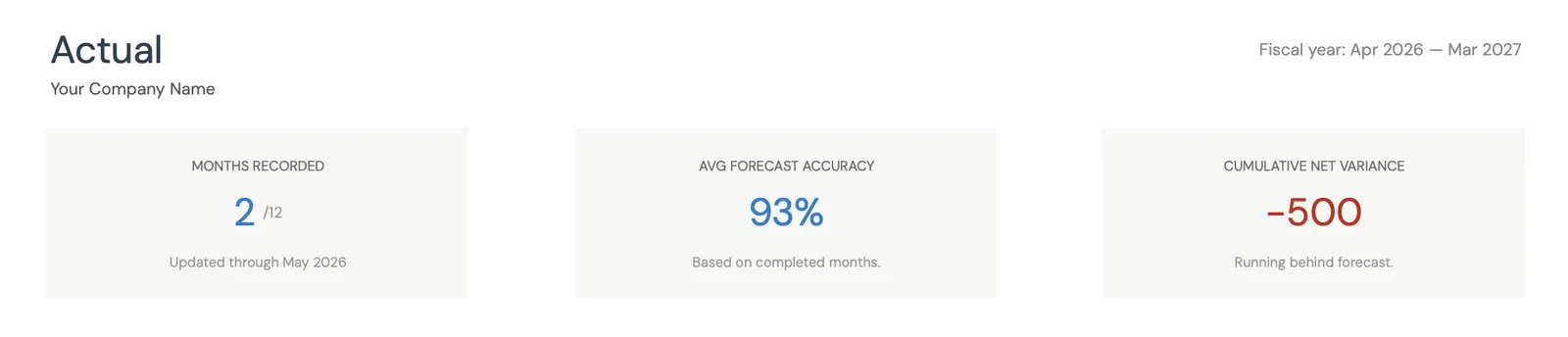
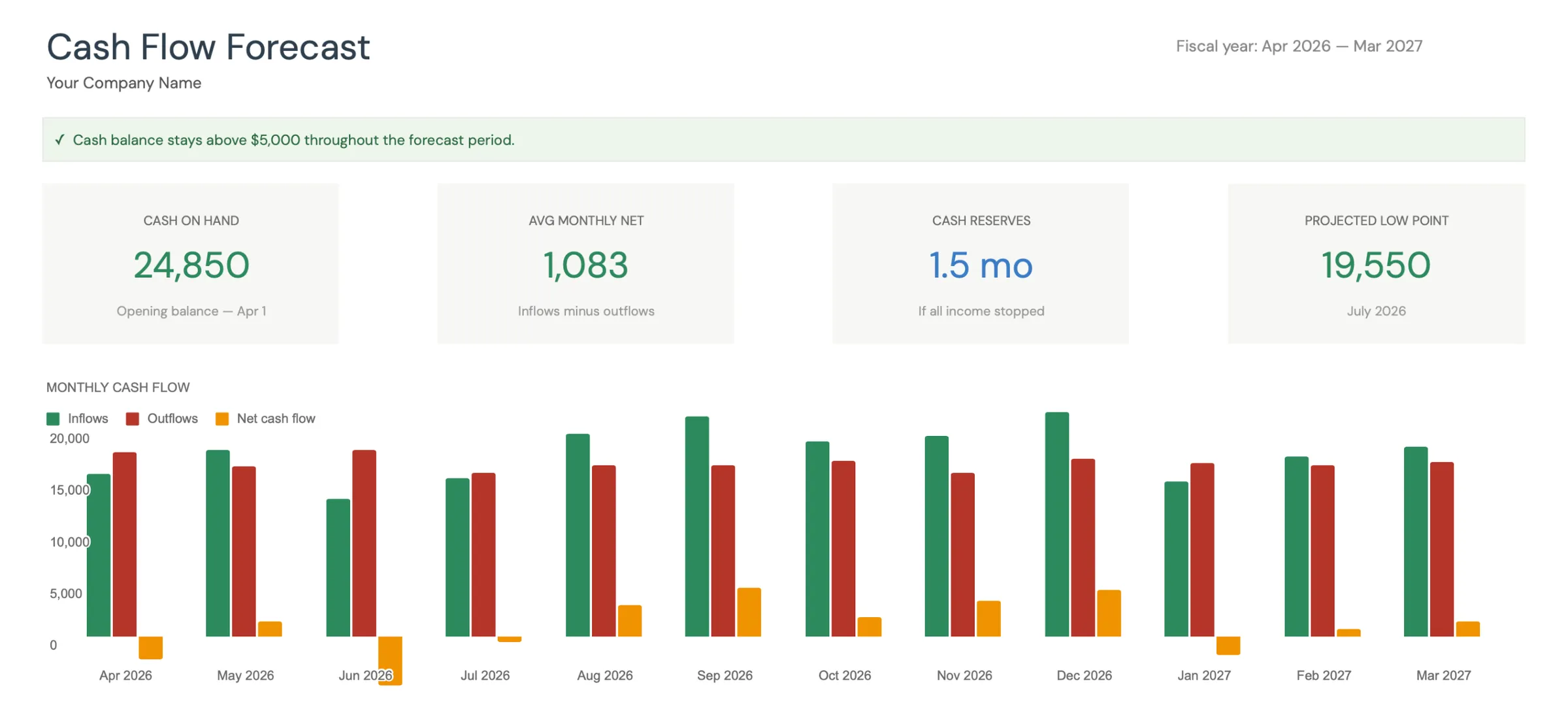
Monthly cash flow overview with KPIs and charts
Track actual cash flow against your forecast
Project cash flow 12 months ahead
Key performance indicators for your cash flow
Model different scenarios for your business
Customize categories for your business type
What You Get
Cash Flow Tools Built for Freelance Agencies
Client-level revenue tracking
See revenue by client to identify concentration risk and track payment reliability. Some clients pay like clockwork; others consistently pay 15 days late. The forecast should reflect actual payment behavior, not invoice terms.
Contractor cost management
Track contractor costs alongside project revenue to see true project profitability. If a project brings in $12,000 but costs $7,000 in contractor fees, the real margin is $5,000 - before your overhead.
Monthly reality check on revenue timing
Compare projected revenue and expenses against actuals each month. For freelance agencies, the biggest variance is usually in revenue timing - projects that were expected to close in March slip to April. Tracking these patterns improves future forecasts.
Year-ahead capacity and cash planning
See your projected cash position over the next year. Identify lean months ahead of time so you can accelerate business development or adjust spending. For agencies, the 12-month view also helps with capacity planning - knowing when you will need more contractor support.
Common Questions
Cash Flow for Freelance Agencies - FAQ
What profit margin should a freelance agency target?
Healthy freelance agencies typically achieve 20-40% net margins after all expenses including owner compensation. If the owner is not paying themselves a market-rate salary, the true margin is lower than it appears. A useful benchmark: after paying all contractors, staff, and expenses, the remaining profit (on top of your salary) represents the real agency margin.
How much cash reserve does a freelance agency need?
A common guideline is 2-3 months of operating expenses. For an agency with $15,000 in monthly costs, that means $30,000-$45,000 in cash reserves. This buffer absorbs late client payments, project gaps, and unexpected expenses. The cash flow forecast helps you track whether you are building toward or drawing down your reserve.
How do I forecast when clients pay late?
Track actual payment timing by client, not just invoice terms. If a client's invoices are net-30 but they consistently pay on day 45, forecast at 45 days. Some agencies add a "payment reliability" factor to their forecast - reducing expected monthly revenue by 10-15% to account for late payments and delays.
How do I handle the feast-or-famine revenue cycle?
The forecast is the primary tool for managing feast-or-famine cycles. During feast periods, the forecast shows you how much cash to set aside for lean months. During famine periods, it shows how long your reserves will last. Over time, diversifying into retainer clients (predictable monthly revenue) helps smooth the cycle.
Can this template help with pricing decisions?
Indirectly, yes. By tracking actual project costs (contractor fees, hours spent, overhead allocation) against revenue, you can calculate true project profitability. If your average project yields a 15% margin, that data informs whether to raise prices, reduce scope, or negotiate different contractor rates.
Can't find the answer you're looking for? Contact our team
Forecast cash flow for your freelance agencie
One-time purchase. No subscription. Your financial data stays in your Google Drive.