Cash Flow Forecast
Cash Flow Forecast Template for Event Planning
Forecast event-based revenue, manage vendor deposit timing, track client payment schedules, and plan for seasonal booking patterns - all in a Google Sheets template built for cash flow management.
In Depth
Deposits, Deadlines, and Event Planning Finances
Event planning finances have an unusual characteristic - a large portion of the money flowing through the business belongs to someone else. A planner managing a $75,000 wedding might handle $50,000 in vendor payments on behalf of the client while earning a $8,000-$12,000 planning fee. The vendor payments create significant cash flow volume that can mask the relatively modest actual business revenue. Distinguishing between pass-through client funds and the planner's own fee income is essential for understanding the true financial health of the business.
The timeline of event planning work creates a cash flow pattern spread across many months. A booking might happen twelve months before the event, with a retainer collected immediately. Over the following months, the planner invests dozens of hours in vendor selection, design development, and client meetings. Additional client payments arrive at milestone dates. The final fee payment comes at or just before the event. This extended timeline means revenue for any given event is collected in stages over 6-12 months, while the planner's time investment is distributed across that same period.
Wedding season - May through October in most markets - concentrates revenue into a half-year window that must sustain the business year-round. A planner coordinating 20-25 weddings annually might have 15-18 of them fall within this peak period. The off-season brings fewer events but also provides time for marketing, portfolio development, and planning for the next season's events. Some planners actively pursue corporate events, holiday parties, and galas specifically because their seasonality differs from weddings, helping to fill the revenue gaps.
Cancellations represent both a financial risk and a reason why non-refundable retainers matter. A planner who has invested 30-40 hours in a canceled event has lost not just the fee income but also the opportunity cost of those hours. Non-refundable retainers - typically 25-50% of the planning fee - provide partial compensation for this risk. In the forecast, confirmed retainers represent secured revenue while outstanding balances carry some uncertainty until the event date approaches. Tracking the historical cancellation rate helps calibrate how much pipeline revenue is likely to actually convert to collected fees.
The Challenge
Cash Flow Challenges for Event Planning Businesses
Event planning businesses manage large sums of money flowing through their accounts on behalf of clients, with their own revenue often being a small percentage of total event budgets. Timing mismatches between client payments and vendor deposits create significant cash flow complexity.
Large vendor payments precede final client collections
Event planners often pay vendor deposits and final payments on behalf of clients. A $50,000 wedding might require $15,000 in vendor deposits 3-6 months before the event. If the client pays in installments (30% at booking, 30% at 90 days, 40% at event), the planner may need to front vendor deposits before collecting the final client payment. This flow-through of other people's money creates cash management complexity.
Revenue is project-based and seasonal
Event planning revenue comes in chunks tied to event dates, not as steady monthly income. A planner might earn $5,000 for a June wedding, $3,000 for a July corporate event, and nothing in August. Wedding season (May-October) drives the bulk of revenue for many planners. Corporate events cluster around Q4 and Q1 for holiday parties and annual meetings. The off-season (January-March) often has minimal income.
Upfront investment in each event is significant
Before earning a fee, an event planner invests 20-60 hours in site visits, vendor meetings, design concepts, and client consultations. If the event cancels or the client chooses another planner, those hours are unrecoverable. Non-refundable retainers help mitigate this risk but do not fully compensate for the opportunity cost of time invested. Cancellation rates of 5-15% are common and create holes in projected revenue.
Client payment collection is a constant challenge
Final event payments are due before or at the event, but collecting on time requires active follow-up. Some clients pay late, dispute charges for changes they requested, or request payment plans. A planner waiting on a $4,000 final payment while $3,000 in vendor bills are due faces a genuine cash crunch - even though the overall event is profitable. Clear payment terms and consistent follow-up are operational requirements, not nice-to-haves.
Start forecasting your cash flow
Forecasting Guide
How to Forecast Cash Flow for Your Event Planning Business
Event planning cash flow forecasting requires mapping client payments and vendor obligations for each event onto a monthly timeline. Here is how to structure it using the Cash Flow Forecast template.
Revenue Categories
- Planning fees (flat fee or percentage of event budget)
- Day-of coordination fees
- Design and styling fees
- Vendor commission income
- Markup on pass-through costs (if applicable)
- Consultation fees
Expense Categories
- Vendor deposits and payments (pass-through)
- Subcontractor costs (day-of assistants, setup crew)
- Transportation and travel
- Marketing and portfolio development
- Insurance (general liability, professional)
- Software (planning tools, CRM, design)
- Office or coworking space
- Professional development and industry events
- Self-employment taxes
- Accounting and legal
- Website and social media management
Cash Flow Timing
Map each confirmed event's client payment schedule and vendor payment obligations onto the monthly forecast. Separate your planning fees (your revenue) from pass-through vendor costs (client money flowing through your account). This distinction is critical for understanding your actual cash flow versus money you are managing on behalf of clients. Use retainers and deposits to front-load cash collection and avoid funding vendor deposits from personal reserves.
See It In Action
What the template looks like
Browse through the template to see dashboards, forecasting, actuals tracking, and scenario planning.
- Visual cash flow dashboard
- Forecast vs actuals comparison
- Scenario planning tools
- Customizable categories
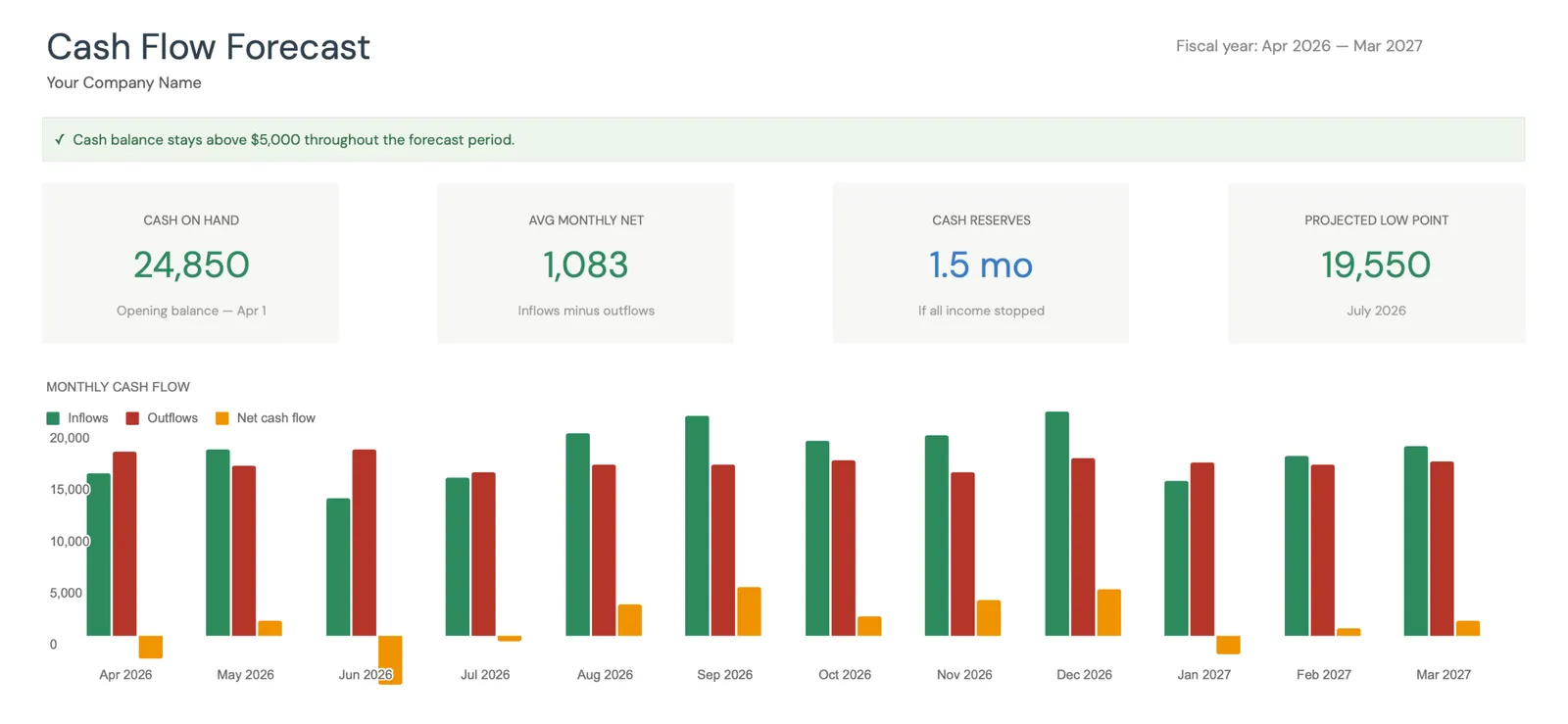
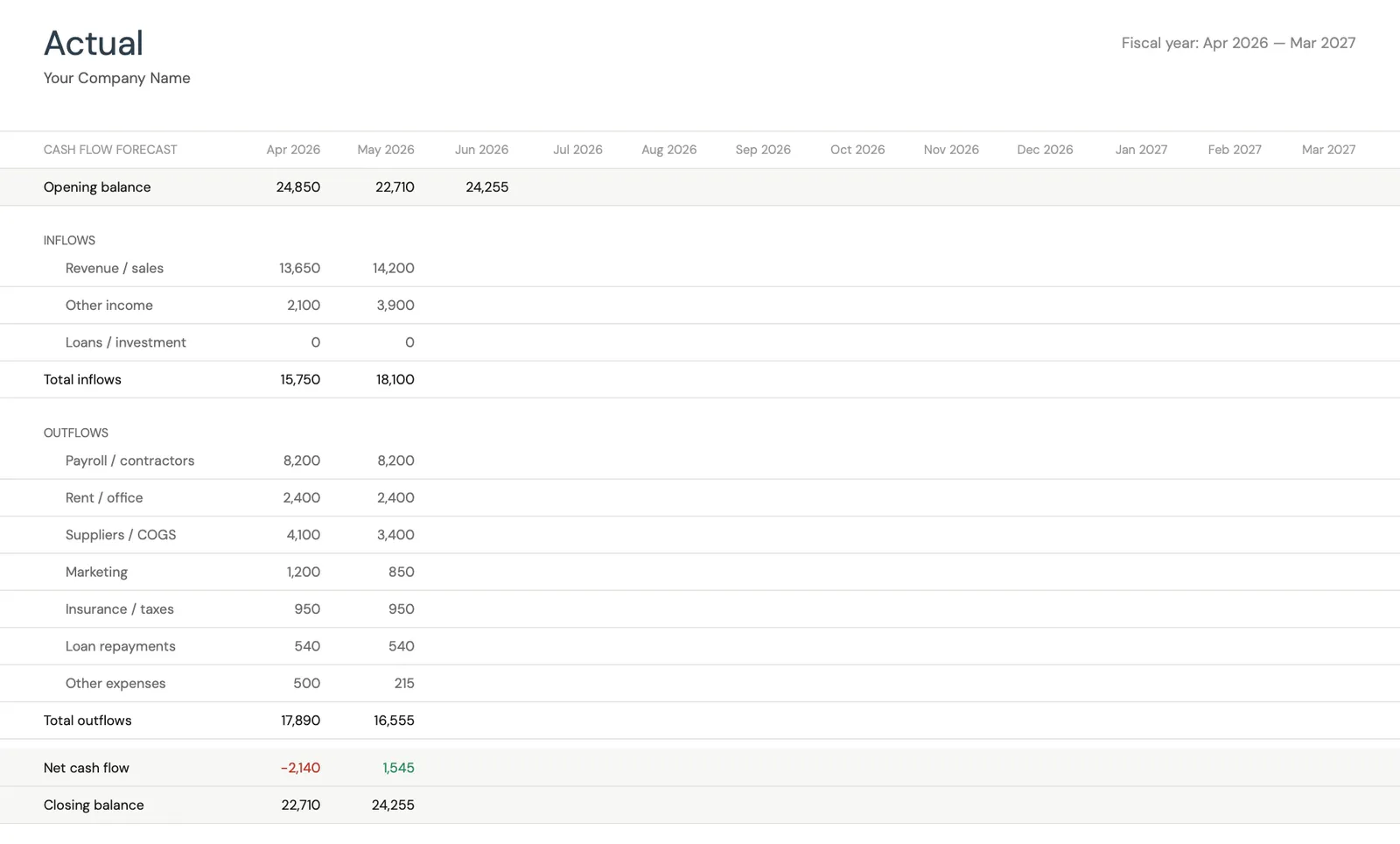
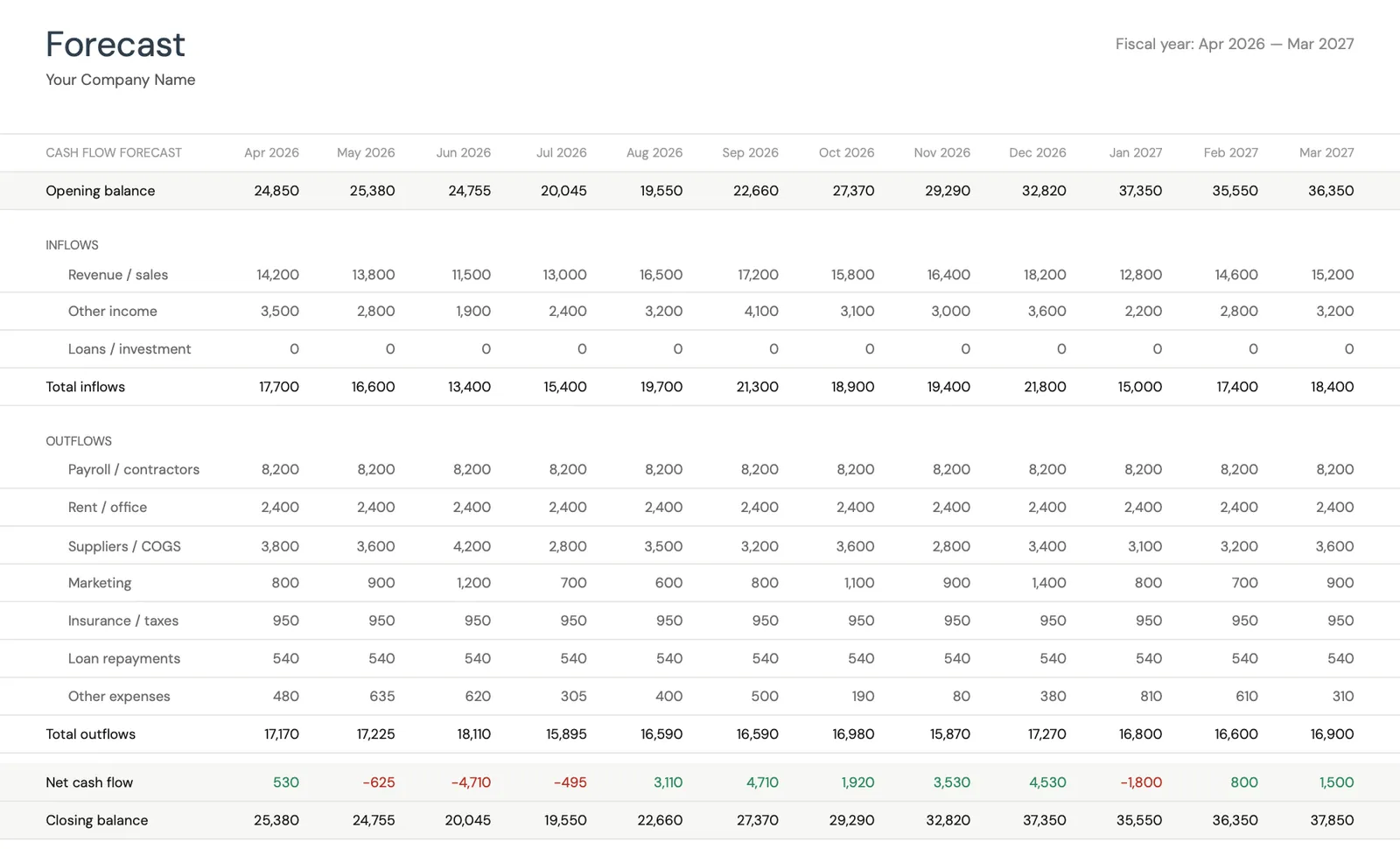
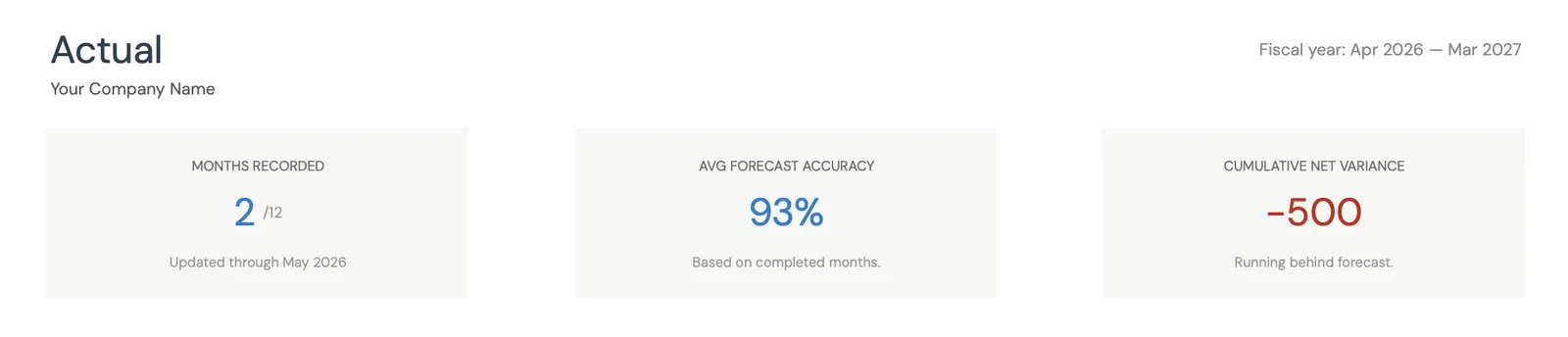
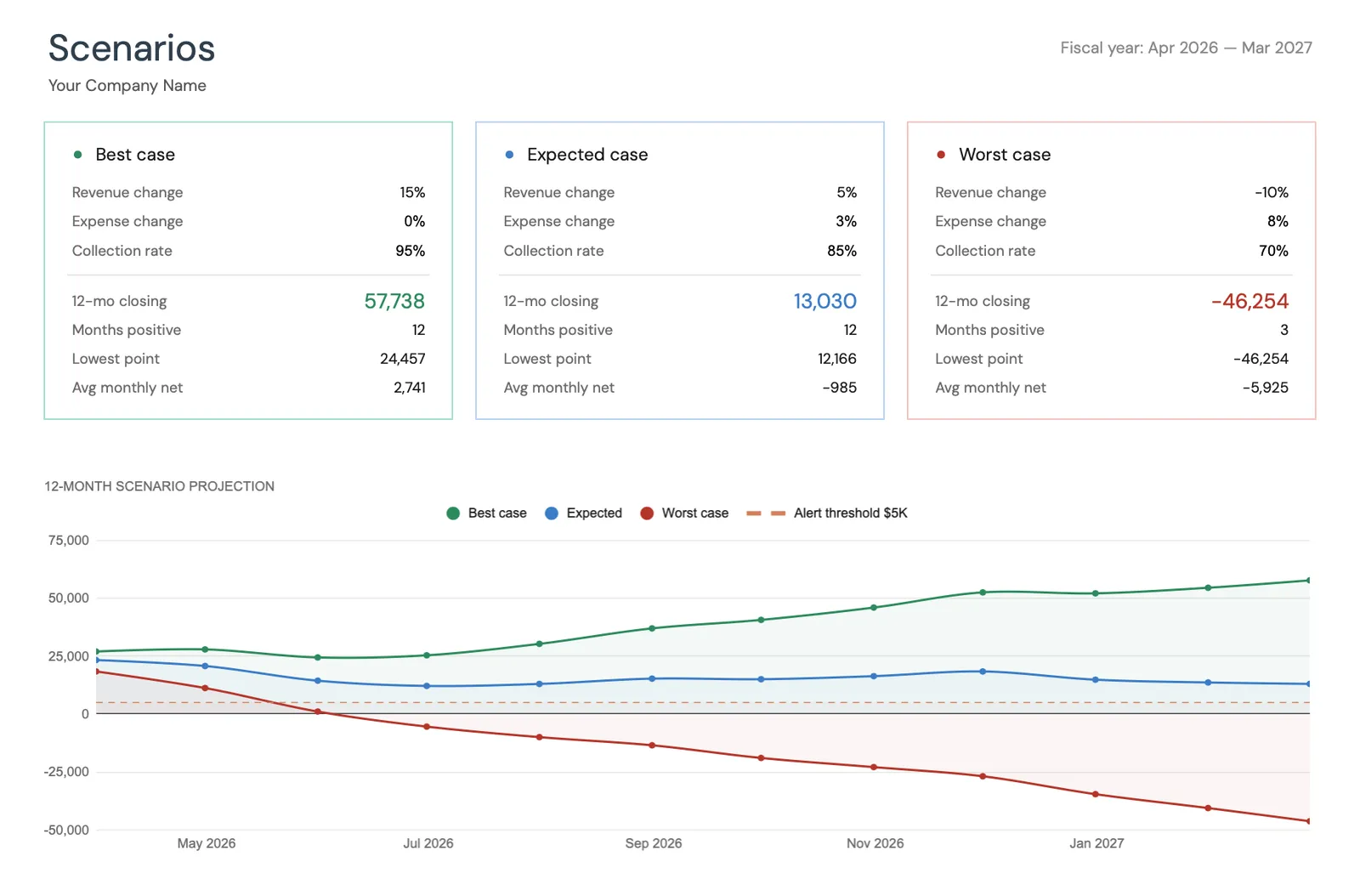
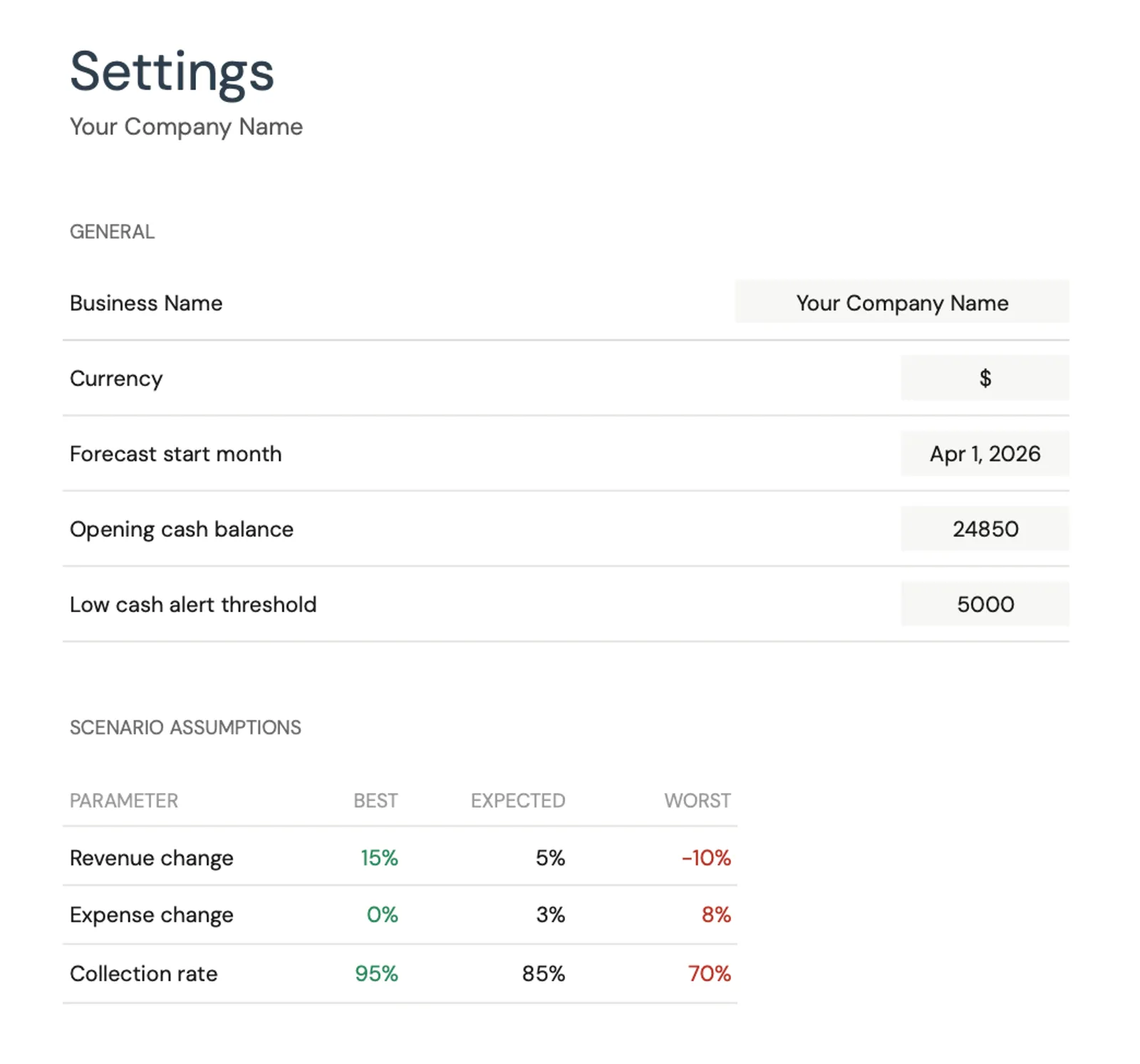
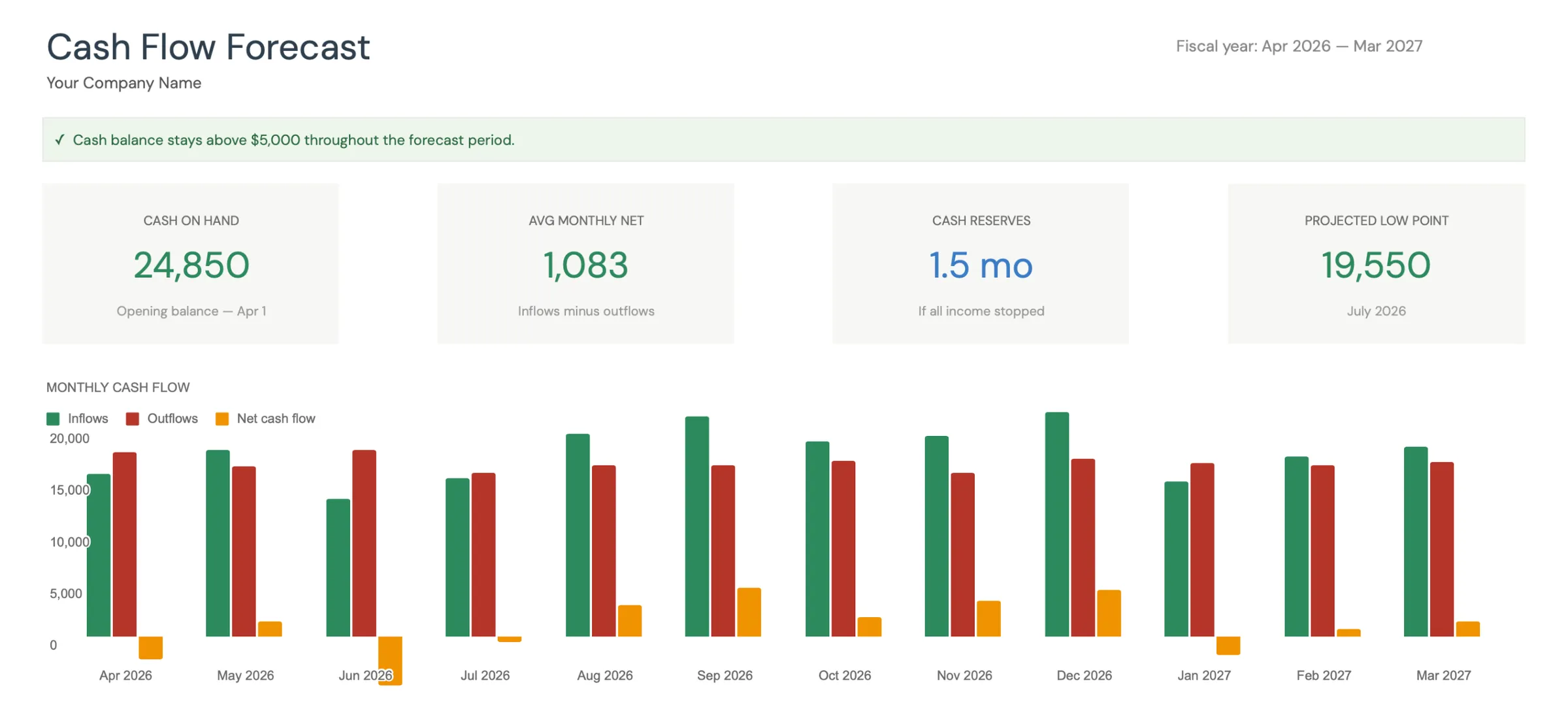
Monthly cash flow overview with KPIs and charts
Track actual cash flow against your forecast
Project cash flow 12 months ahead
Key performance indicators for your cash flow
Model different scenarios for your business
Customize categories for your business type
What You Get
How This Template Fits Event Planning Businesses
Event-by-event revenue tracking
Map each event's fee structure and payment schedule into the forecast. See how booked events translate into monthly cash inflows, and identify months where no events are scheduled (revenue gaps to fill).
Pass-through cost management
Track vendor payments separately from your fees to see your true revenue. Managing $200,000 in vendor payments while earning $30,000 in fees means the cash flowing through your account looks very different from your actual income.
Event revenue and scope changes vs plan
Compare projected event revenue and timing against actuals. Events often involve scope changes, add-ons, and timing shifts - tracking these keeps the forecast aligned with reality.
Full event season fee income forecast
See your projected fee income across the full event season. Identify months with no events scheduled and target marketing efforts accordingly. Plan personal expenses and business investments around months with confirmed event fees.
Common Questions
Cash Flow for Event Planning - FAQ
What profit margin is typical for event planning businesses?
Event planning fees typically yield 15-30% net margins after all business expenses. The common fee structure is either a flat fee ($2,000-$10,000+ per event), a percentage of the event budget (10-20%), or an hourly rate ($50-$150/hour). Margins depend on how efficiently planners manage their time across concurrent events. Solo planners with low overhead achieve higher margins.
How do I handle client money flowing through my business account?
Keep a separate bank account for client pass-through funds whenever possible. In the forecast, clearly distinguish between your planning fees (actual revenue) and vendor payments you are managing on behalf of clients (pass-through). Commingling these makes it impossible to see your true cash position. When forecasting, your operating cash flow should focus on your fees minus your business expenses.
How do I manage the off-season cash gap?
Calculate your monthly operating costs and compare against projected off-season income. If January-March generates minimal revenue but you have $3,000/month in fixed costs, you need $9,000 in reserves. Some planners book corporate events (which have different seasonality) to fill gaps, or offer holiday and year-end party planning to bridge December. Retainers collected in fall for spring events also help.
How should I handle event cancellations in the forecast?
Include a non-refundable retainer (typically 25-50% of your fee) to protect against cancellations. In the forecast, treat retainers as confirmed revenue. Only add the remaining fee balance when the event date approaches and cancellation becomes unlikely. Historically, if 10% of your events cancel, reduce pipeline revenue by that factor.
Can this template handle both wedding and corporate event planning?
Yes. Set up separate revenue categories for each event type since they have different seasonality, fee structures, and payment timing. Wedding planning fees are typically collected in 2-3 installments over 6-12 months. Corporate events often pay on net-30 terms after the event. Seeing both in the same forecast reveals how the different seasonality patterns complement (or compound) cash flow.
Can't find the answer you're looking for? Contact our team
Forecast cash flow for your event planning
One-time purchase. No subscription. Your financial data stays in your Google Drive.